
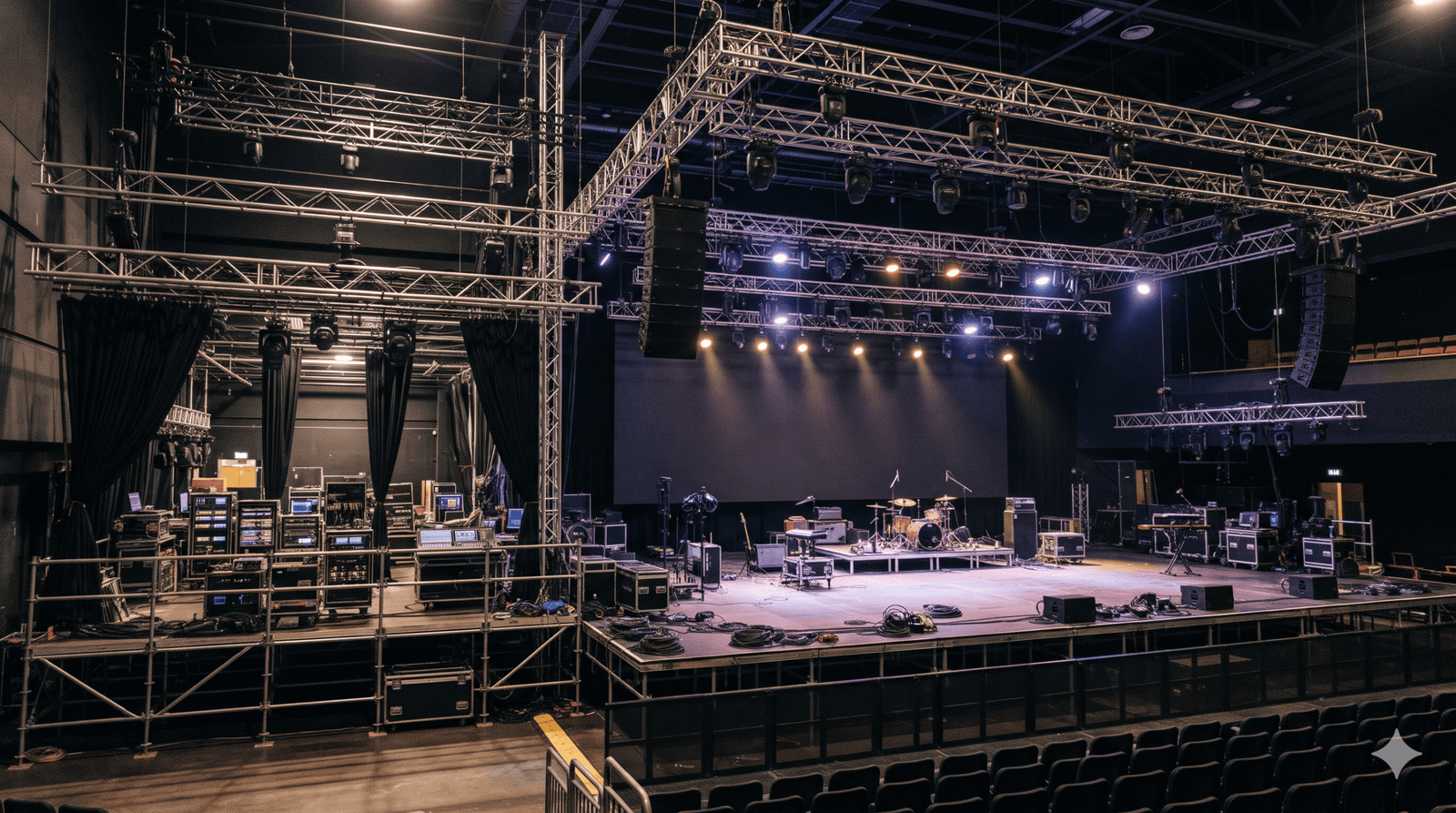
Every live show has one person who knows exactly what happens next. Who walks on. When the LED wall changes. When the lights go. They stand at side-stage on a headset and say “standby” before every big moment. That person is the stage manager, and a stage manager career in India is one of the most important jobs at a live event that almost nobody teaches as a career.
This guide to a stage manager career in India explains the real job at concerts, award shows, corporate launches and big weddings. You’ll see what a stage manager does before, during and after a show, the skills the role needs, how it compares with a production manager, and a practical route in that you can start this wedding season.
It is high-pressure work. The hours are long, the load-ins start before sunrise and the show doesn’t wait for anyone. But the reward is real: you become the person a whole show trusts. If you’re organised, calm when things go wrong and curious about how shows are built, read on.
Table of Contents
What Does a Stage Manager Do at an Event?
The short answer: the stage manager runs the stage. The producer and client decide what the show should be. The designers decide how it should look. The production manager makes sure it can be built, powered and delivered on budget. The stage manager makes sure that, minute by minute, the right thing happens on stage at the right time.
At a theatre show, that job is well known. At Indian live events, it’s often done by someone with no formal title or training, which is exactly why a trained stage manager for events stands out. Here’s what the job looks like across a show.
IIED COURSE
MA in Technical Production
Learn the staging, rigging, safety and show-running skills a stage manager uses on every live event.
Duration: 2 Years (4 Semesters) · Mode: Full time, classroom in Mumbai
Before the show: run-of-show, stage plan and cue sheet
Most of a stage manager’s work happens before the audience arrives. The core documents are the run-of-show (the minute-by-minute order of the event), the stage plan (where every riser, screen, prop and entry point sits), the cue sheet (every light, sound, video and effect change, numbered in order) and the artist schedule (who arrives when, who’s in which green room, who walks on from which side).
The stage manager walks the venue on the recce, checks entries and exits, marks the stage with tape, and confirms with every department that they’re working from the same version of the run-of-show. One outdated PDF on one laptop is how a show goes wrong.
During the show: calling cues and moving people
On show day, the stage manager is on comms with lighting, sound, video, the floor crew and the anchor’s handler. They give “standby” and “go” calls for stage cues, hold artists in the wings until the right moment, run set changes during blackouts, and make sure the anchor knows when to stretch because a performer is late.
At a large award show or concert, a separate show caller may call the technical cues while the stage manager runs the physical stage. At a mid-sized corporate show or wedding sangeet, the stage manager often does both. Either way, the stage manager is the one who decides whether the stage is safe and ready before anyone walks onto it.
After the show: load-out and the show report
When the last act walks off, the job isn’t over. The stage manager supervises the stage clear, makes sure props and artist belongings go back to the right people, and coordinates with the crew during load-out so nobody gets hurt in the rush. Many stage managers also write a short show report: what ran late, what broke, what to fix for the next show.
Stage Manager vs Show Caller vs Production Manager
These three roles get mixed up all the time, especially on smaller Indian shows where one person may cover two of them. Here’s the simple difference.
| Role | Main question they answer | Where they are during the show |
|---|---|---|
| Stage manager | Is the stage ready, safe and running to the run-of-show? | Side-stage, on headset, moving people and set pieces |
| Show caller | Is every light, sound and video cue going at exactly the right moment? | Front-of-house or control position, calling cues on comms |
| Production manager | Can this show be built, powered, crewed and delivered on time and on budget? | Across the whole site, solving problems before they reach the stage |
The stage manager vs production manager question matters most for your career, because the production manager role is usually the next rung up. If you want the full picture of that job, read our guide to the production manager career in India, and see how one production manager handles a real show in what a production manager does on event day.
Where Stage Managers Work in India
Any show with a stage and a running order needs someone to run it. In India, that means:
- Concerts and music festivals — artist changeovers, band set-ups, guest appearances and encores.
- Award shows and televised events — tight running orders, multiple presenters, live-to-air timing.
- Corporate launches and conferences — CEO walk-ons, product reveals, panel set changes.
- Large weddings and sangeets — family performances, choreographed entries, celebrity acts, fireworks cues.
- Venues and cultural centres — in-house teams who run shows every week.
Right now, November to January, is peak wedding and concert season. It’s when stage managers are most visible and most needed, which also makes it the best time to watch one at work.
Skills You Need for a Stage Manager Career in India
Stage management isn’t about shouting into a headset. It’s a technical job that needs you to understand how every department works, even if you don’t operate their equipment. These are the six skills that come up again and again in live-event production job ads.
1. Reading stage plans and technical drawings
You need to read a stage plan, an elevation and a lighting plot without help. Where is the truss? Where are the masking flats? How much clear space is there for a 12-dancer entry? Most of these drawings are made in AutoCAD or Vectorworks. You don’t need to be a full draftsman, but you do need to read the drawings and spot problems.
This is the skill that has moved several IIED students into production roles. Zargam Haider learned CAD at IIED and went into a Consulting Production Designer role at Hyperlink. Technical drawing is how you move up the production ladder.
2. Staging, rigging and load safety
A stage manager decides whether people can safely walk onto a stage. That means knowing the basics of staging decks, risers, truss, hoists and load limits, and knowing when to stop a rehearsal because something isn’t right. Safety is part of the job, not someone else’s problem.
3. Working knowledge of lighting, sound and video
You won’t programme the lighting console or mix the sound. But you need to talk to every department in their own language. What’s a blackout cue? Why does the LED wall need two seconds to switch content? Why can’t the singer’s mic go live during the video playback? The more you understand, the better your calls.
4. Run-of-show and cue-sheet writing
Clear documents run clear shows. You should be able to take a client’s rough event flow and turn it into a numbered, timed run-of-show and a cue sheet that every department can follow without asking questions.
5. Calm communication on comms
On headset, short and clear beats long and polite. “Standby lights cue 14, sound cue 9.” “Go.” When something breaks, the stage manager is the calm voice that tells everyone what happens next.
6. Managing people under time pressure
Artists, anchors, family members, crew and clients all end up at side-stage. A good stage manager keeps them moving, keeps them safe and keeps them out of each other’s way, often with very little time.
Skill → where you learn it
Most event-management programmes in India train you to coordinate clients and vendors. Theatre schools train you for the stage. IIED trains you for live events, with design, lighting and production under one roof in Mumbai. Here’s how each stage manager skill maps to modules in IIED’s 2-year MA in Technical Production.
| Stage manager skill | Where you learn it in the MA in Technical Production |
|---|---|
| Staging, rigging and load safety | Staging, Stage Machinery, Rigging & Load Management |
| Safety calls and risk checks | Health, Safety, Risk & Regulatory Compliance |
| Talking to lighting, sound and video | Audio, Lighting, Video & Systems Integration |
| Run-of-show, schedules and crew coordination | Production Planning, Logistics & Site Management |
| Reading and making technical drawings | Lab I — Structures, Rigging & Technical Documentation; Studio I — Integrated Production Documentation Project |
| Real show experience | Semester 2 industry internship with a production house, technical vendor, venue or event company |
If you want to train for this properly, our event production course in Mumbai lists Stage Manager among the roles it prepares you for, alongside Production Manager and Technical Director. The course page has full details, including fees.
The Career Ladder for an Event Stage Manager Job
Nobody starts as a stage manager. You earn the headset by working your way up through the people who build and run the stage. The ladder for a stage manager career in India usually looks like this.
Rung 1: Stage hand or crew
You move set pieces, tape the stage, run cables and help with load-in and load-out. It’s physical work. It’s also the best way to learn how a show actually runs, because you see every mistake up close.
Rung 2: Assistant stage manager
You look after one side of the stage, one group of artists or one set change. You hold the props list, keep performers ready in the wings and pass cues to the crew. You start reading the run-of-show and cue sheet properly, and the stage manager starts trusting you with timing.
Rung 3: Stage manager
You own the stage. You build the run-of-show with the producer, lead the rehearsals, call the stage cues and make the safety decisions. You talk to every department, and every department listens. This is the role the rest of this guide describes.
Rung 4: Production manager or technical director
Many stage managers move up into production management, where they run the whole site rather than just the stage. Some move into technical direction. The skills carry straight over: planning, safety, crew management and calm under pressure.
A note on pay. We won’t quote a stage manager salary here. There is no reliable public pay figure for event stage managers in India, and we only publish numbers we can verify. What we can tell you is that pay in a stage manager career in India grows with responsibility. Each rung up the ladder means bigger shows, more people reporting to you and better pay.
Land events vs cruise ships
This guide covers a stage manager career in India at land-based live events: concerts, award shows, corporate launches and weddings. Cruise ships also hire stage managers to run their nightly entertainment, and that job has its own contracts, routines and requirements. If life at sea interests you, read our guide to becoming a cruise ship stage manager.
What IIED alumni show about the production route
To be clear: IIED doesn’t yet have an alumnus with the job title “Stage Manager”, and we won’t pretend otherwise. But our alumni do prove that trained people move from planning into production, which is the same route a stage manager career in India follows.
- Suhani Mudra finished an event management degree and felt she was missing production skills. After CAD for Events & Entertainment at IIED, she now works at Potato Heads as a Draftsman and Production Manager. Your degree taught you to plan. Production training teaches you to produce.
- Arun Sagar took the CAD for Events & Entertainment course to upskill technically and now works in the Operations & Production department at NMACC (Nita Mukesh Ambani Cultural Centre), BKC. Venues like this run shows every week.
- Pranay Mhatre joined WIZCRAFT, India’s oldest event company, as a Production Designer after the Event & Wedding Design Visualization course. Big event companies hire trained production people.
IIED students have also been placed with event agencies such as BookMyShow, 70EMG, Wizcraft, Creative Factory, CAB, Showbiz and SeventySeven. These aren’t stage-manager hiring partners, but they show the kind of companies that hire trained production people.
How to Become a Stage Manager in India: 3 Practical First Steps
You don’t need a job title to start a stage manager career in India. Here are three things you can do this month.
Step 1: Crew on 2–3 live events this season and watch the stage manager
Wedding and concert season is running right now. Volunteer or sign up as crew with an event company, a production house or a rental vendor. Don’t just carry boxes. Watch the stage manager. Notice when they give calls, how they handle a late artist, and what’s on the paper in their hand. Write down everything you don’t understand and ask about it after the show.
Step 2: Learn to read a stage plan
Ask the crew chief for a printed stage plan and compare it with the real stage. Then learn the basics of CAD. Even a short course in AutoCAD for events will help you read layouts, elevations and plots, which is the skill that separates a crew member from someone who can run a stage. It also helps you talk to designers and production managers in their language.
Step 3: Book a counselling visit and map your route
Every route in is different. A fresh graduate, an event management graduate and someone already working as AV crew will each need a different plan. A 30-minute conversation with a counsellor who knows live-event production can save you a year of guessing. Come with your questions and we’ll map the route that fits you.
The UK’s National Careers Service stage manager profile lists assistant stage manager as the usual starting title, which matches the ladder above. A stage manager career in India follows a very similar route: start on the floor, learn the documents, then earn the headset.
Frequently Asked Questions
What does a stage manager do at an event?
A stage manager runs the stage during a live event. Before the show, they prepare the run-of-show, stage plan, cue sheet and artist schedule. During the show, they call stage cues on comms, move artists and anchors on and off stage, run set changes and coordinate with lighting, sound and video. After the show, they supervise load-out and write a show report.
How do I become a stage manager in India?
A stage manager career in India usually starts as crew or a stage hand on live events. From there you move up to assistant stage manager and stage manager. Learn to read stage plans and technical drawings, understand staging and rigging safety, and get working knowledge of lighting, sound and video. A structured technical production course plus real show experience is the fastest route.
What is the difference between a stage manager and a production manager?
The stage manager runs the stage minute by minute during the show. The production manager runs the whole production: budget, schedule, crew, vendors, power, rigging and site safety. Production manager is usually the next step up for an experienced stage manager.
Do I need a degree to become a stage manager for live events?
No specific degree is required to work as a stage manager at live events in India. Skills and show experience matter most. That said, structured training in staging, rigging, safety and production planning helps you move up the ladder faster and with fewer costly mistakes.
Can an event management graduate become a stage manager?
Yes. Event management gives you planning and coordination skills, which are useful. What’s usually missing is the technical side: reading drawings, staging, rigging and how lighting, sound and video systems work. Adding those skills is how event management graduates move into production roles.
What skills does an event stage manager need?
Reading stage plans and technical drawings, staging and rigging safety, working knowledge of lighting, sound and video, writing a run-of-show and cue sheet, calm communication on comms and managing people under time pressure.
Is stage management only for theatre, or also for concerts and weddings?
Stage management started in theatre, but every live event with a stage and a running order needs it. In India, stage managers work at concerts, music festivals, award shows, corporate launches, conferences, large weddings and sangeets, and at venues and cultural centres.
Which course helps you become a stage manager in India?
Look for a course that teaches staging, rigging, safety, production planning, technical drawing and systems integration, with a real internship. IIED’s MA in Technical Production in Mumbai covers these and lists Stage Manager among its career outcomes. For a shorter first step, CAD for Events & Entertainment teaches you to read and draw event layouts.
Ready to Start Your Stage Manager Career?
A stage manager career in India suits people who stay calm, think ahead and like being the one who makes the show happen. It’s demanding work, and it isn’t for everyone. But if you’ve ever stood at a concert and wondered who decides when the lights go, that could be your job.
Book your free visit — call 9892966334 or email info@weareiied.com. IIED, Shop No. 506, 5th Floor, Magic Square, Dwarkadhish Road, off Poddar Road, Malad East, Mumbai 400097.
IIED COURSE
CAD for Events & Entertainment
Learn to read and draw the stage plans, layouts and elevations every stage manager works from.
Duration: 1 Month (36 hours) · Mode: Live online or in person in Mumbai