
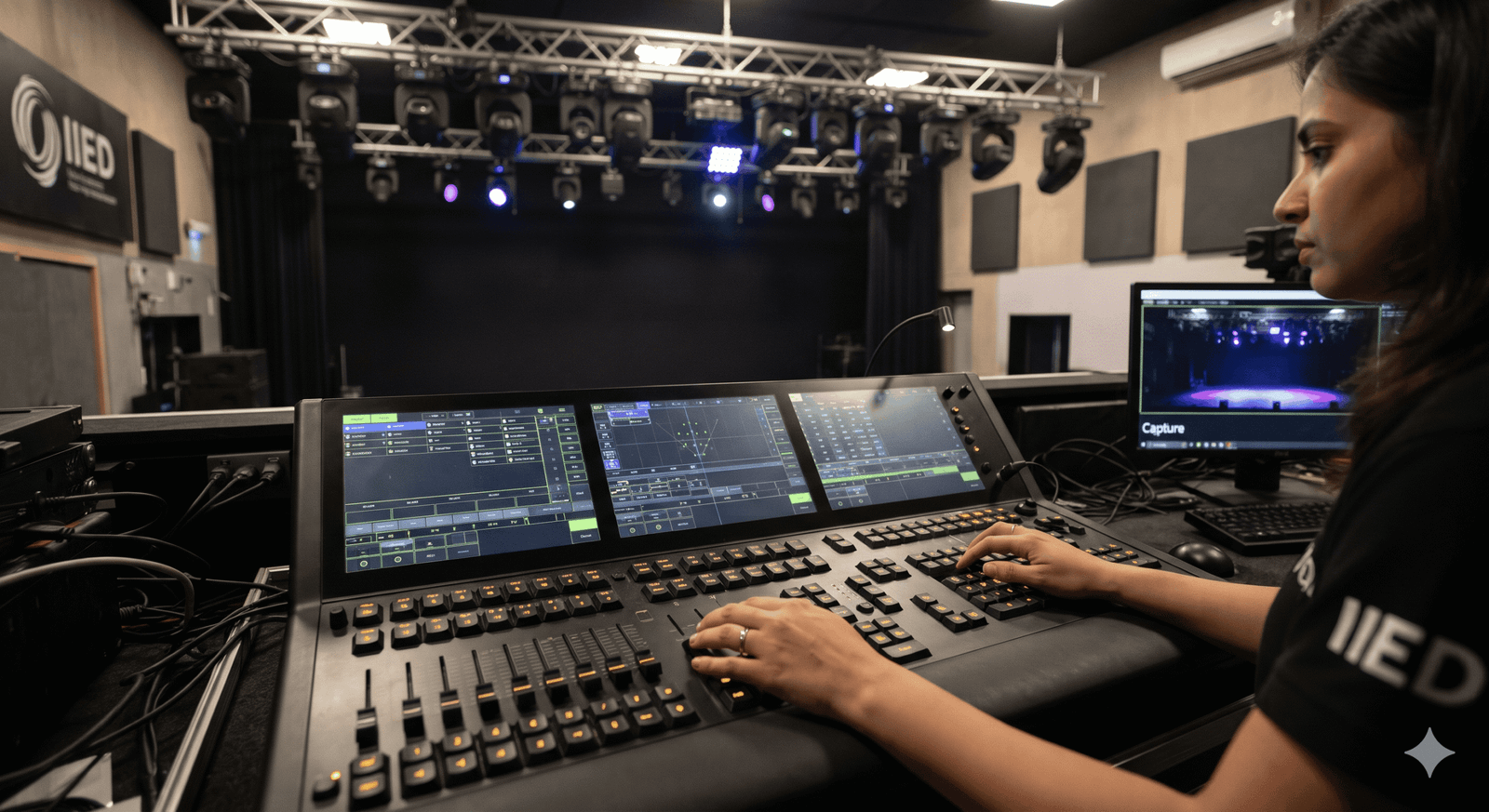
Walk up to the lighting console at most Indian concerts, weddings or award nights and you will usually find a man behind it. That is the honest picture today. Women lighting designers in India are still few. But look closer at who actually runs the show, and it is not decided by gender. It is decided by skill: who can plot the rig, programme the console and run the cues safely when the room goes dark.
Skill can be learned. This guide is for the young woman wondering if lighting design is a real career for her, and for the parents asking the same question. It covers the roles that exist, the challenges women in lighting design actually face, the routes in and what to learn first. No slogans. Just the practical path.
One thing to be clear about up front. We will not invent numbers about how many women work in Indian lighting, or claim pay figures split by gender. Nobody has published reliable data on either. What we can show you is how the work is done, what it pays at IIED’s own entry level, and which skills put you in charge on site.
Table of Contents
Where Women in Lighting Design Already Work in India
Women are not starting from zero. A small number have already built serious careers in Indian lighting, often in the toughest corners of it.
Film sets. Hetal Dedhia is widely reported as India’s first woman gaffer, the person who leads the lighting crew on a film set. She has worked on films like Bluffmaster, Luck By Chance and Karthik Calling Karthik, and assisted on Mission: Impossible – Ghost Protocol. In a 2025 interview with Outlook India, she called the idea that lighting needs physical strength “a myth”. What it needs, she says, is a good eye and an understanding of what a scene requires.
IIED COURSE
MA in Lighting Design
Plotting, rigging safety and console programming from first principles. Skill that earns respect at any console.
Duration: 2 Years (4 Semesters) · Mode: Full time, classroom in Mumbai
Theatre. Women work as lighting designers in Indian theatre too, though they know they are few. A Pune theatre founder told The Bridge Chronicle that she started her company partly to give women technical roles like light and sound design.
Architectural lighting. Building, façade and interior lighting has a visible community of women designers worldwide. The Women in Lighting project profiles women lighting designers across many countries, including India, and has expanded from architectural lighting into entertainment lighting.
These are the women lighting designers India already has to look up to. None of them are connected to IIED. We mention them because they answer the first question every student and parent asks: has a woman done this before? Yes. In film, in theatre and in architecture.
6 Lighting Roles You Can Aim For
“Lighting designer” is the title people know. But a show needs a whole team, and each role is a real career. Here are six you can aim for. For a deeper breakdown of three of them, read lighting designer vs programmer vs operator.
1. Lighting designer
Decides what the audience sees and feels. Draws the light plot, picks the fixtures, sets the looks for each moment of the show and leads the lighting team.
2. Lighting programmer
Turns the designer’s ideas into cues on a console like grandMA3. Programming is precise, screen-based, technical work, and much of it can be done before the show on a laptop.
3. Console operator
Runs the show live. Fires the cues on time, adapts when something changes and keeps the lighting tight with the music or the stage action.
4. Lighting technician
Rigs, cables, focuses and maintains the fixtures. This is where most people learn the physical side of the job, as part of a crew.
5. Wedding lighting designer
Designs the light for mandaps, entries, sangeet stages and receptions. November is peak wedding season, which makes this one of the most visible entry routes right now. See our guide to wedding lighting design for what the job involves and who hires.
6. Architectural and façade lighting designer
Lights buildings, hotels, landscapes and interiors. The work is more project-based and studio-led, with site visits rather than nightly shows.
The Honest Challenges (and the Skill That Answers Each)
We are not going to pretend a lighting career for women in India is easy. It has real challenges. But each one has a practical answer, and almost every answer is a skill you can learn.
| Challenge | The answer |
|---|---|
| Crew respect | Be the person who knows the rig best |
| Physical work | Rigging and safety knowledge, not strength |
| Late nights and travel | Choose your role and your segment |
| Family worries | Show them the work |
Challenge 1: Crew respect
Women in stage lighting sometimes find that crews or venue staff turn to a man by default. A Deccan Herald report on women in theatre described technical staff who preferred to talk to a man about lighting and sound.
The answer: be the person who knows the rig best. On a show site, authority comes from knowledge. If you drew the light plot, you know where every fixture hangs. If you programmed the console, you are the only one who can run the show. If you know the power load and the rigging rules, the crew checks with you before they lift. Technical mastery is the most reliable way to earn respect on site.
Challenge 2: Physical work
Fixtures are heavy. Truss is heavy. That part is true. What is not true is that one person lifts it alone. Lighting is team work, with hoists, rigging procedures and crew.
The answer: rigging and safety knowledge, not strength. A designer or programmer who understands Safe Working Load, truss and hoist rules is far more valuable than someone who can carry a moving head. Hetal Dedhia’s point in the Outlook interview holds here too: strength is not the job.
Challenge 3: Late nights and travel
Live events run late. Concerts tour. That is real, and it does not suit everyone at every stage of life.
The answer: choose your role and your segment. Not every lighting role is a midnight-load-out role. Corporate events often run during the day. Architectural lighting is studio and project work. Programming can be done in advance, on a laptop, before the show. Wedding lighting is seasonal and often local. You can pick the part of the industry that fits your life, and change later.
Challenge 4: Family worries
Many parents have never seen a lighting career up close. Their worries about safety, hours and stability are fair.
The answer: show them the work. Bring your parents when you visit an institute. Let them see the console, the rig and the safety process. Show them real job titles and real pay. A career they can see is much easier to trust than one they can only imagine.
Routes In: Fresher, Career Switcher or Returning After a Break
There is no single way into lighting. Here are three common starting points, and a short path for each.
Route 1: The fresher (18–22)
You have just finished your degree, or you are about to, and you have no lighting background. That is fine. Ashish Gonamanda was a complete fresher who discovered lighting design was a career option, trained at IIED and was hired by Show Genesis in Mumbai as a Lighting Operator / Designer at ₹40,000 a month. Starting from zero is normal in this field.
Your path: learn the foundations properly, build a portfolio of real plots and programmed cues, then join a crew or production company.
Route 2: The career switcher
You already work in interior design, architecture, AV or event management. You have more to build on than you think. Interior and architecture graduates already understand space and drawings. AV people know signal flow. Event managers know how shows run.
Suhani Mudra is a good example of a woman moving into technical, on-site work. She was an event management graduate who felt there were more skills to learn. She took IIED’s CAD for Events & Entertainment course and moved into a Draftsman + Production Manager role at Potato Heads. Hers is a production path, not a lighting one, but it shows how one technical skill can move you from planning to producing.
Your path: add the lighting-specific skills (plotting, DMX, console) on top of what you already know.
Route 3: Returning after a break
You stepped away from work for family or other reasons, and you have a strong eye for design but low technical confidence. Design-led and programming-led roles suit you well, and many can be done freelance.
Flexible learning is possible. Nirali Reshamiya, a wedding designer (not a lighting designer), studied a part-time evening course at IIED for two hours a day while keeping her job, and moved up to Wedding Visualization Designer at Gurleen M Puri. The lesson for you: you do not always have to stop everything to upskill.
Your path: start with software you can practise at home, like grandMA3 onPC, then add hands-on rig time.
Unusual starting points work too. Jude Pereira left MBBS studies for lighting and now works as an Event Designer and Lighting Technician at Disneyland Hong Kong. If a medical student can switch, so can you.
What to Learn First as a Female Lighting Designer in India
Whether you are a fresher or a switcher, the order matters. Here is what a serious lighting design course in Mumbai or anywhere should teach you, and in what sequence. This mirrors how IIED’s lighting design course in Mumbai (the two-year MA in Lighting Design) is built.
- Electrics and safety. Power, load calculation and safe distribution. Then trussing, rigging and structural safety. This is the knowledge that makes crews listen to you.
- Light itself. How light, colour and the human eye work. Colour temperature, beam angles, fixture families: PARs, Fresnels, profiles, moving heads, LED and pixel fixtures.
- Control and DMX. How a console talks to fixtures over DMX, Art-Net and sACN, and how to troubleshoot when it does not.
- Light plots. Drawing the rig in CAD and Vectorworks Spotlight, and pre-visualising it in 3D in Capture. The plot is your proof that you designed the show.
- Console programming. grandMA3 and Avolites Titan, from first cue to timecoded shows.
- The design process. Reading a brief, building looks, documenting the show and presenting it to a client.
In IIED’s MA, the first semester covers light, electrics, rigging and a hands-on lab. The second adds fixtures, DMX networking, the design process and an industry internship. Year 2 moves into advanced design studio, advanced grandMA3 show control, lasers, pixel mapping, effects and a final show in front of a live public audience. Electives let you lean towards events, film and TV, theatre, interiors, façades, concerts or award shows. For fees and full details, see the course page.
Not sure which order suits you? Our step-by-step guide on how to become a lighting designer in India maps the full route.
What the Pay Looks Like
Pay is one of the first things parents ask about, and it should be. Here are IIED’s verified lighting outcomes. These figures are not split by gender, because pay for women lighting designers in India, like everyone else, is set by the role and the skill.
| Measure | IIED lighting outcome |
|---|---|
| Median CTC | ₹3.90 LPA |
| Average CTC | ₹8.20 LPA |
| Highest CTC | ₹29.40 LPA |
| International placements | 3 so far |
Based on IIED lighting students with 0–1 years of experience.
At entry level in India, lighting roles for IIED alumni have paid roughly ₹25,000 to ₹40,000 a month. Several recent graduates, including Ashish Gonamanda and Ritesh Khichariya at Show Genesis, went straight in at ₹40,000 a month. For a fuller breakdown by role, read our guide to lighting designer salary in India.
The median is the honest number to plan around. The average is higher because a few people, often in international roles, earn much more. Your own pay will depend on your skill, your portfolio and the segment you choose.
How to Start a Lighting Design Career for Women This Month
You do not need to wait for a new academic year to begin. Here are three concrete steps you can take in the next few weeks.
Step 1: See a real rig
Wedding and festival season is running right now. Ask a local lighting vendor, event company or theatre if you can watch a setup or shadow a programmer for one show. Watch who does what. Notice how much of the job is planning, plotting and programming.
Step 2: Download grandMA3 onPC
grandMA3 onPC is free to download for Windows or Mac and includes a built-in 3D visualiser. Spend an hour a day learning how to patch fixtures and store a few cues. You will quickly find out whether you enjoy the logic of programming.
Step 3: Book a counselling visit, and bring your parents
Visit an institute where you can sit in on a real class and see the equipment. At IIED’s Mumbai campus in Malad, you can see the consoles, the rig and the safety training first-hand. Bring your parents. Let them ask every question they have.
One more thing worth knowing. Most event management institutes train coordinators, not lighting designers. IIED is the only institute in Mumbai that trains event design, lighting and production together, so you can see how lighting fits into the whole show.
Frequently Asked Questions: Women Lighting Designers in India
Can women become lighting designers in India?
Yes. Women already work in Indian lighting as film gaffers, theatre lighting designers and architectural lighting designers. The jobs are decided by skill: plotting a rig, programming a console and running a show safely. Those skills are learnable by anyone who trains properly.
Is stage lighting too physically demanding for women?
No. Rigging and moving fixtures is team work, done with hoists, procedures and crew, not by one person lifting alone. Designers and programmers spend most of their time on plots, consoles and design decisions. Safety and rigging knowledge matters far more than strength.
Is it safe for women to work late-night events and weddings as a lighting technician?
Live events do run late, and no one can promise every site is the same. Practical steps help: work with established companies, travel in crew transport, know the site’s safety process and choose segments that suit you. Corporate, architectural and programming-led roles often involve fewer late nights.
Which lighting roles suit someone who wants fixed hours or freelance work?
Architectural and interior lighting design is usually project-based with more regular hours. Lighting programming can often be done in advance on a laptop. Wedding lighting is seasonal and suits freelance work. Many lighting designers in India work freelance across these segments.
Do I need an engineering or science background to learn lighting design?
No. IIED’s MA in Lighting Design accepts graduates from any discipline and starts from first principles: light, electrics, rigging and control. A practical, hands-on course teaches the technical side step by step.
How much does a lighting designer earn in India at the start?
For IIED lighting alumni with 0–1 years of experience, the median CTC is ₹3.90 LPA and the average is ₹8.20 LPA. Entry-level roles have paid roughly ₹25,000 to ₹40,000 a month in India. Pay depends on role, skill and segment, not gender.
What should I learn first — lighting design, grandMA3 or Vectorworks?
Start with the foundations: electrics, safety and how light and fixtures work. Then learn DMX control, light plots in Vectorworks Spotlight and console programming on grandMA3. If you want to test your interest at home first, download the free grandMA3 onPC software.
How can I convince my parents that lighting design is a real career?
Show them real job titles, real pay data and real alumni stories. Better still, bring them on a campus visit so they can see the consoles, the rig and the safety training for themselves. A career they can see is easier to trust.
Ready to Start Your Lighting Design Career?
Lighting is still mostly male in India today. But the console does not care who is standing behind it. It responds to whoever knows how to programme it. Learn the electrics, the plots and the programming, and you will have the skill that runs the show.
Book your free visit — call 9892966334 or email info@weareiied.com. IIED, Shop No. 506, 5th Floor, Magic Square, Dwarkadhish Road, off Poddar Road, Malad East, Mumbai 400097.
IIED COURSE
GrandMA3 Mastery Program
Want to start with programming? Learn the console that decides who runs the show.
Duration: 1 Month (74 hours: 24 hrs live training + 50 hrs self-paced practice) · Mode: Classroom, IIED training centre in Malad, Mumbai