You have finished your degree, or you are close. Maybe you already hold a BEM or an event management diploma. Now everyone around you says the same thing: do one more event management course after graduation and the jobs will come. Before you pay for another round of planning lessons, stop and ask a harder question. Is planning really the skill you are missing?
For a lot of graduates, the honest answer is no. You already know how to make a schedule, call vendors and build a budget. What hiring teams in Mumbai keep asking is different: can you design the stage, draw the layout and help run the show?
IIED COURSE
Short Term Event Design Course
Already know planning? Add the design, layout and visualisation skills hiring teams ask graduates for.
Duration: 4 months
This guide walks you through that gap, gives you a quick self-check, and lays out three real routes that IIED alumni from event management backgrounds have already taken.
Table of Contents
What an Event Management Course After Graduation Teaches, and What Employers Ask For
Let’s be fair to event management first. It is a real discipline, and it teaches useful things. A good programme trains you to plan timelines, handle logistics, coordinate vendors, manage guests and keep a budget under control. The US Bureau of Labor Statistics describes event planners in exactly these terms in its Occupational Outlook Handbook: people who coordinate every part of an event, from venue and transport to suppliers. That is the job of a planner and coordinator.
So if you already hold an event management degree or diploma, you have most of that foundation. A second event management course after graduation will mostly repeat it, with a new certificate on top. That is the trap many graduates fall into. They feel stuck, assume they need more of the same, and spend another year and another fee learning what they already know.
Where the planning course stops
Most event management courses stop at the point where the event has to be seen and built. Very few of them teach you to:
- Turn a client brief into a mood board, colour story and design concept
- Sketch a stage or mandap and present it with confidence
- Draw a scaled floor plan or stage elevation in AutoCAD or Vectorworks
- Build a 3D visual the client can sign off on before a single vendor is booked
- Read a lighting plot, or understand how trussing, power and rigging fit together
- Run a show from the technical side, not just the clipboard side
These are the skills that separate a coordinator from a designer or a production professional. They are also the skills most graduates tell us they never touched in their event management degree.
What Mumbai’s event, wedding and entertainment companies ask at entry level
Talk to design teams at wedding companies, event agencies and production houses in Mumbai and you hear the same requests for freshers. Can you show a portfolio? Can you make a layout? Can you produce a 3D visual or a working drawing? Can you be useful on site when the stage goes up?
Planning knowledge helps, but it rarely decides the hire on its own. Companies already have planners and account managers. What they struggle to find are graduates who can draw, design and produce. That is why event management after graduation in India so often leads to the same frustrating loop: applications go out, interviews ask for work samples, and the graduate has nothing visual to show.
We have covered the bigger comparison in our guide on event design vs event management. This post answers a narrower question: you have finished graduation, so what should you study next?
Self-Check: 5 Questions Before Your Next Event Management Course After Graduation
Before you sign up for anything, answer these five questions honestly. They take two minutes, and they will tell you whether you need more management training or new technical skills.
| Question | If you answer “No” | What it points to |
|---|---|---|
| 1. Can you plan an event timeline, vendor list and budget on your own? | You still need planning basics | More management training may help |
| 2. Can you turn a brief into a design concept with a mood board and colour story? | You are missing design skills | Event or wedding design route |
| 3. Can you draw a scaled floor plan or stage elevation in AutoCAD or Vectorworks? | You are missing technical drawing skills | Event production route |
| 4. Do you have a portfolio of 3D visuals, layouts or stage designs to show an employer? | You have nothing visual to prove your skill | Any route that ends in a real portfolio |
| 5. Do lights, consoles and the show itself excite you more than the guest list? | Not applicable if “Yes” | Lighting route |
If you said “Yes” to question 1 and “No” to questions 2 to 4, another planning course is probably not your answer. You already have the planning base. What you need is the skill your course left out.
If you said “No” to question 1 as well, that is fine too. Many of our design students arrive without any event background at all. Design training covers vendor management and budgeting along the way, so you will not be left behind.
3 Routes After Graduation: Design, Production or Lighting
Here is the practical answer to what to do after an event management degree. There are three main routes, and each one adds a skill set that planning courses rarely cover. All three are taught under one roof at IIED in Mumbai, which is still rare in this city. Pick the route that matches your answers above.
Route 1: An event design course after graduation (events and weddings)
This route suits graduates who love the look and feel of an event: the stage, the entry, the colours, the flowers, the mandap. You learn to create the design, not just organise it.
IIED’s Short Term Event Design Course runs for 4 months and is built in four units. You start with design foundations: elements and principles of design, colour theory and basic typography. Then you move into the production side of design, including trussing, lighting and sound basics, fabrics, table styling, floral design, vendor management and budgeting. The third unit covers presentation: sketching, graphic design, scaled drawings and layouts with software. You finish with a self-directed design project that simulates a real commission, and you leave with a professional portfolio.
Two details matter for graduates. First, it runs as a part-time evening programme, so you can study while you work or while you finish your final year. Second, there are focused versions for weddings and for online learners: the Short Term Wedding Design Course, plus online editions of both. If you cannot move to Mumbai yet, the online route still builds a portfolio.
Best for: event management graduates who want to move into event design, wedding design, styling or 3D visualisation.
Route 2: An event production course in India (technical, CAD, Vectorworks)
This route suits graduates who like the build: the structure, the drawings, the load-in, the moment a bare venue becomes a working stage. Production people turn a design into something real and safe.
You have two ways in. The fast way is a focused software course. CAD for Events & Entertainment takes 1 month (36 hours) and teaches AutoCAD for event work: floor plans, seating charts, stage elevations and concert site maps. Vectorworks Spotlight for Event Production also takes 1 month (48 hours) and goes into truss, rigging, lighting devices and full stage technical drawings, with a 3-month internship pathway on completion.
The longer way is the MA in Technical Production, a two-year, full-time, hands-on master’s degree programme at IIED. It covers health and safety, staging and stage machinery, rigging and load management, power, production planning and logistics, and audio, lighting and video integration, with an internship in Semester 2. Any graduate can apply.
If you want the side-by-side view of how production differs from management, read our guide on event production vs event management.
Best for: graduates who want roles like production planner, draftsman, CAD specialist, production manager or venue designer.
Route 3: Lighting design
This route suits graduates who watch a show and notice the light before anything else. Lighting is one of the most technical and best-paid paths in live events, and very few people in India are trained for it properly.
For a full career, the MA in Lighting Design is IIED’s two-year, full-time, hands-on master’s degree programme. Year 1 covers light, vision and colour, electrical systems and power, trussing and rigging safety, fixtures and optics, DMX and networking, and the full design and documentation process, with electives including lighting for events and an internship. For graduates who already have 1 to 2 years around lighting, the GrandMA3 Mastery Program is a 1-month, 74-hour console course that takes you from basic operation to programming real shows.
Best for: graduates who want to become lighting designers, programmers or operators for concerts, weddings, corporate events and theatre.
Time and Cost Reality: Short Course or Another Full Degree?
Graduates often assume the next step has to be a long, expensive programme. It does not. Here is how the options compare on time:
| Course at IIED | Duration | Format |
|---|---|---|
| CAD for Events & Entertainment | 1 month (36 hours) | Classroom, Mumbai |
| Vectorworks Spotlight for Event Production | 1 month (48 hours) | Live training plus self-paced practice |
| GrandMA3 Mastery Program | 1 month (74 hours) | Classroom, Mumbai |
| Short Term Event Design Course | 4 months | Part-time evenings, Mumbai (online version available) |
| MA in Set Design / Technical Production / Lighting Design | 2 years (4 semesters) | Full-time, Mumbai |
A short course is usually the smarter first move if you already have an event management degree and simply need one missing skill. The 4-month Short Term Event Design Course is listed at ₹60,000 plus GST, paid in instalments. Fees for every course are on the course pages, and we compare costs across the market in our guide to event design course fees in India.
A two-year MA makes more sense if you want deep, specialist training and a master’s degree, and you can commit full-time. Neither choice is wrong. The wrong choice is paying to repeat what you already know.
BEM Graduate Jobs: Real IIED Alumni Who Started in Event Management
Here is the part that matters most. These are real IIED alumni who came from event management backgrounds and added a design, production or lighting skill. Their stories are not promises of a result. They show what becomes possible when you fill the right gap.
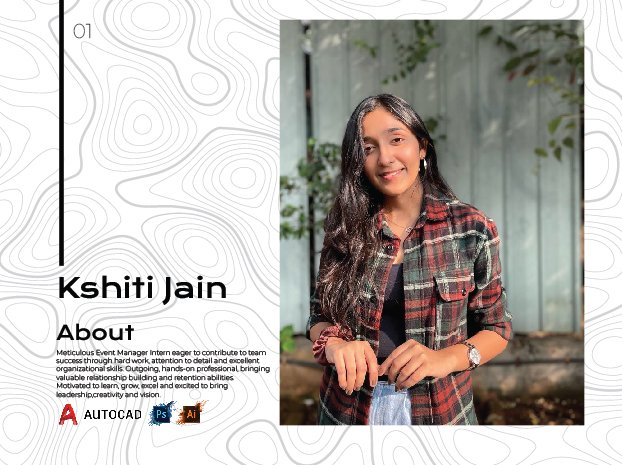
Kshiti Jain, founder of The Episode Events. Kshiti graduated in event management and could not break into wedding design. She completed IIED’s Event & Wedding Design Visualization course, freelanced and consulted, and then started her own company. In her words: “After passing out of event management, I found myself struggling to break into the wedding industry. IIED didn’t just teach me to design; it gave me the foundation to build my own brand.”
Manisha Mahto, Junior Graphic Designer at Inextis Events, Mumbai. Manisha studied event management in Ahmedabad, then moved from Ranchi to Mumbai and joined IIED. After training, she joined Inextis Events at ₹30,000 a month. “After completing my event management studies, I moved from Ranchi to Mumbai and joined IIED,” she says. “I’m now living my dream as a professional designer.”
Lishika Jain, co-founder of Events by Mishka. Lishika finished an event management course, then trained at IIED in Mumbai. “Armed with these new skills, I teamed up with two partners and started my own event design company,” she says.
Suhani Mudra, Draftsman and Production Manager at Potato Heads. After her event management degree, Suhani felt there was more to learn and was drawn to production. The CAD for Events & Entertainment course gave her the technical drawing skills she was missing, and she moved into a draftsman and production manager role.
Arun Sagar, Operations & Production at NMACC, BKC, Mumbai. Arun took the 1-month CAD for Events & Entertainment course specifically to upskill on the technical side. He now works in the Operations & Production department at the Nita Mukesh Ambani Cultural Centre, one of Mumbai’s most respected performance venues.
Aditya Tawde, Assistant Lighting Programmer at Fireflies Creative Technologies, Mumbai. Aditya was working as a freelance event manager when he decided to learn lighting properly at IIED. He joined Fireflies Creative Technologies as a full-time Assistant Lighting Programmer at ₹25,000 a month during probation, moving to ₹40,000 a month after it.
Pranay Mhatre, Production Designer at Wizcraft International Entertainment, Mumbai. Pranay completed the Event & Wedding Design Visualization course and joined Wizcraft, India’s oldest event company, as a Production Designer. It remains our flagship placement for the programme.
For a wider view, IIED’s Wedding, Event & Set Design alumni with 0 to 1 years of experience report an average CTC of ₹4.68 LPA, a median of ₹4.80 LPA and a highest of ₹6 LPA. Treat these as real examples from our offer letters, not a promise. Your outcome depends on your portfolio, your effort and the roles you go after.
How to Choose Your Next Course After Graduation
Whatever route you pick, judge any course, at IIED or anywhere else, on four things. These checks matter more than the name on the certificate.
1. Does it end in a real portfolio?
Employers hire from what they can see. Ask to look at portfolios from past students. If an institute cannot show you real student work, that tells you something. At IIED, every course builds a portfolio, and you can see student work on our portfolio page.
2. Are the mentors working in the industry?
Designers, production professionals and lighting designers who still work on live shows teach you what the job looks like today. Ask who teaches the classes and what they have worked on recently.
3. Will you get your hands on professional tools?
You cannot learn AutoCAD, Vectorworks or a GrandMA3 console from slides. Ask how many hours you will spend on the actual software or equipment, not just watching a demo.
4. How big is the batch?
Small batches mean your work gets reviewed properly and your questions get answered. At IIED we keep batches small for exactly this reason.
The best test: visit before you decide
Reading about a course only goes so far. The quickest way to judge it is to walk in, see the studio, look at student portfolios and talk to a mentor about your degree and your goals. Bring your questions about event management after graduation in India and we will give you a straight answer, including if a short course is enough for you.
If you are thinking about starting in the new year, you can also ask about upcoming February short-course batches when you enquire. There is no rush. Peak wedding season is a good time to watch real events closely and decide what kind of work excites you.
Frequently Asked Questions
Is an event management course worth it after graduation?
It can be, if you have no planning background and want to work as a planner or coordinator. But if you already hold a BEM or event management diploma, another event management course after graduation will mostly repeat what you know. Most graduates in that position gain more from adding a design, production or lighting skill.
What can I do after a BEM or event management diploma if I can’t get hired?
Look at what interviews keep asking for. Usually it is a portfolio, layouts, 3D visuals or technical drawings. A focused course in event design, CAD or Vectorworks fills that gap in 1 to 4 months. IIED alumni such as Kshiti Jain, Manisha Mahto and Suhani Mudra all came from event management and moved into design or production roles this way.
Event management vs event design: which has better career prospects in India?
Both are real careers. Event management focuses on planning and coordination. Event design focuses on creating the look, layout and experience of an event. Design skills are harder to find, so a graduate who can plan and design has an edge over one who can only plan.
Can I learn event design after graduation if I have no design background?
Yes. IIED’s Short Term Event Design Course starts with design foundations such as colour theory, the elements and principles of design, and sketching. Many students join from commerce, arts, science or event management with no design training at all.
How long does it take to become job-ready in event design or event production?
It depends on the route. CAD for Events & Entertainment and Vectorworks Spotlight each take 1 month. The Short Term Event Design Course takes 4 months, part-time. The MA programmes in Set Design, Technical Production and Lighting Design take 2 years, full-time. Being job-ready also depends on finishing a strong portfolio.
Do I need AutoCAD or Vectorworks to work in events?
Not for every role, but they open many doors in event production and design. Layouts, stage elevations and site plans are drawn in this software. Alumni such as Arun Sagar at NMACC and Suhani Mudra at Potato Heads took the 1-month CAD course to build exactly this skill.
Can I study event design while working or in my final year?
Yes. The Short Term Event Design Course runs as a part-time evening programme, so you can study alongside a job or your final year of graduation. Online versions of the event and wedding design courses are also available if you live outside Mumbai.
What salary can a fresher expect in event design in Mumbai?
There is no fixed figure, but here are real examples. Manisha Mahto joined Inextis Events in Mumbai at ₹30,000 a month. IIED’s Wedding, Event & Set Design alumni with 0 to 1 years of experience report an average CTC of ₹4.68 LPA, a median of ₹4.80 LPA and a highest of ₹6 LPA. These are examples from verified offers, not a promise.
Ready to Start Your Event Career?
An event management course after graduation is not the only answer, and for many graduates it is not the right one. You already know how to plan. The graduates who get hired, or start their own companies, are the ones who add the skill their course left out: design, production or lighting. Answer the self-check, pick your route, and judge every course on portfolio, mentors, equipment and batch size.
Want to see which route fits you? Book your free visit to IIED in Malad East, Mumbai.
Book your free visit — call 9892966334 or email info@weareiied.com. IIED, Shop No. 506, 5th Floor, Magic Square, Dwarkadhish Road, off Poddar Road, Malad East, Mumbai 400097.
IIED COURSE
MA in Set Design
Want a full master’s after graduation? Design and build sets for weddings, events, film and TV.
Duration: 2 years (4 semesters) · Mode: Full-time, classroom in Mumbai