
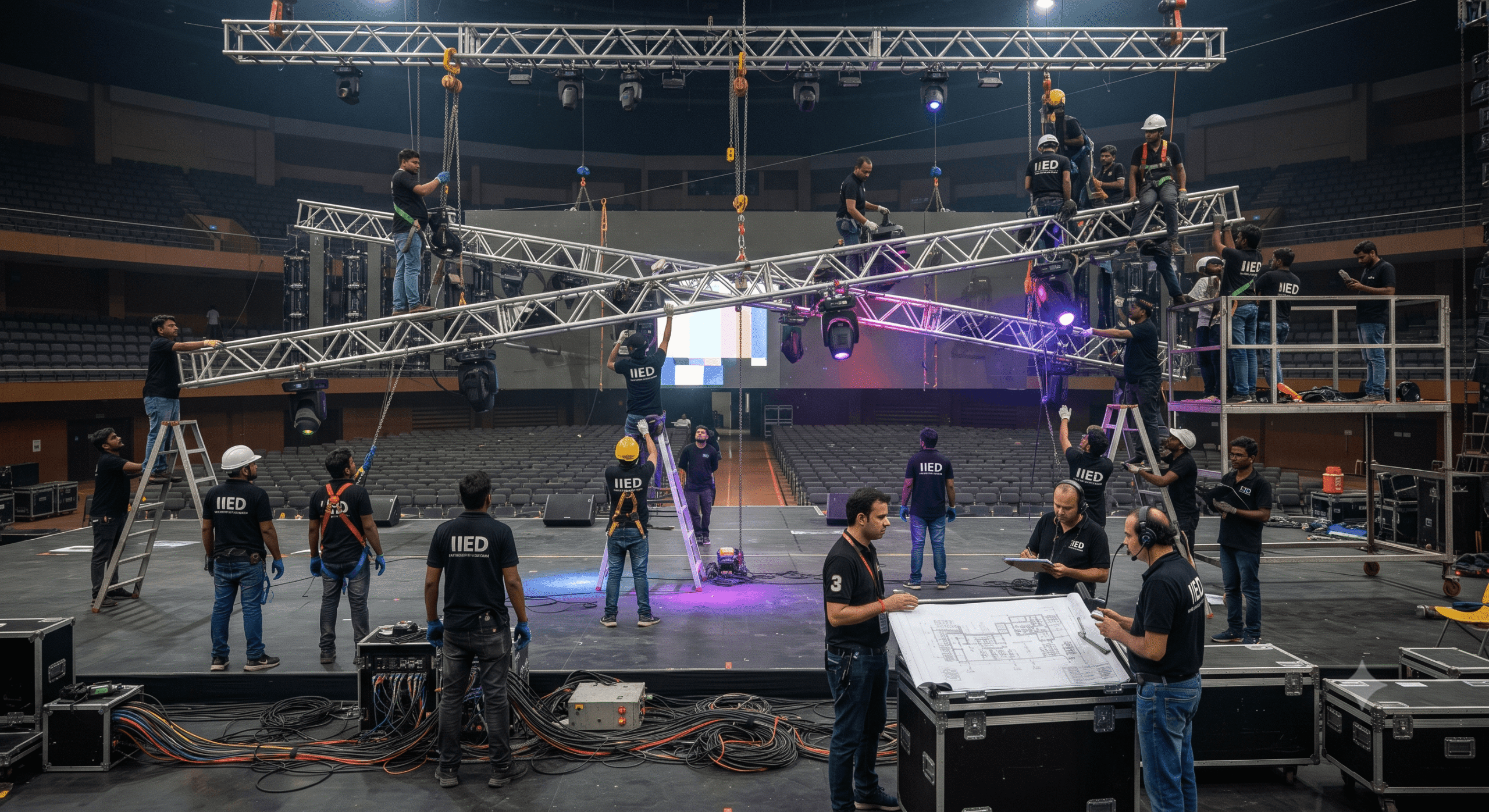
The guests see the décor. Nobody sees the 40 people who made it stand up, light up and run on time.
So, what is event production? It is the work of turning an event design on paper into a live show: building the stage, rigging the lights, setting up sound and video, managing power and running every cue on the night. That is event production, and it is where many of the hands-on jobs in India’s events industry sit.
If you study event management, you learn to plan. You learn budgets, vendors and guest lists. Then you open a job listing and see words like production manager, technical director or lighting programmer. You do not qualify, and nobody told you why. This guide explains what those jobs are, what they do on show day, and how you start.
We write it as mentors at IIED, a Mumbai institute that trains event designers, lighting professionals and production people together. We will keep it plain and practical.
Table of Contents
What Is Event Production? Defined in Plain Words
Event production is everything that happens between an approved design and a finished show. It covers technical drawings, staging, lighting, sound, video, rigging, power, scheduling and logistics, and it ends only when the last truss is packed and the venue is clean.
If you are still asking what is event production in practice, think of it as a relay. A designer hands over a concept. The production team makes it real, safe and on time. Here is the usual flow.
- Concept. The designer sketches the idea and the client approves it.
- Technical drawings. The team draws plans, elevations and lighting plots, often in CAD or Vectorworks, so every department builds from the same page.
- Build. Crew construct the stage, hang trusses, run cables and install fixtures, screens and speakers.
- Technical rehearsal. Lighting, sound and video are tested together. Cues are timed. Problems get fixed now, not in front of guests.
- Show. A show caller or stage manager runs the cues while every department stays on standby.
- De-rig. The team strikes the set, packs equipment and clears the venue, often through the night.
Most people only see step five. Ask any crew member what is event production, and they will describe steps one to four. A good production team makes steps one to four invisible.
Event Production vs Event Management: The Short Version
The two jobs sit side by side on the same event, and people mix them up often. Here is the quick difference.
| Event management | Event production |
|---|---|
| Plans and coordinates the event | Builds and runs the technical show |
| Works with budgets, vendors, guests and timelines | Works with stages, lights, sound, video, power and rigging |
| Mostly office, phone and site visits | Mostly venue floor, load-in and show control |
| Asks: “Is everything booked?” | Asks: “Will it stand, light up and run on time?” |
Neither job is better. They need each other. But employers who hire for production want people who can read a drawing and work with equipment, and event management courses rarely teach that. A full comparison of the two careers is coming in a separate guide.
The Departments Inside Event Production
Another way to answer what is event production: it is not one job. It is a set of departments that work to one schedule. Here are the main ones.
- Staging and set build. Platforms, backdrops, ramps and structures. The crew builds what the designer drew, to the right size and weight limits.
- Lighting. Fixtures, control desks and programming. The lighting team shapes mood, colour and focus. Consoles such as grandMA3 run the show.
- Sound. Speakers, microphones, mixing and monitors. If the audience cannot hear the speaker, nothing else matters.
- Video and LED. Screens, projection and content playback. Video crews keep visuals in sync with lights and sound.
- Rigging and trussing. Safe lifting and hanging of lights, speakers and screens above people. This department carries the highest safety responsibility.
- Power. Generators, distribution and cabling. A show with poor power planning does not finish.
- Production management and logistics. Schedules, crew, transport, permits and budgets. This department keeps all the others working together.
Technical production is one of these departments inside the larger world of event production. If you want the detail, read our guide to technical production in events. This post stays one level above it and shows you the full picture.
Event Production Roles in India
Job titles change from company to company, but these eight roles show up again and again. If you are wondering about the top two, read our comparison of technical director vs production manager.
| Role | What they do on show day | Where they work |
|---|---|---|
| Production Manager | Runs the schedule, crew, budget and safety. Solves problems as they appear. | Production companies, event agencies, venues |
| Technical Director | Owns the technical plan. Decides how the design gets built safely with the available equipment. | Large productions, venues, touring shows |
| Stage / Show Manager | Calls cues, manages performers and crew backstage, keeps the show on time. | Concerts, award shows, corporate shows |
| Lighting Designer / Programmer | Designs the look of the light, then programs and runs it on a console. | Production companies, rental houses, freelance |
| Production Designer | Shapes the visual world of the event and works with the production team to build it. | Event companies, wedding design firms |
| CAD / Vectorworks Draftsman | Turns design ideas into technical drawings, plots and layouts that crews build from. | Design studios, production companies, venues |
| Rigging Lead | Plans and supervises safe hanging of loads. Checks equipment and weight limits. | Touring crews, rental and staging companies |
| Site / Logistics Manager | Manages the venue, vendor arrival, load-in and load-out, and transport. | Large events, exhibitions, wedding production |
Salary depends on city, company and experience, and we will not quote guesses. For senior roles such as production manager and technical director, pay grows with the scale of shows you can run. We share verified alumni figures later in this post.
Skills That Get You Hired in Event Production
Employers do not hire a certificate. They hire someone who can walk onto a venue floor and be useful by the afternoon. Skills fall into two groups.
Technical skills
- Drawings. Reading a plan is the first skill. Making one is the second. Learn CAD and Vectorworks. Our short course on CAD for events is built around this.
- Lighting consoles. grandMA3 operators are in short supply in India, and demand is higher than supply.
- Power and rigging safety. Know load limits, cable routes and safe working practice. This protects people, not just equipment.
- Reading a production schedule. Know what happens at 6 a.m. load-in, who must be there, and what depends on it.
On-site skills
- Calling cues. Clear, calm instructions to many people at once.
- Vendor coordination. Rental houses, caterers, transport and venue staff all work to your clock.
- Problem-solving at 2 a.m. A truck is late. A cable fails. A client changes the layout. You fix it, then tell people.
- Teamwork under pressure. Production runs on trust. A crew that trusts you moves faster.
You build both groups by doing. That is why hands-on training and real set experience matter more than theory.
Where Event Production Work Comes From in India
Event production jobs come from many parts of the industry. The mix changes by season and city.
- Weddings. The peak runs from October to February, and it is starting now. Big wedding sets need staging, lighting, sound and power, built in days.
- Corporate and award shows. Product launches, conferences and award nights need tight schedules and clean technical delivery.
- Concerts and tours. Large crews, heavy rigging and strict show calls.
- Venues and cultural centres. Venues such as NMACC in Mumbai keep in-house production teams all year.
- Exhibitions. Stands, structures, lighting and power across several halls.
- International work. Cruise lines, theme parks and the Gulf hire skilled lighting and production crew from India.
The wider industry is also growing. The US Bureau of Labor Statistics projects 8% employment growth for event planning roles between 2020 and 2030, faster than average for all occupations. That figure covers planners rather than production crews, but every planned event needs a crew to build it. In India, the wedding industry alone is estimated at ₹3.75 lakh crore and still growing.
How to Start a Career in Event Production
You do not need a perfect plan. You need four steps and the habit of showing up.
- Learn to read and make drawings. Start with floor plans and elevations. Move to CAD or Vectorworks. Drawings are the common language between design and production.
- Get on real sets. Look for internships, crew work and weekend shows. Carry cables, hold ladders, watch load-in. You learn how shows really run, and people notice who works hard.
- Pick a department and go deep. Lighting, rigging, sound, video, power or production management. Generalists get started, specialists get hired.
- Build a production portfolio. Keep your drawings, lighting plots, schedules and show photos in one place. A clear portfolio shows what you can do better than a CV line.
If you come from event management, this path is realistic. Your planning skills already count. You are adding the technical layer that employers ask for. If you come from audio, engineering, AV or hospitality, you already have part of it.
Real IIED Students Working in Production Today
These are verified placements from IIED alumni. We share them so you can see real outcomes, not promises.
- Pranay Mhatre completed our Event & Wedding Design Visualization course and now works as a Production Designer at WIZCRAFT International Entertainment in Mumbai, India’s oldest event company.
- Aron Sagar works in the Operations & Production department at NMACC (Nita Mukesh Ambani Cultural Centre) in BKC, Mumbai, after our CAD for Events & Entertainment course. Drawings and CAD skills opened that door.
- Atharv Devikumar Jog, an IIED lighting student, joined SLS Production Equipment L.L.C in Saudi Arabia as a Lighting Operator in August 2025. His package is SAR 10,000 a month plus accommodation, a return air ticket and transport.
- Silas Paul Uba, an IIED lighting student, started in audio mixing and media production, then joined LumaSonic Structures Rental Pvt. Ltd. in Goa as a Technician – Lighting in September 2025. His package is ₹25,000 a month plus ₹5 lakh medical insurance, accident insurance and allowances.
- Rishabh Rao, an IIED lighting student, handles business development and technical operations at his family’s AVL rental company, one of Mumbai’s largest.
Notice the range. One person works at a venue, one at a production company, one abroad, one in a rental business. Event production is not a single job. It is a field with many doors.
Want to Train for Event Production Full-Time?
You can learn on the job, and many people do. It takes longer, and gaps in safety, drawings and systems knowledge show up at the worst moments. A structured programme closes those gaps faster.
IIED runs a 2-year, full-time, hands-on MA in Technical Production at our Mumbai campus. You study staging, stage machinery, rigging and load management, power and on-site energy, audio, lighting and video integration, and production planning and logistics. In Semester 2, you complete a supervised industry internship, so you meet real crews before you graduate.
If you want a quicker way to upskill first, we also teach short courses in CAD and Vectorworks. Many students start there and move into production work.
Most institutes in India train event coordinators. IIED trains designers, lighting people and production professionals together under one roof, so you learn how the whole show fits together. We do not promise a job. We train you on professional equipment, with industry mentors, in small batches, and we show you real alumni outcomes.
Ready to see where you would train? Book your free visit to IIED, Malad East and walk through the labs, meet the mentors and ask us anything about event production careers.