
Table of Contents
You’ve Watched a Hundred Concerts and Award Shows — You’ve Never Asked Who Built the Stage
You’ve watched award shows on television every year of your life. You’ve been to concerts, corporate launches, maybe a friend’s big fat Indian wedding with a stage that looked like it belonged on a world tour. At no point did you ask who actually built it.
It isn’t a decorator with a mood board. It isn’t the event manager holding a clipboard and a walkie-talkie. A concert stage design career in India runs through a technical production team — people working from CAD drawings and Vectorworks models, coordinating rigging, trussing, and lighting on a deadline that does not move, no matter how big the artist or how famous the award show.
This is a real, well-paid, specific career. It is also almost never explained clearly — not by event management courses, not by the industry itself, and definitely not by the people watching from their living rooms. This article breaks down exactly what the job is, the software and skills it actually requires, who is already doing it after training at IIED, and how to start.
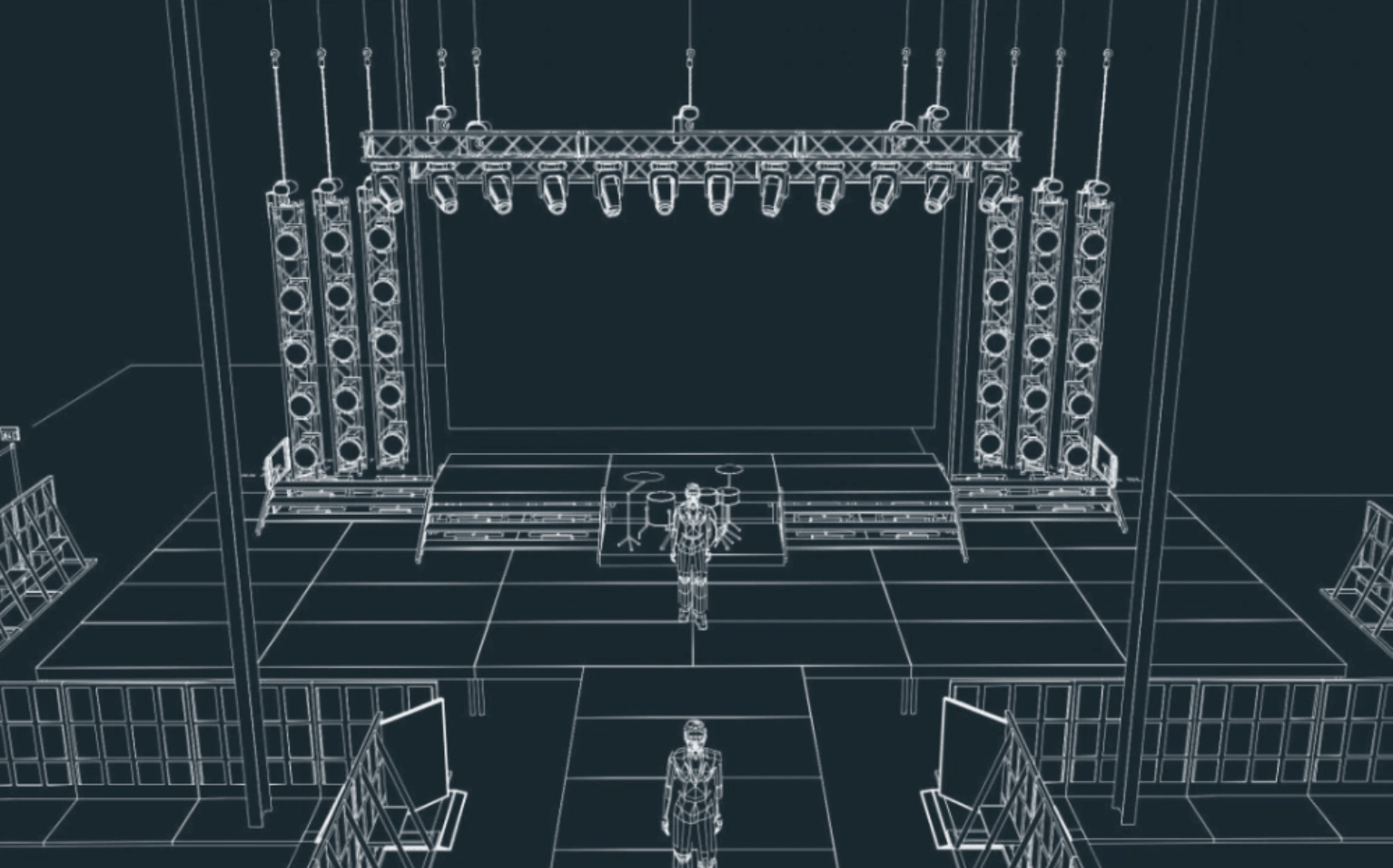
Scale is part of what makes this work different from a wedding stage or a small corporate backdrop. A concert or award show stage carries motorised rigging, dozens of moving lighting fixtures, video walls, and sometimes live pyrotechnics — all of it engineered to go up and come down inside a fixed load-in and load-out window, often overnight. Nothing about that is improvised on site. It is drawn, modelled, and signed off well before the trucks arrive, which is exactly why a concert stage design career in India depends on technical drawing and documentation skill first, and creative eye second.
The Skills Behind Every Concert Stage Design Career in India
Award show and concert stages look effortless on screen. Behind that, a small technical team has already produced dozens of pages of drawings, load calculations, and lighting plots before a single truss goes up. Four skills carry almost all of that weight.
CAD for Technical Drawings and Layouts
Every stage build starts as a set of precise 2D technical drawings — floor plans, layouts, elevations, and production documentation that riggers, carpenters, and electricians actually build from. This is what CAD for Events & Entertainment teaches: a one-month, ₹20,000 course open to anyone with 10+2, no design degree required. It is the exact skill event management diplomas skip, and the exact skill production companies ask for by name.
Vectorworks for 3D Production Documentation
Once the 2D drawings exist, Vectorworks Spotlight takes them into a full 3D BIM workflow — truss positions, lighting plots, seating layouts, and rigging points, all built to scale and viewable from any angle before a single piece of equipment is trucked in. Vectorworks Spotlight for Event Production is a one-month, 48-hour course, and it comes with a 100% three-month internship — a structured, verifiable path into a real production company, not just a certificate on a wall.
Rigging and Trussing Knowledge
A drawing is only useful if someone on site understands what it demands structurally — weight loads, rigging points, trussing configurations, and safety margins. This is the layer between the design on screen and the physical build overhead, and it is what separates a technical production professional from someone who can only make a pretty rendering.
Lighting Integration with GrandMA3
Every award show and concert stage is also a lighting build. The technical production team has to design and document the stage with the lighting rig already factored in — positions, power, and console programming on GrandMA3, the industry-standard lighting console. Training CAD, Vectorworks, and GrandMA3 together, instead of in isolated silos, is what actually mirrors how a real production is built.
None of these four skills works in isolation on an actual show. A rigging plot without a CAD layout underneath it is guesswork. A Vectorworks model without a real understanding of trussing and load limits is a pretty picture that a safety officer will reject on site. A lighting design without power and positions locked into the same drawing everyone else is working from causes clashes the week of the show, not months in advance. This is the real reason a concert stage design career in India rewards people trained across all four areas together, instead of someone who has picked up one software programme on their own and hopes the rest sorts itself out.
Why Your Event Management Course Never Taught You This
Event management diplomas teach planning, vendor coordination, budgeting, and timelines. That is a real and necessary skill — but it is coordination, not execution. It answers “did everything arrive on time,” not “how do you draw a rigging plot that a structural crew can safely build from.”
IIED has always drawn a hard line between event design and event management, and a concert stage design career in India is the clearest, most visible version of that line. NAEMD, NIEM, EMDI, and Mseed all train event coordinators and managers. None of them teach the CAD, Vectorworks, or rigging and production skill this specific career actually requires. It is a gap wide enough to drive a truss truck through, and almost no institute in India is training for the technical side of it.
India’s live events industry is not shrinking while this gap sits open. Live events were the fastest-growing segment of India’s media and entertainment industry in 2025, expanding 44% year-on-year, according to the FICCI-EY Media & Entertainment Industry Report cited by EY India. More concerts, more award shows, more corporate launches all mean more stages that need to be drawn, engineered, and lit — and more demand for people who can actually do it.
This is also where the fee question actually answers itself. CAD for Events & Entertainment costs ₹20,000 for a one-month course. Varun Jain’s confirmed salary of ₹45,000 to ₹50,000 a month means a single month of work at a technical production or design role can recover that investment outright — a very different equation from spending three or four years on a generalist degree that still leaves you needing this exact training afterward.
Who Designs Concert Stage Sets? Career Paths and Who This Is For
“Who designs concert stage sets” is not a single job title — it’s a small technical team. Production designers own the overall look and technical plan of the build. Technical draftsmen and CAD artists turn concepts into buildable drawings. Venue and site designers plan how a stage fits a specific space. Production managers run the schedule, budget, and crew on site. All of these roles sit on top of CAD, Vectorworks, and rigging skill — not decor sense alone.
This career path speaks most directly to one frustration: you have an event management diploma, you understand planning and coordination, and you still cannot get hired for the design or technical build roles that pay more and carry more creative weight. Award shows and concerts are the most visible, most aspirational version of that exact gap — massive, professionally engineered stage builds that a coordination-only background cannot break into.
It also speaks to anyone earlier in that journey — still in college, with real creative instinct but no structured pathway yet, who has never had a reason to believe “stage builder for concerts and award shows” is a real, learnable, hireable job. It is. It just isn’t taught the way it should be, almost anywhere in India.
Both groups tend to carry the same three doubts before they enquire: is there really a job at the end of this, will parents and family understand a course they haven’t heard of, and is the fee worth it. The honest answer to all three sits in the placement section below — real names, real companies, real numbers, not a promise. Parents are welcome to sit in on the free visit and ask the same questions directly.
There is also a version of this reader who is not stuck at all, just unaware. Plenty of people with a genuine eye for visual design end up on the decor or styling side of events by default, simply because nobody ever pointed them toward the technical route. If drawing a floor plan sounds more interesting to you than choosing floral colours, or if you’d rather understand how a truss holds weight than pick a table runner, that instinct is worth paying attention to. It’s a strong early signal that the production side of this industry, not the decor side, is where you actually belong.
Real Proof: IIED Alumni Working in Technical Production
Pranay Mhatre is placed as a Production Designer at Wizcraft International — India’s oldest and largest event company, and the name behind large-scale corporate, award show, and concert productions. He is IIED’s clearest proof that this specific world, the one you watch on television every year, is reachable from a training program, not just a film school or a decade of unpaid assisting.
Aron Sagar completed CAD for Events & Entertainment and is now placed in the Operations & Production department at NMACC — the Nita Mukesh Ambani Cultural Centre in BKC, one of Mumbai’s most prestigious performance venues. He is the first dedicated proof point for the CAD course specifically, and a direct answer to “can this software skill alone get me in the door.”
Varun Jain is a Design Associate at The Finale Eventz, earning ₹45,000 a month on probation, rising to ₹50,000 a month confirmed. His CAD and design skill is explicitly what shows up in his job description — real, verifiable proof that technical skill converts to pay above what coordination-only roles typically offer.
IIED is the only institute in Mumbai training Event Design, Lighting Design, and Event Production together, on real GrandMA3 consoles, real AutoCAD, and real Vectorworks — not screen recordings or theory slides. That combination is exactly what a concert stage design career in India demands: structural drawing, 3D production documentation, and lighting, taught as one connected skill set instead of three unrelated electives.
The lighting layer of this career has its own track record at IIED, beyond this specific brief’s proof points. Cajetan D’Silva, who trained during the COVID lockdown, now works internationally with Royal Caribbean on lighting for large-scale productions at sea. Atharv Devikumar Jog is placed with SLS Production Equipment in Saudi Arabia as a Lighting Operator, on SAR 10,000 a month plus accommodation and flights. Neither of these placements is a concert-specific role in the way Pranay Mhatre’s is, but both confirm the same underlying point: real technical and lighting training from IIED converts into real, international, verifiable production work — not just local freelance gigs.
How to Start a Technical Production Career for Concerts and Award Shows in India
The practical entry point is CAD for Events & Entertainment first — one month, ₹20,000, no design degree required — followed by Vectorworks Spotlight for Event Production, also one month, 48 hours of live and supervised training, which comes with a 100% three-month internship built in. Together, they take you from “I understand events” to “I can produce the drawings a production company actually builds from.” Add GrandMA3 training on top, and you’re covering the same three layers — drawing, 3D documentation, and lighting — that a real technical production team works across every show.
Both courses run in small batches at IIED’s Malad East campus in Mumbai, taught hands-on rather than through screen recordings, and both feed directly into the Vectorworks internship rather than ending at a certificate. If you are coming from an event management background, this sequence is the fastest, most direct route from “I coordinate events” to “I can be hired to design and document the build” — without going back for a second degree.
If you want to see what that actually looks like before committing to anything, come see the CAD and Vectorworks labs in person. Book your free visit to IIED in Malad East, Mumbai, and walk through the same equipment and drawings this article has been describing.