
If you’ve spent two or three years coordinating events — vendors, timelines, guest lists — and you’re still watching someone else run the technical side of the show, you’ve probably searched for technical production manager salary India more than once. It’s a fair question to ask. The role sits above pure coordination and below creative direction, and in India right now, it tends to pay better than most entry-level event management jobs, because almost nobody coming out of a standard event management course is actually trained to do it.
This post answers it directly: what a technical production manager actually does on event day, what the role pays in India based on real, verified alumni outcomes, how it’s different from event management, and the specific technical skills — CAD, Vectorworks, rigging fundamentals — that separate someone who coordinates an event from someone who is trusted to run its technical production.
Table of Contents
What Does a Technical Production Manager Actually Do on an Event?
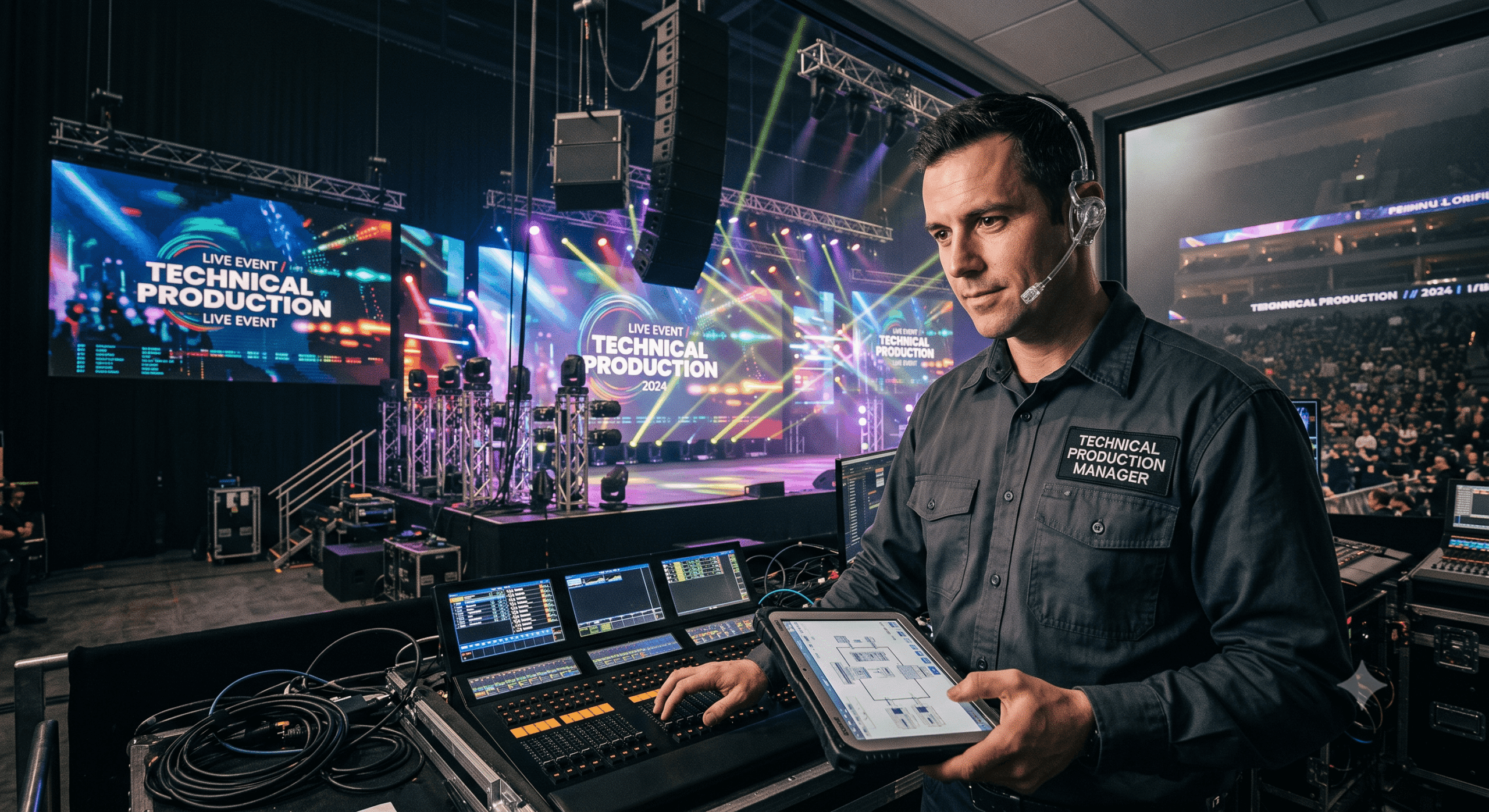
A technical production manager is the person responsible for making sure everything technical on an event — rigging, lighting, sound, staging, power — actually works, is safe, and runs on schedule. Where an event manager is coordinating the guest experience, the technical production manager is running the machine behind it.
On a typical event day, that means reviewing and marking up technical drawings before load-in (CAD or Vectorworks files showing where every truss point, lighting fixture, and cable run needs to go), walking the site with vendors to confirm rigging points and load limits, checking power and electrical safety before anything goes live, and running the technical rundown alongside lighting, sound, and video teams. When something breaks mid-show — and something always does — the technical production manager is the one troubleshooting it in real time, not calling someone else to fix it.
It’s also a documentation-heavy role. Production drawings, equipment inventories, load-in schedules, and safety sign-offs all sit with the technical production side, not the event coordination side. That’s exactly why technical skills like CAD and Vectorworks Spotlight matter more here than a general event management diploma does. A coordinator can manage a run-of-show spreadsheet. A technical production manager has to be able to read a lighting plot, understand a rigging point calculation, and know when a vendor’s setup doesn’t match the approved drawing.
This is also why the role is different depending on the event type. Technical production on a wedding is mostly about staging, lighting, and AV integration. Technical production on a concert, award show, or large corporate activation adds rigging, trussing, and often video and broadcast coordination on top. The underlying skill set — reading and producing technical documentation, understanding rigging and power safety, and operating or supervising lighting and AV systems — carries across both.
Technical Production Manager Salary in India: The Real Numbers
Here’s the honest answer on technical production manager salary in India: there isn’t one single number, because the title varies company to company, and very few job postings in India use “Technical Production Manager” as an exact title. What’s more useful — and more honest — is looking at what real people are actually earning in technical and production-side roles once they have the underlying skill set, verified from real IIED placements.
Varun Jain completed the Event & Wedding Design Visualization course and mastered the technical documentation side of it. He was placed as a Design Associate at The Finale Eventz in Mumbai — starting at ₹45,000/month on probation, confirmed at ₹50,000/month. That’s a design-facing role, but the technical documentation skill is what got him past the interview stage.
Silas Paul Uba switched into lighting from an audio and media production background and was placed as Technician–Lighting (Grade B) at LumaSonic Structures Rental in Goa, at ₹25,000/month, plus medical insurance worth ₹5,00,000, personal accident insurance, a phone allowance, and tools and uniform provided. That benefits package is a realistic picture of what a full-time technical production role looks like once you’re past entry level in India — it isn’t just the monthly number.
Arun Sagar completed CAD for Events & Entertainment — a one-month course — and was placed directly into the Operations & Production department at NMACC (Nita Mukesh Ambani Cultural Centre) in BKC, Mumbai. That’s proof that a short, focused technical course can lead into a production role at one of Mumbai’s most prestigious venues, without needing a full one-year program first.
Rishabh Rao was already working in his family’s AVL rental business before training in lighting design at IIED. The course gave him the technical foundation behind the equipment he was already renting out — he now runs business development and technical operations for the company “with much more precision and confidence,” in his own words.
None of these four alumni hold the exact job title “Technical Production Manager” — and it would be dishonest to claim they do. What they prove is that the underlying technical and production skill set (CAD, rigging awareness, lighting operation, AVL knowledge) is what gets people placed into production-side roles in India, with real salaries ranging roughly from ₹25,000 to ₹50,000 a month at entry-to-mid level, often with benefits on top. As you move from technician-level roles into managing the technical side of a full production, that number moves up with the responsibility.
Why Technical Production Pays More Than Coordination Right Now
The gap between technical production manager salary in India and a general event coordination salary isn’t random — it comes down to supply and demand. India’s wedding industry alone is worth roughly ₹3.75 lakh crore and still growing, and every large event across weddings, concerts, and corporate activations needs someone who can own rigging, power, lighting, and technical documentation safely. Very few people coming out of standard event management programs can do that. GrandMA3 operators, for example, are still rare enough in India that trained ones can effectively name their price on live shows.
The U.S. Bureau of Labor Statistics projects employment for meeting, convention, and event planning roles to grow around 5% from 2024 to 2034 — faster than the average for all occupations. That’s the coordination side of the industry. The technical and production side is growing on top of that, driven by the same expansion in weddings, concerts, and corporate events, but without a matching supply of technically trained people. That imbalance is exactly why technical production, not coordination alone, is where the pay is moving.
Technical Production Manager vs. Event Manager: What’s Actually Different
This is the question that trips up most event management graduates, and it’s worth answering plainly. An event manager coordinates — vendors, timelines, budgets, guest experience, client communication. It’s a real, valuable skill set. But it’s not a technical skill set.
A technical production manager is responsible for the parts of an event that can go seriously wrong if they’re handled by someone without training: rigging a truss over a stage, running enough power to a site without tripping it, reading and correcting a lighting plot, confirming a vendor’s AV setup actually matches the approved technical drawing. Get event coordination wrong and a schedule slips. Get technical production wrong and someone can get hurt, or the show doesn’t happen at all.
That’s also why the pay gap exists. Event management courses across India teach coordination well, but very few teach the technical side — CAD-based layout, rigging fundamentals, lighting and power systems, production documentation. Companies that need someone to actually run technical production are paying for a skill that’s genuinely scarce, not just for another coordinator.
If you’ve been coordinating events for a year or two and keep getting passed over for the technical or production-side roles, this is usually why: not a lack of experience, but a gap in the specific technical skills those roles are hired against.
The Technical Production Manager Career Path in India
The realistic technical production manager career path in India doesn’t start with a management title. It starts with building the technical skills that let you be trusted with technical responsibility on-site, then growing into managing more of it.
The fastest entry point is CAD for Events & Entertainment — a one-month, 36-hour course that teaches you to read and produce the technical drawings that every production team works from: floor plans, stage elevations, seating charts, concert site maps. It’s the same documentation skill that got Aron Sagar placed at NMACC. You can see the full curriculum on the CAD for Events & Entertainment course page.
From there, Vectorworks Spotlight for Event Production goes further into the technical side specifically: rigging, truss and bridle calculations, lighting and AV device placement, and full BIM-style production documentation with a 100% internship pathway built in. This is the course built for people who want to move from documentation into full technical production responsibility. Details are on the Vectorworks Spotlight for Event Production course page.
If your path is more lighting-focused — which is common, since lighting sits at the center of most technical production work — the GrandMA3 Mastery Program and the full One Year Program in Lighting Design build the console operation, DMX, and live programming skills that let you run the technical side of a show from behind the desk, not just on paper.
In practice, the path usually looks like this: technical documentation or technician-level role (CAD, Vectorworks, or lighting operation) → production coordinator or technical crew lead on live events → technical production manager, once you’ve been trusted with rigging sign-off, vendor coordination, and full technical ownership of a show. It’s a real progression, not a straight line into a job title — and it moves faster when you already have coordination experience from event management, which is exactly what Profile 5 students bring to it.
For a closer look at how this plays out on the concert and large-scale event side specifically, see our related post on concert stage design careers in India.
Who This Career Actually Fits — And How Event Management Graduates Break In
If you already have a BEM, a private event management diploma, or a year or two coordinating weddings and corporate events, you’re not starting from zero. You already understand vendor management, budgeting, and how a show actually runs on the day — most people going into a technical course don’t have that. What you’re missing isn’t experience. It’s the specific technical skill set that gets someone trusted with rigging, lighting, and production documentation instead of just the guest list.
This is also a realistic path if you’re a recent graduate in any field looking for a fast, practical way into a real job, or if you’re already working in a related field — hospitality, interior design, AVL rental, architecture — and want a clear technical upgrade rather than starting over completely. Rishabh Rao is a direct example of the second case: he was already in the family AVL business, and the technical training is what let him run it with real precision instead of by instinct.
You don’t need an engineering degree to do this. CAD for Events & Entertainment and Vectorworks Spotlight are both built for a 10+2 eligibility level, with hands-on, supervised practice rather than theoretical engineering coursework. What actually matters is being willing to learn technical documentation and rigging fundamentals properly, on real software, from people who work in live production — not picking it up informally on-site and hoping it’s correct.
If you’re a recent graduate in any field wondering what to do next, the same logic applies, just without the coordination background to build on yet. A one-month technical course is a fast, practical way to get job-ready without committing a full year before you know if the field suits you — and it’s a much smaller decision than a second degree. If you’re already working — in hospitality, interior design, architecture, or an unrelated field entirely — and looking for a clear upgrade rather than a total restart, the same short courses fit around a working schedule and build directly on whatever technical or organisational skill you already bring in.
If this sounds like your gap, the honest next step isn’t another coordination-focused course. It’s a short, technical one that gets you production-ready. Book your free visit to IIED’s Malad East campus and we’ll walk you through exactly which course closes your specific gap — CAD, Vectorworks, or lighting — based on where you already are.