
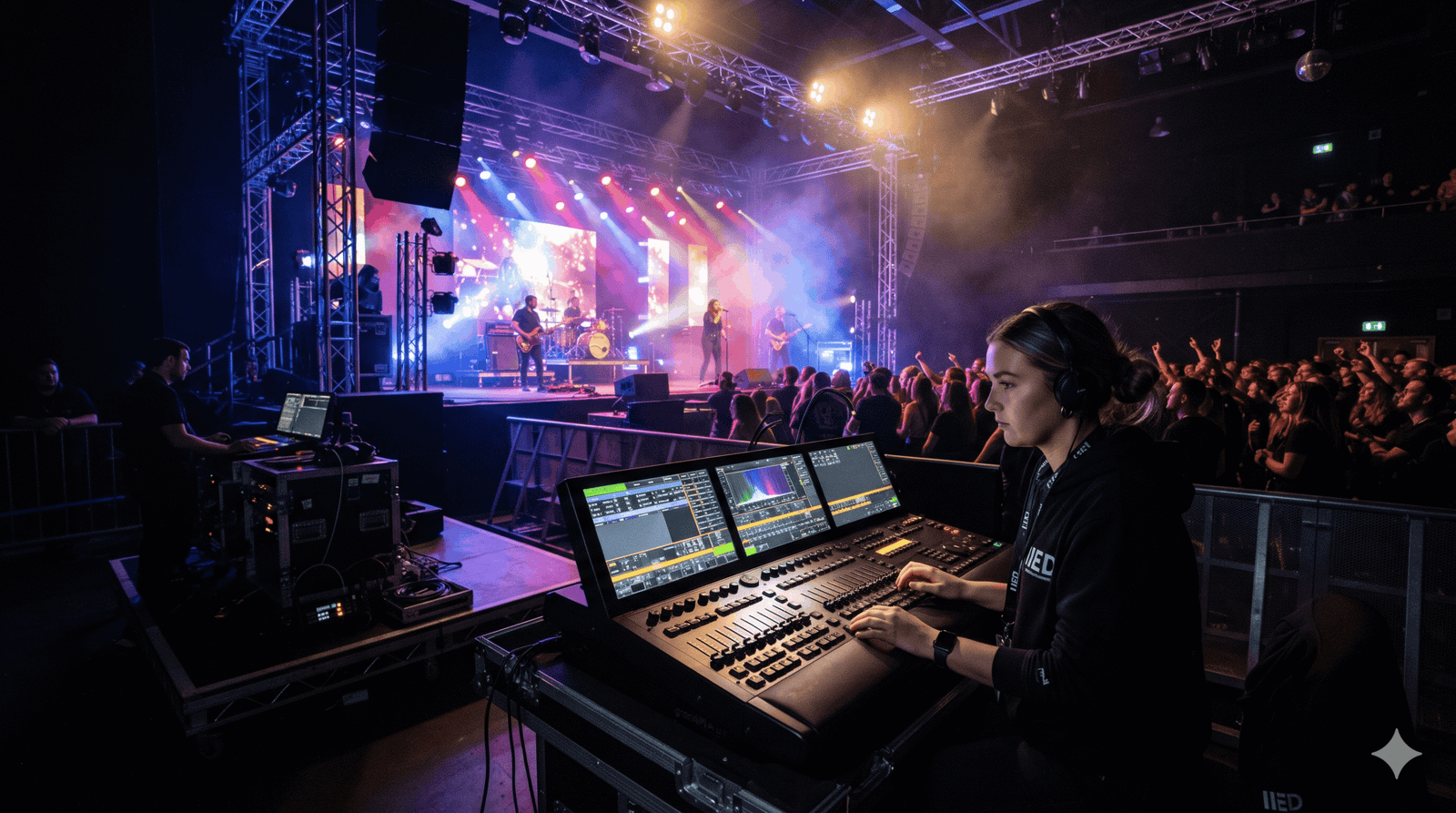
A cruise ship stage manager runs the ship’s main theatre on show nights. They call every lighting, sound, video and scenery cue, keep the cast and crew on schedule, file a report after each performance and make sure the venue is safe.
Nobody walks onto a ship in this role. Most cruise ship stage managers started lower down, pushing scenery, coiling cable and running a lighting desk, and moved up one skill at a time.
IIED COURSE
MA in Technical Production
Learn the staging, rigging, power, systems and show-running skills every rung of the cruise ladder depends on.
Duration: 2 Years (4 Semesters) · Mode: Full-time, classroom in Mumbai
This guide shows you that real ladder. You will see what the job involves, what live job ads actually ask for, what each rung pays (only where the ads say so), and the technical skills that move you from one rung to the next. You will also meet three IIED alumni who are already on the technical side of cruise entertainment. If you are a theatre or event technician in India, or you already work on a ship in another department, this is written for you.
Table of Contents
What a Cruise Ship Stage Manager Actually Does
On land, a show might run for one night and pack up. On a ship, the same theatre runs production shows, guest entertainers, game shows and changeovers, often every single night of a contract. The cruise ship stage manager is the person who holds that schedule together. When the house lights go down, they are the voice on headset that tells lighting, sound, video, fly and automation operators exactly when to go.
The duties listed in a live ad
We checked a current ad from RWS Global for MSC Cruises, for a Production Stage Manager (allcruisejobs.com, updated 16 Oct 2026). It lists the core of the job in plain terms:
- Calling cues seven nights a week. Every lighting state, sound effect, video playback and scenery move happens on the stage manager’s call.
- A daily cast and crew schedule. Rehearsals, tech checks, maintenance and changeovers all have to fit around guest shows.
- Nightly show reports. What went well, what broke, who was injured, what needs fixing before tomorrow.
- Safety inspections. The venue, the stage machinery and the backstage areas have to be checked and kept safe.
- Changeover liaison. Working with other departments when the theatre switches from one show or event to the next.
Read that list again and notice something. Almost every duty is technical. You cannot call a lighting cue well if you do not understand what the lighting desk is doing. You cannot inspect stage machinery if you do not know how it works. That is why the role is filled by people who came up through the technical side of the show.
Stage manager vs stage and production manager on a cruise ship
On larger ships, the job grows. Royal Caribbean’s ad for a Stage & Production Manager (allcruisejobs.com, updated 22 Oct 2026) describes a role that also manages all the entertainment technical disciplines in the venue. That means the stage and production manager is responsible for the lighting, sound, rigging and automation teams, not just the cue calling.
In simple terms: a stage manager runs the show. A stage and production manager runs the show and the technical department behind it. The second role needs everything the first one does, plus people management, maintenance planning and a working knowledge of every technical system on that stage. If you want to understand the land-based version of that management track, our guide to the production manager career in India covers it in detail.
What Cruise Ship Stage Manager Job Ads Ask For
The fastest way to understand any job is to read what employers ask for. Here is what the two current cruise ship stage manager ads we checked actually say. Every line comes from the ad itself, with the date it was last updated.
| Requirement | Royal Caribbean — Stage & Production Manager (updated 22 Oct 2026) | RWS Global for MSC Cruises — Production Stage Manager (updated 16 Oct 2026) |
|---|---|---|
| Experience | Minimum 5 years of show stage management (Broadway/Vegas-style or equivalent onboard) | Theatre degree or equivalent field experience |
| Education | Theatre, stage management or technical degree preferred | Theatre degree or equivalent field experience |
| Technical knowledge | Sound, lights, rigging and/or automation | Basic sound, lighting and video |
| Work pattern | Not stated in the ad summary we checked | Up to 6–8 month periods, 7 days a week; cues called 7 nights a week |
| Physical | Not stated in the ad summary we checked | Able to lift 25 kg |
| Salary | Not stated | Not stated |
“I have no theatre degree. Is this closed to me?”
No. Look at the education row. Royal Caribbean says a degree is preferred. RWS Global for MSC accepts a theatre degree or equivalent field experience. In both cases, what really counts is years of real show work and real technical knowledge.
That is the honest answer. A degree can help, but nobody in these ads is hiring a stage manager straight from a classroom. The five-year experience line in the Royal Caribbean ad tells you the truth about this role: it is earned on the job, show by show. So the real question is not “how do I become a cruise ship stage manager tomorrow?” It is “what is the first rung I can actually get, and what skills move me up?”
What the technical knowledge row is telling you
Both ads ask for technical knowledge across departments: sound, lighting, video, rigging, automation. The stage manager does not have to be the best operator in every department. But they must understand each one well enough to call it, plan around it and keep it safe. People who have worked on one or two technical rungs first have a big advantage here. They have already lived the problems the stage manager has to solve.
How to Become a Stage Manager on a Cruise Ship: The 3-Rung Ladder
Here is the route most people take. It is not fast. It is real. Each rung builds a skill the next rung depends on.
Rung 1: Cruise ship stage staff, rigger or automation technician
What you do: Stage staff move scenery, set and strike props, run fly lines and automation, check rigging, and keep the stage clean and safe. You are on deck for every show, every rehearsal and every changeover. It is physical work, and it teaches you how a theatre really runs.
What the ad asks: An ad from Excite Recruitment for an unnamed five-star cruise line (Stage Staff / Rigger / Automation Technician) asked for 1–2 years of stage equipment experience and listed pay of USD 1,600–2,300 per month onboard, on a 7 months on / 2 months off pattern (allcruisejobs.com). Please note this ad was posted on 18 Oct 2025, so it is older. Treat the figures as a guide, not a current offer.
What moves you up: Rigging awareness and safety discipline. Stage staff who understand loads, truss, hoists and safe working practice get trusted with more. Add basic lighting or sound knowledge, and you become the person the technician team calls when they need help. If you are in India and want the land-side equivalent of this rung, read our guide to a backstage technical crew career in India.
Rung 2: Lighting, sound or video technician
What you do: Technicians operate and maintain the systems that make the show. A lighting technician programs and runs the console, focuses fixtures and fixes faults. Sound and video technicians do the same for their departments. On ships, technicians often cover more than one discipline.
What the ad asks: A Faststream Recruitment ad for an unnamed premium cruise line (Entertainment Stage Staff / Lighting Technician) asked for 2+ years in live entertainment and familiarity with lighting consoles such as HOG, grandMA2/3 and ETC. It listed pay from USD 1,899 per month paid onboard, on a 7 months on / 2 months off pattern (allcruisejobs.com, published 9 Sep 2026, now expired).
What moves you up: Console skill, troubleshooting and calm under pressure. The technician who can program a show quickly, fix a fault mid-performance and explain the problem clearly to the stage manager is the one who gets considered for the next step. We cover this rung in much more detail in our guide to cruise ship lighting technician jobs.
Rung 3: Stage manager or stage and production manager
What you do: You call the show, run the venue schedule, write the reports, lead safety checks and, on bigger ships, manage the whole entertainment technical team.
What the ads ask: As the table above shows, Royal Caribbean asks for a minimum of 5 years of show stage management. Both ads ask for knowledge across sound, lighting and video, and Royal Caribbean adds rigging and automation.
What gets you there: Time on real shows, a record of reliable work, and the ability to see the whole production, not just your own department. Show calling is its own discipline: clear voice, exact timing, a well-kept prompt book and the nerve to hold a cue when something on stage is not safe.
What each rung pays (only what the ads say)
We will not guess at numbers. Here is everything the ads we checked actually state:
| Rung | Pay stated in ad | Source and date |
|---|---|---|
| Stage staff / rigger / automation | USD 1,600–2,300 per month onboard | Excite Recruitment, posted 18 Oct 2025 (older ad) |
| Entertainment stage staff / lighting technician | From USD 1,899 per month paid onboard | Faststream Recruitment, published 9 Sep 2026 (now expired) |
| Stage & production manager | Not stated | Royal Caribbean, updated 22 Oct 2026 |
| Production stage manager | Not stated | RWS Global for MSC Cruises, updated 16 Oct 2026 |
Neither stage manager ad lists a salary. Any website that gives you an exact cruise ship stage manager salary without naming a source is guessing. If pay matters to your decision (and it should), ask the recruiter directly at interview, and get the figure in writing in your contract.
Real IIED Routes Into Cruise Entertainment
None of our alumni are cruise ship stage managers yet, and we will not pretend otherwise. What they are is something more useful to you right now: proof that people from India get onto the technical rungs of this exact ladder.
Already on a ship in another department? Akash’s story
Akash already worked on AIDA Cruises’ ships, but not in entertainment. He worked in another department and wanted to move into the Entertainment (Lighting) Department. He came to IIED for GrandMA3 training. After completing it, he got the department transfer into Entertainment.
If you are already crew, this is the most practical route on this page. You already have a contract, your documents and life at sea sorted. What you are missing is the technical skill the entertainment team needs. One focused skill, like console programming, can be enough to get the conversation started with your entertainment department.
Coming from theatre or events in India? Sanket and Caje
Sanket is from Pune. He had 5–6 years of theatre lighting experience, working on big theatre shows across India. Even with all that experience, he added grandMA3 programming to his skill set at IIED, and that led to a cruise ship opportunity. His story shows that years on stage are valuable, but adding the console the job ads name can be what opens the international door.
Cajetan (Caje) D’Silva learned lighting during the COVID lockdown and trained in Lighting Design at IIED. Today he handles lighting for international cruise productions with Royal Caribbean. In his words: “I took the uncertainty of COVID-19 and turned it into an opportunity. Now I’m traveling the world and working with Royal Caribbean, the biggest cruise line in the industry, handling lighting for their massive productions.”
These are not the only international technical careers from IIED. Atharva Jog trained in Lighting Design and now works as a Lighting Operator with SLS Production in Saudi Arabia, on SAR 10,000 a month plus accommodation, a return air ticket and transport. That is a land-based role, not a cruise role, but it shows the same thing: strong technical skills travel. You can read more routes like his in our guide to international lighting jobs from India.
And one more name worth knowing. Jerry, a lighting designer and vendor from Jamaica with more than 20 years of experience, travelled to India specifically to learn grandMA3 at IIED. When a 20-year professional crosses the world for console training, it tells you how much that skill matters on international stages.
What to Learn Before You Apply for Cruise Ship Entertainment Technical Jobs
If the cruise ship stage manager role is your long-term goal, your short-term goal is the first rung you can realistically get. Here are the skills the ads point to, and how to build them.
1. A professional lighting console
The Faststream technician ad names HOG, grandMA2/3 and ETC consoles. grandMA3 is one of the most common on large stages. Being able to program, update and run a show on it makes you useful on day one. At IIED, the GrandMA3 Mastery Program is hands-on console training on the real desk, the same training Akash, Sanket and Jerry chose.
2. DMX and control basics
Every technician and every stage manager needs to understand how control signals move from desk to fixture, and what to check when something stops responding. You do not need to be a network engineer, but you must be able to find a fault fast during a show.
3. Rigging awareness and safety
Stage staff ads ask for stage equipment experience. Stage manager ads ask for rigging and automation knowledge. Both depend on a safety-first mindset: understanding loads, truss, hoists and safe working practice. Our MA in Technical Production covers staging, stage machinery, rigging and load management, with a mandatory rigging safety competence check.
4. Technical drawings and documentation
Production managers live by drawings: stage plans, rigging plots, lighting plots and changeover schedules. If you can read and produce them in AutoCAD or Vectorworks, you can talk to every department in its own language. IIED’s CAD for Events & Entertainment and Vectorworks Spotlight courses build exactly this.
5. Show-calling discipline
Calling cues is a skill you practise, not one you read about. Start now on any show you work: keep a cue sheet, watch how the stage manager calls standbys and “go”s, and volunteer to call simple cues in rehearsals. On a ship, this is the habit that marks you out as stage management material.
Who this route is right for (and who it is not)
This route suits you if: you are a theatre or event technician with a few years of show work and want an international career; you already work on a cruise ship outside entertainment and want to switch; or you are a theatre, BMM or engineering graduate who is happy to start at stage staff or technician level and work up.
This route may not suit you if: you want a management title immediately, you dislike physical work, or you are looking for a hospitality role. Cruise entertainment is technical theatre. Many “cruise career” courses in India train you for hospitality, food and beverage or guest services. That is a different department and a different career. If your goal is the theatre, train for the theatre.
IIED trains the technical side of the show: lighting, consoles, rigging awareness, production documentation and show running. That is the side of the ship this ladder lives on.
Frequently Asked Questions
What does a stage manager do on a cruise ship?
A cruise ship stage manager runs the ship’s theatre on show nights. According to a current RWS Global ad for MSC Cruises (updated 16 Oct 2026), the role calls cues seven nights a week, writes the daily cast and crew schedule, files nightly show reports, carries out safety inspections and liaises with other departments during changeovers.
How many years of experience do you need to become a cruise ship stage manager?
Royal Caribbean’s Stage & Production Manager ad (updated 22 Oct 2026) asks for a minimum of 5 years of show stage management, Broadway/Vegas-style or equivalent onboard. Most people build that experience on the technical rungs first, as stage staff or technicians.
Do you need a theatre degree to be a stage manager on a cruise ship?
Not always. Royal Caribbean says a theatre, stage management or technical degree is preferred. RWS Global for MSC Cruises accepts a theatre degree or equivalent field experience. Real show experience and technical knowledge matter most.
What is the difference between a stage manager and a stage and production manager on a ship?
A stage manager runs the show: calling cues, scheduling and reporting. A stage and production manager, a role Royal Caribbean advertises on larger ships, does that and also manages all the entertainment technical disciplines in the venue, including sound, lighting, rigging and automation.
How much do cruise ship stage staff and entertainment technicians earn?
Only going by the ads we checked: an Excite Recruitment stage staff / rigger / automation ad (posted 18 Oct 2025, older) listed USD 1,600–2,300 per month onboard. A Faststream Recruitment stage staff / lighting technician ad (published 9 Sep 2026, now expired) listed from USD 1,899 per month. The two stage manager ads we checked did not state a salary.
Can I move into the entertainment department if I already work on a cruise ship in another role?
Yes, it can happen. IIED alumnus Akash worked on AIDA Cruises in another department. After completing GrandMA3 training at IIED, he got a transfer into the Entertainment (Lighting) Department.
Which technical skills help most for cruise ship entertainment jobs: lighting, sound, rigging or automation?
All four appear in the ads. For technician roles, lighting console skills (HOG, grandMA2/3, ETC) are named directly. For stage manager roles, Royal Caribbean asks for knowledge of sound, lights, rigging and/or automation. A strong base in one discipline plus working knowledge of the others is the most useful mix.
Can Indians apply for cruise ship entertainment technical jobs, and what documents are needed?
Yes. IIED alumni from India, including Caje, Akash and Sanket, work on the technical side of cruise entertainment. Document, visa and medical requirements are set by each cruise line and listed in each job ad, so read the requirements section of the specific ad carefully and confirm with the recruiter before you apply.
Ready to Start Your Cruise Ship Stage Manager Career?
The cruise ship stage manager is the person calling the show, but every one of them started on a technical rung. If you want to build the skills that get you onto that ladder, and then up it, come and see the training for yourself.
Book your free visit — call 9892966334 or email info@weareiied.com. IIED, Shop No. 506, 5th Floor, Magic Square, Dwarkadhish Road, off Poddar Road, Malad East, Mumbai 400097.
IIED COURSE
CAD for Events & Entertainment
Stage plans, rigging plots and changeover drawings are the stage manager’s language. Learn to draft them properly.
Duration: 1 Month (36 hours) · Mode: Live online or in person in Mumbai