
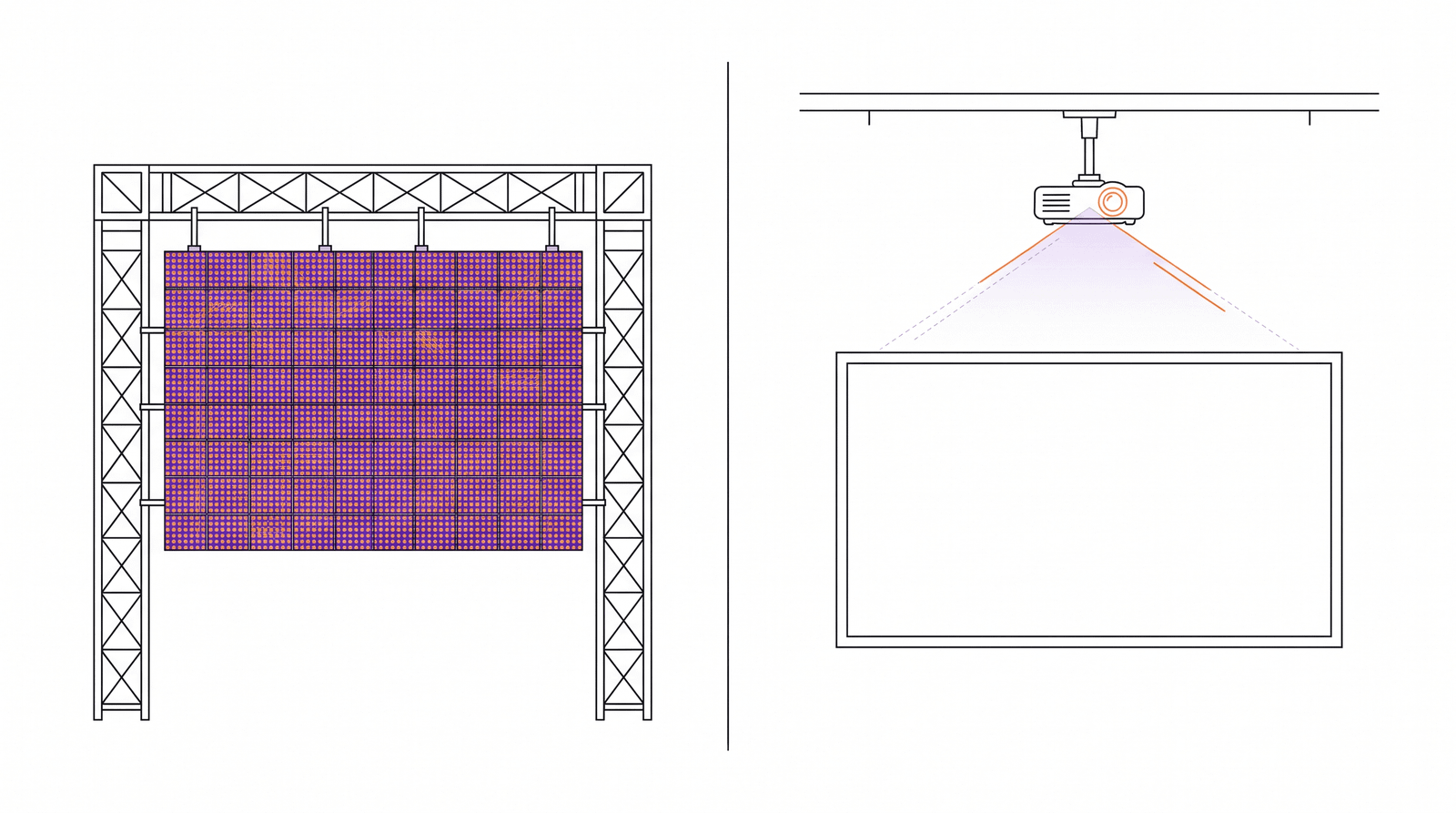
On many wedding and corporate stages, the screen is one of the biggest lines in the technical budget. Yet most event management students are never taught how that choice gets made. So the LED wall vs projector for events question lands in an interview, and the answer is a guess.
Here is the short version. An LED wall wins in bright rooms, daylight, big stages and anywhere you need a clean, punchy picture. A projector still wins in dark, controlled rooms, on odd surfaces, for mapping, and when the budget is tight. Everything else depends on five questions a production team answers on the recce, and on a scaled drawing. This guide walks you through those questions, the mistakes crews make, and the real jobs behind every screen.
Most articles on this topic come from rental vendors in the US and UK. They want to sell you a screen. That is fair, but it skips the part that matters to you as a student: who makes the call, who builds it, who runs it, and what that means as a job in India. That is the angle we take here.
Table of Contents
LED Wall vs Projector for Events: The Comparison at a Glance
Before the detail, here is how the two compare on the points a production team actually checks. Read it as a starting map, not a rulebook. Every venue changes the answer a little.
| What you check | LED wall | Projector |
|---|---|---|
| Brightness in ambient light | Strong. Holds up under stage light, decor light and daylight. | Washes out quickly when room or stage light hits the screen. |
| Black levels and contrast | Deep blacks, since pixels switch off. | Blacks are only as dark as the screen surface in that room. |
| Size and shape | Built from panels, so you can make wide, tall, curved or custom shapes. | Very large images are possible, and it can paint onto almost any surface. |
| Setup time and rigging weight | Heavy. Needs ground support or flown truss and a load check. | The projector is light. The screen frame and throw distance need planning. |
| Power and heat | Needs a planned power supply and some airflow. | Lower total power in most setups. |
| Budget and rental | Usually the costlier line item. Priced by size and pitch. | Often cheaper for a large image in a dark room. |
| Failure risk | A dead panel can be swapped. Processor failure stops the whole wall. | A single lamp or unit failure blacks out the image unless you have a backup. |
| Best for | Concerts, award nights, bright wedding stages, outdoor shows. | Dark ballrooms, conferences, projection mapping, pop-ups. |
Notice what the table does not say. It does not say one is “better.” The LED wall vs projector debate only makes sense once you know the room, the content and the money. That is why the next section matters most.
IIED COURSE
MA in Technical Production
Learn to plan, rig, power and run screens, sound and light as one show, not guesswork.
Duration: 2 years · Mode: Full-time in Mumbai
The 5 Questions Behind Every LED Wall vs Projector Decision
On a real job, nobody opens a spec sheet first. The production team walks the venue, asks the client a few sharp questions, and draws the stage to scale. These five questions decide the screen.
1. How much light will hit the screen?
This is the first and biggest question in any LED wall vs projector for events decision. Is it a daylight haldi on a lawn? A sangeet stage with heavy decor lighting? A dark ballroom for a product launch? Light from the sun, the venue and your own stage rig all fall on the screen. An LED wall makes its own light, so it holds up. A projector bounces light off a surface, so any stray light flattens the picture.
This is also where the lighting team comes in. Even with an LED wall, a good lighting designer keeps front light and spill off the screen surface. Screen and lighting decisions are made together, not one after the other.
2. How far away is the audience? (Pixel pitch)
Pixel pitch is the distance between the centres of two pixels on an LED panel, in millimetres. A smaller pitch means pixels sit closer together, so the image looks smooth from nearer. A larger pitch is cheaper but looks grainy up close.
There is no single magic formula. Manufacturers use different rules of thumb. Daktronics, one of the large LED display makers, suggests the optimal viewing distance in feet is roughly three times the pixel pitch in millimetres. Other makers use slightly different multipliers. Treat any rule as a starting point, then check the front row on your floor plan. If guests sit close and read text on the screen, go finer. If the content is mostly moving video seen from far back, a coarser pitch can work fine.
3. What does the venue allow?
This is where a recce earns its keep. Check:
- Ceiling height, so the wall or screen fits above the stage with the right clearance.
- Rigging points and load limits, if you plan to fly an LED wall. Many hotel ballrooms have limits, and some have none to hang from at all.
- Floor loading, if the wall is ground-stacked on truss towers.
- Throw distance, if you plan to project. Front projection needs a clear line from the projector to the screen. Rear projection needs space behind the screen.
- Power, and whether the venue supply is enough or a generator is needed.
4. What will play on the screen?
Live camera feed of the couple? Slides for a CEO keynote? Music visuals for a concert? Content changes the answer. Slides with small text need a fine pitch or a sharp projected image. Wide, cinematic content may need a custom aspect ratio, which panels handle well. Mapping onto a building or a sculpted set piece is projector territory. Whoever builds the content must know the exact pixel size of the canvas early. Otherwise the visuals stretch or crop on the day.
5. What is the budget, and what can you actually rent?
Budget is real, and so is availability. Many LED wall vs projector for events choices are settled here. During Diwali and peak wedding season, good LED stock in Mumbai books out fast. The LED wall rental vs projector cost gap changes with size, pitch, days on site, crew and transport. That is why we do not quote fixed rates here. Rates move with the season and the vendor. Ask two or three rental houses for a quote against the same drawing, so you compare like with like.
When an LED Wall Wins, and When a Projector Still Wins
Once you have answers to the five questions, the LED wall vs projector for events choice is usually clear. Here is how it plays out on the kinds of shows IIED students work on.
When an LED video wall is the right call
- Bright wedding stages. Indian wedding decor is often lit hard, with warm wash, pin spots and chandeliers. An LED wall behind the couple keeps the picture strong.
- Corporate stages with heavy front light. Presenters need to be lit for cameras. That light spills. LED holds up.
- Daylight and outdoor shows. Afternoon functions, lawn events and open-air concerts. Projection struggles here.
- Concert backdrops. High-contrast visuals, fast cuts, and walls that become part of the set.
- Custom shapes. Curves, columns, floor-to-ceiling strips, or a wall split around a central entry.
Demand for the LED video wall for events in India has grown with this kind of stage. That also means more work for the crews who plan and run them.
When a projector still wins
- Dark ballrooms and conference halls. If you control the light, a projector gives a large, sharp image for less.
- Odd surfaces. Projecting onto fabric, a sculpted set piece, a dome or a building facade. LED panels cannot follow those shapes.
- Projection mapping. Lining up visuals with the edges of a real object. It is a craft of its own, and very popular around Diwali.
- Big image, small budget. For a long seminar where the screen is mostly slides.
- Short-throw or rear projection where there is little room in front of the stage.
- Pop-ups and temporary installs where weight and setup time are tight.
So the honest answer to “projector or LED screen for event?” is this: match the tool to the room, the content and the budget. Then prove it on a drawing.
Common Mistakes, and Who Does What on Show Day
Mistakes that cost shows
Ignoring venue light. A projector looks great at the morning tech check in a dark hall. Then the doors open, the house lights come up, and the picture vanishes.
Wrong pixel pitch for the seating. A coarse pitch looks fine from the mixing desk and grainy from the first row of VIP tables.
No rigging load check. Flying an LED wall without confirming hang points and loads is a safety risk, not a design choice.
No plan for the processor or media server. The panels are only half the system. Someone must plan the video processor, signal routes, content playback and who operates it.
No backup. A spare processor, spare panels, a second playback machine, or a backup projector. Shows that run well usually have a plan B nobody sees.
Who does what
The LED wall vs projector call is never one person’s choice. Here is how a typical team splits the work.
| Role | What they do |
|---|---|
| Production designer | Places the screen in the stage design and draws it to scale with the set and decor. |
| Technical director or production manager | Checks loads, power, rigging, crew and schedule. Signs off what can be built safely. |
| Video and LED crew | Builds the wall, sets up the processor, runs content playback. On many jobs one person is the video wall operator for the event, cueing content live. |
| Lighting team | Keeps light off the screen and balances stage looks so the screen and the people both read well on camera. |
The thread that ties them together is the drawing. A plan and elevation in AutoCAD or Vectorworks shows the screen size, the truss, the throw line, the sightlines and the hang points. When everyone works from the same drawing, the screen decision stops being an argument and becomes a fact on paper. If you want to see how production and management split responsibility more widely, read our guide on event production vs event management.
Careers Behind the Screen: Real Roles and Real Alumni
Here is the part most LED wall vs projector for events articles leave out. Someone has to draw the screen, rig it, power it and run it. Those people get hired. And event management graduates are often well placed to move into these roles, because they already understand clients and timelines.
Roles that touch the screen decision every week include:
- Production manager
- Technical director or technical production lead
- Draftsman or technical documentation specialist
- Video and LED operator
- Rigging coordinator
Our guide to the production manager career in India breaks down how that ladder works.
What IIED alumni are doing
To be clear: none of the alumni below are on record working on LED walls specifically. We share them because they show where technical production skills lead.
Suhani Mudra finished an event management degree but felt something was missing. She took IIED’s CAD for Events & Entertainment course and now works as Draftsman and Production Manager at Potato Heads. Your degree taught you to plan. Drawings teach you to produce.
Arun Sagar took the same CAD course to build his technical skills. He now works in the Operations & Production department at NMACC, BKC, one of Mumbai’s best-known performance venues.
Rishabh Rao, an IIED Lighting Design alumnus, works in his family’s AVL rental business, one of Mumbai’s largest, and freelances with LGL Designs. In his words: “The education I received at IIED completely transformed my understanding of the science and artistry behind the equipment.”
Ritesh Khichariya and Ashish Gonamanda, both IIED Lighting Design alumni, work as Lighting Operators/Designers at Show Genesis, Mumbai, at ₹40,000 a month each.
Aditya Tawde was a freelance event manager. After studying lighting at IIED, he joined Fireflies Creative Technologies as an Assistant Lighting Programmer, at ₹25,000 a month on probation and ₹40,000 a month after.
See more stories on our Careers & Placements page.
Who this guide is for
Event management students and graduates. If an interviewer asks “what screen would you put on that stage?”, you now have a real answer. The next step is learning to show it on a drawing.
Recent graduates from any stream. If you like the idea of live shows but don’t want a pure desk job, technical production is a hands-on path where skills count more than your degree subject.
People already in AV rental, interiors or hospitality. You already know equipment, spaces or guests. Structured technical training turns that into production management.
How to start a career in event technical production
Start with drawing. A short, focused course in CAD for events gets you reading and making stage plans in weeks. If you want the full picture, from safety and rigging to power, video, LED and systems integration, IIED’s MA in Technical Production is a 2-year, full-time, hands-on programme in Mumbai. It covers sound, lighting, video, LED and show networks as one integrated production, with technical drawings in AutoCAD and Vectorworks. You can see the full curriculum on the MA in Technical Production page.
Why IIED? We are the Mumbai institute that trains event design, lighting and production together, with real industry mentors and hands-on work on professional equipment. That matters here, because the screen decision sits right where design, light and production meet.
Frequently Asked Questions
Is an LED wall better than a projector for events?
Not always. An LED wall is better in bright rooms, daylight, outdoor shows and on stages with heavy lighting, because it makes its own light and keeps strong contrast. A projector can be the smarter choice in a dark, controlled room, for projection onto unusual surfaces, or when you need a large image on a tighter budget.
When should I use a projector instead of an LED wall?
Use a projector when you control the room light, such as a dark ballroom or conference hall. Also use one for projection mapping onto buildings, sculpted sets or fabric, for pop-up installs where weight matters, and when a large screen for slides matters more than punchy brightness.
What is pixel pitch and which one do I need for an event?
Pixel pitch is the distance between pixel centres on an LED panel, in millimetres. Smaller pitch looks smoother from closer. Manufacturers use different rules of thumb linking pitch to viewing distance, so treat any rule as a starting point. Check your closest seats on the floor plan, and go finer if guests are close or reading text.
Can LED walls be used outdoors or in daylight?
Yes. LED walls are the usual choice for daylight and outdoor shows because they produce their own light. Outdoor use needs panels rated for the conditions, a weather plan, secure ground support or rigging, and a planned power supply.
How much does LED wall rental cost compared with a projector in India?
It varies widely. LED wall rental depends on size, pixel pitch, days on site, crew, transport and season. In peak wedding and Diwali season, stock is tighter. Projectors are often cheaper for a large image in a dark room. Get quotes from two or three vendors against the same drawing to compare fairly.
Who operates an LED wall at an event?
A video and LED crew builds the wall and sets up the video processor. A video wall operator runs content playback and cues during the show. The technical director or production manager signs off loads, power and safety, and the lighting team keeps light off the screen.
Do I need to learn CAD or Vectorworks to plan screen placement?
If you want to work in production, yes. Screen size, truss, throw lines, sightlines and hang points are all planned on scaled drawings in AutoCAD or Vectorworks. A drawing turns the screen decision into something the whole crew can build from.
How do I start a career in event technical production?
Start by learning to read and make technical drawings, then build hands-on knowledge of staging, rigging, power and show systems. A short CAD course is a quick first step. A full programme like IIED’s MA in Technical Production covers the complete path, with an internship and real production work.
Ready to Start Your Event Production Career?
The LED wall vs projector for events question is not a spec-sheet debate. It is a production decision made on a recce and proven on a drawing. Learn to make that call, and you become the person on the team people turn to.
Want to see how production teams plan a stage, step by step? Book your free visit to IIED, Malad.
Book your free visit — call 9892966334 or email info@weareiied.com. IIED, Shop No. 506, 5th Floor, Magic Square, Dwarkadhish Road, off Poddar Road, Malad East, Mumbai 400097.
IIED COURSE
CAD for Events & Entertainment
Draw the stage, screen, truss and sightlines to scale, so your screen choice holds up on paper.
Duration: 1 month · Mode: In-person in Mumbai