
A technical production career in India means being the person who makes an event physically work: the stage, the rigging, the power, the lights, the sound and the schedule. It suits people who like tools, drawings and problem-solving under pressure. With focused training and a small portfolio, many people land a first crew or technician role within a few months.
Every event has two teams. One team plans it. The other team makes it actually work on the day. Technical production is the second team, and almost nobody explains how to get in.
If you are thinking about a technical production career in India, you have probably seen the same thing we did: lots of pages about “event management careers,” lots of job listings, and nothing that maps the whole ladder from your first crew call to running a show. This post is that map.
Table of Contents
What Technical Production People Actually Do
Planning decides what the event should be. Technical production decides how it gets built, powered, lit, heard and run safely. If you want the full definition, read our guide on what technical production is. Here is the short version.
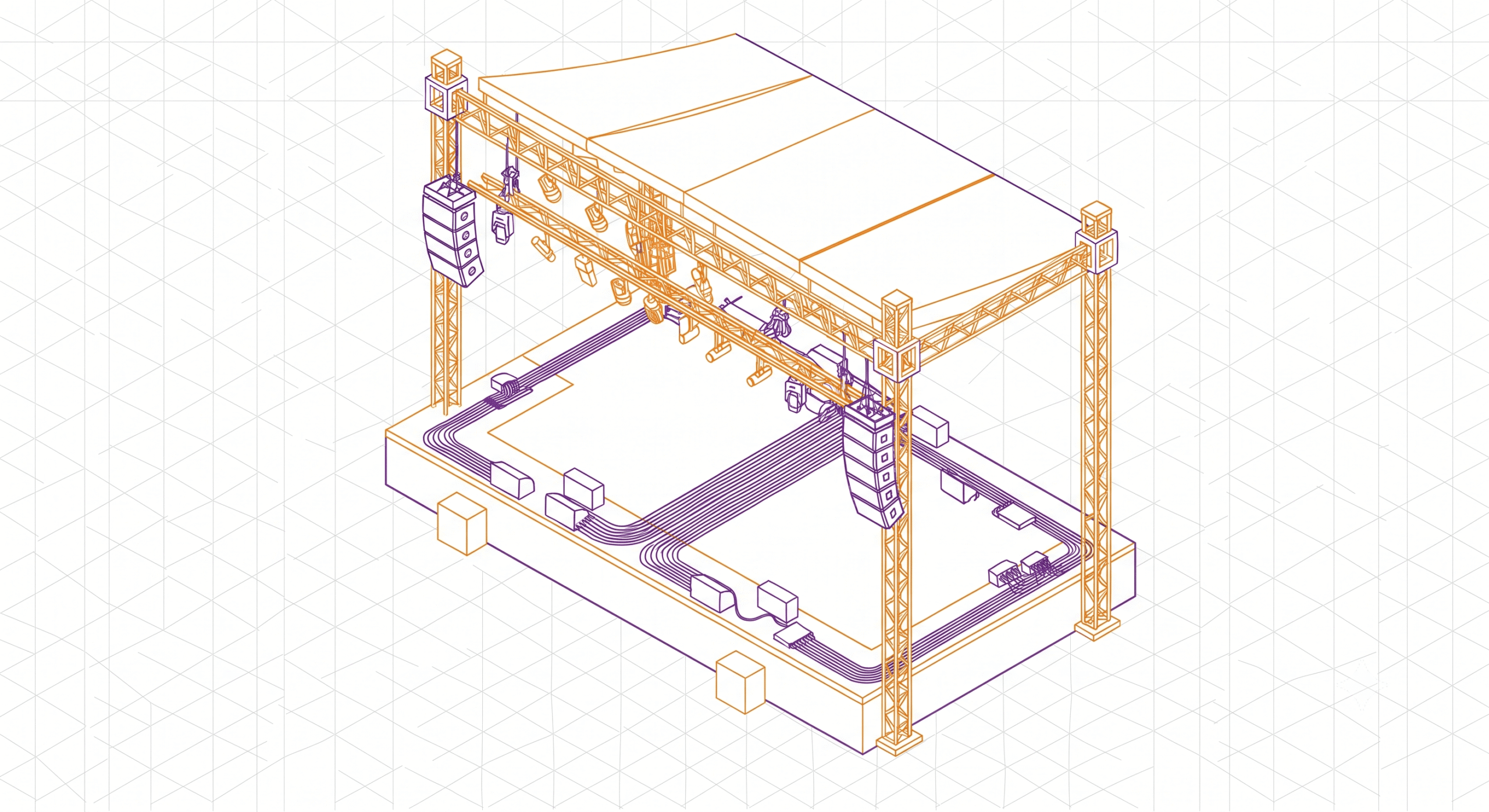
A technical production team turns a design into a working site. They read the drawings. They plan where trucks unload, where the truss goes up and how much weight each point can carry. They work out how much power the show needs and where it comes from. They schedule the build, the rehearsal, the show and the de-rig. Then they stand by the whole time in case something fails.
That last part matters. When a mic dies or a fixture goes dark in front of 2,000 guests, nobody calls the planner. They call production.
This is why a technical production career in India is different from an event management career. Event management is about clients, guests and logistics. Technical production is about systems, safety and timing. Both are real jobs. They just need different people and different skills.
Here is a simple way to check which side you lean towards. Do you enjoy the run sheet and the guest list, or do you enjoy figuring out why the generator is tripping? If it is the second one, keep reading.
[Image: Simple six-step ladder diagram, ascending blocks left to right, each block a plain icon of a tool or document (cable, truss, console, clipboard, floor plan). Labels added in page design.]
Alt text: Six-step ladder of technical production roles in events, from crew to technical director
The 6 Technical Production Roles in Events
Technical production is a ladder. Most people start on the lower rungs and climb as they prove they can be trusted with bigger systems and bigger budgets. Here are the six roles you will see most often in India.
| Role | What you do | Who it suits |
|---|---|---|
| 1. Crew / Technician | Load in, set up, run cables, assist the department heads, de-rig after the show. | Fresh starters who want to learn on site fast. |
| 2. Rigging & Staging Crew | Build stage decks and truss, hang points, check loads, work at height under supervision. | People who are calm at height and careful with safety checks. |
| 3. Lighting / Audio / Video Operator | Program and run a console or system during rehearsal and show. | Detail-focused people who like a craft they can master. |
| 4. Production Coordinator / Assistant | Track drawings, schedules, vendor calls, crew lists and paperwork. | Organised people, often from event management, who want to move technical. |
| 5. Production Manager | Own the build: budget, schedule, vendors, crew and the site. | Experienced people who can lead teams and handle pressure. |
| 6. Technical Director | Own the technical design and sign off that every system works and is safe. | Senior specialists with deep systems and safety knowledge. |
Production manager vs technical director: the two-line version
The production manager runs the build: money, time, people and vendors. The technical director runs the systems: whether the rig, power and technical design work and are safe. We break this down in detail in Technical Director vs Production Manager.
How a technical director career in India usually grows
Very few people walk straight into a technical director role. A technical director career in India usually starts on the crew or behind a console. You learn how systems fail. You learn how long things really take to build. You learn which vendors deliver. Over several years, you take on bigger shows and more responsibility until you are the person who signs off the whole technical plan.
The good news: every rung pays you to learn the next one. A technician learns rigging by doing it. An operator learns power and networking by running shows. A coordinator learns budgets and schedules by tracking them. Nothing on this ladder is wasted time.
Real people on real rungs
IIED alumni already work across this ladder. Silas Paul Uba joined LumaSonic Structures Rental in Goa in September 2025 as a Technician, Lighting (Grade B), on ₹25,000 a month plus medical insurance and accident cover. He came in from audio mixing and media production. That is a classic entry rung at a staging and rental company.
Atharv Devikumar Jog shows what the operator rung can look like. In August 2025 he joined SLS Production Equipment L.L.C in Saudi Arabia as a Lighting Operator, on SAR 10,000 a month plus company accommodation, a return air ticket and transportation. He was already working in lighting but lacked a technical foundation. Training in the technical detail of light changed that.
The Technical Production Skills Behind Those Roles
Here is the honest truth about technical production skills: you do not need all of them on day one. You need the right ones for your first rung, then you add the rest as you climb. These are the five skill groups that matter most.
1. Drawings and documentation (CAD, Vectorworks)
Every build starts on paper. Ground plans, rigging plots, stage elevations and cable routes all live in CAD drawings. If you can read them, you are useful on site. If you can draw them, you are useful in the office too. AutoCAD and Vectorworks Spotlight are the two tools you will meet most often in Indian production companies.
Needed first by: production coordinators, and anyone who wants to move off the floor and into planning. Operators and riggers need to read drawings early.
2. Power and safety
Power is the part of production nobody notices until it goes wrong. You need to understand load, distribution, earthing and safe cable practice. Safety goes beyond power: working at height, PPE, crowd areas, fire exits and risk checks. Industry bodies such as ESTA’s Technical Standards Program publish standards for rigging, electrical power and event safety, and serious production teams work to standards like these.
Needed first by: everyone. Even a day-one crew member must follow safe practice. Production managers and technical directors are responsible for it.
3. Rigging basics
Rigging is how weight gets into the air safely: truss, motors, shackles, slings and load calculations. On Indian sites you will see a lot of ground-supported truss and hung points in venues. You start by learning the hardware and the checks. Load planning comes later, with experience and supervision.
Needed first by: rigging and staging crew. Production managers and technical directors must understand it well enough to question a plan.
4. Lighting and console basics
Lighting is one of the most visible technical departments. You need to understand fixtures, DMX, patching and how a console like GrandMA3 stores and plays back a show. GrandMA3 operators are still rare in India, and demand far exceeds supply. The same logic applies to audio and video systems: learn one properly before spreading across all three.
Needed first by: lighting operators and technicians. Coordinators and managers need enough to talk to the operators clearly.
5. Scheduling and vendor handling
A show is a timeline. Trucks, crews, rehearsals and changeovers all have to fit. You need to build a production schedule, track vendors, confirm deliveries and keep everyone informed. This is the skill that most often moves people from coordinator to production manager.
Needed first by: production coordinators and assistants. Production managers live in it.
Skill priority at a glance
| Role | Learn first | Learn next |
|---|---|---|
| Crew / Technician | Safety, cable practice | Reading drawings, rigging hardware |
| Rigging & Staging Crew | Rigging basics, working at height | Load planning, CAD reading |
| Operator | Console or system basics | Power, networking, drawings |
| Production Coordinator | CAD / Vectorworks, scheduling | Power and safety, vendor handling |
| Production Manager | Scheduling, budgets, safety | Deeper systems knowledge |
| Technical Director | All five, in depth | Specialist systems and standards |
Which Starting Route Fits You
There is no single way into a technical production career in India. Your best starting rung depends on where you are coming from. Here is one honest line for each type of student we meet.
| You are… | Best first move | Honest note |
|---|---|---|
| An event management graduate | Learn CAD and aim for a production coordinator role. | You already know how events run. What you lack is the technical language and drawings. |
| An engineering or diploma graduate | Learn rigging, power and drawings, then join crew or a rental company. | Your maths and electrical basics are a real head start, but site experience still matters most. |
| A working professional switching in | Pick one technical skill you can learn part-time and build a small portfolio. | Your existing work habits help. Expect to start a rung or two lower than your current title. |
| Returning after a career break | Start with drawings and documentation, which you can practise from home. | Documentation work is a practical way back in before you return to long site hours. |
If you studied event management and feel stuck
This is the student we meet most often. You finished an event management degree. You know planning. But every production job asks for technical skills you were never taught. That gap is real, and it is fixable.
Look at Aron Sagar. He took IIED’s CAD for Events & Entertainment course to upskill technically, and he is now in the Operations & Production department at NMACC (Nita Mukesh Ambani Cultural Centre), BKC, Mumbai. That is a technical drawing course leading straight into a production team at one of Mumbai’s best-known venues. Read more about CAD for events and entertainment.
If you are coming from design
Design and production overlap more than most people think. Pranay Mhatre trained in Event & Wedding Design Visualization at IIED and now works as a Production Designer at WIZCRAFT International, India’s oldest event company. Designers who understand how things get built are valuable on both sides of the line.
If you are coming from audio or media
Silas Paul Uba is the proof here. He started in audio mixing and media production, trained in lighting at IIED, and moved into a lighting technician role in Goa. Your existing production habits are an asset, not a reset.
Your First 90 Days: How to Become a Technical Producer in India
If you want to know how to become a technical producer in India, here is a practical plan. It will not make you a production manager in three months. Nobody can promise that. It will get you from “interested” to “ready to be hired on a first rung.”
- Days 1–15: Shadow a build. Ask a local rental company, venue or production firm if you can watch a load-in and de-rig. Turn up early, stay late, carry things. Write down every piece of equipment you do not recognise and look it up that night.
- Days 1–30: Learn drawing basics. Start with AutoCAD or Vectorworks. Learn to draw a simple ground plan for a ballroom setup: stage, truss, FOH position and seating. Keep it clean and to scale.
- Days 15–45: Learn power and safety. Understand load, distribution and safe cabling. Learn the basics of working at height and PPE. This is what makes a site lead trust you.
- Days 30–60: Pick one specialism to start. Lighting, audio, video or rigging. Learn the basics properly. If it is lighting, get hands-on time on a professional console.
- Days 45–75: Build a small documentation portfolio. Three to five pieces are enough: a ground plan, a rigging or lighting plot, a cable schedule and a simple production schedule. Real or practice projects both count if you label them honestly.
- Days 75–90: Apply to rental and production firms. Send your portfolio to rental companies, staging firms, venues and production houses. Offer to start on crew. Follow up after every show you see them work.
How long until the first job? It depends on your starting skill and your portfolio. Someone with an engineering background and a clean CAD portfolio may move in weeks. Someone starting from zero may need a few months of training and site time. Both are normal.
Why a structured course speeds this up
You can do all of this alone, but it is slower. A structured course gives you a mentor who checks your drawings, professional equipment to practise on, and a route into real internships. For example, IIED’s Vectorworks Spotlight course is 48 hours and includes a 100% three-month non-paid internship. That internship is often the bridge between “trained” and “hired.”
Where the Jobs Are in India
A technical production career in India is not limited to one kind of event. These are the five areas where most technical production jobs sit.
Live entertainment and concerts
Concerts, festivals and touring shows need large crews, heavy rigging and strong lighting and audio teams. The hours are long and the learning is fast. This is where many operators and riggers build their skills.
Corporate events
Conferences, product launches and award nights run on tight schedules and high expectations. They need clean video, reliable audio and precise stage management. Coordinators and production managers find steady work here.
Weddings and exhibitions
India’s wedding industry is worth ₹3.75 lakh crore and still growing. Big weddings now use stage builds, truss, lighting rigs and LED walls that would look familiar at a concert. Exhibitions need booth builds, power planning and drawings for every stall.
Rental and staging companies
Rental and staging firms own the equipment and supply the crews. They are often the best first employer for a technician, because you touch every kind of gear. Silas’s role at LumaSonic Structures Rental in Goa is a good example.
Venues
Cultural centres, auditoriums and hotels run in-house production teams. These roles give you steadier hours and deep knowledge of one building. Aron’s role in Operations & Production at NMACC shows the kind of opening a venue can offer.
International scope
Technical skills travel. Atharv’s operator role in Saudi Arabia shows that trained technicians from India are hired abroad. Lighting, rigging and console skills work the same way in Mumbai as in Riyadh.
How IIED Trains This
IIED is the only institute in Mumbai that trains Event Design, Lighting and Production together. That matters for technical production, because the job sits right where those three meet. Our training is hands-on, on professional equipment (AutoCAD, Vectorworks, GrandMA3), with real industry mentors, not just academics.
Short courses to get on the ladder
- CAD for Events & Entertainment (1 month): technical drawing for events. The course behind Aron Sagar’s move into production at NMACC.
- Vectorworks Spotlight (1 month, 48 hours): production and lighting drawings, with a 100% three-month non-paid internship.
The MA in Technical Production
For students who want the full technical production career path, IIED runs its own 2-year, full-time, hands-on master’s degree programme: the MA in Technical Production. Any graduate can apply, from any discipline. Batches are small, and Semester 2 includes a supervised industry internship.
Year 1 covers the skills on the ladder above:
- Health, safety, risk and compliance
- Staging, stage machinery, rigging and load management
- Power and on-site energy
- Production planning, logistics and site management
- Audio, lighting, video and systems integration
- Structures, rigging and documentation lab, plus an integrated production documentation studio
- Electives in live entertainment and concerts, or corporate, weddings and exhibitions, among others
The MA is a new programme, so it does not have graduates yet. The alumni stories in this post come from IIED’s lighting, design and CAD courses. Fees and full details are on the course page.
What does a technical production professional do at an event?
They make the event physically work. That means reading drawings, building the stage and truss, planning power, running lighting, sound and video, and keeping the site safe. They schedule the load-in, rehearsal, show and de-rig, and they stay on standby to fix anything that fails during the event.
Do I need an engineering degree to start a technical production career in India?
No. An engineering or diploma background helps with power and load maths, but it is not required. Many people start with crew work, a CAD course or a lighting course, then learn on site. What hiring managers want most is safe practice, reliable attendance and proof that you can read and make drawings.
What is the difference between a production manager and a technical director?
The production manager runs the build: budget, schedule, vendors, crew and site. The technical director runs the systems: the technical design, rigging, power and equipment, and signs off that they work and are safe. On smaller events one person may do both. On large shows they are separate roles.
Which skills should I learn first: CAD, Vectorworks, lighting consoles or rigging?
Start with drawings, because every role reads them. AutoCAD or Vectorworks gives you a skill you can show in a portfolio. Then pick one specialism based on the role you want: a lighting console if you want to operate, rigging if you want staging work. Learn power and safety alongside both.
Can an event management graduate move into technical production?
Yes. Event management graduates already understand how events run. The gap is technical language and drawings. A short CAD course plus some site experience can move you into a production coordinator role. IIED alumnus Aron Sagar took the CAD for Events & Entertainment course and joined the Operations & Production team at NMACC.
How long does it take to get a first technical production job?
It depends on your starting skill and your portfolio. With a technical background and clean drawings, some people move into crew or coordinator roles within weeks. Starting from zero, expect a few months of focused training and site time. A structured course with an internship usually shortens the gap.
What kind of companies hire technical production staff in India?
Lighting and AV rental companies, staging and structures firms, production houses, event companies, venues and cultural centres, hotels, and exhibition builders. Concert and festival teams hire large crews. Trained technicians are also hired abroad, as an IIED alumnus placed as a lighting operator in Saudi Arabia shows.
Ready to Start Your Technical Production Career?
You do not need to know everything to start. You need the right first skill, a small portfolio and someone who will show you how real builds work. Come and see our equipment, look at student drawings and talk to us about which rung fits you.
Book your free visit — call 9892966334 or email info@weareiied.com. IIED, Shop No. 506, 5th Floor, Magic Square, Dwarkadish Road, off Poddar Road, Malad East, Mumbai 400097.