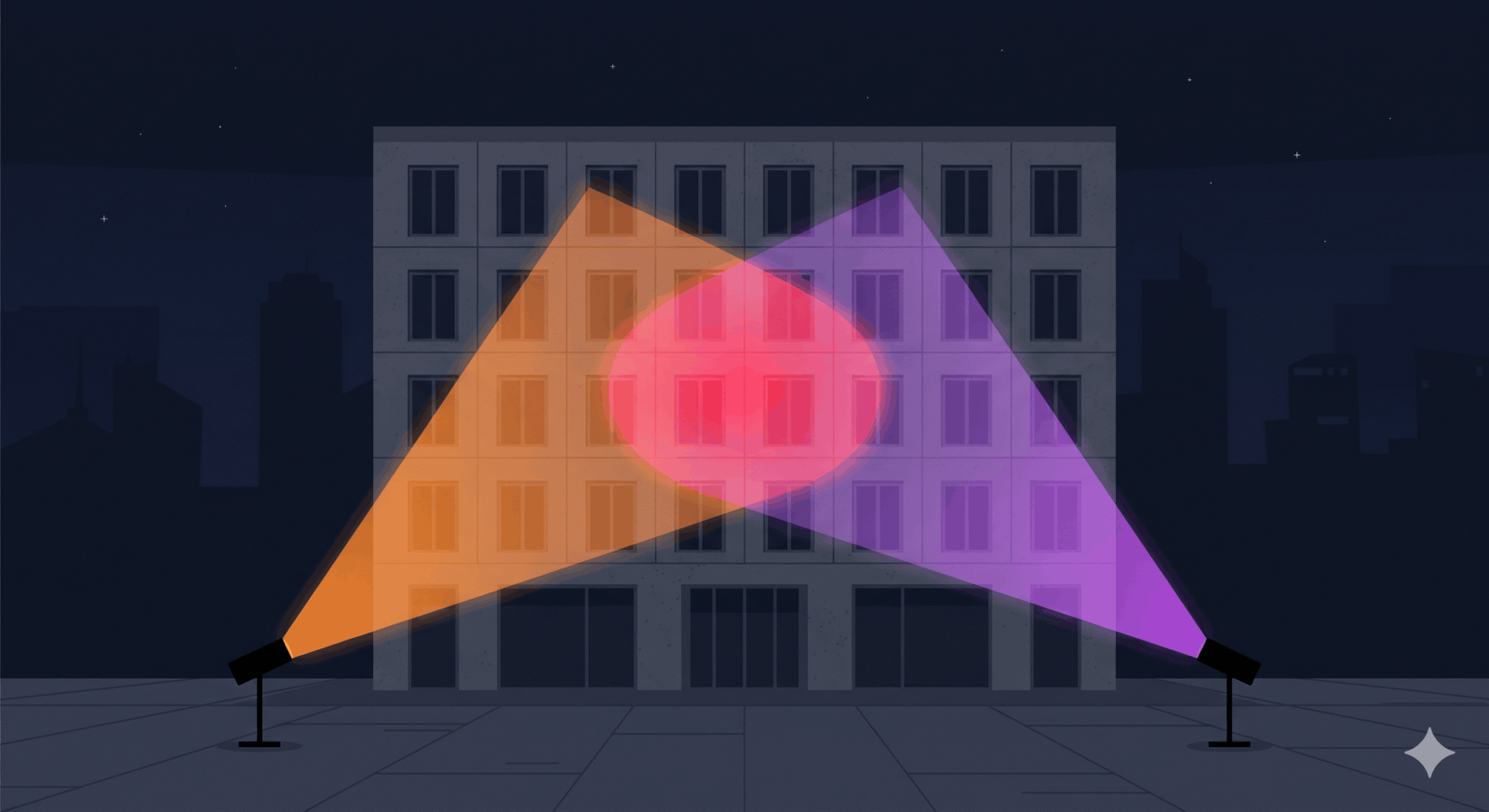
Every Diwali, a building somewhere in India turns into a moving canvas. Patterns crawl up the columns, light pours out of the windows, and for ten minutes a plain facade looks alive. Someone designed that content. Someone placed the projectors and lined up the image to the last brick. And someone ran it live, on cue, in front of a crowd. If you have watched one of these shows and wondered whether a projection mapping artist career in India is a real job, this guide is for you.
The short answer is yes. But it is not one job. It is three: the content artist, the projection technician who aligns and blends the image, and the show operator who runs it live. Most newcomers picture only the first. The hiring often happens in the other two, and that is where hands-on technical skill matters most.
IIED COURSE
MA in Technical Production
Projection is one system in a live show. Learn to plan, power, rig and run the whole production.
Duration: 2 Years (4 Semesters) · Mode: Full time, classroom in Mumbai
In this guide you will see what each role does day to day, where the work comes from, the skills each role needs, the venue-side skills most beginners skip, and how to start with no experience. We will also be honest about pay, and about what IIED does and does not teach.
Table of Contents
What a Projection Mapping Artist Career in India Really Involves
Projection mapping is the craft of shaping video so it fits a real, three-dimensional surface instead of a flat screen. The surface can be a building facade, a stage set, a wedding mandap backdrop, a car at a brand launch or a sculpture in a museum.
Because the image is mapped to every edge and corner of the object, it can make the surface appear to move, fold, crack or glow. The effect only works if the content, the projectors and the live playback are all exact. That is why the work splits into three jobs, and why a projection mapping artist career in India can start from any one of them.
| Role | What they do | Who it suits |
|---|---|---|
| Content artist | Creates the video that will be projected | People from animation, motion graphics, VFX or video editing |
| Projection technician | Makes the image land on the surface | People who like equipment, cables and problem-solving on site |
| Show operator | Runs the show live | People who like equipment, cables and problem-solving on site |
Role 1: The content artist
The content artist creates the video that will be projected. They start with a 3D model or a precise drawing of the surface, then build animation that fits it. A window ledge becomes a shelf for a falling ball. A column becomes a waterfall. Day to day, this person works in 3D and motion software, renders long sequences, and revises content after test projections on site.
This is the role most people imagine when they think of a projection mapping artist. It suits people from animation, motion graphics, VFX or video editing. It is also the most crowded entry point, because many design graduates already have some of these skills. Standing out takes more than good animation. It takes content that reads well on a real surface, from a real distance.
Role 2: The projection technician
The projection technician makes the image land on the surface. They decide where each projector goes, which lens it needs, and how far it must sit from the surface. When one projector is not wide or bright enough, they use two or more and overlap them. Then they warp each image to match the surface geometry and blend the overlap so no seam shows.
Blending is precise work. The WATCHOUT edge blending guide from Dataton, written for one of the media servers used on large shows, explains that overlapping projectors create a bright band unless each output fades across the overlap. It also says to finish physical alignment and geometry correction before blending, and to let projectors warm up before you calibrate. On site, this means long nights of focusing, aligning, checking test patterns and matching colour between projectors.
Role 3: The show operator
The show operator runs the show live. They load the media on the server, build the cue list, and trigger every moment at the right time. On bigger shows, video is locked to music and lighting through timecode, so one clock drives everything. The operator watches that clock, handles a frozen frame or a dropped signal, and keeps the show running when something goes wrong.
In India, this person is often called a media server operator or video operator. On smaller jobs the technician and the operator are the same person. It is a crew role with real responsibility, and it is one of the most common ways people get paid on projection shows early in their career.
Projection Mapping Jobs in India: Where the Work Comes From
Projection work in India follows the event calendar. Demand peaks around festivals, the wedding season and the brand launch cycle. Here is where most projection mapping jobs in India come from:
- Festival and facade shows. Diwali and other festival seasons bring building projections at malls, housing societies, heritage sites and public celebrations.
- Brand launches and corporate events. Car reveals, product launches and award nights use mapping on stages, set pieces and the products themselves.
- Concerts and live shows. Projection sits alongside LED walls, lighting and lasers on concert and festival stages.
- Weddings. Large Indian weddings use mapping on mandap structures, entrance walls, ceilings and decor elements.
- Museums, exhibitions and installations. Permanent and semi-permanent pieces in exhibitions, experience centres and public spaces.
Many shows now mix projection with LED walls. Choosing between them depends on the venue, the ambient light, the budget and the crew available. Our guide on LED wall vs projector for events breaks down how production teams decide, and who runs each system.
Who hires? Mostly AV rental companies, production houses, event agencies and specialist content studios. Content studios hire artists. Rental companies and production houses hire technicians and operators, and they tend to hire people they have already seen work well on a site. That is an important point for anyone planning a projection mapping artist career in India: your first booking often comes from a crew you have already worked with.
What does a projection mapping artist earn in India?
We will not invent a number. We have not found reliable, published pay data specific to projection mapping roles in India, and job ads vary widely by city, company and show size. Freelance artists are often paid per project, and crew are often paid per show day. Anyone quoting you one fixed salary for this field is guessing.
What we can share is verified pay for nearby live-show technical roles, taken from IIED alumni offers. Ritesh Khichariya and Ashish Gonamanda joined Show Genesis in Mumbai as lighting operator/designers at ₹40,000 a month each after IIED’s lighting design training. Ashish started as a fresher with no background in lighting. Tushar, who worked as a lightman on film crews, moved up to a lighting operator role at Pluto Disco Light at ₹30,000 a month in hand after GrandMA3 training.
These are lighting roles, not projection roles. But they show what technical crew who can run a show from a console earn at entry level in India, and projection technicians and operators sit in the same crew, on the same shows.
Skills You Need for a 3D Projection Mapping Career
A 3D projection mapping career needs different skills depending on which of the three roles you aim for. Here is an honest breakdown, role by role, followed by the venue-side skills that apply to everyone.
| Role | Key skills | Who hires |
|---|---|---|
| Content artist | 3D modelling, animation and motion graphics | Content studios |
| Projection technician | Projector throw and lens maths, warping, edge blending and colour matching | Rental companies and production houses |
| Show operator | Cue lists, timecode and calm problem-solving | Rental companies and production houses |
Content artist skills
- 3D modelling and animation: Blender, Cinema 4D or Maya, to model the surface and build animation that fits it.
- Motion graphics and compositing: After Effects or similar tools for 2D animation, type and effects.
- Real-time tools: TouchDesigner, Notch or Unreal Engine for interactive or live-generated content.
- Render discipline: very large canvas sizes, correct frame rates and file formats the media server can play smoothly.
Most of these skills can be self-taught to a starting level. What separates working artists is understanding how their content will look on a real surface, at a real distance, with real ambient light around it.
Projection technician skills
- Projector throw and lens maths: working out distance, image size and the lens needed.
- Brightness and contrast: matching projector output to the surface size and the ambient light.
- Warping, edge blending and colour matching across multiple projectors.
- Signal flow and networking: cables, video formats, converters and show networks.
- Mapping and playback software: MadMapper, Resolume Arena, WATCHOUT, disguise and similar tools.
Video mapping artist in India: show operator skills
- Cue lists and show files: building and running a clean, well-labelled cue structure.
- Timecode and show control: locking video to audio and lighting so every department hits the same frame.
- Calm under pressure: fixing problems live without stopping the show.
- Communication: working on comms with the show caller, the lighting operator and the audio engineer.
The Venue-Side Skills Most Beginners Skip
This is the layer that decides who gets booked again. Before a single frame is projected, someone has to answer site questions. Where can the projectors go? Is there a safe position at the right distance? Does that position need a tower, a scaffold or a truss? Where does the power come from, and is there enough of it? Will the audience walk into a beam? Will a passing vehicle block the throw?
The answers live in drawings. A projector placement plan shows each projector’s position, height, throw distance and beam on a scaled site plan. Production teams draw these in AutoCAD and Vectorworks Spotlight. A crew member who can read and produce that plan is useful from day one.
Rigging and safety follow from the plan. Projectors on a truss or tower must be rigged and secured properly. Cables must be run safely. Power must be distributed without overloading a circuit. These are technical production skills, not design skills, and they are learned hands-on, with real equipment.
IIED alumni show how much this drawing layer matters. Arun Sagar took IIED’s CAD for Events & Entertainment course to upskill technically and was placed in the Operations & Production department at NMACC (Nita Mukesh Ambani Cultural Centre), BKC. IIED’s Vectorworks Spotlight course runs 48 hours over one month, covers rigging, truss and AV equipment placement, and includes a 3-month non-paid internship for students who complete it. To see what that training looks like in practice, read our breakdown of the 48-hour Vectorworks hands-on workshop.
Media Server Operator in India: How Lighting and Projection Work Together
On a real show, projection never runs alone. Lighting can wash out a projected image in seconds if it hits the same surface. So the lighting designer and the projection team agree which surfaces are for light and which are for video, and they plan cue timing together during programming.
On music-driven shows, the media server, the lighting console and the audio playback often follow the same timecode. When the beat drops, the facade changes and the lights hit on the same frame. A media server operator in India who understands lighting consoles and timecode is far more useful than one who only knows playback. For a closer look at how this works, read our guide on lighting synchronization with audio.
This is also why lighting crew can move across into projection work. Jude Pereira, an IIED lighting design alumnus, works as an Event Designer and Lighting Technician at Disneyland Hong Kong, handling lighting for live shows. Large live shows combine light, video and effects, and the technical crew who run them need to understand how all three fit together.
How to Become a Projection Mapping Artist With No Experience
You do not need to wait for a big break. Here is how to become a projection mapping artist step by step, starting from zero. The order matters less than the habit: learn, build, show up, repeat.
Step 1: Pick your entry role
Decide whether you are aiming for content, technician or operator work first. If you already edit video or animate, content is your natural door. If you like equipment, cables and problem-solving on site, aim for technician or operator roles. You can move across later. Many people do.
Step 2: Learn one tool properly
Do not try to learn six programmes at once. Pick one mapping or playback tool and learn it until you can set up a basic mapped surface from scratch. Several of these tools offer free trials or learning versions. The goal is a working result on a real surface, not a long list of software on your CV.
Step 3: Build a small, real portfolio
Project onto something real. A stack of cardboard boxes, a plain wall, a set of white cubes. Film the result properly, from where an audience would stand. Then document how you did it: the surface measurements, the projector position, the distance and how you aligned the image. Hiring teams want to see your process, not just a final clip.
What to include:
- 3 to 5 short clips of mapped surfaces, filmed in real conditions
- A simple placement drawing for at least one project
- A short breakdown of your workflow and tools
- Any live show you worked on, with your exact role stated honestly
Step 4: Get on a crew
Shadow a crew. Approach AV rental companies and production houses during festival and wedding season, when they need extra hands. Offer to help with load-in, cabling and setup. Crew who show up on time, learn fast and stay until the get-out get called back. That is how most technicians and operators enter this field in India.
Step 5: Add the technical layer
Once you have done a few shows, fill the gaps. Learn to read and make site drawings. Learn basic power and rigging safety. Learn how a lighting console and timecode work. This is what moves you from the helper on the crew to the person who plans the projector positions. It is also the stage where a projection mapping artist career in India starts to pay more steadily, because you can take on more of the show.
Who This Career Suits
A projection mapping artist career in India is open to people from very different starting points. These four groups usually find the fastest way in.
Event management graduates. You have seen these shows from the client side. You know timelines, vendors and venues. What you may be missing is the technical layer: drawings, power, rigging and systems. Adding it turns you from the person who books the projection vendor into the person who can plan the setup.
Recent graduates who are unsure what to do next. If you love visuals and live events but do not want a desk job, this field rewards people who learn by doing. Ashish Gonamanda had no lighting background when he joined IIED and went on to a ₹40,000-a-month role at Show Genesis. His field is lighting, not projection, but the path is the same: learn the craft hands-on, build proof and get on real shows.
Video editors, VFX artists and motion designers. Your existing skills are an asset for content work. To get booked for live shows, add what screen work does not teach: surfaces, distances, ambient light and playback on a live server. Silas Paul Uba, an IIED lighting alumnus, moved from audio mixing into a lighting role at LumaSonic in Goa, which shows how skills from one production discipline carry into another.
Event and AV crew. If you already carry projectors and run cables, you are closer than you think. Learning the playback software and the drawing side can move you up, the same way Tushar moved from film lightman to console operator.
Where IIED Fits, and Where It Does Not
Let us be clear. IIED does not currently teach projection mapping software or projection content creation. We will not pretend otherwise.
What IIED does teach are the skills that surround and support projection work on a live show. The MA in Technical Production is IIED’s own 2-year, full-time, hands-on programme in Mumbai. It covers staging, rigging, power, health and safety, and audio, lighting, video and systems integration, including media servers and show networks, plus technical drawings in AutoCAD and Vectorworks. The Vectorworks Spotlight and CAD for Events & Entertainment short courses teach the drawing side: site plans, rigging plots and equipment placement. For lighting, the MA in Lighting Design and the GrandMA3 Mastery Program cover consoles, cueing and show control.
If you want to work on projection shows as a technician, operator or production lead, these are the foundations hiring teams look for. If you want to be a pure content artist, learn your 3D and motion tools first, and add the venue-side understanding as you go.
Frequently Asked Questions
What does a projection mapping artist do?
A projection mapping artist creates and fits video to real 3D surfaces such as building facades, stages and sets, so the surface appears to move or change. On live shows the work splits into three roles: the content artist, the projection technician who aligns and blends the projectors, and the show operator who runs playback live.
Is projection mapping a good career in India?
A projection mapping artist career in India can be a good choice if you build both creative and technical skills. Demand comes from festival facade shows, brand launches, concerts, weddings and exhibitions, and peaks in festival and wedding season. Technicians and operators who understand drawings, power, rigging and show control are usually the ones who keep getting booked.
What skills do you need for projection mapping?
Content artists need 3D modelling, animation and motion graphics. Projection technicians need projector throw and lens maths, warping, edge blending and colour matching. Show operators need cue lists, timecode and calm problem-solving. All three benefit from reading site drawings and understanding power and rigging safety.
What is the difference between a projection mapping artist and a lighting designer?
A lighting designer shapes a show with light fixtures, colour, intensity and movement, programmed on a lighting console. A projection mapping artist shapes it with video fitted to a surface and played from a media server. On big shows they work together, agreeing which surfaces get light and which get video, and syncing their cues.
Do you need a degree to become a projection mapping artist?
No specific degree is required to start. Hiring teams look at your portfolio and your work on real sites. A structured programme helps if you want a strong technical base in production, drawings, power and safety, but many people start with one tool, a small portfolio and crew work.
Which software is used for projection mapping?
Common tools include Blender, Cinema 4D and After Effects for content; TouchDesigner, Notch and Unreal Engine for real-time content; and MadMapper, Resolume Arena, WATCHOUT and disguise for mapping and playback. Production teams also use AutoCAD and Vectorworks to draw projector placement plans.
Can an event or lighting technician move into projection mapping?
Yes. Lighting and AV crew already understand rigging, power, signal flow and live cueing. Learning a playback tool and the basics of warping and blending is often the main gap. Operators who understand both lighting and video are especially useful on shows that combine them.
How do I start a projection mapping portfolio?
Project onto something real, such as stacked boxes or a plain wall, and film it from where the audience would stand. Include three to five short clips, a simple placement drawing and a breakdown of your workflow. If you have worked on a live show, state your exact role honestly.
Ready to Start Your Projection Mapping Career?
A projection mapping artist career in India is real, and the work returns every festival and wedding season. But the people who keep getting booked are not only good with content. They understand the venue, the drawings, the power, the rigging, and how video works with light and sound on show night.
If that technical side is what you want to build, come and see it in person. Book your free visit to IIED in Malad East, Mumbai, and see the hands-on lighting and production labs for yourself.
Book your free visit — call 9892966334 or email info@weareiied.com. IIED, Shop No. 506, 5th Floor, Magic Square, Dwarkadhish Road, off Poddar Road, Malad East, Mumbai 400097.
IIED COURSE
Vectorworks Spotlight
Draw the projector placement plans, rigging plots and site layouts that every projection show starts with.
Duration: 1 Month (48 hours: 24 live training + 24 self-paced practice) · Mode: In person, classroom in Mumbai (Malad)