Table of Contents
Rigging and Trussing Safety Training: What the Hands-On Safety Module in a Lighting Design Course Actually Covers
Short answer: yes. A good lighting design course teaches rigging and trussing safety alongside consoles and software. At IIED, the MA in Lighting Design includes a full safety module covering loading, rigging, weight, smoke, haze and pyrotechnics awareness, manpower management, and electrical safety.
Most lighting content sells you the console. Nobody tells you what a rental crew checks first. It is the truss, the load and the power. Not your programming. This guide explains rigging and trussing safety training in India for lighting students: what you learn, why employers care, and what parents should know.
1. Why Safety Is the First Thing a Lighting Crew Is Judged On
Think about a live show from the ceiling down. Fixtures hang from truss. Truss hangs from points that carry a load. Cables run from a power source through dimmers to every light. Someone below is walking, working or performing. Every link in that chain has a weight, a limit and a person responsible for it.
That is why crews check the rig before they check the cues. A beautiful lighting design means nothing if a fixture falls or a circuit trips mid-show. Rental companies and production houses know this. They hand expensive gear and live audiences to people who understand loads, height and power.
So safety is not a boring add-on. It is a hireable skill. A technician who can read a load, spot a bad connection and manage a crew calmly gets trusted with bigger jobs. A technician who only knows the console stays at the back of the room.
Working at height also carries real risk, and regulators treat it seriously. The US safety regulator OSHA publishes fall protection guidance because falls from height are a well-known workplace hazard. Live events are not exempt from that reality. Good training takes it seriously from day one.
If you want the career side of this trade, read our rigging and trussing career guide. This post covers the training side: what you actually learn.
2. What the Safety Module Covers at IIED: 7 Skills
IIED’s MA in Lighting Design includes a section called Safety in the Workplace. It covers loading, rigging, weight, smoke, haze and pyrotechnics, and manpower management. A separate Power and Electrics section covers the basics of electricity, earthing, generators, dimming circuits, and electrical safety. Together, they form the seven skills below.
Skill 1: Loading and weight
Every truss, clamp and motor has a limit. Every fixture has a weight. Loading and weight training teaches you to ask the first question of any rig: how much is hanging, and can this structure carry it?
This is arithmetic plus judgment. You add up fixtures, cables and accessories. You compare the total to what the structure is rated for. You leave a margin. Skipping this step is how rigs fail.
Skill 2: Rigging
Rigging is how a load gets from the floor to the sky and stays there. It covers how equipment is attached, supported and secured overhead. In a lighting career, you do not need to be a heavy-lift specialist. You do need to understand what the rigging crew is doing and why, so you can work safely around it and plan your design around it.
This connects directly to design. A lighting plot that ignores where the rig can hold weight is a plot that cannot be built.
Skill 3: Electrical safety and earthing
Lighting is an electrical trade first. The course covers the basics of electricity and electrical safety, including earthing. Earthing gives stray current a safe path. Without it, a metal truss or fixture body can become dangerous to touch.
You learn what safe looks like before you learn how to fix unsafe. That order matters. Most electrical mistakes on a show happen when someone is rushing and guessing.
Skill 4: Generators
Outdoor weddings, concerts and open-air events often run on generators. Generators bring their own risks: load balance, fuel, placement and cabling. The course includes generators in its power module so you know what you are plugging into before you plug into it.
Knowing your power source is part of knowing your show.
Skill 5: Dimming circuits
Dimmers control the level of conventional fixtures. They also carry heavy current. The course covers dimming circuits inside its power and electrics section, so you understand how power reaches a light and what happens when a circuit is overloaded.
This is the skill that stops a crew from blowing a breaker during the first cue.
Skill 6: Smoke, haze and pyrotechnics awareness
Haze makes beams visible. Smoke and pyrotechnics create big moments. They also create risk near people, fixtures and exits. The safety module includes awareness of smoke, haze and pyrotechnics.
Note the word: awareness. The aim is that a lighting professional knows the hazards, respects the specialists who handle these effects, and never treats them casually on a live show.
Skill 7: Manpower management
Shows run on crews. Rigging, cabling, focusing and operating often happen at the same time in the same space. Manpower management covers coordinating people so that work is safe, sequenced and clear.
Who is at height? Who is below? Who has the power off? A calm, clear crew lead prevents most accidents. This is the skill that turns a technician into a technical supervisor over time.
3. Trussing and Rigging Basics Inside Event Design and Production
Safety training is one half of the picture. The other half is understanding the rig on paper before you touch it in real life. IIED teaches both.
In the Short Term Event Design Course, Unit 2 (Production of Event Design) covers trussing, lighting and sound basics. Students see how truss fits into an event’s structure before they draw a single stage.
In the Vectorworks Spotlight for Event Production course, the advanced level covers rigging: truss, mother grids and bridles. Students place lighting devices, audio and video equipment, and produce professional stage technical drawings with title blocks, labels and dimensions.
Why does this matter for safety? Because drawing the rig and understanding the rig go together. When you place truss in a drawing, you have to think about where it hangs, what it carries and how it connects. A designer who understands rigging draws plans a crew can build safely. A designer who does not draws plans that cause arguments on site.
Our stage lighting safety guide goes deeper on day-to-day best practice. Read it alongside this post if you want the checklist view.
4. Classroom vs On-Site: What “Hands-On” Means
Every institute says hands-on. Here is what it should mean for safety training.
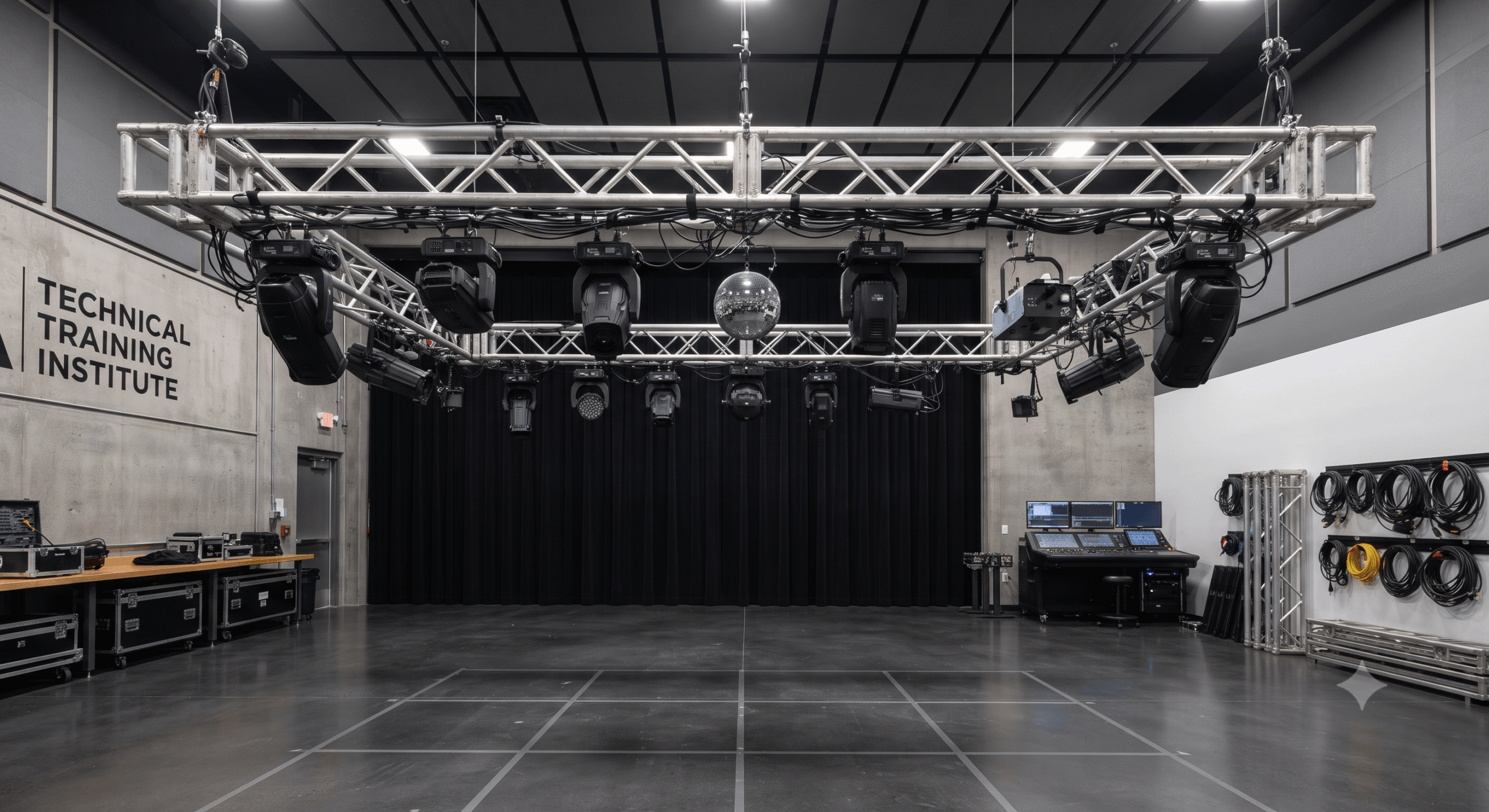
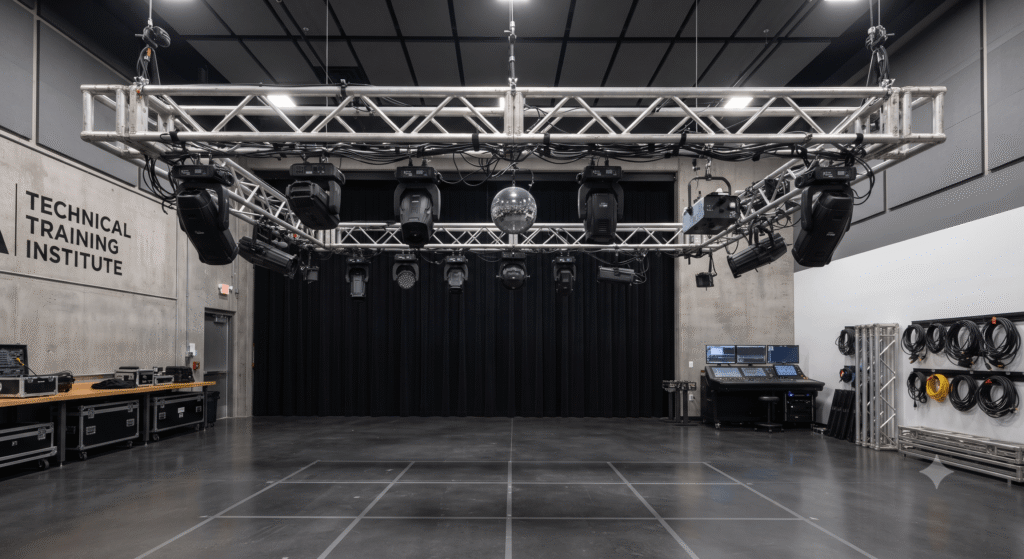
You cannot learn weight, load or electrical safety from a screen recording alone. You need real equipment in front of you, a mentor beside you, and space to make small mistakes where they cost nothing. That is why IIED trains on professional gear, including real GrandMA3 consoles, and keeps batches small so every student gets attention.
The Lighting Design programme includes practicals in power and cabling, light plotting, programming, console training, and live events. Safety runs through those practicals, because you rig, cable and power a system before you programme it.
Your trainer is Lloyd Albuquerque, a working Light Director with live-show experience in events and concerts. He trains you the way the industry actually works: check the structure, check the power, then create the look.
Small batches matter for safety more than for any other topic. A mentor can watch how you handle a cable or a fixture. They can correct a habit on day three, not discover it on show night.
5. What Employers Look For: Rental Companies and Production Houses
Ask a rental company what they want in a new technician. Skills and attitude come first, but underneath is trust. Can I send this person to a site with expensive gear and a live audience?
Safety knowledge answers that question before you speak. Here is where IIED alumni have landed, using verified placements.
Silas Paul Uba: LumaSonic Structures Rental, Goa
Silas started in audio mixing and media production, then switched to lighting. In September 2025 he joined LumaSonic Structures Rental Pvt. Ltd. in Goa as Technician – Lighting (Grade B). His package: ₹25,000 a month, medical insurance of ₹5,00,000, personal accident insurance, a telephone allowance, plus tools and uniform.
A structures rental company is exactly where rigging and load awareness matter every day. In his words: “I joined IIED to professionalize my passion.”
Atharv Devikumar Jog: SLS Production Equipment L.L.C, Saudi Arabia
Atharv was already working in lighting but lacked a technical foundation. In August 2025 he joined SLS Production Equipment L.L.C in Saudi Arabia as a Lighting Operator. His package: SAR 10,000 a month, company accommodation, a return air ticket and transportation.
Subha Bhattacharya: Stagegear, Mumbai
Subha came from a small town near Calcutta and was not confident in English. She started her professional career with Stagegear, a leading lighting rental company in Mumbai.
These stories share one thread. Each of these companies puts gear and people at risk every working day. They hire people who understand the work, not only the software. We do not claim any injury-rate or safety-record data here. The point is simpler: employers in rental and production trust trained people.
Want the full picture on outcomes? The MA in Lighting Design carries a 100% internship or job opportunity. Book your free visit and we will walk you through it.
6. How This Differs from an Industrial Rigging Course
Search for rigging training in India and you will find industrial lifting and crane courses from providers such as NIST Global and TUV SUD. Those are real, respected programmes. If you plan to work on construction sites, in ports or on heavy lifting, they may be the right path.
Live-event rigging is different. The loads are lighter, but the setting is complex. You hang fixtures over audiences. You work around stages, sets, power distribution and tight load-in schedules. You coordinate with lighting, sound, video and set crews at the same time.
Here is the honest comparison.
- Industrial rigging courses: focus on lifting, slinging and crane operation. They usually lead to a standalone certificate for industrial work.
- Safety training inside a lighting course: focuses on live-event loading, rigging awareness, electrics and crew coordination, taught as part of becoming a lighting professional.
To be clear, IIED does not issue a standalone rigging certificate. Our safety module is part of the MA in Lighting Design. If you want a lifting certificate for industrial work, choose an industrial provider. If you want a career in lighting where you work safely at height and under load, choose training built around that career.
Many people do both over time. There is no conflict. Pick the one that matches the job you want first.
7. Who This Is For, and What Parents Should Know
If you are a student or recent graduate
You finished your degree and feel lost. You like events, tech and the energy of a live show, but you do not know how to start. The MA in Lighting Design is open to any graduate. You do not need a technical background. You learn the physics of light, power and safety, then consoles, design and programming.
If you are a working professional switching in
Silas came from audio and media. Vinith moved from sound to lighting. Your existing production skills are an asset. The safety module fills the gap that most career switchers have: structured, mentored knowledge of loads and power.
If you are a parent reading over a student’s shoulder
You are right to ask: is this dangerous work? Fair question. Working at height and with electricity carries real risk. That is exactly why training matters.
Untrained people take the risks. Trained people manage them. IIED’s programme teaches safety first, in small batches, under a working Light Director. It runs in Mumbai at a real institute with real equipment. You are welcome to visit, see the space and ask any question before your child enrols.
The fee for the One Year Program in Lighting Design is ₹3,00,000, with instalments. We are happy to explain how that works.
Ready to See It for Yourself?
Safety is the first thing a lighting crew is judged on, and it is the easiest thing to learn badly from a video. Come and see how we teach it.
Book your free visit to IIED: call 9892966334 or email admission@iiedeventdesign.com. Walk the floor, meet the mentors, and see the equipment you will train on. Explore the Lighting Design course page first if you want the full curriculum.
IIED, Shop No. 506, 5th Floor, Magic Square, Dwarkadish Road, off Poddar Road, Malad East, Mumbai 400097.