
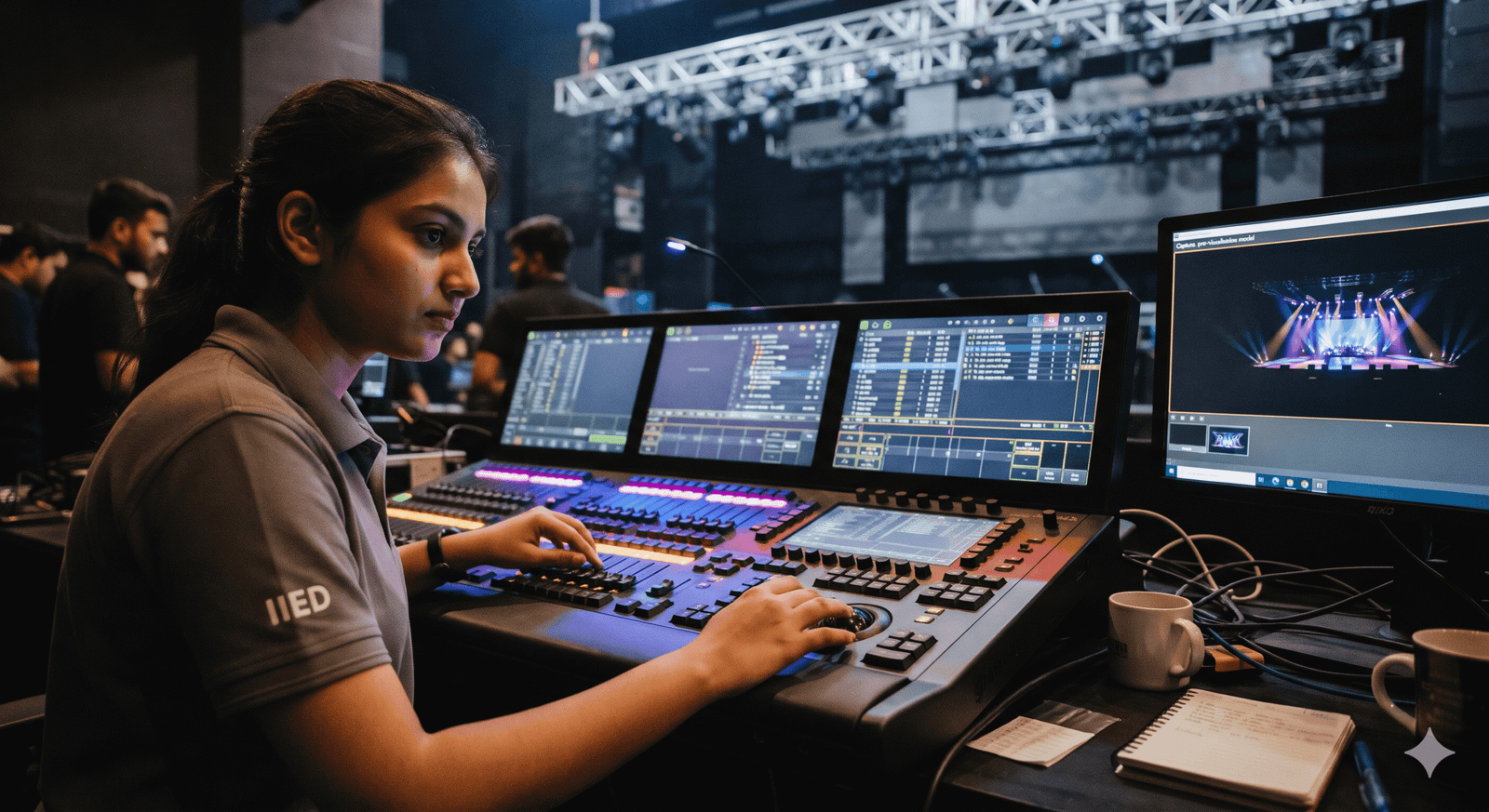
Short answer: A masters in lighting design trains you to design, rig, programme and run light for shows. Most programmes abroad lean towards architectural lighting. If you want a masters in lighting design India-based and built for live events, options are rare. Check one thing first: how many hours you will spend on real consoles and rigs.
Here is the problem most students hit. A masters in lighting design is not one thing. Abroad, it often means architectural lighting theory: buildings, offices, museums and daylight. In India, most of the jobs are on live shows: weddings, concerts, corporate launches, award nights, theatre and TV. So before you compare countries, fees or labels, check which career you are actually signing up for.
This guide is for three kinds of readers. Final-year students and recent graduates asking, “Do I need a masters, and should I leave India for it?” Working professionals, such as sound engineers, architects and interior designers, who want a formal step into lighting. And parents who are researching on their child’s behalf. We will keep it plain, practical and honest.
Table of Contents
Why “Masters in Lighting Design” Means Two Different Careers
Type “masters in lighting design” into Google and look at the results. Most of them are European or UK programmes. Most are written for architecture and interior graduates. They teach you how to light a building, a façade, a hotel lobby or a museum gallery. That is real, valuable work. But it is a different job from lighting a concert.
Architectural lighting is about fixtures that stay put for ten years. You calculate lux levels, energy use and glare. You work with architects, on drawings, over months. Entertainment lighting is about light that moves. You hang a rig in the morning, programme it in the afternoon and run the show that night. You work with directors, artists and production crews, often against the clock.
IIED COURSE
MA in Lighting Design
A two-year, hands-on masters built for live-event, concert, theatre and film lighting, right here in Mumbai.
Duration: 2 years · Mode: Full-time in Mumbai
The tools are different too. An architectural lighting designer lives in calculation software like DIALux or Relux. An entertainment lighting designer lives on a console such as grandMA3 or Avolites Titan, in a visualiser like Capture, and in Vectorworks Spotlight for plots. The safety knowledge is different as well. Live-event lighting means truss, chain hoists, power distribution and rigging loads above people’s heads.
| What changes | Architectural lighting | Entertainment lighting |
|---|---|---|
| What the light does | Fixtures that stay put for ten years. | Light that moves. |
| Daily work | You calculate lux levels, energy use and glare. | You hang a rig in the morning, programme it in the afternoon and run the show that night. |
| Who you work with | Architects, on drawings, over months. | Directors, artists and production crews, often against the clock. |
| Main tools | Calculation software like DIALux or Relux. | A console such as grandMA3 or Avolites Titan, a visualiser like Capture, and Vectorworks Spotlight for plots. |
Now look at the Indian job market. India’s wedding industry alone is worth ₹3.75 lakh crore and growing. Add concerts, corporate launches, award nights, theatre, film and TV. Most lighting jobs here are on live shows and sets. So when you search for a masters in lighting design India students can use for a career, the first filter is simple: does the course train you for the jobs that actually exist where you want to work?
Neither path is wrong. If you love architecture and want to light buildings, an architectural lighting masters makes sense. If you want to stand behind the desk at a concert, light a wedding entry or run a TV set, you need training built around shows. The mistake is choosing by the word “masters” alone.
Masters in Lighting Design Abroad vs India: The Honest Picture
What lighting design masters abroad usually cover
Most lighting design masters abroad, especially in the UK and Europe, share a pattern. They run for one to two years. They lean towards architectural and interior lighting. They include a lot of theory: perception, photometry, sustainability, daylight and research writing. Some offer theatre lighting modules, but live-event and concert lighting is often a small part of the course, if it appears at all.
Going abroad also brings practical questions that parents ask straight away. Living costs in cities like London are high, on top of tuition. You need a student visa, and the rules on funds and documents are strict. The UK government’s official student visa page lists what you must show before you can even travel. Some European programmes also expect you to work in a local language outside class.
Then there is the return. Many Indian students who study abroad plan to come back and work here. When they do, recruiters at AVL rental companies, event agencies and production houses ask a simple question: “What shows have you run?” A strong theory background helps. But if your course gave you little console time and no live-show experience, you may still start at the bottom of the crew.
Postgraduate lighting design in India: what exists today
Now the honest picture at home. Dedicated postgraduate lighting design programmes in India are rare. For years, students who wanted to learn lighting properly had to piece things together: a short certificate here, a console workshop there, a related degree in architecture, interior design, media or theatre, and a lot of learning on the job.
That patchwork can work. Plenty of good lighting professionals in India learned as crew, moved up to operator and then to designer. But it is slow. You often learn one company’s way of doing things, with gaps in the basics such as electrical load, rigging safety or DMX networking. And it rarely leaves you with a structured portfolio that shows design thinking, not just operation.
This is why the search for a masters in lighting design India-based, focused on live entertainment, often ends with no clear answer. The niche is open. That is exactly why you should check any programme carefully, including ours, against the checklist further down.
IIED’s MA in Lighting Design: one option to compare
IIED’s MA in Lighting Design is our own two-year, full-time, hands-on master’s programme in entertainment lighting, taught in Mumbai. It runs over four semesters. Any graduate can apply, from any discipline. We include it here as one option for you to measure against the checklist, not as the only answer.
Semester 1 covers the fundamentals of light, vision and colour; electrical systems, power and distribution; trussing, rigging and structural safety; and a hands-on lab in power, cabling, rigging and fixtures. You choose an elective in interior architectural lighting or façade and landscape lighting.
Semester 2 moves into fixtures, sources and optics; control systems, DMX and networking; the lighting design process; and a studio design and documentation project. You choose an elective in lighting for events or lighting for film and television. This semester also includes a supervised industry internship with a lighting or event production company.
Across the programme you also study Indian Knowledge System modules on light in Indian performance, festivals and ritual, plus research modules that lead to a dissertation. The tools are the ones the industry uses: grandMA3, Avolites Titan, Capture and Vectorworks Spotlight. Batches are kept small, so every student gets real time on the desk. In the final year, you design and run your own show in front of a live public audience. For the full curriculum and fee details, see the MA in Lighting Design course page.
Do you have to leave India to work abroad?
No. Many students assume that an international career needs an international degree. Our alumni show otherwise. Atharva Jog trained with IIED in Mumbai and now works as a Lighting Operator at SLS Production Equipment L.L.C in Saudi Arabia. Cajetan (Caje) D’Silva handles lighting for international cruise productions with Royal Caribbean. Jude Pereira, who left MBBS studies to follow lighting, now works as Event Designer and Lighting Technician at Disneyland Hong Kong.
None of them went abroad for the degree first. What they took abroad was skill: console programming, rigging knowledge and show experience. If an international career is your goal, read our guide to international lighting design jobs from India for the roles, countries and skills recruiters look for.
The 7-Point Checklist Before You Choose a Masters in Lighting Design
Whether you are looking at a masters in lighting design India-based or one overseas, use the same seven checks. Ask every institute these questions, in writing if you can. A good programme will answer clearly. A vague answer is an answer too.
| Check | Why it matters | Question to ask |
|---|---|---|
| 1. Hands-on console time | Employers hire people who can programme and run a show, not just describe one. | How many hours will I spend on a real grandMA3 or Avolites desk? |
| 2. Rigging and electrical safety | Live-event lighting hangs above people. Safety is part of the job from day one. | Do you teach truss, hoists, load and power distribution with practical checks? |
| 3. A real internship | Load-ins, focus sessions and strikes teach what a classroom cannot. | Is the internship supervised, and with what kind of company? |
| 4. Who teaches | Working designers bring current methods and industry contacts. | Are my teachers working lighting designers and programmers? |
| 5. Portfolio you leave with | Recruiters check plots, cue lists and show footage before they call you. | Will I design and run a full show of my own? |
| 6. Software and documentation | Plots, patch sheets and pre-visualisation win jobs and prevent mistakes on site. | Do you teach Vectorworks Spotlight, Capture and CAD light plots? |
| 7. Where graduates actually work | Named alumni in real roles are the clearest proof a course works. | Can you name past students, their companies and their roles? |
1. Hands-on console time
This is the single biggest gap between programmes. Some courses show you a console in a demo. Others put you on the desk week after week until programming is muscle memory. Ask for a number of hours, not a promise. Ask whether you practise on the physical console or only on a laptop. Both matter, but the physical desk is what you will face at a show.
2. Rigging and electrical safety
A lighting designer who does not understand load, power and truss is a risk on any site. Look for a course that teaches three-phase power, load calculation, truss and hoists, and safe working load, with a practical competence check. This knowledge also makes you more employable, because production companies trust people who understand safety.
3. A real internship
An internship with a lighting rental company or production house shows you how shows really happen. You see load-in schedules, focus calls, the chaos of a change-over and the calm of a well-run strike. Ask whether the internship is supervised, whether you keep a logbook, and what kind of companies host students.
4. Who teaches
Check whether your teachers still light shows. At IIED, lighting is led by Lloyd Albuquerque, a professional lighting designer for 20 years, who set up LGL Designs and has lit fashion shows, EDM concerts, rock shows, corporate launches, theatre, award nights, film and TV. Working mentors teach the methods used on sites today, and they know who is hiring.
5. The portfolio you leave with
Your portfolio is your real CV in this industry. It should show a light plot, a patch sheet, a cue list, design notes and footage of a show you designed and ran. Our guide on building a lighting design portfolio covers what hiring teams in India check first.
6. Software and documentation skills
Design is not only what happens on the night. It is the plot that tells the crew where every fixture hangs, the patch that tells the console what each fixture is, and the pre-visualisation that lets a client see the show before it is built. Check for Vectorworks Spotlight, Capture and CAD drawing in the syllabus.
7. Where graduates actually work
Ask for names, companies and roles. Not “great placements”, but real people. For IIED’s lighting alumni, those names include Ritesh Khichariya, who worked as an operator for two to three years, moved from Raipur to Mumbai to study lighting design properly, and is now Lighting Operator / Designer at Show Genesis, Mumbai, at ₹40,000 a month.
Outcomes from IIED’s earlier lighting design programme, the course the MA now replaces, based on students with 0–1 years of experience, are: highest CTC ₹29.40 LPA, average ₹8.20 LPA, median ₹3.90 LPA, and three international placements so far. These are past results from that earlier programme, not a promise for the MA. But they are the kind of specific, checkable numbers you should ask every institute for.
Masters vs Certificate vs Experience: When Each Makes Sense
A masters is not the only way into lighting. Here is the short version of a longer argument we have made before. A short certificate makes sense when you already work in the industry and need one specific skill, such as console programming. A two-year master’s makes sense when you are starting from scratch, want depth across design, safety and control, or want a formal postgraduate qualification. Experience alone works, but it is slow and leaves gaps.
For the full comparison, read Lighting Design Certificate vs MA in India. It covers what recruiters check and when each route pays off.
Which route fits which student: MA lighting design India options by background
Graduate in any subject (commerce, science, arts, engineering). If you have finished your degree and lighting is a new world, a lighting design course after graduation in India that starts from first principles is the safest route. You need the physics of light, power and rigging before the console makes sense. A two-year, full-time programme gives you time to build that base and a portfolio. Jude Pereira’s story shows that an unconventional start is not a barrier. The training and mentorship are what count.
Architect or interior designer. You already think in space, materials and drawings. You may be drawn to architectural lighting, and a masters abroad could suit you if that is your goal. But if live events, weddings or façades for events excite you, a programme that offers both an architectural elective and entertainment depth lets you keep both doors open.
Sound or AV technician. You already know signal flow, cables, crews and show pressure. That is a strong base. Many of our lighting alumni came from audio. What you usually need is lighting-specific depth: optics, colour, DMX networks, console programming and design process. Decide whether you want the full master’s or a focused console course first.
Working lighting operator. If you have been running desks for a few years and want to design bigger shows, you are in Ritesh’s position. A structured programme fills the gaps that on-the-job learning leaves, from load calculation to design documentation. Atharva Jog was in a similar place before IIED; the technical foundation he gained led to his role in Saudi Arabia.
A note for parents
If you are a parent reading this, your questions are fair ones. Is lighting a real career? Is it safe? Will my child earn? Lighting design is a skilled, technical profession. The salary figures above are real, and they come from named alumni. Ask every institute you visit for the same kind of proof. And visit in person. Watch a class. See whether students are actually touching the equipment.
The bottom line on a masters in lighting design India vs abroad
Do not choose by label or by country. Choose by what you will touch with your own hands, and by who will see your work. Consoles, rigging, plots and live shows build a lighting career in India. A well-known name abroad may help if you want architectural lighting. For live entertainment, the right training at home can take you abroad anyway, as our alumni in Saudi Arabia, Hong Kong and on cruise ships show.
Frequently Asked Questions
Is there a masters in lighting design in India?
Yes, but options are few. Most lighting courses in India are short certificates or workshops. IIED offers a two-year, full-time MA in Lighting Design in Mumbai, focused on entertainment lighting for events, concerts, theatre, film and TV. Compare any programme against hands-on console time, rigging safety, internship and portfolio before you choose.
What is the difference between a masters in lighting design abroad and in India?
Many masters abroad, especially in the UK and Europe, focus on architectural and interior lighting, with heavy theory. Indian jobs are mostly in live events, weddings, concerts and media. A programme in India built for entertainment lighting puts more weight on consoles, rigging and live shows. Abroad also adds living costs and visa requirements.
Can I do a masters in lighting design after a degree in any subject?
At IIED, yes. Any graduate from any discipline can apply for the MA in Lighting Design. You do not need prior experience in lighting, electrics or design, because the course starts with the fundamentals of light, power and rigging. Programmes abroad may set their own entry requirements, often favouring architecture or design graduates.
Do I need a masters to become a lighting designer in India?
No. Many lighting designers in India learned on the job, and short courses can work if you already have experience. A masters helps when you are starting from zero, want depth across design, safety and control, or want a formal postgraduate qualification. What every employer checks is your skill and your portfolio.
How long is a masters in lighting design?
It depends on the programme. Many masters abroad run for one to two years. IIED’s MA in Lighting Design runs for two years, across four semesters, full time in Mumbai. That includes a supervised industry internship in Semester 2 and a live public showcase that you design and run in the final semester.
What subjects and software does a lighting design masters teach?
A strong programme covers light and colour, electrical power, rigging and safety, fixtures and optics, DMX and networking, and the design process. IIED’s MA also includes Indian Knowledge System and research modules. Software and consoles include grandMA3, Avolites Titan, Capture and Vectorworks Spotlight, so you graduate with industry-ready tools.
Is it worth going abroad for a masters in lighting design if I want to work in India?
It depends on the course content, not the country. If the programme abroad is mostly architectural theory and you want live-event work, you may return with little show experience. Weigh living costs, visa rules and console time. IIED alumni have reached Saudi Arabia, Hong Kong and cruise ships after training in Mumbai.
What jobs can I get after a masters in lighting design?
Roles include Lighting Designer for events, weddings, concerts and theatre; Lighting Programmer or Console Operator; Light Director for live shows; Pre-visualisation Specialist; Pixel-Mapping and Media Operator; Lighting for TV, film and broadcast; and Lighting Crew Chief. IIED lighting alumni work at companies like Show Genesis, Royal Caribbean and Disneyland Hong Kong.
Ready to Start Your Lighting Design Career?
The best way to judge any masters in lighting design is to see it in person. Watch a real class. Stand at the console. Ask our mentors the seven questions above and hold us to the answers. Book your free visit to IIED’s Mumbai campus through the MA in Lighting Design page.
Book your free visit — call 9892966334 or email info@weareiied.com. IIED, Shop No. 506, 5th Floor, Magic Square, Dwarkadhish Road, off Poddar Road, Malad East, Mumbai 400097.
IIED COURSE
GrandMA3 Mastery Program
Checklist point one is console time. Get serious grandMA3 programming hours on a real desk in Mumbai.
Duration: 1 month · Mode: In-person in Mumbai