
“Will AI replace event designers?” It’s the question we hear most this year — from students, and even more from their parents. You’ve seen an AI tool turn a one-line prompt into a glowing mandap image in ten seconds. So it’s fair to ask whether the job you’re about to train for will still exist when you finish.
Here’s the honest answer from people who build events for a living. AI is already in the room. It makes mood boards faster. It throws out ten colour palettes before your chai goes cold. But it doesn’t walk the venue. It doesn’t read the client. It doesn’t solve the load-in problem at 2 a.m. And it doesn’t stand behind the design on event day.
This guide breaks it down without hype and without fear. What AI can do in event design today. What it can’t. What’s actually changing for new designers. And the skills that still get you hired in India.
Table of Contents
Will AI Replace Event Designers? The Short Answer
No. AI is replacing tasks, not event designers. It speeds up mood boards, concept variations and rough visuals. But it can’t survey a venue, manage a budget, read a client’s family, produce construction drawings or solve problems on site. Designers who use AI at the concept stage, and back it with real skills, will move faster and stay hired.
That’s the short version. The longer version matters more, because “no” doesn’t mean “nothing changes.” Some parts of the job are changing fast. If you ignore that, you’ll walk into interviews with a portfolio that looks like everyone else’s.
So before deciding whether AI will replace event designers, let’s be fair to AI first. Then we’ll look at where it stops.
What AI in Event Design Does Well in India Today
Across India, design teams at wedding and event companies have started using AI tools in the early, messy stage of a project. That’s where it helps most. We’re keeping tool names out of this post on purpose — tools change every few months. The tasks don’t.
Quick mood boards. A client says “royal, but not heavy — maybe ivory with a touch of rani pink.” Earlier, a junior designer might spend half a day pulling references. Now an AI tool can produce a rough mood board in minutes. That gives you something to react to in the first meeting.
Concept variations. Want to see the same sangeet stage in three palettes, or with florals versus fabric drapes? AI can generate those variations quickly. It’s a fast way to rule things out before you invest hours in a proper 3D model.
Rough render ideas. AI images can hint at mood, lighting colour and overall feel. They’re useful for early alignment with a client or your senior designer. They’re not accurate. Proportions are often wrong, structures float, and the “flowers” don’t exist in any market.
Pitch copy and presentation drafts. Writing a theme note, a concept description or a first draft of a proposal is faster with AI. You still need to edit it, so it sounds like you and matches what you can actually deliver.
| Task | What AI does | Where it stops |
|---|---|---|
| Quick mood boards | Produces a rough mood board in minutes | Gives you something to react to in the first meeting |
| Concept variations | Generates the same stage in different palettes, florals or drapes | A fast way to rule things out before a proper 3D model |
| Rough render ideas | Hints at mood, lighting colour and overall feel | Not accurate: proportions are often wrong, structures float |
| Pitch copy and presentation drafts | Speeds up theme notes, concept descriptions and first-draft proposals | You still need to edit it so it matches what you can deliver |
That’s a real shift, and we won’t pretend otherwise. Concepting is faster. Basic “pretty pictures” are cheaper to make. If your only skill is making a nice-looking image, that skill has lost value. But that was never the whole job.
What AI Can’t Do on a Real Event
An event isn’t an image. It’s a physical thing built in a real space, by real vendors, on a real budget, against a clock. This is where the question “will AI replace event designers?” gets its clearest answer. Here’s where AI stops and a trained designer takes over.
1. Site recces and venue constraints
Every venue has rules. Ceiling heights. Entry gate widths. Power availability. Where trucks can unload and at what time. Whether you can drill into the floor of a heritage property (usually, you can’t). A designer walks the venue, measures it, photographs it and notes the problems.
AI doesn’t know that the banquet hall’s chandelier hangs exactly where your stage backdrop needs to go. You do — because you stood there with a measuring tape.
2. Budgets and vendor negotiation
A beautiful concept that costs three times the client’s budget is not a design. It’s a problem. Real event designers know what materials cost, which fabricator can deliver on time and where to cut without the setup looking cheap.
That knowledge comes from working with vendors — florists, carpenters, fabric suppliers, lighting rental companies. AI can’t call your fabricator at 9 p.m. to ask if the arch can be done in MDF instead of metal to save cost.
3. Reading the client (and the family)
Anyone who has worked an Indian wedding knows the “client” is rarely one person. The bride wants pastel. Her mother wants gold. The groom’s side has a ritual that needs a specific stage orientation. A grandparent can’t climb stairs, so the mandap needs a ramp.
A good designer listens, reads the room and finds the version everyone signs off on. That’s human work — empathy, patience and a bit of diplomacy. No prompt captures how a family really works.
4. Construction drawings and production detail
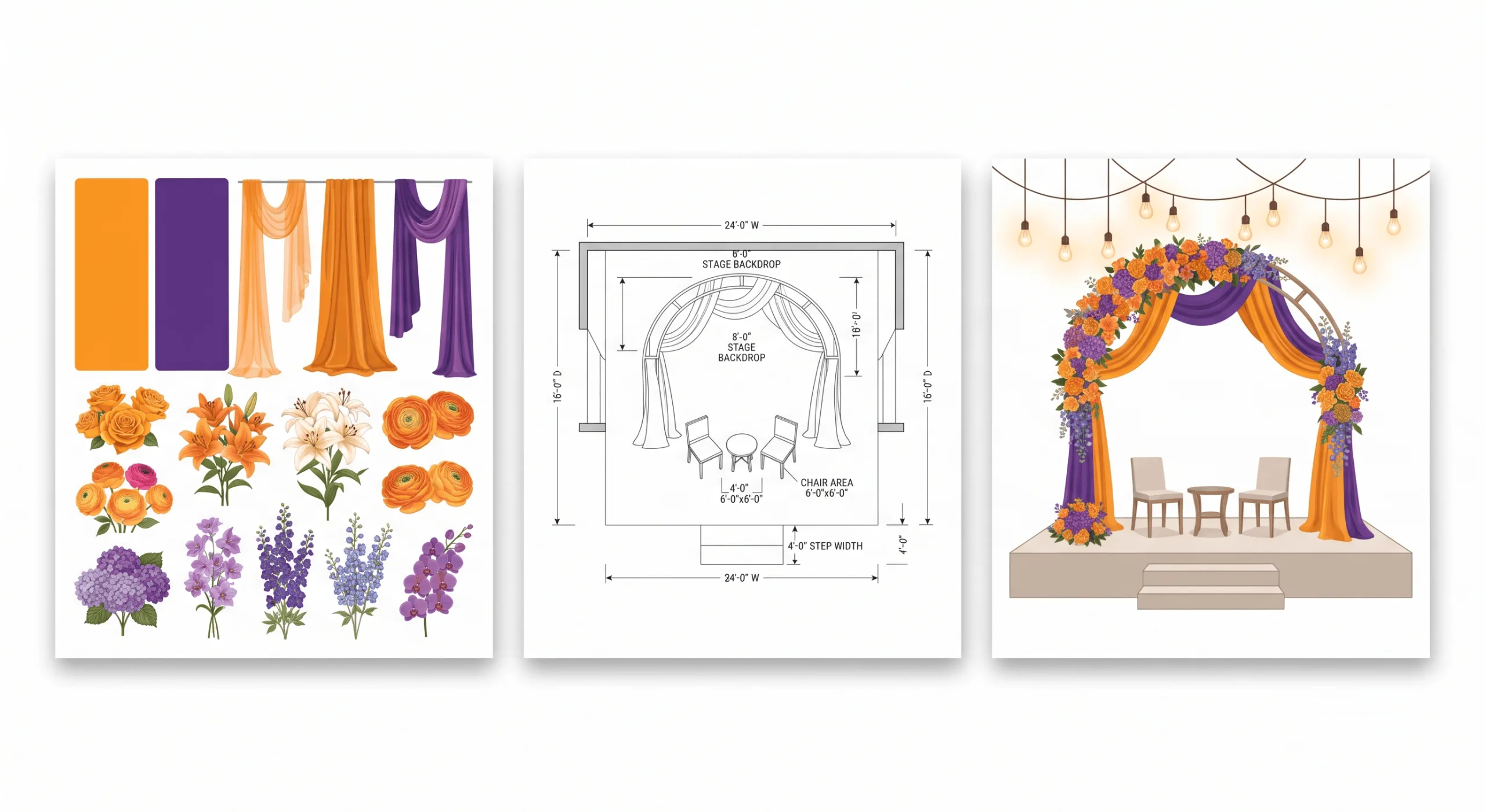
Fabricators don’t build from mood boards. They build from drawings — floor plans, elevations, dimensions, material callouts. That’s where software like AutoCAD and Vectorworks comes in. An AI image can’t tell a carpenter how deep the stage platform is or where the steps go.
This is the gap between “concept” and “production.” It’s also where many self-taught designers get stuck. They can make a design look good on screen. They can’t make it buildable.
5. Safety, load and rigging reality
Hanging installations, ceiling drapes, truss structures, heavy floral arches — all of these carry weight. Someone has to think about how they’re supported, whether the venue allows rigging and what happens if it rains at an outdoor setup.
AI-generated images regularly show structures that would fall over in real life. A trained designer spots that instantly. Safety isn’t a creative choice. It’s a responsibility.
6. On-site problem-solving
Event day never goes exactly to plan. The flowers arrive in the wrong shade. The venue shifts your setup time by three hours. A backdrop panel cracks during unloading. The designer on site makes quick decisions that protect the final look.
That’s experience and judgment under pressure. You learn it by being on live setups, not by typing prompts. Put these six tasks together and you can see why the people who ask “will AI replace event designers?” usually haven’t stood backstage on a wedding night.
| Task | Why a trained designer is needed |
|---|---|
| Site recces and venue constraints | A designer walks the venue, measures it, photographs it and notes the problems |
| Budgets and vendor negotiation | Knows what materials cost, which fabricator can deliver on time and where to cut |
| Reading the client (and the family) | Listens, reads the room and finds the version everyone signs off on |
| Construction drawings and production detail | Fabricators build from floor plans, elevations, dimensions and material callouts |
| Safety, load and rigging reality | Spots structures that would fall over in real life |
| On-site problem-solving | Makes quick decisions on site that protect the final look |
Will AI Replace Wedding Designers? Why Clients Still Hire a Human
Many people asking “will AI replace event designers” are really asking about weddings. India’s wedding industry is huge — our own placement records put it at ₹3.75 lakh crore and growing. So will AI replace wedding designers? Here’s why families still hire people.
Accountability
When a family spends lakhs on décor, they want one person who answers for it. Someone who’ll pick up the phone, fix the issue and stand behind the result. An AI tool can’t be accountable. A designer can.
Taste and judgment
AI tools average what they’ve seen. That’s why so many AI wedding images look alike. A designer brings a point of view — knowing when to hold back, when a single bold element works better than ten small ones, and when a trend doesn’t suit this couple.
Cultural knowledge
Indian weddings aren’t one style. A Marwari wedding, a Konkani wedding and a Bengali wedding each carry their own rituals, colours and stage logic. Mandap orientation, the placement of the havan, how the baraat enters, where elders sit — these details matter to families. Getting them wrong isn’t a small mistake. Designers who know regional styles are trusted with more.
Execution
Clients don’t pay for a picture. They pay for the moment the guests walk in and the space looks exactly as promised. That only happens when someone turns the concept into drawings, coordinates vendors and supervises the build.
Look at what IIED alumni actually do in the industry. Priyanka Saini, who completed our online Event & Wedding Design Visualization course, works as a Wedding Designer and Visualizer in Jaipur. In her words: “Today I’ve successfully transitioned into a specialist role as a Wedding Designer and Visualizer, consulting for multiple wedding companies to bring their concepts to life through high-end 3D layouts.”
Notice the phrase — “bring their concepts to life.” Companies have ideas. They need trained people who can turn those ideas into accurate, buildable 3D layouts. That demand doesn’t disappear because a tool can make a rough image.
Nirali Reshamiya‘s story makes the same point. She was already working with a wedding decorator in Gujarat. She upskilled through our part-time evening programme, two hours a day, without leaving her job. “This training was a complete game-changer — I moved instantly into a much higher position at Gurleen M Puri,” she says. She’s now a Wedding Visualization Designer there. Her promotion came from skill, not from a shortcut.
Is Event Design a Good Career with AI? What Changes for New Designers
Yes — event design is still a good career with AI in the picture. But the entry bar is moving. Instead of asking “will AI replace event designers?”, the better question is how the job is changing. Here’s what’s changing, and what to do about it.
The portfolio bar is rising
When anyone can make a pretty picture, pretty pictures stop impressing recruiters. Hiring managers now look harder at what’s behind the image. Is there a floor plan? Real dimensions? A material list? Does the stage fit the venue? Your portfolio has to show you can take a design from idea to execution.
Shreya Pais came to IIED as a fresh graduate with zero experience. “By the time I finished the course, my work spoke for itself — I had a portfolio so impressive that it landed me a job instantly,” she says. “IIED bridged the gap between being a fresh graduate and a ready-to-hire designer.” That gap — between knowing what looks nice and knowing how to build it — is exactly what a strong portfolio proves.
Basic visual work is getting commoditised
Simple mood boards and generic concept images are now quick and cheap. If that’s all you offer, you’re competing with a free tool. The designers who stand out pair visualisation skill with production knowledge. They understand structure, materials, vendors and timelines.
That’s why production roles stay valuable. Pranay Mhatre completed our Event & Wedding Design Visualization course and joined WIZCRAFT International Entertainment — India’s oldest event company — as a Production Designer. Varun Jain, who moved from Jodhpur’s wedding industry to Mumbai for our offline training, is now a Design Associate at The Finale Eventz. These are roles built on technical skill and real-world judgment.
| IIED alumni | Starting point | Role now |
|---|---|---|
| Priyanka Saini | Online Event & Wedding Design Visualization course | Wedding Designer and Visualizer, Jaipur |
| Nirali Reshamiya | Working with a wedding decorator in Gujarat; part-time evening programme | Wedding Visualization Designer, Gurleen M Puri |
| Shreya Pais | Fresh graduate with zero experience | Landed a job on the strength of her portfolio |
| Pranay Mhatre | Event & Wedding Design Visualization course | Production Designer, WIZCRAFT International Entertainment |
| Varun Jain | Moved from Jodhpur’s wedding industry to Mumbai for offline training | Design Associate, The Finale Eventz |
The wider job market points the same way. In the World Economic Forum’s Future of Jobs Report 2025, employers list creative thinking among the top core skills they want, alongside analytical thinking and resilience. AI and technology skills are rising too. The message for designers is simple: learn the tools, but keep building the human skills that sit on top of them. You can read more about where event design is heading this year.
The Skills That Make an Event Design Career Future-Proof
No career is fully future-proof. But some skills hold their value because they depend on judgment, physical reality and people. If you want an event design career that lasts, build these.
1. Design foundation
Colour, composition, proportion, scale, balance. These basics decide whether an AI-generated idea is actually good. Without them, you can’t edit what the tool gives you. You’ll just accept it.
2. Visualisation software
Clients and companies expect accurate 3D visuals built to real measurements — not loose AI images. Learning proper visualisation tools lets you show a client exactly what they’ll see on the day. If you’re unsure where to start, here’s our guide on which software to use for wedding design.
3. Technical drawings
AutoCAD and Vectorworks let you produce floor plans and elevations that vendors can build from. This is the single biggest gap between hobbyists and hireable designers. It’s also very hard for AI to fake.
4. Vendor and budget knowledge
Knowing material costs, fabrication timelines and which vendor handles what makes you useful from day one. Companies value juniors who don’t design things that can’t be built on budget.
5. Floral and décor craft
Understanding real flowers, fabrics, props and finishes — how they look under lights, how long they last, what they cost in season — is hands-on knowledge. You get it from touching materials and watching setups, not from a screen.
How to Use AI as a Designer, Not Against It
The smartest approach isn’t to avoid AI or to depend on it. It’s to put it in the right place in your process.
- Use it at the concept stage only. Mood boards, quick variations, early theme notes. Treat the output as rough sketches.
- Then switch to your own judgment. Pick a direction, sketch it, measure the venue and build an accurate 3D visual.
- Produce real drawings. Floor plans and elevations go to vendors. That’s your job, not the tool’s.
- Be honest with clients. Never show an AI image as a past event you executed. Check usage rights before putting AI visuals in a client presentation.
- Keep your portfolio real. Show your process — reference board, layout, drawing, final visual, and photos of the built setup wherever you have them.
We build this thinking into our training. IIED’s MA in Set Design — a 2-year, full-time, hands-on master’s degree programme — includes CAD, graphic visualisation and generative AI as part of its coursework, with a focus on ethical, copyright-aware use. The point isn’t to replace your skills with AI. It’s to use AI responsibly, then do the real design work yourself.
What to Do This Month If You’re Worried
If “will AI replace event designers?” keeps you up at night, remember that worry is useful only if it turns into action. Here’s a simple plan for the next 30 days.
- Build three portfolio pieces by hand plus software. Pick three event types — say, a haldi, a corporate stage and a reception. For each, make a reference board, a sketch, a floor plan and a 3D visual. Use AI only for the reference board if you like.
- Visit a live setup. Ask a decorator or event company if you can watch a load-in. Notice what changes between the design and the build. You’ll learn more in one evening than in a week of tutorials.
- Learn one drawing tool. Start with the basics of AutoCAD or Vectorworks. Draw a simple stage plan with real dimensions. That one skill instantly separates you from people who only make images.
If you’re still deciding whether formal training is worth it, read why an event design course in India is worth considering. And remember: you don’t need a design background to start. Shreya walked in with zero experience. Nirali studied two hours a day around her job. Both built careers on skills no tool can fake.
So, will AI replace event designers? Not the ones who can walk a venue, read a family, draw a buildable plan and deliver on event day. AI changes the tools. It doesn’t remove the need for a trained eye.
Frequently Asked Questions
Will AI replace event designers in India?
No. AI is taking over some tasks, like first-draft mood boards, quick concept images and pitch copy. But Indian events still need site visits, vendor coordination, budget control, cultural knowledge and on-site execution. Those need a trained designer. Designers who use AI at the concept stage and back it with drawings and production skills will stay in demand.
Can AI design a wedding decor setup on its own?
It can produce an image that looks like a wedding setup. It can’t check the venue’s ceiling height, power or entry points, price materials with local vendors, produce construction drawings or supervise the build. An AI image is a starting point, not a design that can actually be built.
Which event design skills can AI not replace?
Site recces, reading client and family needs, budgeting and vendor negotiation, technical drawings for fabricators, safety and rigging awareness, cultural and ritual knowledge, and on-site problem-solving on event day. These depend on physical reality, judgment and people.
Is event design still a good career in 2026–27?
Yes, if you train properly. India’s wedding industry alone is estimated at ₹3.75 lakh crore and growing. IIED alumni work as a Production Designer at WIZCRAFT, a Design Associate at The Finale Eventz and a Wedding Visualization Designer at Gurleen M Puri. The bar for portfolios is rising, so technical and production skills matter more than ever.
Should I learn AI tools as an event designer?
Yes, for the concept stage. Use them for mood boards, variations and pitch drafts. Then switch to your own judgment, sketches, 3D visualisation and drawings. Check usage rights before showing AI visuals to clients, and never present an AI image as a real past event.
Do clients prefer AI-generated concepts or a human designer?
Clients may enjoy quick AI visuals, but they hire a person. They want someone accountable for the budget, the timeline and the final look on event day. The concept image is a small part of what they pay for. The rest is trust and execution.
Do I need software skills to work as an event or wedding designer?
Yes. Event and wedding companies expect accurate 3D visualisation and 2D layout drawings, using tools like AutoCAD or Vectorworks. Alumni like Priyanka Saini now consult for multiple wedding companies on 3D layouts. Software skills are what turn your ideas into designs vendors can build.
Can I learn event design with no design background?
Yes. Shreya Pais joined IIED as a fresh graduate with zero experience and landed a job on the strength of her portfolio. Nirali Reshamiya upskilled through a part-time evening course, two hours a day, while keeping her job. What matters is hands-on practice and a portfolio that shows real, buildable work.
Ready to Start Your Event Design Career?
Want to see how real event design is taught? Book your free visit to IIED, Malad East, and see the hands-on event design practicals yourself.
Book your free visit — call 9892966334 or email info@weareiied.com. IIED, Shop No. 506, 5th Floor, Magic Square, Dwarkadhish Road, off Poddar Road, Malad East, Mumbai 400097.