
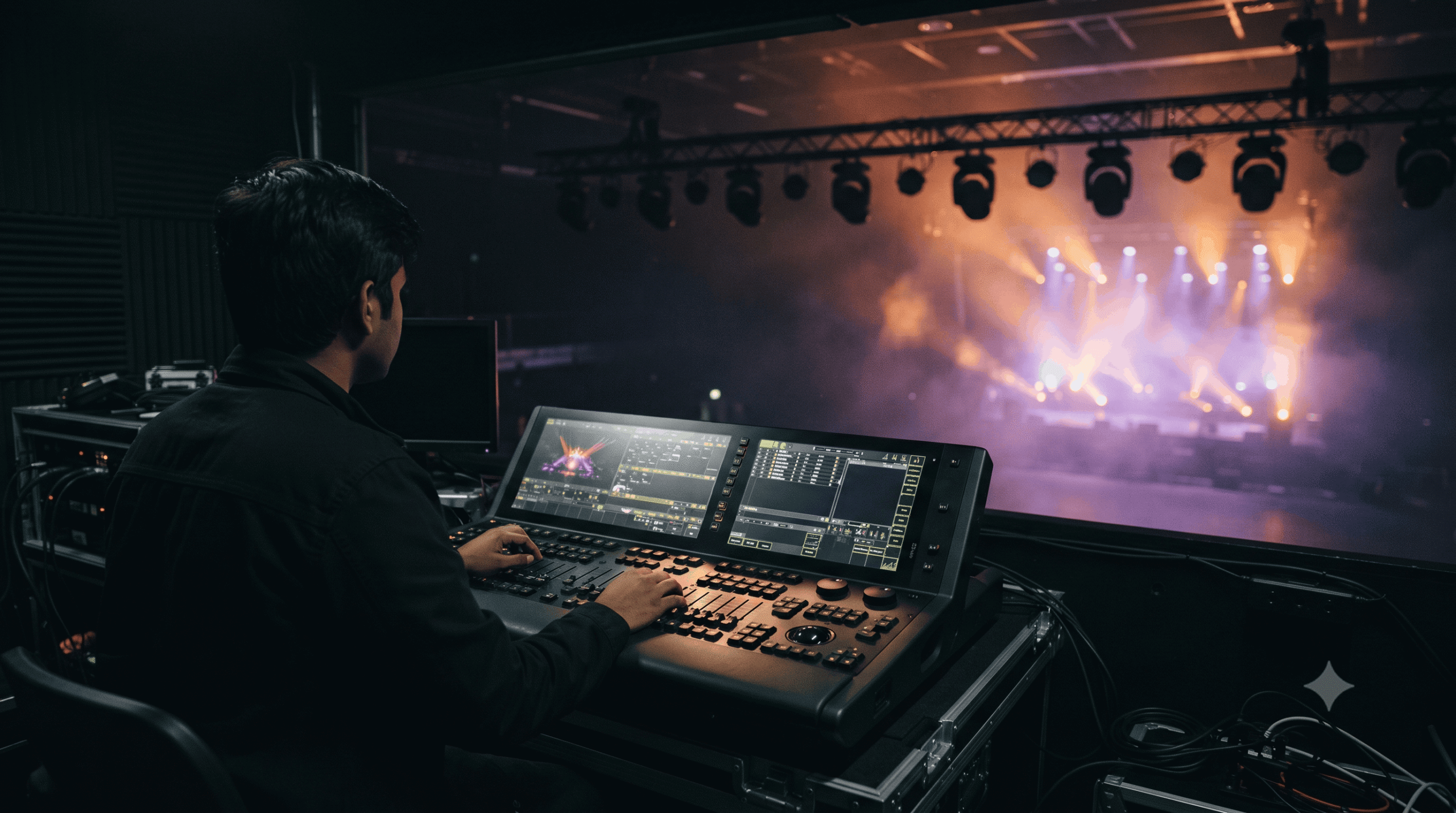
What is the lighting designer salary in India? It is one of the most common questions we hear at IIED, usually from someone standing next to a console for the first time. Here is the honest answer in one paragraph. Entry-level lighting technician pay is modest. The jump comes from three things: console skill, design ability and a portfolio that proves both.
Pay also changes with the city, the employer, the show season and whether you work salaried or freelance. Below, you will find the real numbers we can verify from IIED alumni offer letters, plus a clear map of what moves a lighting person from technician pay to designer pay.
These are individual offers, not an industry average. We will not invent a range, because nobody in India publishes one you can trust.
Table of Contents
Why Lighting Designer Salary in India Is So Hard to Find
Search for lighting designer salary in India and you will get a mess of numbers. Most of them are not about stage or event lighting at all. Many salary aggregator pages mix in interior lighting, architectural lighting and even showroom sales roles under the same “lighting designer” title. So the figure you see may have nothing to do with concerts, weddings or corporate shows.
There are three bigger reasons the real picture stays hidden.
1. There is no standard pay scale
Events & Entertainment lighting in India grew out of rental businesses, not from a formal profession with fixed grades. Each company sets its own pay. A technician at a rental house in Goa and a technician on a touring production in Mumbai can share a title and get very different offers.
2. Much of the work is freelance
A big share of lighting work runs on day rates and per-show fees. Those numbers live in WhatsApp chats and crew rate cards, not on job portals. That makes any “average” very hard to calculate honestly.
3. Three very different employer types
Lighting people work for rental companies (who own the gear), production houses (who run the show) and touring or international productions (who travel). Each pays differently and offers different benefits, such as accommodation, insurance or flights.
Most institutes in this space do not help either. Many event management schools publish no lighting salary data and do not teach lighting at all. Even lighting-focused academies rarely publish outcomes with names, companies and actual offers. That is the gap this post fills, with verified specifics only.
The Lighting Pay Ladder: Technician to Designer

Pay in lighting follows responsibility. The more of the show that depends on you, the more you earn. We have covered the full ladder in our post on the lighting design career path in India. Here we add only the pay angle to each step.
| Role | What you do | What moves the pay |
|---|---|---|
| Lighting technician | Rig, cable, patch and maintain fixtures; load in, focus and load out | Entry point of the ladder; the benefits package often matters as much as the monthly number |
| Lighting operator | Run the console during the show; take cues, follow the music, fix problems live | Console skill is the price of entry; one mistake is visible to the whole audience |
| Lighting programmer | Build the show inside the console: cues, effects, palettes and timecode | Strong GrandMA3 programmers are hard to find in India, which gives them bargaining power |
| Lighting designer / light director | Create the concept, plot, documentation and cue structure, then lead the crew | Owns the creative outcome, so event lighting designer pay reaches its highest level |
1. Lighting technician
Technicians rig, cable, patch and maintain fixtures. They load in, focus and load out. This is where most people start. Lighting technician salary in India at this level is the entry point of the ladder, and the benefits package often matters as much as the monthly number.
2. Lighting operator
Operators run the console during the show. They take cues, follow the music and fix problems live. Lighting operator salary moves up because one mistake is visible to the whole audience. Console skill is the price of entry here.
3. Lighting programmer
Programmers build the show inside the console before anyone hits “Go”. They create cues, effects, palettes and timecode. Strong programmers on consoles like GrandMA3 are hard to find in India, which gives them bargaining power.
4. Lighting designer or light director
The designer decides what the show looks like. They create the concept, the plot, the documentation and the cue structure, then lead the crew to deliver it. This is where event lighting designer pay reaches its highest level, because the designer owns the creative outcome.
The ladder is not always climbed in order. Some people skip from technician to programmer because they put in serious console hours. Others go straight into design roles because they arrive with a strong visual background and a portfolio. What every step has in common: proof of skill beats years on the job.
Real Lighting Offers from IIED Alumni
These are verified offers from IIED lighting alumni. They come from actual offer letters. They are individual outcomes, not averages, and your offer will depend on your role, city, employer and skill level.
| Alumni | Role | Company | Location | Offer (monthly) |
|---|---|---|---|---|
| Silas Paul Uba | Lighting Designer (Technician – Lighting, Grade B) | LumaSonic Structures Rental | Goa (Sept 2025) | ₹25,000/month + medical insurance ₹5,00,000 + personal accident insurance + telephone allowance + tools and uniform |
| Atharv Devikumar Jog | Lighting Operator | SLS Production Equipment L.L.C | Saudi Arabia (Aug 2025) | SAR 10,000/month + company accommodation + return air ticket + transportation |
Note: the Saudi offer is shown in Saudi riyal (SAR), exactly as on the offer letter. We have not converted it because exchange rates change daily.
Silas Paul Uba: the career switcher’s entry route
Silas did not start in lighting. He came from audio mixing and media production. After training in lighting at IIED, he joined LumaSonic Structures Rental in Goa. His offer shows something students often miss at entry level: the package. Medical cover of ₹5,00,000, accident insurance, a phone allowance, tools and uniform all add real value on top of the monthly figure. His story also proves that production skills from another field transfer well into light.
Atharv Devikumar Jog: from working in lighting to an international offer
Atharv was already working in lighting before he came to IIED. What he lacked was the technical foundation behind the work. Once he had it, he was placed as a Lighting Operator with SLS Production Equipment in Saudi Arabia. Accommodation, transport and a return air ticket come with the role. If you are already on a crew and feel stuck, this is the pattern to study.
The outcomes without a number on file
Not every placement comes with a salary we can publish. These are still real careers, and they show where the ceiling sits.
- Jude Pereira left medical studies for lighting. He now works as an Event Designer and Lighting Technician at Disneyland Hong Kong, handling lighting for their shows.
- Cajetan D’Silva handles lighting for international productions with Royal Caribbean, travelling the world as part of the job.
- Vinith, a former sound engineer, received an offer from a global production company. He turned it down to join his mentor Lloyd Albuquerque’s company, LGL Designs, as a Lighting Designer.
- Subha Bhattacharya came from a small town near Kolkata and started a professional career at Stagegear, a leading lighting rental company in Mumbai.
- Jayesh works as a Lighting Designer with a top production firm, designing for major events.
Want the event design side of the pay story too? Our post on event designer salary in India covers that separately, so we have not repeated those figures here.
What Moves Event Lighting Designer Pay Up
If you take one thing from this post, take this: the lighting designer salary in India rewards specific, provable skills. Here are the five that matter most.
1. Console skill, especially GrandMA3
GrandMA3 operators in India are rare, and demand is higher than supply. Large concerts, award shows and premium weddings increasingly spec MA consoles. If you can program and run one confidently, you become hard to replace. That is why GrandMA3 operator salary India searches keep coming up. We explain the full route in our guide to a GrandMA3 career in India. You can also read about the console platform itself on MA Lighting’s official website.
2. CAD and documentation
Designers do not just choose colours. They produce lighting plots, patch sheets and rigging drawings that the crew and venue can build from. Skill in tools like Vectorworks and AutoCAD separates the person who runs the show from the person who plans it.
3. A portfolio that shows real shows
Employers hire what they can see. Photos and videos of rigs you built, cue lists you programmed and looks you designed do more than any certificate. A portfolio is how a technician argues for operator pay, and how an operator argues for design pay.
4. International work
Indian lighting professionals are working in the Gulf, Hong Kong and on cruise lines. These roles often include accommodation, travel and transport on top of the salary, as Atharv’s offer shows. Our post on international lighting design jobs from India covers how people get there.
5. Knowing the safety and power side
Rigging, trussing, load limits and electrical power are not glamorous. They are the reason a production manager trusts you with a big show. Lighting people who understand safety get more responsibility, and responsibility is what pay follows.
Salaried vs Freelance: How Much Do Lighting Designers Earn Either Way?
This is the question behind “how much do lighting designers earn”, and the honest answer is: it depends on how you work, not just what you know.
| Route | How you earn | What comes with it |
|---|---|---|
| Salaried | Fixed monthly income | Benefits such as insurance, steady hours on the gear, learning from senior people every day |
| Freelance | Per show or per day; higher in peak months, quieter in the off-season | You handle your own bookings, invoices and network |
The salaried route
A salaried role, like Silas’s at LumaSonic, gives you a fixed monthly income, benefits such as insurance, and steady hours on the gear. It is the best way to build console time and crew experience early. You learn from senior people every day, and you get paid while you do it.
The freelance route
Freelancers like IIED alumnus David, who works as a freelance Lighting Designer, earn per show or per day. Income can be higher in peak months and quieter in the off-season. Freelancers also handle their own bookings, invoices and network.
How to compare without guessing
We will not quote day rates, because there is no reliable public number and rates change from crew to crew. Instead, do this:
- Ask the rental company, production house or crew you want to join for their rate card or pay structure.
- Compare the total package, not just the monthly figure. Insurance, accommodation, travel and tools add up.
- Count the months. A freelance rate that looks high may only run for part of the year.
- Most people start salaried to build skill and contacts, then decide whether freelance suits them.
Festival and Wedding Season: Why October Matters
October is when lighting gets busy. Navratri and Dussehra kick off the festival run for lighting crews, Diwali preparation follows, and the wedding season stretches from October through February. Corporate shows and year-end events pile on top.
For lighting people, this means three things.
- More shows, more work. Crews are stretched, and skilled operators and programmers get booked first.
- Better bargaining power. When demand peaks, people who can run a console without supervision are in a strong position.
- Faster learning. One busy season can give a junior technician more rig and show hours than months of quiet time.
We will not attach a number to “season pay”, because it varies widely. But if you are planning a move into lighting, timing your training so you are job-ready before a busy season makes practical sense.
Who This Career Suits (and Who It Doesn’t)
Salary is only useful if the work suits you. Here is who tends to do well in lighting, based on the alumni stories above.
Working professionals who feel stuck
If you are 24 to 35 and asking “will this be better than what I have?”, look at Atharv and Silas. One was already in lighting but lacked the technical base. The other switched from audio and media. Both used existing experience as a foundation, not a starting-over point.
Recent graduates looking for a real job
If you have a degree and no clear direction, lighting gives you a hireable, technical skill that companies need every season. Jude left medical studies. Subha arrived from a small town, unsure about speaking English. Both built real careers.
Event management graduates who want a technical edge
Many event management graduates know how to run an event but not how to light one. Adding console and lighting design skill turns you from a coordinator into someone a production cannot do without.
Who should think twice
Lighting means late nights, heavy gear, travel and working while others celebrate. If you want fixed 9-to-6 hours every day of the year, this may not suit you. If you enjoy the pressure of a live show going right, it probably will.
How to Start: Skill Upgrade or Full Programme
There are two practical routes into better lighting pay, depending on where you are now.
Short skill upgrade: GrandMA3 Mastery
If you already work in lighting or production and need console skill fast, IIED’s GrandMA3 Mastery program focuses on:
- Hands-on programming on the console itself
- Operation on the console itself
- A move into operator or programmer roles for working technicians
Full programme: MA in Lighting Design
If you want the complete path from technician skills to designer thinking, the MA in Lighting Design is IIED’s 2-year, full-time, hands-on master’s degree programme. Any graduate can apply. Year 1 covers:
- Light, vision and colour
- Electrical systems and power
- Trussing, rigging and structural safety
- Fixtures and optics
- Control systems, DMX and networking
- The design and documentation studio
Students choose electives such as lighting for events, or lighting for film and television, and complete an internship in Semester 2. See the MA in Lighting Design course page for fees and full details.
What makes IIED different
- Real industry mentors, not just classroom teachers. Vinith now designs alongside the mentor who taught him.
- Hands-on training on professional gear, including GrandMA3, AutoCAD and Vectorworks.
- Small batches, so you get real time on the console.
- Event Design, Lighting and Production under one roof, the only institute in Mumbai to specialise in all three together.
Frequently Asked Questions
How much does a lighting designer earn in India?
There is no reliable published average for stage and event lighting in India. Pay depends on role, city, employer, season and whether you are salaried or freelance. As verified examples, IIED alumnus Silas Paul Uba joined LumaSonic in Goa at ₹25,000/month plus full benefits, and Atharv Devikumar Jog was placed in Saudi Arabia at SAR 10,000/month plus accommodation and flights.
What is the starting salary of a lighting technician in India?
Starting pay for a lighting technician is modest and varies by employer. One verified IIED example: a technician-grade role at LumaSonic Structures Rental, Goa, at ₹25,000/month with medical insurance of ₹5,00,000, personal accident insurance, a telephone allowance, tools and uniform. Always compare the full package, not just the monthly figure.
Do lighting designers earn more than lighting operators?
Generally, pay rises with responsibility. Designers own the creative look and the documentation of the show, so they sit at the top of the ladder. A highly skilled operator or programmer, especially on GrandMA3, can still earn very well, particularly in international roles.
Is GrandMA3 knowledge worth it for higher pay?
Yes. It is one of the strongest skills you can add. GrandMA3 operators in India are rare and demand is higher than supply. That gives skilled programmers and operators more options and stronger bargaining power.
Can a lighting designer earn abroad (Saudi Arabia, Hong Kong, cruise lines)?
Yes. IIED lighting alumni work with SLS Production in Saudi Arabia, at Disneyland Hong Kong and with Royal Caribbean. International roles often include accommodation, travel and transport on top of salary.
Is freelance lighting design more profitable than a salaried job?
It can be in peak months, but income is less steady. Salaried roles give fixed pay, benefits and steady console time. Many people start salaried to build skill and contacts, then move to freelance. Ask for real rate cards before you decide.
Which skills increase a lighting designer’s pay the most?
Console programming (especially GrandMA3), CAD documentation in Vectorworks or AutoCAD, a strong portfolio of real shows, rigging and power safety knowledge, and readiness for international work.
Do I need a degree to become a lighting designer in India?
Employers hire on skill and portfolio first. Structured training still speeds you up. If you are a graduate and want a full path, IIED’s 2-year MA in Lighting Design is a hands-on master’s degree programme. If you already work in lighting, a focused GrandMA3 skill upgrade may be enough to move up.
Ready to Start Your Lighting Design Career?
The fastest way to know if lighting is right for you is to stand in front of a console and ask the people who do this every week. See the consoles, talk to our mentors, and ask any salary question you like.
Book your free visit — call 9892966334 or email info@weareiied.com. IIED, Shop No. 506, 5th Floor, Magic Square, Dwarkadhish Road, off Poddar Road, Malad East, Mumbai 400097.