
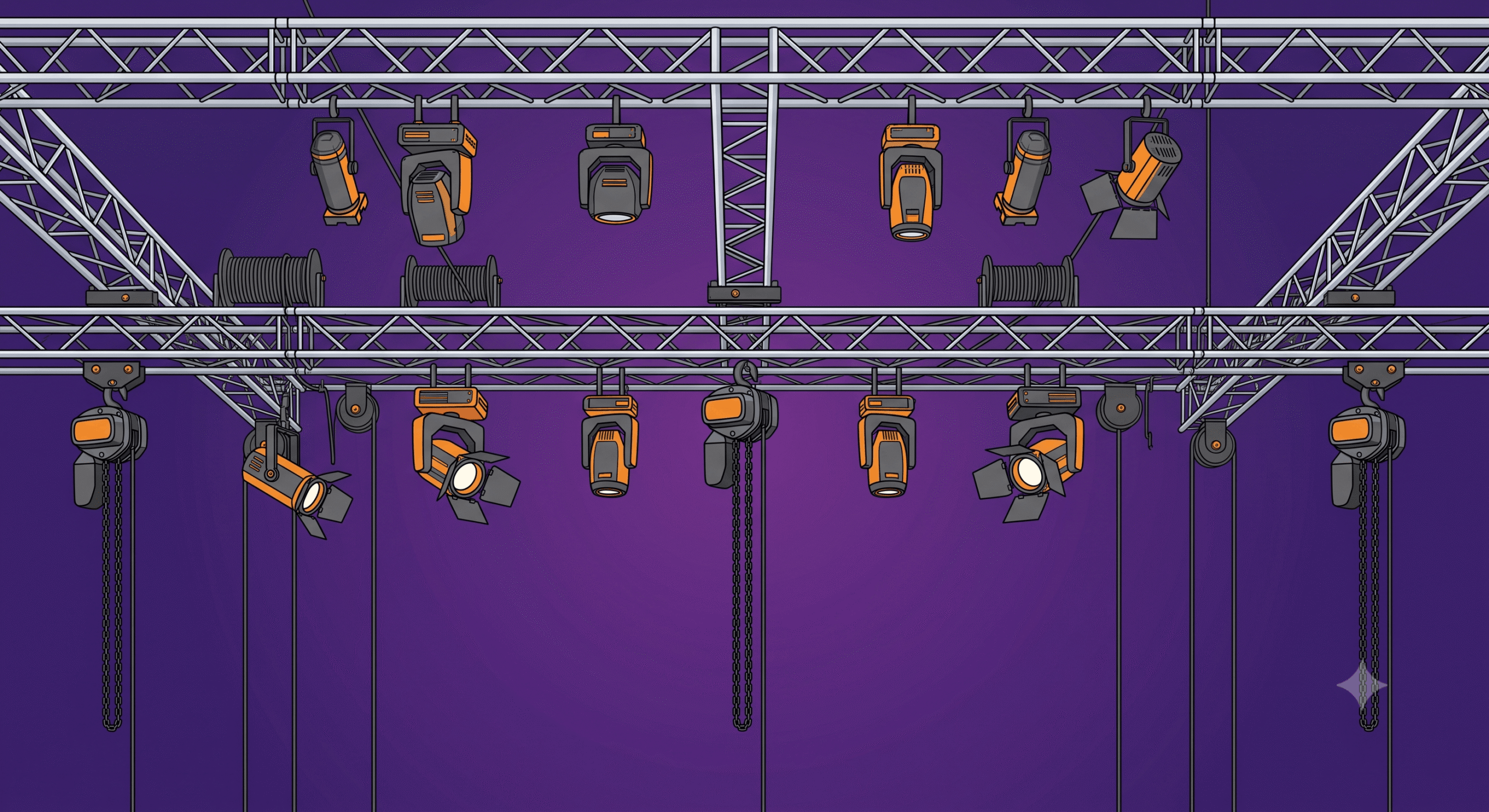
Walk into any big Indian wedding, award show, or concert an hour before doors open and look up. Everything hanging above the stage — the lighting rig, the video wall, the speaker clusters — is held there by aluminum truss, chain motors, and load-rated hardware. Someone built that system, checked every connection, and signed off on it being safe to stand under. That’s rigging and trussing work, and almost nobody in India talks about it as a real career path. This guide answers the question straight: what the job actually involves, whether it pays enough to build a life on, what training gets you taken seriously, and where it can lead.
If you’re an event management graduate who knows how to plan a run-of-show but has never been handed a load chart, or a fresher wondering if there’s a technical, hands-on job in live events that isn’t “just gig work,” this is written for you.
Part of why this career stays invisible is that most event management courses in India teach coordination — vendors, timelines, budgets — and stop there. Nobody sits students down and explains that the truss above the stage is a specialised, well-paid technical job with its own skill set. That gap is exactly why capable graduates end up stuck in planning roles long after they’ve realised the technical side pays better and interests them more.
Table of Contents
What Does a Rigging and Trussing Technician Actually Do at a Live Event?
A rigging and trussing technician builds the overhead structure that carries lighting, sound, and video safely above a crowd. That means assembling aluminum box truss into grids, hanging chain motors or hoists from fixed points, calculating how much weight each point can safely carry, and checking every shackle, coupler, and steel connection before a single light goes up. The job sits underneath everything visible on stage — nobody in the audience notices good rigging, but everybody notices when it fails.
On event day, the work starts hours before the crew that hangs lights and speakers even arrives. Riggers read the load plan, mark hang points, build the mother grid, and run motors up and down until the truss sits level and secure. Through the show, they’re the ones a technical director calls if something shifts, sags, or needs re-checking. It’s precise, physical, safety-critical work — closer to structural problem-solving than to the “creative behind-the-scenes” framing most career content gives live events.
What a Rigging Technician’s Day Actually Looks Like
A typical event day starts with a load-in call — often before sunrise for a large show. The rigging team walks the venue first, checks the fixed hang points or truss towers against the load plan, and confirms the structure can safely take the planned weight. Truss goes up in sections, motors get chained in, and every connection gets a visual and physical check before anything else is hung from it.
Once the lighting and video teams start loading equipment onto the rig, the technician’s job shifts to monitoring — watching for uneven load, checking motor positions during the show, and being the first call if anything needs adjusting mid-event. It’s a job built on checklists and repetition, not improvisation.
Is Rigging and Trussing a Real Full-Time Career in India, or Just Gig Work?
Rigging work in India runs on both ends of that spectrum, and which one you land in depends on where you build your skills. Freelance riggers get called project to project by production houses for concerts, award shows, and large weddings — real income, but inconsistent. Full-time event rigging technician roles exist inside structures rental companies and production equipment companies, the businesses that own the truss, motors, and hardware and deploy it on every job that comes through.
Where Rigging Work Actually Lives
Structures rental and AVL (audio-visual-lighting) rental companies are the segment of the industry where rigging and trussing sits as a permanent job function, not a freelance gig. IIED alumnus Silas Paul Uba was placed as a Technician–Lighting (Grade B) at LumaSonic Structures Rental in Goa — ₹25,000 a month plus medical insurance, personal accident cover, phone allowance, tools, and uniform. LumaSonic is exactly the kind of company that owns and deploys trussing and rigging equipment for a living, and a full-time technician role there comes with the same salary structure and benefits you’d expect from any stable technical job.
The same pattern shows up internationally. Alumnus Atharv Devikumar Jog was placed as a Lighting Operator at SLS Production Equipment L.L.C in Saudi Arabia — SAR 10,000 a month, with company accommodation, a return air ticket, and transportation included. SLS is a production equipment company, and rigging, trussing, and lighting hardware are core to what they deploy on-site. Neither Silas nor Atharv holds the exact job title “Rigger,” but both work inside the structures-rental and production-equipment ecosystem where rigging and trussing careers actually live — proof that this is a real employment category, not a patchwork of one-off gigs.
Beyond structures-rental and production-equipment companies, rigging work also sits inside touring production houses that travel with concerts and award shows, and inside the in-house technical teams that larger venues and cultural centres keep on staff year-round. Each of those settings pays differently — a touring crew role might mean irregular but higher-paying stints, while an in-house or rental-company technician role means steadier income with the kind of benefits Silas’s offer included. Knowing which of these you’re aiming for changes how you should build your skills and who you should be applying to.
To be direct about it: IIED does not run a standalone rigging certification course, and we won’t pretend otherwise. Rigging fundamentals — load calculation, safety protocol, truss and mother grid work — are taught as part of the One Year Program in Lighting Design and the Vectorworks Spotlight for Event Production course, not as a separate diploma. If you want the technical foundation this field runs on, that’s where it’s built.
Do You Need an Engineering Degree to Work in Event Rigging?
No. Rigging work rewards hands-on technical skill, attention to detail, and a working understanding of load, angles, and basic physics — not a formal engineering degree. What actually gets you hired is proof you understand how a truss system behaves under weight, how to read a rigging plot, and how to follow a safety protocol without shortcuts. That’s trainable through structured, practical courses; it isn’t gatekept behind a four-year engineering pathway the way some people assume.
Who This Career Path Is For
This path fits three kinds of people especially well. First, event management graduates who can plan a wedding or corporate event but keep getting passed over for technical production roles because they’ve never touched a load chart, a truss section, or a lighting console — the planning-and-coordination skillset they already have doesn’t translate into rigging or technical crew work on its own. Second, directionless graduates with a creative or technical instinct who want proof this is a stable, real career before committing years to it. Third, recent graduates who want a fast, practical route into a paying technical job — not another semester of theory with no hands-on equipment time.
If you recognise yourself in any of those descriptions, the honest next step is talking to someone who’s placed people into this exact ecosystem, not reading another generic “exciting career in events” listicle.
How Much Does a Rigging or Trussing Technician Earn in India?
Real numbers, from verified offer letters, tell this story better than any industry estimate. Silas Paul Uba’s role at LumaSonic Structures Rental in Goa pays ₹25,000 a month, plus ₹5,00,000 medical insurance, personal accident insurance, a phone allowance, and tools and uniform provided. That’s a full benefits package attached to a technical crew role — not a one-off freelance day rate. Atharv Devikumar Jog’s placement at SLS Production Equipment in Saudi Arabia pays SAR 10,000 a month with accommodation, flights, and transportation covered, which is a meaningfully different earning picture once you account for zero living-cost deductions.
Pay in this field scales the same way it does across live event production: entry-level technician and crew roles start modest but come with real benefits at established structures-rental and production-equipment companies. Earnings climb once you can run a rig independently, supervise a crew, or move into console operation and lighting design.
India’s live events market is growing quickly enough to support that climb. The organised live events segment grew 44% in 2025 alone, according to a BookMyShow-EY-Parthenon report, and is projected to keep expanding at close to 19% a year through 2028 as ticketed, experiential events spread beyond the metro cities. More events means more overhead structure to build safely, and more demand for people who know how to build it.
That expansion matters more than it looks on paper. The same industry data shows growth increasingly coming from “Next 10” cities beyond Mumbai and Delhi — meaning the demand for people who can safely rig a truss isn’t staying locked inside two or three metros. If you’re building this skill set now, you’re not just competing for a fixed number of Mumbai-based jobs; you’re positioning for a market that’s actively expanding into new cities that don’t yet have an established pool of trained technicians.
What Technical Foundation Actually Gets You Hired for Rigging Work?
Rigging and trussing sits at the intersection of two skill areas: structural/load safety knowledge and technical production documentation. You don’t need both taught as a single “rigging course” — you need real depth in the courses that already cover this ground properly.
The One Year Program in Lighting Design covers loading, rigging, weight calculation, and workplace safety as a full module inside the curriculum — alongside power and electrics, DMX, and live console training on GrandMA3 and Avolite Titan. This is where you learn why a load chart says what it says, not just how to follow one.
The Advanced Level of the Vectorworks Spotlight for Event Production course covers rigging documentation directly: truss, mother grids, and bridles, plus lighting device placement and custom scaffolding systems. This is the software skill that lets you produce the rigging plot a technical director actually works from — the same kind of technical documentation foundation that placed alumnus Aron Sagar into the Operations & Production department at NMACC (Nita Mukesh Ambani Cultural Centre) in Mumbai after completing CAD for Events & Entertainment.
Rigging safety standards internationally are governed by real technical bodies — ANSI/ESTA E1.2, for example, is the published standard covering the design, manufacture, and use of aluminum trusses and towers in entertainment. You won’t need to read the standard cover to cover, but the courses above are built around the same safety logic it codifies: know your load, check your hardware, never guess.
Where This Career Goes From Here
Rigging and trussing is rarely a career destination on its own — it’s a technical entry point. Alumnus Rishabh Rao already worked in his family’s AVL rental business before training with IIED; the Lighting Design program gave him the load, rigging, and safety foundation behind the equipment he now runs business development and technical operations on. That’s the realistic trajectory: start on the technical crew side, and the same load-and-safety knowledge that gets you hired as a technician becomes the foundation for moving into lighting design, console programming, technical direction, or production management as you gain experience.
It helps to see where rigging sits inside the wider technical production picture rather than as an isolated skill. We’ve covered the broader landscape of technical crew careers — camera, sound, lighting, and production roles that sit behind the scenes at a live event — in What Is Technical Production in Events? Rigging is one entry point into that landscape; production management and technical direction are common places it leads.
Ready to Build the Technical Foundation?
Rigging and trussing is real, safety-critical, paying technical work — and it’s built on skills you can actually learn: load safety, rigging documentation, and the console and CAD tools the industry runs on. If you’re an event management graduate stuck outside technical roles, or you just want proof this career is real before you commit, come see the training in person. Book your free visit at IIED’s Malad East campus and ask to see the Lighting Design and Vectorworks Spotlight curriculum for yourself.