
Every college fest has one or two students who never go on stage. They’re behind it — focusing the lights before the show, taping cables to the floor so nobody trips, calling “go” on the cue that starts the music. If that’s you, you already know more about a backstage technical crew career in India than you think. Nobody ever tells you this counts. It gets filed under “extracurricular,” somewhere below your actual degree, as if running a live show under pressure is a hobby and not a skill.
It isn’t a hobby. It’s raw material. Live event companies in India are short on people who can rig safely, run a console, and stay calm when a show is thirty seconds from going live and something breaks. That’s exactly what backstage crew work teaches you — informally, for free, usually at 11pm the night before opening. What’s missing isn’t talent. It’s the technical training that turns that instinct into a job offer.
This post is the honest version of that path: what backstage and stage crew experience is actually worth, what event production companies look for that a college fest doesn’t teach you, and five practical steps to go from unpaid backstage volunteer to paid technical crew member.
Table of Contents
Your Backstage Theatre Work Already Looks Like a Technical Crew Job
Strip away the “college theatre” label and look at what you actually did. You read a lighting plot, or built one from scratch on a whiteboard. You focused fixtures before a show. You ran a basic console, even a cheap one, and called or followed cues in real time. You dealt with cabling, rigging a truss or a batten, and probably fixed something backstage under time pressure with nobody senior around to ask.
That is the job. Not a simplified version of it — the actual daily work of a technical crew member on a live event. A stagehand at a concert, a rigging assistant at a wedding, a lighting technician at a corporate event: all of them are doing a professional version of what you already did for free.
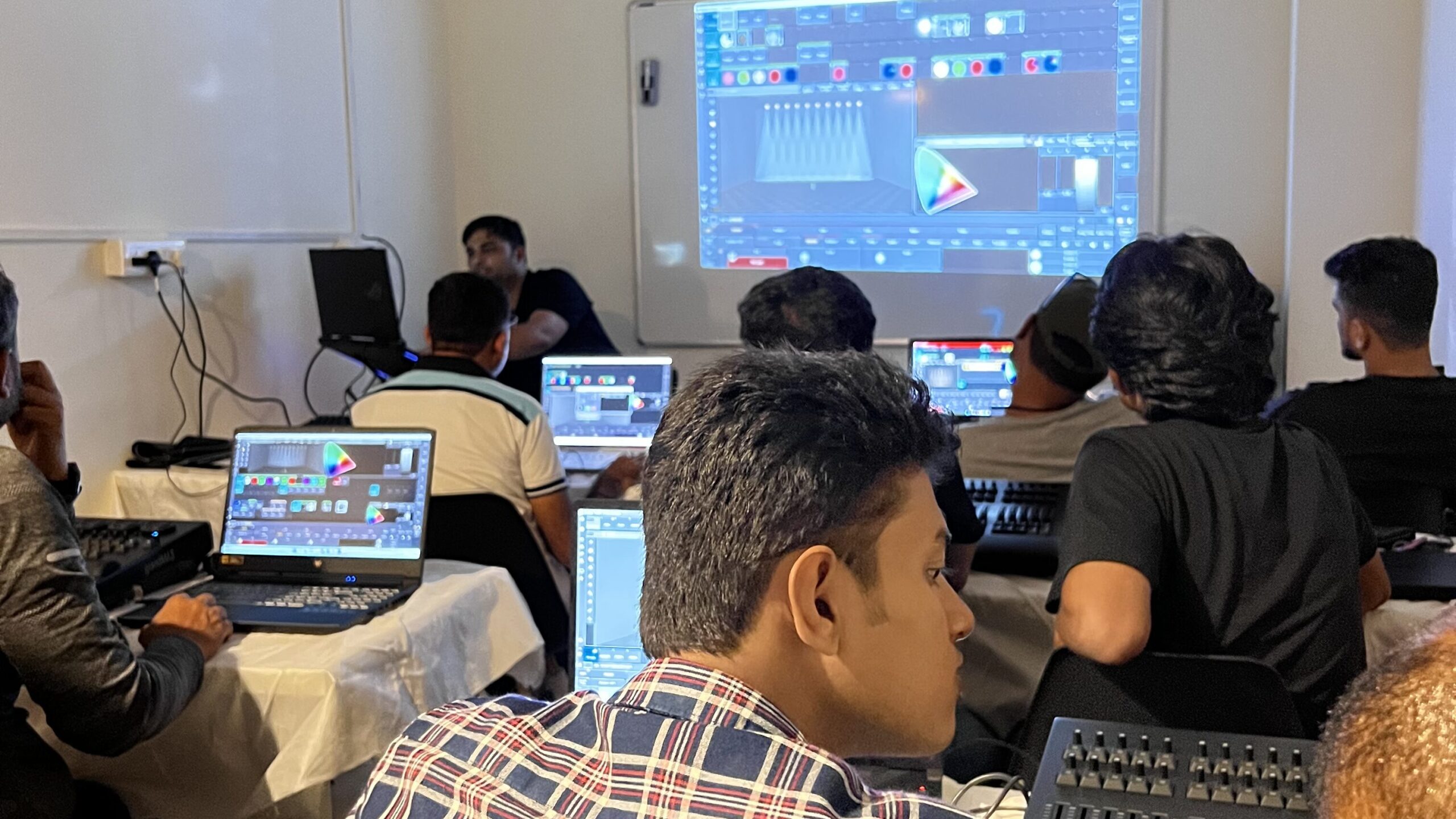
The gap isn’t ability. It’s certification and exposure to professional-grade equipment. College and community theatre rarely has a GrandMA3 or Avolite Titan console, proper DMX networking, or documented rigging safety training. Event production companies won’t take your word for it that you can run a show — they need to see that you have worked on the equipment they actually use, and that you understand the safety standards that protect a room full of people under a rigged truss.
Theatre Stage Crew to Event Production Career in India: What Actually Changes
Moving from theatre stage crew to an event production career in India is less about starting over and more about translating what you know into an industry that has its own vocabulary, its own equipment standards, and its own hiring process.
A few real differences:
Scale and stakes. A college play runs for a weekend in a 200-seat auditorium. A corporate event or wedding might run once, for one night, in front of five hundred guests and the client’s entire reputation. There is no dress rehearsal that matters more than opening night — every night is opening night.
Equipment. Community theatre often runs on whatever the auditorium already owns. Professional live events run on GrandMA3 or Avolite consoles, wireless and wired DMX, moving lights, and rigging hardware rated and inspected to a safety standard. If you have never touched this equipment, that’s the first real gap to close — not your instincts, your equipment hours.
Documentation. Professional productions run on light plots, cable schedules, and rigging plans drawn in CAD or Vectorworks, not a sketch on a notepad. Event companies hire people who can read and build these documents, because it’s how a crew of strangers sets up a show correctly in six hours instead of guessing.
Pay and structure. Theatre backstage work is usually unpaid or a stipend. A technical crew role in live events is a real job, with a salary, sometimes benefits, and a career ladder from crew member to technician to operator to designer.
None of this means your theatre background doesn’t count. It means it’s the starting point, not the finish line. The students who make this move successfully are the ones who stop treating backstage work as a side interest and start treating it as year one of a technical career that just hasn’t been trained properly yet.
Who This Career Path Actually Suits
This route suits two kinds of people specifically.
The first is the college theatre student — usually 18 to 22 — who has been quietly running lights, building sets, or managing cues for the annual fest or a local theatre group. You’re not sure if this “counts” as a real skill because nobody in your life has called it one. You’re exploring this path a little secretly, unsure whether to tell your parents you’re thinking about lighting and production instead of the career your degree suggests.
The second is the event management graduate or student who has also done backstage or theatre work on the side — and is frustrated that neither path alone got them hired as an actual technical operator. Event management diplomas teach coordination: vendors, timelines, client communication. They rarely teach you to run a console or read a rigging plan. If you’ve done both, on paper you look like a coordinator, when what you actually want is a technical role. That mismatch is common, and it’s fixable with the right training rather than a second full degree.
If either of those sounds like you, the gap between where you are and a paid role isn’t your potential. It’s a specific, short list of technical skills — and that’s the good news, because a specific gap is one you can close on a timeline, not an open-ended “figure it out.”
It’s worth being honest about why a general event management course alone often doesn’t solve this. Event management programmes are built around coordination: budgets, vendors, timelines, client conversations. That’s a real and useful skillset, but it’s a different job from the one you learn backstage. A coordinator plans the show. A technical crew member builds and runs it. Students who complete an event management diploma and then discover their real interest is technical production often end up applying for coordinator roles they don’t actually want, simply because that’s what their qualification says they’re for. Backstage experience plus focused technical training points you at the role you actually did in college — running the show, not scheduling it.
The Backstage Technical Crew Career Path in India: 5 Practical Steps
Here is the honest, step-by-step version of the backstage technical crew career path in India — from where you are now to a paid crew role.
Step 1 — Name what you already have
Before anything else, write down what you’ve actually done backstage: shows run, consoles touched, rigging you’ve helped with, problems you’ve solved live. This becomes the first draft of your technical portfolio, and it’s also proof to yourself that you’re not starting from zero. Most students underestimate this list until they see it written down.
Step 2 — Get formal rigging and safety training
This is the single most important gap between “backstage volunteer” and “hireable technical crew.” Professional rigging and trussing safety training covers load limits, correct hardware, inspection routines, and the electrical safety basics — earthing, dimming circuits, generator power — that a college auditorium never required you to learn because nobody’s life depended on it there. In a professional event, it does. Employers will not hand you rigging responsibility without proof you understand this.
Step 3 — Learn a real console and DMX properly
Whatever you ran in college theatre, it almost certainly wasn’t a GrandMA3 or an Avolite Titan, and it probably wasn’t running full DMX networking with wireless links, RDM, or Art-Net protocols. Learning a professional console — programming cues, building presets, understanding tracking — is what turns “I can technically operate lights” into “I can run this show.” Console skills are also the fastest way to move up from crew member to operator, because they’re the most visibly billable skill on a live event.
Step 4 — Build CAD literacy for light plots and documentation
Event production runs on paper before it runs on stage: light plots, cable schedules, rigging drawings. Knowing how to read one is useful. Knowing how to build one in CAD or Vectorworks is what gets you trusted with more responsibility, faster, because it proves you understand the show as a system, not just your one task inside it.
Step 5 — Take the first paid crew role and specialise
Your first paid job in live events is rarely your final role — it’s proof of employability. Take the entry-level technical crew position, do the unglamorous cabling and load-in work well, and use it to decide where you specialise: lighting, rigging, or console operation. Every alumni story below started exactly here — an entry point, not a finished career.
Real Placements: From Adjacent Technical Work to Paid Lighting Careers
None of this is theoretical. IIED trains students on the same equipment — GrandMA3 consoles, AutoCAD, Vectorworks — and with the same industry mentors that live event companies actually hire from. Here’s what that path has looked like for students who came in with adjacent technical experience, not a theatre or lighting degree.
Silas Paul Uba started in audio mixing and media production — adjacent technical work, not lighting. After training at IIED, he switched to lighting and was placed as a Lighting Designer (Technician – Lighting, Grade B) at LumaSonic Structures Rental in Goa, on a package of ₹25,000 per month plus medical insurance of ₹5,00,000, personal accident insurance, a telephone allowance, and tools and uniform provided, in September 2025. His own words: “My journey is proof that your previous production skills can be the perfect foundation for a new career in light.”
Vinith came from a background as a sound engineer, not lighting. After training with IIED, he was offered a role at a global production company — and turned it down to join LGL Designs, working directly under his mentor Lloyd Albuquerque. That’s a career built on real technical skill, not a lucky break.
Atharv Devikumar Jog was already working in lighting, but without the technical foundation employers wanted. After completing IIED’s One Year Program in Lighting Design, he was placed as a Lighting Operator at SLS Production Equipment in Saudi Arabia, on SAR 10,000 per month plus accommodation and return flights, in August 2025.
Rishabh Rao came from a family AVL rental business — already adjacent to technical production — and joined IIED for the professional foundation he was missing. He now runs the family business with design precision he didn’t have before.
The pattern across all four: none of them started with a lighting degree. They started with adjacent, hands-on experience — audio, media, a family AVL business — the same category of experience most backstage theatre crew already have. Training closed the gap. It didn’t replace what they already knew.
What Technical Crew and Lighting Roles Actually Pay in India
Real numbers, from verified placements, not averages pulled from a jobs site:
Silas Paul Uba, Lighting Technician (Grade B) at LumaSonic Structures Rental, Goa: ₹25,000 per month, plus medical insurance of ₹5,00,000, personal accident insurance, telephone allowance, tools and uniform.
Atharv Devikumar Jog, Lighting Operator at SLS Production Equipment, Saudi Arabia: SAR 10,000 per month, plus company accommodation, return flights, and transportation.
These are entry-level and early-career numbers for people with prior adjacent experience plus formal training — not ten-year veteran salaries. They’re also proof that a backstage technical crew career in India is a real, paying job, not an abstract possibility. Console operators, especially those trained on GrandMA3, are in particularly short supply in India relative to demand, which puts consistent upward pressure on what a trained operator can ask for.
The Technical Standards Behind This Work
This isn’t an informal industry, even though it can feel that way from inside a college green room. Rigging, DMX networking, and lighting console operation are treated as skilled, standards-based work by the international bodies that govern live event technology — organisations like PLASA, the Professional Lighting and Sound Association, which publishes technical standards for exactly this kind of work. That’s the honest reason certification and formal training matter here: this is a field with real safety consequences and real professional standards, not a space where enthusiasm alone gets you hired.
If you want to go deeper on where this fits in the wider event production landscape, IIED has a full breakdown of what technical production in events actually covers, and a more detailed look at what a rigging and trussing career in India involves day to day. If lighting specifically is the direction you’re leaning, the lighting design career path in India breaks down the five honest levels from technician to director, so you can see exactly where step five above is heading. You can also see the full curriculum for the One Year Program in Lighting Design IIED alumni referenced above went through.
If you’ve been running lights or crewing backstage and wondering whether it’s a real career, come find out properly. Book your free visit to IIED and see the console, rigging, and CAD training that turns backstage experience into a paid technical crew career.