
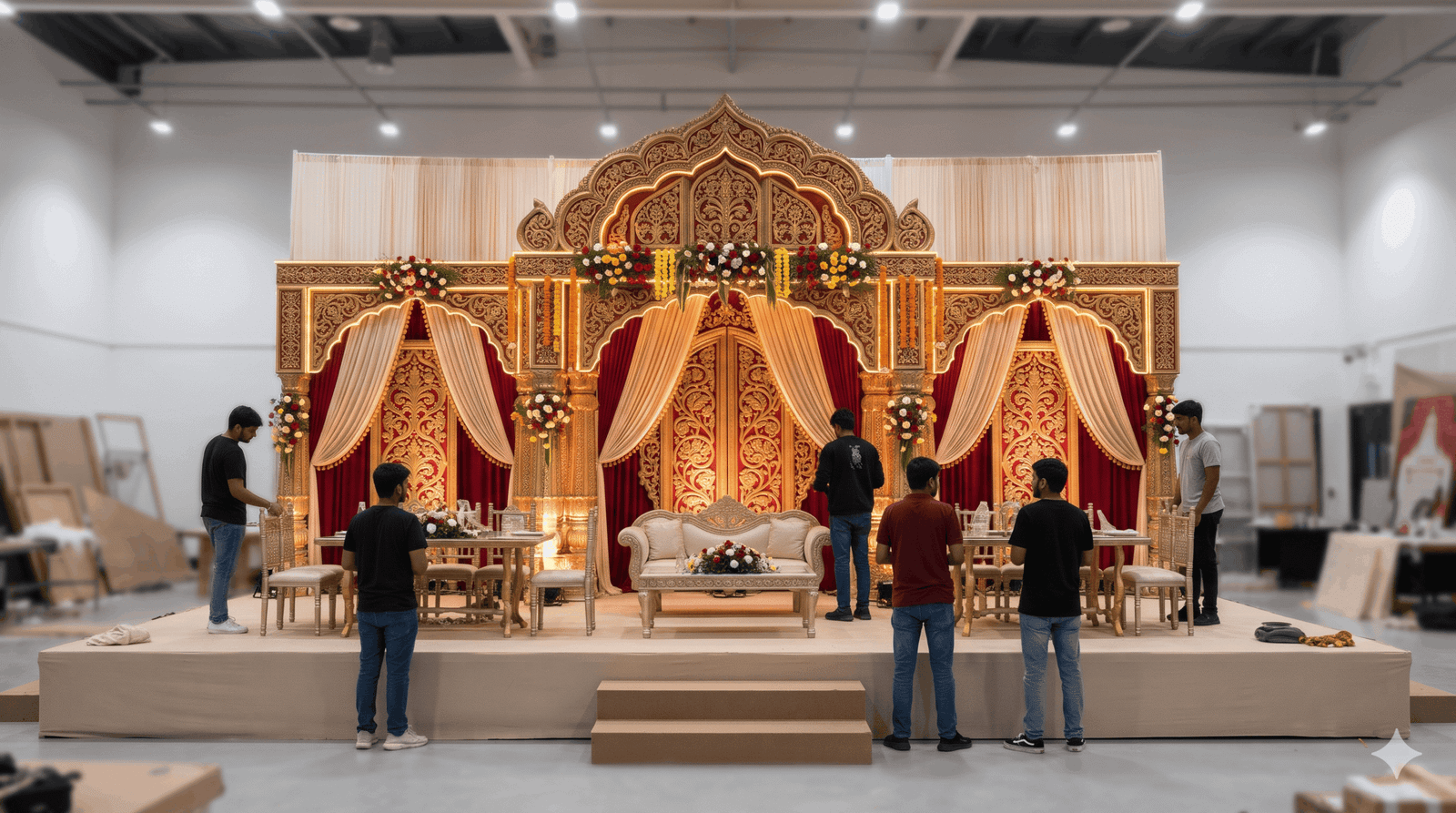
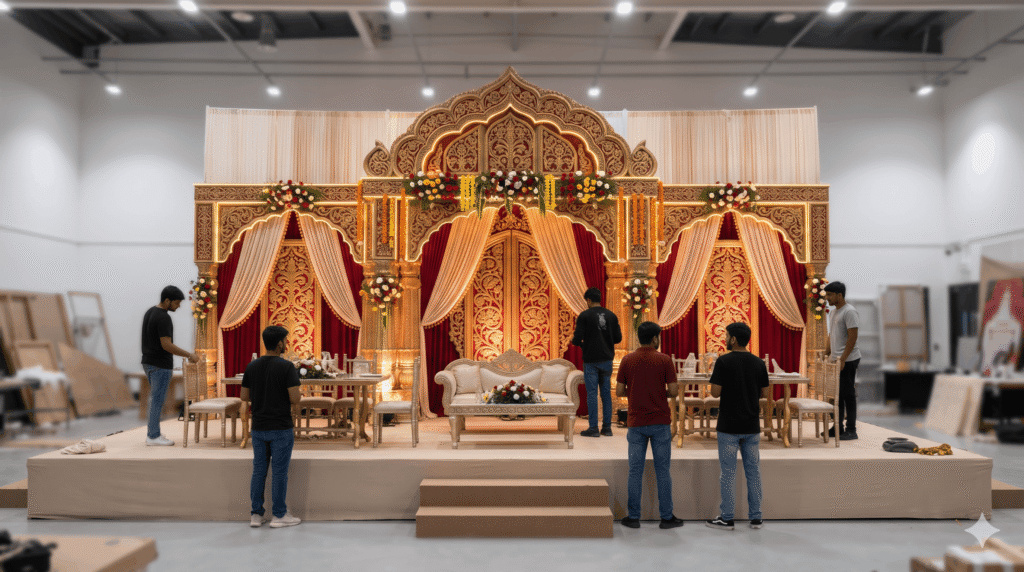
Yes, you can do a masters in set design in India. But the options are not alike. Some are film-only production design programmes. Some are short workshops. Some sit inside interior or architecture schools.
Very few train you for weddings, live events, corporate shows, exhibitions and film/TV together, which is where much of India’s set work actually happens.
This guide lays out your real options, what you build in a two-year MA in Set Design, the careers it leads to, and six honest checks to help you choose. No guarantees, no hype. Just the information we wish more graduates had before they picked a course.
Table of Contents
What Is a Masters in Set Design?
A masters in set design is a postgraduate programme that trains you to design and build physical worlds for an audience. That world could be a wedding mandap, a corporate launch stage, an award show, an exhibition stall or a film set. The job is the same at its core: take a brief, turn it into a concept, draw it, model it, cost it, and see it built safely and on time.
Most people looking for a masters in set design India get confused by three terms that get used interchangeably. They overlap, but they are not the same job.
IIED COURSE
MA in Set Design
Two years of hands-on set design for weddings, events, film and TV, built for graduates from any stream.
Duration: 2 Years (4 Semesters) · Mode: Full-time, classroom in Mumbai
Set design vs production design vs art direction
Set design focuses on the physical set: its structure, layout, materials, finishes and how it is built. Production design is the complete visual world of a production, including sets, props, colour and overall style. Art direction sits between the two. The art director runs the art department and turns the production designer’s vision into drawings, builds and dressing on the ground.
In Indian weddings and events, these roles often blend. A single designer may sketch the mandap, draw it in CAD, pick fabrics and sign off the build. On a film set, the roles are more separated. If you want the full breakdown, read our guide on set design vs production design.
Who a masters suits, and who doesn’t need one
A two-year masters suits you if you have finished graduation, want a creative career on stages and sets, and can commit two full years to building skill and a portfolio. It suits graduates in architecture, interior design, fine arts and design. It also suits graduates in commerce, science, arts or anything else who know they want to build things people walk into.
You may not need a masters if you already work in decor or events and only need one skill, like CAD or 3D visualisation. A short, focused course may get you there faster. And if you cannot step away from work for two years, a full-time MA is not the right fit right now. Being honest about that saves you time and money.
Your Options for Postgraduate Set Design in India
When you search for a postgraduate set design India programme, most results are film production design programmes or masters courses in the UK and US. Here is a fair look at the main routes open to a graduate in India, and what each is built for.
| Route | Focus | Duration type | Hands-on level | Best for |
|---|---|---|---|---|
| Film-school production design programmes | Film and screen | Multi-year, full-time | Varies; studio and shoot-based | Graduates certain they want to work only in film |
| Short film/theatre design workshops | A taste of production design | Days to weeks | Light; introductory | Testing interest before committing |
| Interior design or architecture routes | Built spaces and interiors | Multi-year | Studio-based, art-school framing | Those who want interiors first, sets second |
| Short certificate courses in event or wedding design | One skill area (decor, visualisation, CAD) | Weeks to months | Practical, narrow | Working professionals adding one skill |
| IIED’s 2-year MA in Set Design | Weddings, events, film and TV together | 2 years (4 semesters), full-time | High: drawing, models, CAD, workshop builds, internship | Graduates from any stream who want a full set design career across live and screen work |
A few honest notes on this table. Whistling Woods offers an MA in Film Making with a Production Design track, and it is film-focused. FTII runs short workshops, which are good tasters but not a full career route. Interior design schools tend to frame set work as an art-school subject. Each of these can be the right choice for the right person.
Where the gap sits is breadth. Very few programmes treat set design across weddings, live events, corporate shows and film/TV as one craft. That matters in India, where a huge share of set work happens off-screen. India’s wedding industry alone is worth an estimated ₹3.75 lakh crore, and every one of those weddings needs a stage, a mandap and an entry. On the screen side, IBEF reports that India’s media and entertainment sector grew 3.3% to ₹2,50,000 crore in 2024.
So when you compare production design masters India options, ask a simple question first: where do I want to work? If the answer is “only film”, a film-school route makes sense. If the answer is “anywhere people build sets”, you need training that covers live events too.
What You Learn in a Two-Year MA in Set Design (IIED)
IIED’s MA in Set Design is our own two-year, full-time, hands-on master’s programme, run from our Mumbai studio. It is open to a graduate in any discipline. The course builds skills in order, from drawing by hand to designing full productions, with a supervised industry internship in Semester 2.
Semester 1: Foundations
You start with the basics every set designer needs, whatever industry they end up in:
- Design fundamentals, composition and colour
- History and theory of set and production design
- Set sketching, perspective and model-making
- Visual storyboarding, concept and rendering
- Health, safety, rigging awareness and production management
- Indian Knowledge System: Indian architecture and performance spaces
- Research methodology for design practice
- Elective: Interior Design and Décor for Set Environments, or Architecture, Period Style and Spatial Reference
If you have never sketched seriously, this is where you learn. Perspective and model-making are taught from the ground up, so you do not need an art background to begin.
Semester 2: Digital design and realisation
In the second semester, your ideas move from paper to screen to real builds:
- CAD, graphic visualisation and Generative AI (AutoCAD, Photoshop, Illustrator)
- Set construction, materials, structures and backdrops
- Production design principles
- Props, set dressing and décor
- Indian Knowledge System: Indian craft, décor and festive design
- Elective: Set Design for Film and Television, or Theming and World-Building for Weddings and Events
- Industry internship with a set, event or art-department company
A quick word on the Generative AI module. It teaches you to use AI tools for early concept work in an ethical, copyright-aware way. It is not a replacement for design skill. A client still needs a designer who can draw a buildable set, read a venue and solve problems on site. AI helps you explore ideas faster; your training decides whether those ideas can actually be built.
Year 2: Advanced practice and capstone
The second year takes you into advanced set construction and finishes, advanced 3D visualisation and virtual sets, and production design across weddings, events, film and TV. You also learn budgeting, costing and vendor management, which is the part many designers learn the hard way on the job.
The final semester ends with a capstone project that you design and deliver before a live public audience, plus a research dissertation. That capstone becomes the centrepiece of your portfolio. Full semester details are on the MA in Set Design course page.
Why the Indian Knowledge System modules matter
Indian sets draw on festival, ritual, craft and performance traditions. A mandap is not just a structure. It carries meaning, proportion and craft that guests notice, even if they cannot name it. Studying Indian architecture, performance spaces, craft and festive design gives you a deeper reference library than mood boards alone. It also helps you design with respect for tradition rather than copying a trend.
How this compares with a short course
A short course teaches one area well. A two-year MA in set design India gives you the full chain: concept, drawing, CAD, materials, construction, safety, budgeting and creative direction. If you are a fresh graduate with no industry contacts yet, that full chain plus an internship and a public showcase gives you more to show an employer on day one.
The Set Designer Career Path in India: Where an MA Leads
The set designer career path in India is wider than most graduates expect. Set work is not limited to Bollywood. It runs through weddings, corporate events, award shows, concerts, exhibitions, retail and television. Roles a set design graduate can aim for include:
| Role | What the role does |
|---|---|
| Set Designer | Designs the physical set for a show, event or shoot |
| Production Designer | Owns the overall visual world of a production |
| Art Director / Assistant Art Director | Runs the art department and the build |
| Set Dresser / Props Master | Sources, makes and places props and décor |
| Wedding and event scenic designer | Mandaps, stages, entries and themed worlds |
| Exhibition and retail environment designer | Stalls, pavilions and brand spaces |
| 3D Visualiser | Turns concepts into renders clients can sign off |
For a closer look at day-to-day work and pay, read our guide to the set designer career in India.
What IIED alumni are doing today
The MA in Set Design is new, so it has no graduates yet. We will not pretend otherwise. What we can share is where IIED’s Wedding, Event & Set Design alumni (from the Event & Wedding Design Visualization programme) are working now. These are real outcomes from the same studio and the same design approach.
- Pranay Mhatre is a Production Designer at WIZCRAFT International Entertainment in Mumbai, India’s oldest and #1 event company.
- Shreya Pais joined as a fresh graduate with zero experience. Her portfolio landed her a job instantly, and she now works in Dubai.
- Bhavya studied online from Jodhpur and was hired as a Designer at Taxi Design, Mumbai, on the strength of her portfolio.
- Varun Jain is a Design Associate at The Finale Eventz, Mumbai, on ₹45,000/month during probation and ₹50,000/month once confirmed (verified offer letter).
Across the Event & Wedding Design Visualization programme, for students with 0–1 years’ experience, the highest CTC is ₹6 LPA, the average is ₹4.68 LPA and the median is ₹4.80 LPA. These are entry-level figures, not promises. Your pay will depend on your portfolio, your city and the company you join.
Why the portfolio matters more than the certificate
Notice the pattern in these stories. Shreya and Bhavya were hired because of what their portfolios showed. In set design, employers want to see what you can draw, model and build. A strong course should leave you with real projects, real drawings and real build photos, not just a certificate. Ask any course you consider what your portfolio will look like when you finish.
Is this a good fit for career switchers?
If you are already working and want to switch into set design, the MA is a serious option, but be honest with yourself. It is full-time for two years. If you can commit to that, you get the full chain of skills and an internship. If you cannot, a short course in event or wedding design, or a focused CAD course, can be a smarter first step while you keep your job.
How to Choose a Set Design Course After Graduation: 6 Honest Checks
Whether you pick IIED or another route, use these six checks before you commit to any set design course after graduation. They will save you from paying for a course that does not match your goals.
1. Focus: film only, or live events too?
Check where the course expects you to work. If every project is a film set, you will graduate film-ready but may struggle in weddings and events, where much of India’s set work is. If you want options, look for a course that covers both.
2. Hands-on hours
Ask how much time you will spend drawing, model-making and building, versus listening to lectures. Set design is a physical craft. You learn it by making things, failing, and fixing them.
3. Who teaches
Find out whether the faculty are working set designers, fabricators and architects, or mainly academics. Real industry mentors teach you how jobs actually run: deadlines, budgets, vendors and venue rules.
4. Tools taught
Look for AutoCAD, Photoshop and Illustrator at minimum, plus 3D tools like SketchUp, 3ds Max or Blender, and production drawing tools like Vectorworks. If a course skips CAD, you will need to learn it separately later.
5. A real internship
An internship inside the course gives you industry exposure before you graduate. Check whether it is supervised, with a real company, and part of the programme rather than something you arrange alone.
6. The portfolio you leave with
Ask to see past student portfolios. Does the work look like something a production house or wedding design company would hire? Are there built sets, not just renders? Your portfolio is your job application.
Who IIED’s MA fits: graduates from any discipline who want a full set design career across weddings, events, film and TV, and can commit two full-time years in Mumbai. Who it may not fit: someone who wants film only, or someone who needs to keep working full-time. In those cases, another route from the table above may suit you better.
Skills and Software to Start Now
You do not have to wait for a course to start building set design skills. Here is what you can begin this month, at home.
Sketching and perspective
Carry a sketchbook. Draw stages, shop fronts, temple gateways and wedding entries you see around you. Practise one-point and two-point perspective. You are training your eye to see space, scale and proportion.
CAD and Vectorworks
AutoCAD is the common language for floor plans and elevations in Indian events and production. Vectorworks Spotlight is widely used for stage and production drawings. Start with free tutorials to learn the interface, then draw a simple stage plan from a real event photo.
Rendering and 3D
SketchUp is the easiest place to start modelling. Blender is free and powerful. Once you are comfortable, explore 3ds Max with V-Ray for realistic renders. For a full rundown of tools, read our guide to set designer software in India.
Observation and research
Watch award shows, concerts and films with the sound off. Notice how the set guides your eye. Visit exhibitions and note how stalls are built. Collect photos of Indian craft, textiles and architecture. This becomes your design library.
Start a mini portfolio
Pick one brief, like a 20-foot reception stage, and take it from sketch to model to simple CAD drawing. Even one complete project shows a course or an employer that you can think like a designer.
Frequently Asked Questions
Is there a masters in set design in India?
Yes. Options include film-school production design programmes, short workshops, interior and architecture routes, and IIED’s 2-year, full-time MA in Set Design, which covers weddings, events, film and TV together.
What is the difference between a masters in set design and a masters in production design?
Set design focuses on the physical set: structure, layout, materials and build. Production design covers the complete visual world, including sets, props, colour and style. Many programmes, including IIED’s MA in Set Design, train you in both.
Can I do a masters in set design after a degree in any subject?
Yes. IIED’s MA in Set Design is open to a graduate in any discipline, whether architecture, fine arts, interior design, commerce, science or anything else.
How long is a masters in set design, and is it full-time?
IIED’s MA in Set Design runs for two years across four semesters and is full-time, so it suits someone who can commit two years to study.
What do you learn in an MA in set design — which software and skills?
You learn design fundamentals, colour, sketching, perspective, model-making, storyboarding and rendering, then AutoCAD, Photoshop, Illustrator and ethical use of Generative AI, plus set construction, props, set dressing, production design, safety, budgeting and Indian Knowledge System modules.
What jobs can I get after a set design masters in India (events, weddings, film, TV)?
Roles include Set Designer, Production Designer, Art Director, Set Dresser or Props Master, wedding and event scenic designer, exhibition designer and 3D Visualiser. Outcomes depend on your portfolio and the work you put in.
Do I need a drawing or art background before starting?
No. Sketching, perspective and model-making are taught from the basics in Semester 1. Practising sketching before you join will help you settle in faster.
Does a masters in set design include an internship?
At IIED, yes. A supervised industry internship with a set, event or art-department company is part of Semester 2.
Ready to Start Your Set Design Career?
A masters in set design in India is worth it when it matches where you want to work and gives you real hands-on skill, a real internship and a portfolio that gets you hired. Compare routes honestly. Use the six checks. Then pick the one that fits your life and your goals.
If you want set design across weddings, events, film and TV under one roof, with working mentors, small batches and studio-based training in Mumbai, come and see the studio for yourself. Talk to our team about the MA in Set Design and the upcoming intake.
Book your free visit — call 9892966334 or email info@weareiied.com. IIED, Shop No. 506, 5th Floor, Magic Square, Dwarkadhish Road, off Poddar Road, Malad East, Mumbai 400097.
IIED COURSE
Short Term Event Design Course
Not ready for two years? Start with event set design fundamentals, sketching and layouts, and build a first portfolio.
Duration: 4 months