
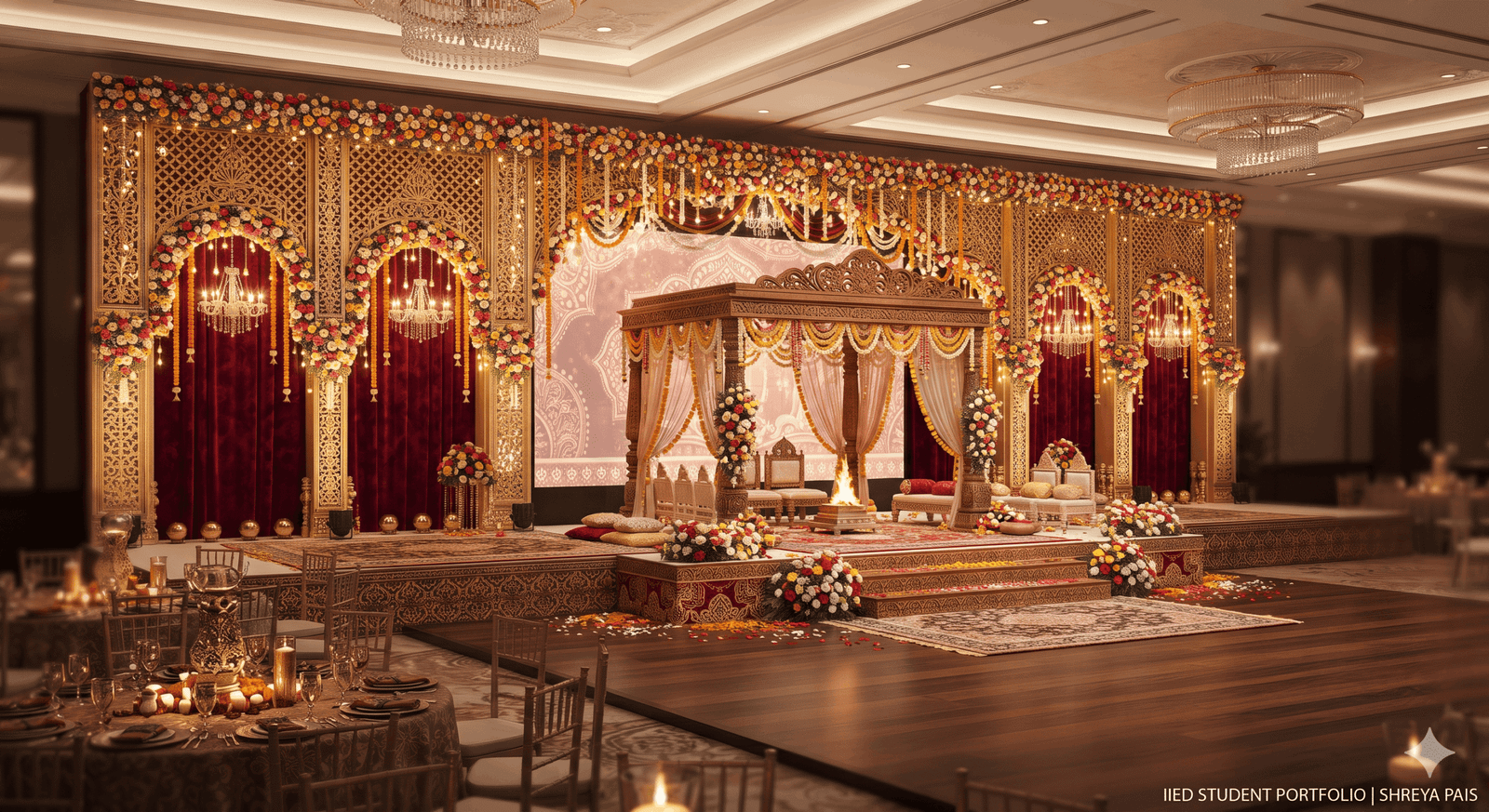
Picture one empty banquet hall. An interior designer walks in and plans it for the next ten years: flooring that survives a thousand dinners, lighting that suits every season, seating guests will use every week. A set designer walks into the same hall with 48 hours to turn it into a stage that will be gone by Monday morning. Same room. Two very different jobs.
The short answer: the set design vs interior design career choice comes down to time and purpose. Interior designers create permanent spaces people live and work in, so durability, comfort and building rules lead. Set designers create temporary worlds for one show, shoot or wedding, so visual impact, storytelling and fast, safe builds lead.
Both are strong, creative careers. Neither is a “lesser” option. But they reward different temperaments. If you love seeing a space mature and get used well for years, interior design will feel right. If you love the rush of a deadline, a reveal and a crowd seeing your work for the first time, set design will feel like home.
Table of Contents
This guide is for two kinds of readers. The first is the interior design or architecture graduate, maybe 24 to 35, who already reads plans, knows materials and uses AutoCAD, and keeps wondering if set design is the better creative fit. The second is the graduate (or parent) choosing between an interior design course and a set design course, and asking a fair question: is set design a real job? By the end, you should know which one fits you.
What Set Designers and Interior Designers Actually Do
Before comparing a set design vs interior design career, it helps to see a normal working week in each. Job titles can sound similar. The actual work is not.
IIED COURSE
MA in Set Design
Already thinking in plans and materials? This two-year programme turns that into stages, mandaps and screen sets.
Duration: 2 years (4 semesters) · Mode: Full-time in Mumbai
What a set designer does
A set designer imagines a world, draws it, models it, costs it and then sees it built safely, on time and on budget. Then, very often, they watch it come down. In India, set designers work across four big areas:
- Stages, concerts and award shows: main stages, LED-wall surrounds, entry tunnels and backdrops that must look right from the last row and on camera.
- Weddings and events: mandaps, reception stages, themed entries, corporate launch sets and brand activations. This is the biggest employer of set designers in India today.
- Film, TV and advertising: studio sets, location dressing and art-department work, where the set has to serve the story and the camera lens.
- Exhibitions and retail: trade-show booths, brand pavilions and pop-up environments that must be built, used and struck within days.
For a deeper look at the day-to-day job, read what a set designer does in India.
What an interior designer does
An interior designer plans spaces that people will use every day for years. The work usually falls into three areas:
- Residential: homes and apartments, from layout and storage to finishes, furniture and lighting.
- Commercial: offices, clinics, showrooms and retail stores, where workflow, branding and footfall matter.
- Hospitality: hotels, restaurants and cafés, where the space must look good and survive heavy daily use.
Interior designers think about comfort, function, maintenance, building and fire-safety norms, and how a space will age. They coordinate with civil contractors, carpenters, electricians and plumbers, and they hand over a space the client will live with long after the designer has left. For a neutral, detailed outline of the profession’s daily duties, the U.S. Bureau of Labor Statistics guide to interior designers is a useful read, even for Indian students.
If you are also weighing event design against interior design, we compared those two careers in a separate guide: interior design vs event design career. This post focuses only on set design: the temporary, built worlds behind stages, shows, screens and weddings.
Set Designer vs Interior Designer: 5 Honest Differences
Here is the difference between set design and interior design at a glance. Then we will go through the five that matter most when you are choosing a career.
| Factor | Set design | Interior design |
|---|---|---|
| Purpose | Create a world for an audience or a camera | Create a space people live or work in |
| Lifespan of the work | Hours, days or weeks — then struck | Years, often a decade or more |
| Project timeline | Usually weeks; builds often in 24–72 hours | Usually months |
| Materials | Light, fast, scenic: ply flats, carving foam, fabric, scenic paint, truss | Durable: stone, tile, laminate, hardware, built-in joinery |
| Main rules to respect | Sightlines, camera angles, rigging and load-in safety | Building and fire norms, comfort, long-term maintenance |
| Typical clients | Event and wedding companies, production houses, brands, studios | Homeowners, businesses, developers, hotels |
| Work hours | Office plus late-night builds and show days | Mostly office hours plus site visits |
| Common tools | AutoCAD, SketchUp, 3ds Max, Vectorworks, scale models | AutoCAD, SketchUp, 3ds Max, rendering software |
| Typical first roles | Design associate, 3D visualiser, assistant set designer, junior art director | Junior interior designer, design assistant, draughtsperson |
1. Purpose: lived-in vs looked-at
An interior must work on an ordinary Tuesday. The sofa has to be comfortable, the kitchen has to be easy to clean, and the lighting has to suit reading, cooking and guests. A set has to work at one decisive moment: when the curtain opens, the bride walks in or the camera rolls. That changes every design decision. Set designers exaggerate scale, colour and depth so a space reads from 50 metres away or through a lens. Interior designers do the opposite. They refine a space so it feels right up close, every day.
2. Timeline and pace: months vs days
Interior projects usually run for months. There is time for revisions, samples, mock-ups and careful site work. Set projects run in weeks, and the build itself is often squeezed into a day or two because the venue is only free the night before. In a set design career, a wedding stage might be designed over three weeks, built overnight, used for one evening and struck by sunrise. If tight deadlines energise you, that pace is a thrill. If they drain you, it is a real cost. Be honest with yourself here.
3. Materials and rules: durable vs fast and safe
Interior designers pick materials that last: stone, tiles, laminates, quality hardware and solid joinery. Set designers pick materials that look rich but are light, quick to build and quick to remove: ply flats, timber frames, carving foam, printed fabric, scenic paint and faux finishes. Interior work answers to building and fire-safety norms. Set work answers to a different list: audience sightlines, camera angles, load-in and load-out, and rigging safety around truss and hanging elements.
4. Clients and teams: owners vs productions
An interior designer usually works directly for the person or business that will own the space. A set designer usually works inside a production: an event company, a wedding design firm, a film or TV art department, or a brand agency. Your team is bigger and changes on every project. You will coordinate with lighting designers, fabricators, AV vendors, stage managers and choreographers. If you enjoy working in a crew with shared adrenaline, that is a big plus.
5. Tools and first roles: overlapping but not identical
Both careers use AutoCAD, SketchUp and 3D rendering. Set designers add scale models, scenic drawing, backdrop design and, often, Vectorworks for stage and production drawings. Early roles also look different. New interior designers often start as junior designers or draughtspersons in a studio. New set designers often start as design associates, 3D visualisers or assistant set designers at event, wedding or production companies.
Skills, Work Life and Earning in a Set Design vs Interior Design Career
Skills that overlap
This is the good news for interior designers. A big part of your training transfers straight across:
- Technical drawing: plans, sections and elevations to scale.
- AutoCAD and 3D visualisation: SketchUp, 3ds Max or similar tools.
- Material sense: what a finish costs, how it behaves and how it looks under light.
- Scale and space planning: how people move through a space and where the eye goes.
- Client communication: presenting concepts, mood boards and revisions.
Skills that are different
These are the skills set design adds, and the ones most interior graduates have not trained in:
- Scenic construction: flats, platforms, backdrops, carving and scenic painting.
- Rigging awareness: how hanging elements, truss and loads are planned safely.
- Lighting-aware design: designing surfaces and colours that look right under stage light and on camera.
- Fast build and strike: designing so a crew can put it up overnight and take it down in hours.
- Storytelling through space: building a world that supports a performance, a brand story or a couple’s theme.
Work life and pace
Interior design life is more predictable. Most days are studio hours, with site visits to check progress. Projects overlap, but the rhythm is steady. Set design life comes in waves. You will have calm design weeks, then intense build nights and long show days. Wedding season and award-show season can be packed. In exchange, you see your work used by hundreds or thousands of people, often within weeks of drawing it. Neither rhythm is better. In any set design vs interior design career decision, the right one is the rhythm you can sustain for years.
Career paths and earning
Set design branches into several routes once you have a portfolio and site experience:
- Set designer (events, weddings, stage shows)
- Wedding and mandap designer
- Production designer
- Art director or assistant art director (film, TV, advertising)
- Exhibition and retail environment designer
- 3D visualiser, and later creative director
We will not quote interior design salary figures here, because we do not have verified data for that field. What we can share are verified numbers from IIED’s own Wedding, Event & Set Design students, all with 0–1 years of experience who completed our Event & Wedding Design Visualization course:
| Measure | Figure |
|---|---|
| Average CTC | ₹4.68 LPA |
| Median CTC | ₹4.80 LPA |
| Highest CTC | ₹6 LPA |
Real people sit behind those numbers. Pranay Mhatre completed the Event & Wedding Design Visualization course and joined WIZCRAFT International Entertainment, India’s oldest event company, as a Production Designer in Mumbai. Varun Jain, who moved from Jodhpur to Mumbai for the offline course, joined The Finale Eventz as a Design Associate at ₹45,000 a month on probation, rising to ₹50,000 a month once confirmed. For a fuller breakdown by sector and career stage, see our guide to set designer salary in India.
For parents asking whether set design is a real job: Saanchi Rajwani landed a paid Event Design internship at Robust Events at ₹30,000 a month while she was still in her second year of graduation. That is a working professional’s stipend before she even had her degree.
Interior Design to Set Design Career Switch: What Carries Over
Can an interior designer become a set designer? Yes, and you are not starting over. Your drawing, CAD, material and space-planning skills are the foundation. What you need to add is the “live” layer: scenic construction, rigging awareness, lighting-aware design and the habit of designing for an audience or a lens instead of a resident.
In practice, an interior design to set design career switch usually looks like this:
- Reframe your portfolio. Pull out any hospitality, retail or exhibition work. These sit closest to set design.
- Learn the set-specific skills. Scenic materials, backdrops, stage layouts, truss and rigging basics, and designing under stage light.
- Build two or three set projects. A wedding stage, an event entry and a small stage or studio set are a strong start.
- Get on a real build. Nothing teaches load-in, timing and crew coordination like being there at 2 a.m. when the backdrop goes up.
- Apply to the right employers. Event and wedding design companies, production houses and art departments.
Your interior background is an advantage here. Many set teams need people who understand finishes and spatial detail. For the full route into the field, read our set designer career in India guide.
Quick self-check: 5 questions to decide which fits you
Answer these honestly. There are no wrong answers, only better fits.
- Do you want your work to last, or to land? If seeing a space used well for years excites you, lean interior. If a single unforgettable reveal excites you, lean set.
- How do you handle deadlines? If a 48-hour build sounds energising, lean set. If it sounds stressful, lean interior.
- Do you prefer steady hours or seasonal waves? Steady studio hours suit interior. Busy seasons with late nights suit set.
- Who do you want to design for? One family or business you get to know well (interior), or audiences, cameras and guests (set)?
- Do you enjoy crew energy? If working with lighting, AV and fabrication teams on a show day sounds fun, set design will suit you.
Mostly “set” answers? Then the set design vs interior design career question is probably already settled for you. Mostly “interior”? That is a great career too, and you should pursue it with confidence.
How to Start: Choosing a Set Design Course in Mumbai
Set design rewards training that is hands-on. You need to sketch, build models, draw in CAD, understand how sets are built and stand on a real build site. That is why choosing the right set design course in Mumbai matters so much. Mumbai is where many of India’s event companies, wedding design firms and production houses are based, so your training and your first job can happen in the same city.
IIED’s MA in Set Design is a two-year, full-time master’s programme for weddings, events, film and television. You learn design fundamentals, colour, sketching, perspective and model-making, then AutoCAD, Photoshop, Illustrator and 3D visualisation, then set construction, materials, backdrops, props and production design. For interior graduates, there is a natural bridge: in Semester 1 you can choose the Interior Design & Décor for Set Environments elective, which builds on exactly what you already know. There is a supervised industry internship in Semester 2, and in Year 2 you design and deliver a capstone project before a live public audience.
Not sure yet whether you want a two-year commitment? Look at what portfolios can do. Shreya Pais joined our Event & Wedding Design Visualization course as a fresh graduate with zero experience. Her portfolio got her hired immediately, and she now works in Dubai. You can browse real student work on our portfolio page, and if you are comparing postgraduate options, our guide to a masters in set design in India walks through your choices.
What makes the difference at IIED is simple: real industry mentors who work on actual events, hands-on training with AutoCAD and Vectorworks, and small batches, so you get personal feedback on every drawing and model. We are also the only institute in Mumbai teaching Event Design, Lighting and Production together, so you learn how sets work alongside the lighting and production teams you will build them with.
Frequently Asked Questions
What is the difference between set design and interior design?
Interior design creates permanent spaces people live or work in, so it focuses on comfort, durability and building norms. Set design creates temporary worlds for a show, event, wedding or camera, so it focuses on visual impact, storytelling, fast builds and safe load-in and load-out. Both use drawing, CAD and 3D.
Is set design a good career in India?
Yes, for people who enjoy drawing, building and solving visual problems under deadlines. Weddings, concerts, award shows, corporate events, film, TV and exhibitions all need sets designed and built. IIED’s Wedding, Event & Set Design students with 0–1 years of experience report an average CTC of ₹4.68 LPA.
Can an interior designer become a set designer?
Yes. Your drawing, CAD, material and space-planning skills carry over directly. You will need to add scenic construction, rigging awareness, lighting-aware design and fast build-and-strike planning, plus a portfolio of two or three set projects.
Which pays more in India — set design or interior design?
It depends on the role, city, sector and your portfolio, and we do not have verified interior design salary data to compare. For set design, IIED’s verified figures for freshers show an average CTC of ₹4.68 LPA, a median of ₹4.80 LPA and a highest of ₹6 LPA.
Do set designers need to know AutoCAD or 3D software?
Yes. AutoCAD is used for plans, elevations and stage layouts, and 3D tools like SketchUp, 3ds Max or Blender are used to show clients how the set will look. Many production teams also use Vectorworks for stage and production drawings.
Where do set designers work besides film and theatre?
In India, the biggest employers are event and wedding design companies. Set designers also work on concerts, award shows, corporate launches, brand activations, exhibitions, retail environments, TV studios and advertising shoots.
Is set design harder than interior design?
Not harder, just different. Set design has tighter deadlines, late-night builds and more on-site pressure. Interior design has longer projects, more technical detailing for permanent use and more responsibility for how a space ages. The better fit depends on your temperament.
How do I start a set design career after graduation?
Learn design fundamentals, sketching and model-making, master CAD and 3D tools, understand how sets are built, and build a portfolio through real projects. A hands-on course with an industry internship, like IIED’s MA in Set Design, covers each step.
Ready to Start Your Set Design Career?
The set design vs interior design career choice is not about which field is better. It is about which one fits the way you like to work. Interior design gives you lasting spaces, steady rhythm and deep client relationships. Set design gives you fast cycles, crew energy and the moment an audience sees your world for the first time. If you already have interior skills, set design is not a restart. It is a new direction built on what you know.
Want to see real sets, real portfolios and the studio where students build them?
Book your free visit — call 9892966334 or email info@weareiied.com. IIED, Shop No. 506, 5th Floor, Magic Square, Dwarkadhish Road, off Poddar Road, Malad East, Mumbai 400097.
IIED COURSE
Short Term Event Design Course
Want to test set and stage design before a two-year commitment? Start with this short, hands-on course.
Duration: 4 months