
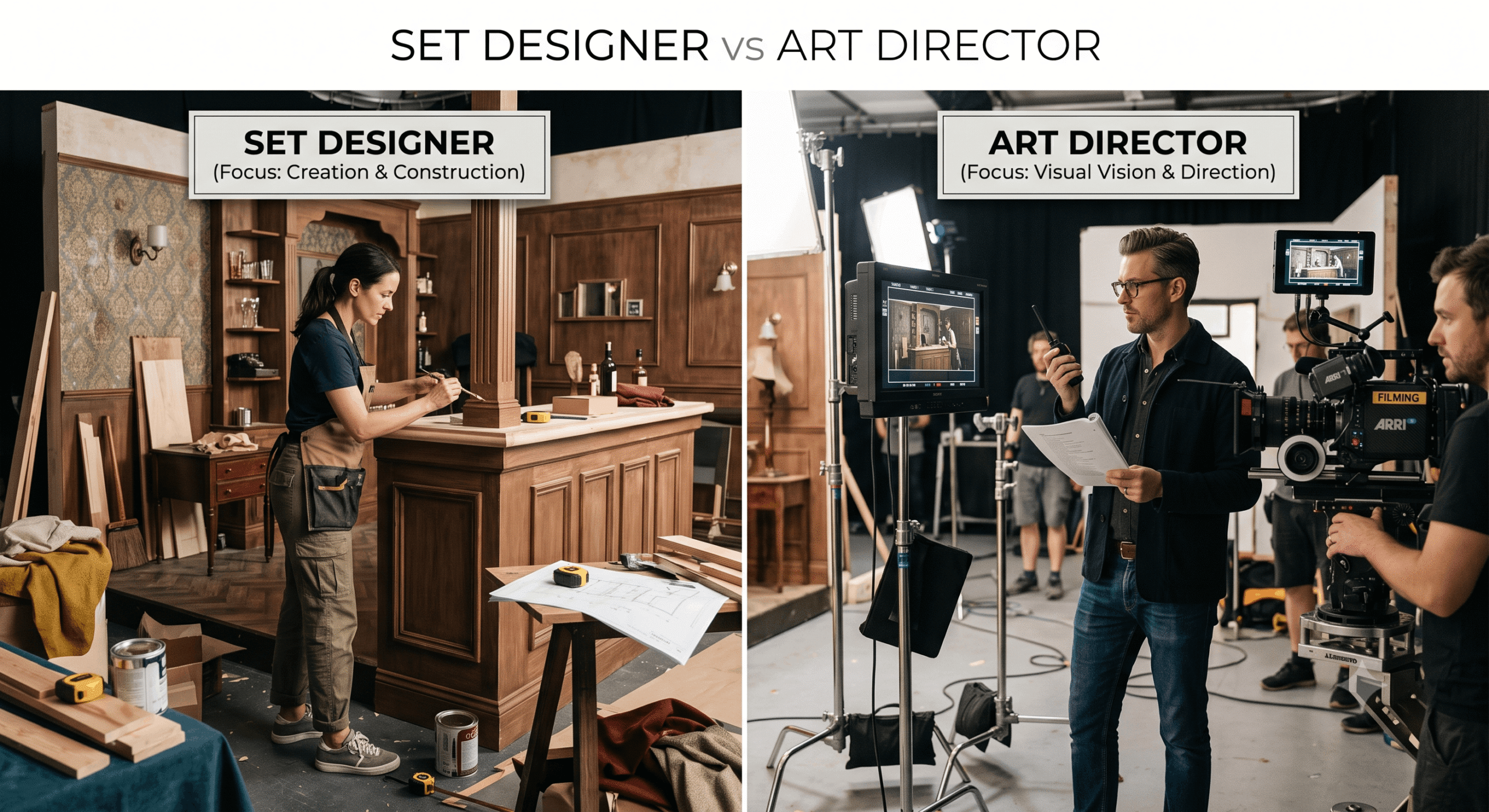
“Set designer” and “art director” get thrown around like they mean the same thing. On a real event, a real production, or a real wedding stage build in India, they don’t. The set designer vs art director question isn’t academic — it decides which skill you actually need to learn, how fast you can get hired, and how much you’ll earn while you’re doing it.
One is a hands-on design skill. You can be trained into it in weeks to months. The other is a leadership role — budgets, schedules, a whole department reporting to you — and you grow into it only after you’ve already put in the design hours. Mixing the two up is a big part of why so many event management graduates in India feel stuck: they’re aiming at a leadership title before they’ve built the technical skill that gets them in the room in the first place.
This article breaks down exactly what a set designer does, exactly what an art director does, how the career path actually flows between them in India’s live events, wedding, and production world, and which one you should aim for first if you’re starting out.
Table of Contents
Set Designer vs Art Director: Why the Titles Get Confused in India
In the US and UK film and TV world, these job titles are fairly fixed. A production designer sets the overall visual concept for a project. An art director runs the art department under them. A set designer draws and builds the technical documentation that makes the design real — floor plans, elevations, construction drawings. Three distinct jobs, three distinct skill sets.
India’s live events, wedding, and production industry doesn’t run on the same org chart. Titles get borrowed loosely — “art director” shows up on a corporate event credit list, a wedding vendor’s Instagram bio, sometimes even on a set designer’s own visiting card because it sounds senior. That looseness is exactly why the set designer vs art director confusion is worse here than it needs to be, and why so many students pick a course based on a job title they don’t fully understand.
Strip away the title and look at the actual work, and the difference gets clear fast: a set designer draws and builds. An art director budgets, schedules, and signs off. One sits at a drafting table. The other sits in a review meeting. Both matter — but they are not interchangeable, and they are not learned the same way.
What a Set Designer Actually Does Day to Day
A set designer is hands-on, technical, and detail-first. Their job is to turn a concept — a mandap layout, a stage backdrop, an award show set, a corporate exhibit — into something that can actually be built, safely and on budget, by a team of carpenters, riggers, and vendors who weren’t in the room when the idea was first sketched.
On a real event, that means:
- Drafting technical drawings that carpenters, riggers, and vendors can build from — not a mood board or a rough sketch.
- Working in CAD and Vectorworks to produce scaled floor plans, elevations, and construction drawings.
- Preparing construction documentation — measurements, materials, load points, and site constraints.
- Working under a designer, art director, or production head, and delivering exactly what the brief calls for, on schedule.
The Technical Skills Behind the Job
The single skill that separates someone who can talk about set design from someone who actually gets hired to do it is technical drawing. Event management courses teach coordination, vendor management, and logistics. They don’t teach a student to open CAD and draft a stage floor plan to scale, or to build a construction-ready drawing set in Vectorworks. That’s a completely separate, learnable skill — and it’s exactly the gap Aron Sagar closed.
Aron trained in CAD for Events & Entertainment and now works in the Operations & Production department at NMACC (Nita Mukesh Ambani Cultural Centre) in BKC, Mumbai — one of the city’s most prestigious performance venues. He didn’t get there through coordination experience. He got there because he could produce the technical drawings a production team could actually build from.
This isn’t just an Indian phenomenon — it’s recognised internationally as its own occupation. The US Bureau of Labor Statistics tracks “set and exhibit designers” as a distinct role, built around CAD-based technical drawing for entertainment, display, and production work. That’s proof this is a real, defined, hireable career — not a vague creative title someone made up.
What an Art Director Actually Does — And Why Indian Events Use the Title Loosely
An art director isn’t a drafting job. It’s a management job. On a real production, the art director owns the budget for the whole art department, builds and holds the schedule, manages the team of set designers, painters, and craftspeople under them, and gives the final creative sign-off on what actually gets built.
That means an art director spends less time at a drafting table and more time in vendor meetings, budget spreadsheets, and team check-ins. It’s a leadership role that sits on top of design experience — not a separate creative skill you learn instead of design. Nobody can sign off on a set designer’s drawing, catch a budget problem before it becomes a build problem, or make a fast creative call under pressure without having done hands-on design work themselves first.
In India’s wedding and events world specifically, “art director” doesn’t always show up as a formal job title the way it does in film credits. The responsibility exists — someone is running the art department’s budget and team on a big wedding or a large corporate show — but it often hides under titles like creative head, design head, or production head instead. That’s a large part of why the set designer vs art director India distinction feels blurry on the ground: the job exists, the title is just inconsistent.
The Real Career Path: Design Skills First, Leadership Later
Here’s the part most people get backwards. Nobody walks into an art director role without first being able to design and draft. The career path runs one direction only: set designer skills first, art director-level responsibility later — not the other way round.
That’s because an art director has to be able to judge a set designer’s drawings, catch a budget or build problem before it reaches the site, and make a fast, confident creative call under pressure. None of that judgment is possible without having done the hands-on design work yourself, on real projects, first.
Kshiti Jain is a clear example of this arc in the Indian context. She graduated in event management and struggled to break into wedding design — the exact gap this article is about. After training at IIED, she didn’t just get placed somewhere as an employee; she started her own event design company, effectively running her own art-director-style operation: budgets, team, creative sign-off, all hers to call. The design skill came first. The leadership followed once she had it.
The Set Designer Job Role in India’s Weddings, Live Events, and Production World
This isn’t a theoretical career path. It’s already happening at real Indian companies, across weddings, corporate events, and large-scale productions.
Pranay Mhatre trained in Event & Wedding Design Visualization at IIED and is now placed as a Production Designer at WIZCRAFT International — India’s oldest and largest event company. That’s the technical design track leading directly into a real production role at the top of the industry, and it’s the strongest proof that this path is genuinely open, not aspirational.
Varun Jain moved from Jodhpur’s wedding industry to Mumbai specifically to master the technical side of design. He’s now a Design Associate at The Finale Eventz, earning ₹45,000 a month on probation, rising to a confirmed ₹50,000 a month. His growth wasn’t about years of experience alone — it was the design skill itself that moved him up in pay and title.
Between Pranay, Varun, and Aron, these stories show the set designer job role in India isn’t limited to weddings or to a handful of big production houses. It shows up wherever an event, wedding, or show needs something built to spec, on time, and on budget — which, in a country with a live events and wedding industry as large as India’s, is nearly everywhere.
Scale is part of why this matters. India’s wedding industry alone is worth roughly ₹3.75 lakh crore, and it keeps growing every year. Corporate events, award shows, and live productions add another large, separate market on top of that. Every one of those events needs a real, buildable set — a stage, a mandap, a backdrop, an exhibit booth — and someone has to draw and build it. That’s not a handful of jobs. It’s a standing, ongoing demand for a specific technical skill that most event management courses in India still don’t teach.
Who This Career Path Suits
Set design suits people who want to create with their hands and their eye for detail, not manage a team. If you’d rather be at a drafting table solving a construction problem than in a budget meeting managing five vendors at once, set design — not art direction — is where you’ll be happiest and get hired fastest.
It’s also the natural next step for two groups who feel stuck right now. Event management graduates who can plan and coordinate but were never taught technical design software fall into this category directly — the course outline for planning simply never covered CAD or Vectorworks, so the design side of the industry stayed closed to them. Directionless graduates exploring a creative career, who like the idea of “event design” but have never had the job titles or the skills demystified, are the second group — this is the specific, learnable entry point that turns a vague creative instinct into an actual hireable skill.
Neither group needs a design degree to start. What they need is the technical foundation — and that’s a course, not a four-year degree.
Which One Should You Aim For First — And What Gets You There Fastest
If you’re starting out, aim for the set designer skill set first. It’s learnable in months, not years. It gets you hired faster than a leadership title ever will, because a company can see exactly what you can draw and build — there’s no ambiguity in a construction drawing the way there is in a resume line about “creative leadership.” And it’s the only real path to an art-director-style role later. You cannot skip the design step and go straight to signing off on someone else’s work.
IIED trains the design and technical foundation that either path starts from — not a dedicated “art director” course, because that role isn’t something a classroom teaches. It’s something you grow into after real design experience, the way Kshiti Jain did. The practical starting points are:
- Event & Wedding Design Visualization — covers design foundation, production of event design, presentation methods, and a final design project. Its listed career outcomes explicitly include set designer and art director/set designer roles, alongside production planner and production manager.
- CAD for Events & Entertainment — the specific technical drawing skill that gets you into the room, taught in one month.
- Vectorworks Spotlight for Event Production — 3D and BIM-style production documentation, with a 100% three-month internship built into the course.
You can see the full breakdown of these and IIED’s other courses on the IIED courses page. And if you’re weighing this against a closely related question — set design versus production design specifically — that’s covered in detail in Set Design vs. Production Design: What’s the Difference (and Which Pays More)?
The honest starting point for almost everyone reading this: learn to draw and build first. Book your free visit to see IIED’s Event & Wedding Design and CAD training in person, and find out which starting course fits where you already are.