
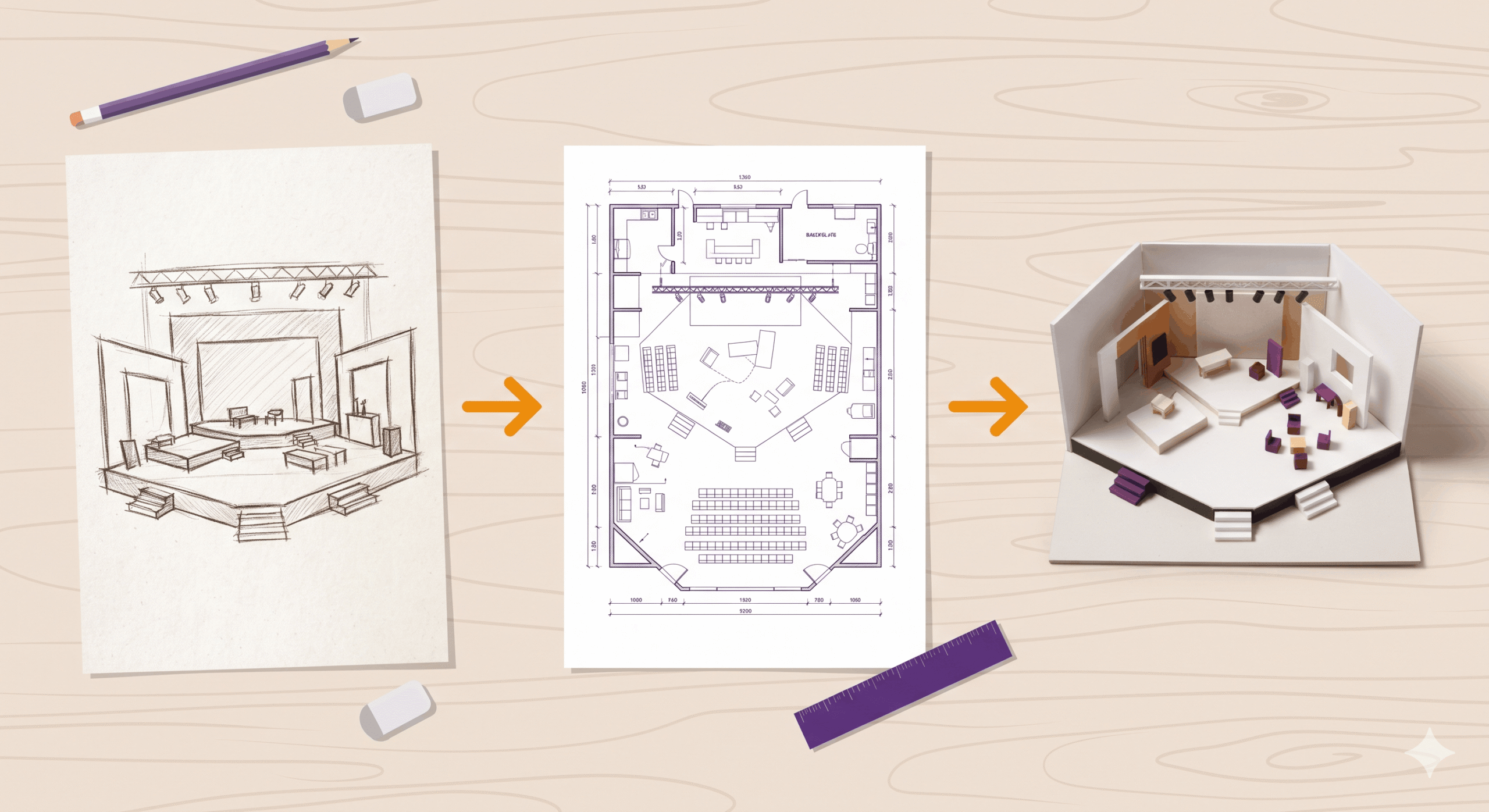
“Will AI take my set design job?” It is one of the first questions students ask us at IIED now, often before they ask about software or timings. Here is the short answer: no.
AI in stage and set design is changing how the first ideas get made. It is not changing who gets hired to make those ideas stand up, light up and last through the show.
AI can produce ten mood images before your chai cools. It cannot walk a venue, read a ceiling height, pick a board that will not sag, or fix a backdrop at 2 a.m. before the doors open. That work still needs a trained set designer. This guide shows you where production teams really use AI in 2026, where it stops, what a modern workflow looks like, and the skills that still get you hired.
Table of Contents
A quick note before we start. We covered the wider question of AI and event design in our post Will AI Replace Event Designers? This one stays on the set itself: the stage, the mandap, the backdrop, the build. If you want to design physical worlds that people walk into, sit in front of or film inside, this is for you.
How Production Teams Use AI in Stage and Set Design in 2026
Walk into most design studios in Mumbai today and you will find AI in the early part of the job. Not on the workshop floor. Not on site. It shows up in the first few days, when a team is turning a client brief into a direction everyone can agree on.
IIED COURSE
MA in Set Design
Learn the parts AI can’t do: sketching, models, CAD, set construction and safety, with generative AI used as a tool.
Duration: 2 years · Mode: Full-time in Mumbai
That is the honest picture of AI in stage and set design right now. It is a fast sketchbook for ideas. It is not a drawing set, a cost sheet or a build plan.
AI tools for set designers: the four jobs they do well
1. Concept mood boards. A client says “royal, but modern” or “a forest that feels calm, not dark.” Those words mean different things to different people. A designer can use an image generator to make a quick spread of looks in minutes, then show the client and ask, “Which of these is closest?” It saves a round of guessing. The designer still picks, edits and explains the direction.
2. Colour and texture options. Should the mandap canopy be dusty rose or deep marigold? Should the stage floor read as polished stone or raw timber? AI lets a team test several palettes and surface finishes side by side before anyone buys a metre of fabric or a litre of paint. It is a cheap way to rule options out early.
3. Rough visual variations. Once a direction is chosen, a designer can ask for variations: a taller arch, a softer backdrop, more greenery on the side flats. This helps the team see options fast. But the images are loose. Proportions drift. Structures float. Nothing is to scale. Treat them as conversation starters, not designs.
4. Early client pitch decks. Agencies often pitch against two or three other teams. AI images can help a small team put a first-round deck together quickly, alongside real hand sketches and reference photos. The smart teams label these clearly as concept images. Clients trust you more when you are open about what is a concept and what is a buildable plan.
Notice the pattern in how teams use AI in stage and set design. Every one of these jobs is about speed at the start. None of them produces something a carpenter, a fabricator or a rigger can build from. That is the line we look at next.
Where AI Stops: What AI for Event Stage Design Can’t Do
An AI image can look finished. That is exactly why AI in stage and set design can mislead a beginner. A picture of a stage is not a stage. Between the picture and the opening night sit a long list of decisions that need a trained person who understands space, materials, money and safety. Here is where AI for event stage design runs out, and the skill that takes over at each point.
Scale and sightlines
AI does not know that the ballroom ceiling is 4.2 metres, that the LED wall needs clearance above it, or that guests at the back tables must see the couple’s faces. A set designer works from measured plans. They check sightlines from the worst seat in the house, not the best one. This is why IIED students learn scaled drawing, perspective and plan views before they touch any visual tool.
Load, rigging and structure
A generated image will happily hang a two-tonne chandelier from nothing. Real sets have weight. Flats need bracing. Platforms need legs that suit the floor. Anything flown overhead must be rigged by trained people to the venue’s limits. A set designer does not need to be a rigger, but they must know enough to design something that can be rigged safely and to talk to the production team in their language.
Materials and construction
Plywood, MDF, carving foam, metal framing, fabric, scenic paint: each behaves differently under heat, lights and handling. AI cannot tell you which material will warp in a humid outdoor wedding in Goa or which finish will look cheap under a follow spot. A trained designer specifies materials that look right, travel well and survive load-in, the show and load-out.
Fire and crowd safety
Drapes near hot fixtures, narrow exit paths, decorative elements that block an emergency route: these are real risks at live events. A good set designer designs safety in from the first sketch. Exit routes stay clear. Fabrics are treated. Nothing blocks a fire point. No image generator checks any of this for you.
Budgets and vendors
An AI concept has no price tag. A real set does. The designer has to cost it, cut it back when the client’s budget changes, and brief the fabricator, the florist, the lighting vendor and the printer so their pieces fit together on the day. That is design work too, and it is often what separates a junior from a senior.
Venue rules and on-site fixes
Every venue has rules: no nails in the walls, a load-in window of four hours, a lift that fits only 2.4-metre flats. And something always changes on show day. A panel arrives in the wrong colour. A backdrop is ten centimetres too tall. The person who solves that calmly, on the spot, is a trained set designer, not a prompt.
| Where AI stops | What the trained set designer does |
|---|---|
| Scale and sightlines | Works from measured plans and checks sightlines from the worst seat in the house |
| Load, rigging and structure | Designs something that can be rigged safely |
| Materials and construction | Specifies materials that look right, travel well and survive load-in, the show and load-out |
| Fire and crowd safety | Designs safety in from the first sketch |
| Budgets and vendors | Costs the set and briefs the fabricator, the florist, the lighting vendor and the printer |
| Venue rules and on-site fixes | Solves show-day changes calmly, on the spot |
A 2026 Set Design Workflow, Step by Step
So where does AI in stage and set design actually sit in a working day? Below is a simple workflow that matches how many production teams operate now. We have marked which steps are human-led and where AI can help.
| Step | What happens | Who leads |
|---|---|---|
| 1. Brief | Meet the client, understand the event, guest count, venue, budget and mood | Human |
| 2. Hand sketch | Quick thumbnails and rough plans to find the big idea | Human |
| 3. Exploration | Mood boards, colour and texture options, loose variations | Human, AI-assisted |
| 4. CAD working drawing | Scaled plans, elevations and sections in AutoCAD or Vectorworks | Human |
| 5. 3D visual | An accurate 3D model and render built from the CAD drawings | Human |
| 6. Build | Fabrication, painting, props and set dressing with vendors | Human |
| 7. On-site fix | Load-in, adjustments, problem-solving on show day | Human |
Count it up. In this workflow, AI in stage and set design helps in one step out of seven. It can make that step faster and more fun. But steps 1, 2 and 4 to 7 decide whether the set gets built, stays within budget and is safe for the crowd. Those are the steps clients and employers pay for.
Look closely at step 3 too. The designer leads it. They decide what to ask for, reject most of what comes back, and carry only the useful ideas into the CAD drawing. A beginner who skips steps 1 and 2 and starts with AI images usually ends up with a pretty picture and no plan.
Step 4 is where many students feel the biggest jump in confidence. Once you can draw a stage plan to scale, you can talk to any fabricator in the city. If you want to build that skill first, the CAD for Events & Entertainment course at IIED focuses on exactly those plans, elevations and layouts.
Set Designer Skills in 2026 That Still Get You Hired
When studios hire a junior set designer, they look at your portfolio and ask one question: can this person turn an idea into something we can build? Here are the set designer skills in 2026 that answer that question with a yes.
Sketching and model-making
A pencil is still the fastest way to think in front of a client. Quick perspective sketches and simple scale models show that you understand space, not just images. You do not need to be “good at drawing” to start. Sketching is a skill you practise, like typing.
CAD: AutoCAD and Vectorworks
Working drawings are the language of production. AutoCAD is widely used for plans and elevations. Vectorworks Spotlight is common on the technical side of live events, where sets, lighting and rigging share one drawing. Learn one well, then add the other. IIED’s Vectorworks Spotlight for Event Production course is built around event drawings, not generic architecture.
Colour and composition
AI can give you a hundred palettes. Knowing which one suits a 9 p.m. sangeet under warm light, and why, is a trained eye. Composition, balance and focal points decide where guests look first. These basics never go out of date.
Production documentation
Material lists, cut lists, vendor briefs, setup schedules and revision notes. Clear documents save hours on site and money in the budget. They also make you the person every production manager wants on the next job.
Vendor coordination
A set is built by many hands. The designer keeps the carpenter, the painter, the florist and the lighting team working to one plan. Clear briefs and calm follow-ups are a design skill in this industry.
Generative AI in production design, done responsibly
Generative AI production design work comes with real questions about ownership and honesty. Use it for concepts, not for copying. Do not prompt for a famous designer’s signature look or a branded set and pass it off as your own. Be open with clients when an image is a concept made with AI.
Ownership is still being worked out. The U.S. Copyright Office’s report on AI and copyrightability says purely AI-generated material is not protected without enough human creative input, though human arrangement and changes can be. Rules differ by country, so the safest habit is simple: let AI help you explore, then make the final design clearly your own work.
This is why IIED’s MA in Set Design teaches generative AI inside a module on CAD, Graphic Visualisation & Generative AI, alongside AutoCAD, Photoshop and Illustrator. AI sits next to the core tools, not in place of them.
What real alumni portfolios show
The proof of these skills is in real careers. Shreya Pais joined IIED’s Event & Wedding Design Visualization course as a fresh graduate with zero experience. Her finished portfolio landed her a job straight away, and she now works in Dubai. Varun Jain, an alumnus of the same programme, works as a Design Associate at The Finale Eventz in Mumbai, earning ₹45,000 to ₹50,000 a month.
Nirali Reshamiya was a wedding planner. She took the part-time evening course while keeping her job and moved up to Wedding Visualization Designer at Gurleen M Puri. Priyanka Saini studied online and now consults for several wedding companies, producing 3D layouts. Across the Wedding, Event & Set Design programme, students with up to a year of experience have placed at an average CTC of ₹4.68 LPA, with the highest at ₹6 LPA.
None of them got hired for typing prompts. They got hired for portfolios that showed sketches, plans, 3D layouts and finished work. You can see that kind of student work on the IIED portfolio page.
Starting Out? What to Do This Month
If you are reading this because you are worried that AI has made set design a risky career, here is the reassurance, and then the plan. The industry still needs people who can design and deliver real sets. What has changed is that the bar for the basics has gone up. Employers expect you to sketch, draw in CAD, build a 3D visual and understand AI in stage and set design well enough to use it sensibly.
AI and set design in India: who this is for
You have just graduated and you are not sure what next. Maybe you studied commerce, arts or science and none of it feels like you. Set design rewards curiosity and hard work more than your past marks. Any graduate can start from the basics.
You finished your degree and feel a little lost. You may have tried a job or two that did not fit. A hands-on field where you see your work built in front of a live audience can bring back a sense of direction. Read our full guide to the set designer career in India to see the four main ways in.
You already work in interiors, architecture or graphics. You have a head start. You already understand space, materials or visual layout. Set design adds event and screen work, faster timelines and the thrill of a live show. Your drawing and software skills transfer directly.
You are restarting after a break and worry you are “not technical”. Many of our students felt the same on day one. CAD and 3D tools are taught step by step. Sketching is practised, not inherited. Your life experience with planning, budgets and people is already part of the job.
Four actions for the next 30 days
- Build a daily sketch habit. Fifteen minutes a day. Draw stages, mandaps and room corners you see at events, in films or on your phone. Date every page. In a month you will see the difference.
- Start learning CAD. Pick AutoCAD or Vectorworks and draw one simple stage plan to scale: a 12 by 8 metre stage, steps, a backdrop and two side flats. Then draw its front elevation.
- Plan a three-project portfolio. Choose one wedding set, one corporate or concert stage and one film or TV room. For each, show the brief, your sketch, a CAD plan, a 3D visual and a short note on materials. Use AI only for early mood boards and label it.
- Visit IIED and see real work. Look at what students produce by hand and on screen. Ask the mentors honest questions about the path that fits you.
That is the real answer to “will AI take my job?” and the honest future of AI in stage and set design. Learn the parts AI cannot do, use AI where it saves time, and build a portfolio that proves both.
Frequently Asked Questions
Will AI replace set designers in India?
No. AI helps with early mood boards and visual options, but someone still has to measure the venue, draw to scale, choose materials, keep the build safe, manage the budget and fix problems on site. Those tasks need a trained set designer.
How do production teams use AI in stage and set design?
Mostly at the start of a project: concept mood boards, colour and texture options, rough visual variations and early client pitch decks. The working drawings, 3D models, build and on-site work are still led by designers and crew.
Do I need to learn AI tools to become a set designer?
It helps to know how to use AI for concepts, and employers increasingly expect it. But AI tools come after the core skills. Sketching, CAD, 3D visualisation, materials and production documentation matter far more when you are being hired.
Which software should a set designer learn first: AutoCAD, Vectorworks or an AI tool?
Start with CAD. AutoCAD or Vectorworks gives you scaled plans and elevations, which are the language of production. Add a 3D tool next. Learn AI tools last, as a way to explore ideas faster.
Can AI create working drawings for a stage or wedding set?
Not reliably. AI images are not to scale, have no accurate dimensions and do not account for structure, rigging or venue limits. Working drawings still need to be made in CAD by someone who understands construction.
Is it ethical or legal to use AI-generated images in a client design?
It can be, if you use them openly as concepts, avoid copying another designer’s or brand’s recognisable work, and make the final design your own. Copyright rules on AI-generated material are still developing and differ by country, so be transparent with clients.
What skills do employers look for in a junior set designer in 2026?
A portfolio that shows sketching, scaled CAD drawings, 3D visuals, an eye for colour and composition, clear production documents and the ability to work with vendors. Sensible use of AI for concepts is a bonus, not a substitute.
Can a beginner with no technical background start a set design career?
Yes. Sketching, CAD and 3D are all taught from the basics. Many IIED alumni started with zero design experience, built a strong portfolio during their course and were hired soon after.
Ready to Start Your Set Design Career?
AI in stage and set design is a tool in a skilled designer’s hands. It speeds up the first sketchbook stage and helps clients see options sooner. It does not measure a venue, draw a buildable plan, keep a crowd safe or fix a set at 2 a.m. That work is still yours to learn, and it is still what gets people hired.
Book your free visit to IIED, Malad East, and see the Set Design and CAD work our students do by hand and on screen.
Book your free visit — call 9892966334 or email info@weareiied.com. IIED, Shop No. 506, 5th Floor, Magic Square, Dwarkadhish Road, off Poddar Road, Malad East, Mumbai 400097.
IIED COURSE
Short Term Event Design Course
Want to start sooner? Learn sketching, layouts, scale drawings and stage design basics, and build your first portfolio.
Duration: 4 months