
Table of Contents
Ask five working lighting technicians in India whether they should run wireless DMX or wired DMX on their next rig, and you will get five confident, slightly different answers. That confidence is usually the problem. Wireless DMX vs wired DMX is not a trend question or a gear-envy question. It is a reliability question, and getting it wrong on a live show means a moving head that freezes mid-cue, a wash that drops out during the couple’s entrance, or a truss run that takes two extra hours to cable because nobody planned the signal path properly.
This is not a buzzword comparison. It is the actual technical decision working lighting designers make on almost every job, and it is a decision most self-taught technicians never learned properly, because nobody sat them down and explained what each system is actually doing. Here are five real differences between wireless DMX and wired DMX, why they matter on a real rig, and where the training gap usually sits.
What Wired DMX Actually Is (And Why Most Rigs Still Run On It)
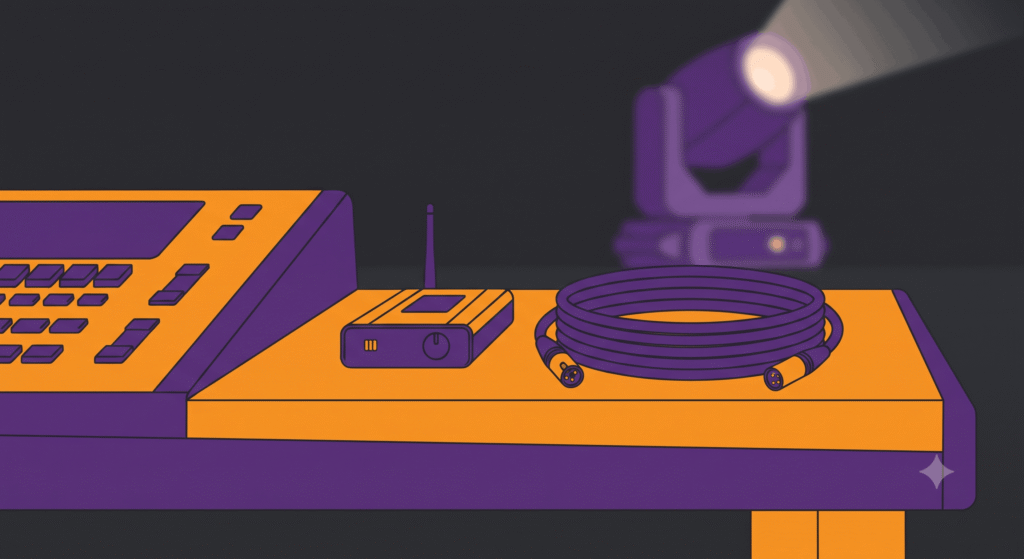
Wired DMX runs on DMX512, the digital protocol that has controlled stage lighting since the 1980s and is still the industry standard today. A console sends a constant stream of 512 channels of data down a cable, usually a 5-pin XLR line, to every fixture on that line in a daisy chain: console to fixture one, fixture one to fixture two, and so on down the run, ending in a terminator that stops the signal reflecting back and corrupting the data.
The appeal of wired DMX is almost entirely about reliability. A properly terminated, properly cabled DMX line does not drop packets, does not suffer from radio interference from a nearby Wi-Fi router or another rig’s wireless system, and does not care how many phones are in the room. For a concert’s main truss, a theatre’s fly system, or any rig where a fixture freezing mid-cue is not an option, wired DMX is still the default for a reason.
The real cost is physical. Every fixture needs a cable run back to the console or to a distribution point, cable runs have a maximum practical distance before signal degrades, and every metre of cable is something that has to be rigged, taped down, coiled, and struck at the end of the night. On a large rig, cabling is often the single biggest chunk of load-in and load-out time.
What Wireless DMX Actually Changes On a Rig
Wireless DMX replaces the cable run with a transmitter connected to the console and small receivers mounted at or near each fixture, sending the same DMX512 data over a radio link, usually in the 2.4GHz band. The fixture still receives real DMX data. What changes is how that data gets there.
The obvious benefit is speed and flexibility. A moving head rigged on a truss with no easy cable path, a follow spot at the back of a wedding lawn, or a decorative fixture on a mandap structure that keeps shifting position during setup can all be powered and controlled without running a single metre of signal cable across a dance floor or a guest area. For weddings and events with scattered fixture positions, this alone can cut hours off a load-in.
The real cost is that wireless DMX is only as good as the radio environment it operates in. Line-of-sight matters. Distance between transmitter and receiver matters. And in India, where a wedding venue or corporate hall is frequently packed with Wi-Fi routers, other wireless mics, and other production companies’ own wireless DMX systems all fighting for the same 2.4GHz spectrum, interference and dropped packets are a real, recurring problem, not a theoretical one. A working lighting designer who does not understand RF basics will eventually get burned by this, usually during a show, not during setup.
Wireless DMX vs Wired DMX: How Working Lighting Designers Actually Decide
In practice, almost no working lighting designer in India runs an entirely wireless or entirely wired rig. The real skill is deciding, fixture by fixture, which signal path a given position actually needs, and building a hybrid rig that uses each system where it is strongest.
Concert and Touring Rigs
Main truss positions on a concert or touring rig are almost always wired. The fixture count is high, the positions are fixed for the night, and a dropped signal on the primary wash or the back truss during a headline set is not a risk any touring lighting designer wants to take. Wireless DMX shows up here mostly for isolated positions: a moving light on a satellite truss, an audience-side effect, or a fixture where running cable would mean closing an aisle.
Console and networking skill matters as much as the cable choice here. This is exactly where GrandMA3 or Avolite Titan proficiency becomes the real differentiator, because the console has to manage universes, patch, and DMX output across both wired and wireless links without the operator losing track of which fixture is on which path.
Corporate Events and Award Shows
Corporate stages and award shows usually sit closer to the wired end, because the rig is built in a controlled hall over a fixed load-in window, and reliability during a live broadcast or a CEO’s keynote matters more than saving an hour of cable time. Wireless DMX still earns a place for audience-facing effects, uplighting scattered around a room, or fixtures added late in the plan that were never cabled into the original run.
Weddings and Mandap Lighting
Weddings are where wireless DMX earns its keep. Mandap structures, entrance points, scattered uplighting around a lawn or banquet hall, and fixtures that get repositioned right up until the couple arrives all benefit from not being tied to a cable run. A lighting designer working Indian weddings who cannot set up and troubleshoot wireless DMX confidently is working with one hand tied behind their back, because so much of wedding lighting is exactly this kind of scattered, last-minute fixture placement.
Festivals and Outdoor Rigs
Outdoor festival rigs tend to mix both, depending on scale. Main stage trussing is wired for the same reliability reasons as a concert. Anything spread across a field, a walkway, or a secondary stage without an existing cable infrastructure leans wireless, with the added complication that open-air RF environments can behave differently from an indoor hall, which is its own skill to learn.
Who This Actually Matters For
This is a real, practical decision for two kinds of people, not just working professionals with years on the job. The first is the technician already running lights for events, weddings, or corporate shows who has cabled a hundred DMX runs by feel but has never had anyone explain why a wireless link drops out mid-cue, or how to plan a hybrid rig on purpose instead of guessing. The second is the event management graduate or career switcher trying to move from coordination into a real technical role, where knowing the difference between DMX512, Art-Net, and sACN is exactly the kind of specific, verifiable skill that separates a coordinator from a lighting operator on a hiring manager’s shortlist.
Neither group needs to start over. What both need is the same thing: formal, hands-on exposure to both signal paths, under someone who has actually rigged both on a real show, rather than a YouTube video and a few burned cues to learn it the hard way.
The Real Training Gap: What a Lighting Design Course Should Actually Teach About DMX, Art-Net and sACN
Most self-taught lighting technicians in India learn wired DMX by trial and error on a job, get comfortable with it, and never formally learn wireless DMX, network protocols, or fibre optic signal distribution, because nobody ever sat them down and taught it as a system. That gap shows up the first time a rig gets complicated: multiple universes, a mix of wired and wireless fixtures, and a network backbone running Art-Net or sACN to move DMX data over standard networking cable instead of a dedicated DMX line.
This is precisely the gap IIED’s MA in Lighting Design is built to close. The DMX module in the course does not stop at daisy-chaining a few fixtures. It covers the full picture: DMX history and daisy chain topology, networking DMX over Art-Net and sACN, RDM (Remote Device Management) for two-way communication with fixtures, wireless DMX, and fibre optic distribution for long cable runs, alongside live console training on GrandMA3 and Avolite Titan under mentor Lloyd Albuquerque, a working Light Director. Students plot, patch, and troubleshoot real rigs during practicals, not just watch a slide about how DMX works.
That distinction, between knowing what wireless DMX is and having actually rigged, patched, and troubleshot it under a mentor before a client’s show depends on it, is the entire gap between a technician and a lighting designer employers trust with a real rig.
The course’s power and electrics module matters here too, and it is easy to underrate. A generator running rough, a poorly earthed distro, or a dimming circuit sharing a phase with a wireless transmitter can introduce exactly the kind of electrical noise that causes DMX flicker or wireless dropout that looks like a bad receiver but is actually a grounding problem. Working lighting designers who have only learned DMX in isolation, without the electrical fundamentals underneath it, end up chasing the wrong fault on site. Students who go through both modules together learn to diagnose the actual cause instead of guessing.
Real Careers Built on Solid DMX Fundamentals
None of this is theoretical. IIED trains students on the same DMX systems, consoles, and networking protocols that working lighting professionals use on real shows, and the placements below are proof of what that foundation leads to.
Jude Pereira left medical studies to pursue lighting design and is now working as an Event Designer and Lighting Technician at Disneyland Hong Kong, handling lighting for some of its biggest shows. Cajetan D’Silva learned lighting during the COVID lockdown and now travels the world working lighting for Royal Caribbean, the world’s largest cruise line.
Atharv Devikumar Jog was already working in lighting but lacked the technical foundation employers wanted. After completing IIED’s One Year Program in Lighting Design, he was placed as a Lighting Operator at SLS Production Equipment in Saudi Arabia, on SAR 10,000 per month plus company accommodation and return flights, in August 2025. Silas Paul Uba came from audio mixing and media production, not lighting, and was placed as a Lighting Technician (Grade B) at LumaSonic Structures Rental in Goa, on ₹25,000 per month plus medical insurance of ₹5,00,000, personal accident insurance, a telephone allowance, and tools and uniform, in September 2025.
Vinith, a former sound engineer, was offered a role at a global production company after training at IIED and turned it down to join LGL Designs, working directly under his mentor Lloyd Albuquerque. Every one of these placements is built on the same fundamentals this article covers: knowing exactly what a DMX signal is doing, wired or wireless, and being trusted to run it on a real show.
What This Skillset Pays in India
Real, verified numbers from actual offer letters, not industry averages: Silas Paul Uba’s placement at LumaSonic Structures Rental in Goa pays ₹25,000 per month plus medical insurance of ₹5,00,000, personal accident insurance, a telephone allowance, and tools and uniform provided. Atharv Devikumar Jog’s placement at SLS Production Equipment in Saudi Arabia pays SAR 10,000 per month plus company accommodation, return flights, and transportation.
These are entry-level and early-career numbers for lighting technicians and operators with formal training in exactly the DMX, networking, and console fundamentals covered in this article. Trained GrandMA3 operators in particular remain in short supply relative to demand in India, which keeps upward pressure on what a properly trained lighting professional can ask for.
For a deeper look at where this fits in a lighting career overall, IIED has a full breakdown of the lighting design career path in India, and a direct comparison of GrandMA3 vs Avolite Titan for anyone deciding which console to master first. The DMX, Art-Net, and sACN fundamentals in this article are taught hands-on as part of the MA in Lighting Design.
DMX512 itself is maintained as an open technical standard by the entertainment lighting industry, and protocols like Art-Net that carry it over standard networking cable are documented publicly by their originating manufacturers, including the official Art-Net protocol documentation — worth a read for anyone who wants the full technical specification behind what this article covers at a working level.
If you have been running wired DMX on instinct and guessing your way through wireless dropouts, it is time to learn the system properly. Book your free visit to IIED and see the DMX, console, and networking training that turns a technician into a lighting designer clients trust with the whole rig.