is GrandMA3 hard to learn? A Real 74-Hour Timeline
Category: Lighting Design
Date: July 2026
Author: Team IIED
Search “is GrandMA3 hard to learn” and you’ll find two kinds of answers: forums insisting only “real programmers” can run it, and course pages promising you’ll be job-ready in a weekend. Neither is honest. The real answer to whether GrandMA3 is hard to learn depends entirely on where you’re starting from, and IIED would rather give you a straight timeline than sell you a shortcut that doesn’t exist.
This matters because GrandMA3 operators are still rare in India. Demand for people who can genuinely run one far exceeds the supply of trained operators — which is exactly why the console has a reputation for being difficult. Not enough people have had access to real, structured training on it. That same rarity is also why it pays well once you clear the learning curve.
This article breaks down the real timeline: how many hours the training actually takes, who should start on the console directly and who should build lighting fundamentals first, and what real IIED students who have gone through this training are doing today.
Table of Contents
Is GrandMA3 Hard to Learn? The Honest Answer
Yes and no — and the honest answer depends on your starting point, not on some fixed difficulty score. GrandMA3 has more depth than almost any other lighting console on the market: system architecture, DMX universes, macros, tracking, Phasers. If you sit down at one with zero lighting background, it will look overwhelming. If you already understand how a rig is built and have spent time programming cues, GrandMA3 becomes a matter of learning a new interface for skills you already have.
If you’re a complete beginner
A true beginner — someone with no console time, no understanding of DMX, no experience patching a rig — is not the target student for a short, intensive GrandMA3 course. Trying to learn the console from zero, with no lighting fundamentals underneath it, is where most people get stuck and give up, then go online and say GrandMA3 is impossible to learn. It isn’t impossible. It’s the wrong entry point for where they were standing.
The right starting point for a true beginner is IIED’s MA in Lighting Design, which builds console skills on top of a full year of lighting fundamentals — the physics of light, DMX, rigging safety, fixture types, and live console training — so that by the time you sit at GrandMA3, you already understand what every button is doing and why.
If you already have 1-2 years of lighting experience
If you’ve spent a year or two working as a lighting technician, operator, or in AV or event production, and you already understand DMX, patching, and basic programming, GrandMA3 is a genuinely fast, learnable skill. You’re not starting from zero — you’re translating existing knowledge onto a more powerful console. This is exactly the student IIED’s GrandMA3 Mastery Program is built for.
The GrandMA3 Beginner Timeline: How Long It Actually Takes in India
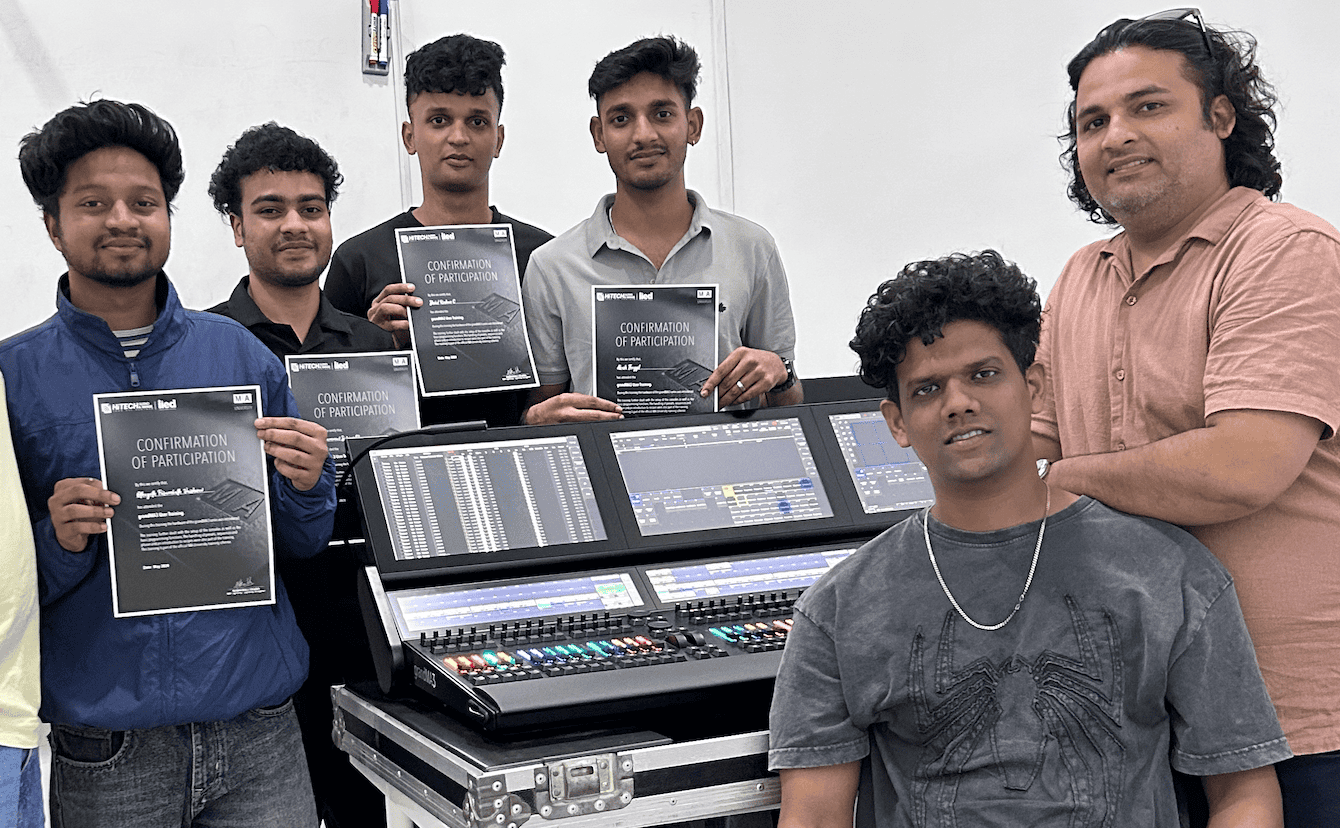
Here’s the number most sources won’t give you. IIED’s GrandMA3 Mastery Program is a defined 74-hour course, delivered over 1 month. That’s the honest answer to how long it actually takes to learn GrandMA3 in India — not a vague “it depends,” but an actual hour count, split into two phases.
Phase 1 — Foundational User Training
The first half of the course covers system architecture, DMX signal flow, and core programming — how GrandMA3 is structured, how it talks to fixtures, and how to build your first cues. This phase assumes you already know what DMX is and have handled a rig before. It teaches you GrandMA3’s specific way of doing what you already understand conceptually.
Phase 2 — Advanced System Management
The second half moves into macros, advanced tracking, and Phasers — the tools that separate someone who can run a basic show from someone who can program a complex, multi-scene production on the fly. This phase is what turns a technician into a designer-level operator, and it’s the part of the GrandMA3 beginner timeline that genuinely cannot be compressed.
74 hours sounds short, and it is — because it’s not trying to teach you lighting from scratch. It’s bridging you from technician to designer on a console you’re already conceptually ready for. If you’re starting with zero lighting background, stretching that same 74 hours over material you haven’t built a foundation for is exactly where the “GrandMA3 is too hard” myth comes from.
What a realistic month actually looks like
Spread over four weeks, 74 hours works out to roughly 18-19 hours a week. That’s a manageable load alongside a job for someone already working in audio, AV, or event coordination — the exact profile the Mastery Program is built for. Roughly the first half of the month sits inside Phase 1 — system architecture, DMX signal flow, patching, and building your first cues. The second half moves into Phase 2 — macros, advanced tracking, and Phasers. Thinking of the timeline in weeks rather than a single lump of “74 hours” makes it easier to judge honestly whether it fits around your current work.
Is There a GrandMA3 Course for Beginners? Where to Actually Start
Not directly — and IIED would rather tell you that honestly than sell you a mismatched course. If you’re asking whether there’s a GrandMA3 course for beginners, the honest answer is that the real beginner course is the MA in Lighting Design. It starts with the physics and anatomy of light, moves through DMX, rigging, and fixture types, and only then puts you on a live console — including GrandMA3 — once you have the fundamentals to make sense of it.
Once you’ve built that foundation, through the MA or through 1-2 years working in the industry, the GrandMA3 Mastery Program is where you go to specialise and go deep on the console itself. Skipping straight to the Mastery Program without that foundation is the single biggest reason people find GrandMA3 harder than it needs to be.
Who This Path Is Actually For
Most of the people asking whether GrandMA3 is hard to learn fall into one of three groups, and the honest timeline looks slightly different for each.
If you’re a recent graduate with no lighting background, wondering whether a technical console skill is realistic without an engineering degree, the answer is that GrandMA3 itself is not where you start. You start with lighting fundamentals, and GrandMA3 becomes realistic once those fundamentals are in place. Treat the console as the destination, not the entry point, and the timeline stops feeling scary.
If you’re already working in audio, AV, or event coordination and wondering whether the learning curve fits around a job, the 74-hour Mastery Program is built with exactly that in mind. It runs over a month, not a year, and it assumes you already have the rig-and-DMX experience that a coordination or AV role gives you. This is the fastest honest route from where you are to a console-designer skill set.
If you’re an event management graduate who assumes console work requires a technical degree you don’t have, that assumption is the actual barrier, not GrandMA3 itself. Console training is a trained skill, not a credential. What it requires is time on the fundamentals first, then time on the console — not a different educational background than the one you already have.
Real Students, Real Timelines: From Operator to Console-Trained Professional
Numbers on a curriculum page are one thing. Here’s what that timeline actually looked like for real IIED students.
Atharv Devikumar Jog
Atharv was already working in lighting but lacked a technical foundation underneath his hands-on experience. After completing IIED’s One Year Lighting Design Program, he said it let him “dive deep into the intricate details and technicalities of light.” He was placed as a Lighting Operator at SLS Production Equipment L.L.C. in Saudi Arabia in August 2025, earning SAR 10,000 a month plus accommodation and flights. His path is a real example of the operator-to-technically-trained-professional timeline — he didn’t start from zero, but he needed structured training to close the gap between running lights and understanding them.
Silas Paul Uba
Silas started in audio mixing and media production, not lighting at all. He switched fields entirely and was placed as a Technician – Lighting at LumaSonic Structures Rental in Goa in September 2025, earning ₹25,000 a month plus medical insurance and benefits. His story is proof that a non-lighting background is not a disqualifier for learning console work — but it also means he built lighting fundamentals first, rather than jumping straight into an advanced console course.
Vinith
Vinith was a sound engineer who moved into lighting design at IIED, including console training, and now works as a Lighting Designer at LGL Designs — a role he chose over an offer from a global production company. His outcome shows what real console competence, not just a certificate, actually opens up.
None of these three are exceptions picked to flatter the article. They’re what the honest timeline looks like when someone builds fundamentals first and specialises second.
Operating GrandMA3 vs Designing on GrandMA3: Why the Difference Matters
This is the distinction most “how hard is it” articles skip entirely. Operating GrandMA3 means running a show that’s already been programmed — following cues, triggering looks, reacting live. Designing on GrandMA3 means building that show from nothing: patching the rig, creating the palettes, programming the cues, structuring the macros that make a complex show run smoothly.
You can learn to operate a pre-built show in a matter of days. Learning to design on GrandMA3, which is what the Mastery Program’s Phase 2 is actually training you for, takes the full 74 hours — and it’s the difference between being hired as a technician and being hired as a programmer or designer, with the pay difference that comes with it.
Is Learning GrandMA3 Actually Worth the Effort?
Given how few GrandMA3 operators exist in India relative to how many shows need one — concerts, weddings, corporate events, festivals — the difficulty is exactly why the skill pays well. It’s not the easiest console to pick up. But most people who call it too hard tried to learn it as their first lighting skill, with no foundation underneath. Start in the right place, and it’s a specific, learnable, well-paid skill — not a mystery reserved for engineers. MA Lighting, the manufacturer behind grandMA3, builds the console for exactly this level of professional production work, which is part of why the learning curve is real and not manufactured hype.
Weigh the effort against the alternative. Staying a technician who can wire a rig but not program one caps your ceiling at the same rate for years. Closing that specific gap — through fundamentals first, console training second — is what moves someone from being hired to run someone else’s show to being the person shows are actually built around.
Almost nobody publishes an honest, India-specific answer to how long GrandMA3 actually takes to learn. Most results online are either generic two-day vendor certification courses aimed at markets with a completely different training ecosystem, or vague YouTube-tutorial promises with no real timeline at all. That gap is exactly why this article exists — not to inflate the difficulty for drama, and not to flatten it into a weekend promise, but to give the same honest number a mentor would give a student sitting across the table: 74 hours, in the right order, once you’re ready for it.
Ready to Find Out Where You Actually Stand?
If you already have lighting experience and want to specialise on the console that’s rarest and most in-demand in India, the GrandMA3 Mastery Program is built for exactly that jump. If you’re starting from zero, the MA in Lighting Design is the real starting point — not a shortcut, but a foundation that makes GrandMA3 make sense once you get there. And if you want to see how this training turns into a real career, read GrandMA3 Career in India: What It Pays & How to Start.
Book your free visit to IIED in Malad East, Mumbai, and we’ll tell you honestly which course fits where you’re starting from.
Event management courses teach you how to plan an event. They don’t teach you the one console that actually runs the room. GrandMA3 is the world’s most powerful lighting console, and it’s also the rarest technical skill in Indian live events. Almost nobody trains on it. And almost nobody has written honestly about what a […]
In the event production world, the right Lighting Console is key to translating your creative vision into a captivating experience. Lightning Console helps to control lights, create moods, and deliver stunning visuals that captivate audiences. From dynamic concerts to elegant weddings, the console you choose can make or break the impact of your lighting design. […]
Stage Lighting for Beginners: Tips and Techniques Your No-Nonsense Guide to Lighting Up Any Stage Essential Stage Lighting Techniques for Beginners: A Guide for Mastering Stage Lighting for Beginners in India Table of Contents So You Want to Light Up a Stage? Let me tell you something. The first time I stood behind a lighting […]
Related
Is GrandMA3 harder to learn than other lighting consoles like Avolites Titan?
+
-
GrandMA3 has more depth and more advanced features than most consoles, including Avolites Titan, which makes it feel more complex at first. But depth is not the same as difficulty for someone with the right foundation. Once you understand DMX and basic programming logic, the extra depth becomes extra capability, not extra confusion.
How many hours does it actually take to get comfortable operating GrandMA3?
+
-
IIED’s GrandMA3 Mastery Program is a defined 74-hour, 1-month course, split into Phase 1 (Foundational User Training) and Phase 2 (Advanced System Management). That’s the real, honest number for someone who already has 1-2 years of lighting experience.
Do I need a technical or engineering background to learn GrandMA3?
+
-
No. You need a working understanding of DMX, rigs, and basic programming, which comes from hands-on lighting experience or a structured foundational course, not an engineering degree.
Can a complete beginner join the GrandMA3 Mastery Program, or do I need experience first?
+
-
The Mastery Program is built for people with 1-2 years of lighting experience already. A complete beginner should start with the One Year Program in Lighting Design, which builds up to console work from lighting fundamentals.
What's the real difference between "operating" GrandMA3 and "designing" on GrandMA3?
+
-
Operating means running a show someone else has already programmed. Designing means building the show yourself, from patching through programming to structuring cues from nothing. The Mastery Program trains you for the second one.
Is learning GrandMA3 through free YouTube tutorials enough, or is structured training necessary?
+
-
Tutorials can show you where the buttons are. They can’t replace hands-on time on a real console, a structured progression from basic programming to advanced tracking, or feedback from a working lighting professional — all of which the 74-hour course is built around.
Is GrandMA3 worth learning if I want to work internationally, not just in India?
+
-
Yes. GrandMA3 is used on major productions worldwide, and IIED alumni trained on it are placed internationally, including in Saudi Arabia.
How soon after learning GrandMA3 can I realistically expect to get hired or start freelancing?
+
-
It depends on your starting point and existing network, but IIED alumni with console training have moved into paid technician and operator roles within months of finishing training, not years.