
Search “stage lighting workshop” and you’ll land on a dozen pages that all say roughly the same thing: explore your creativity, discover the magic of light, unleash your inner designer. None of them tell you what you’ll actually be doing for the hours you’re paying for. Will you touch a real console? Will someone teach you DMX, or just wave at a truss and call it “ambiance”? Will you leave with a skill you can put on a résumé, or a certificate and a vague feeling?
That gap is what this post is here to close. Below is what a real stage lighting workshop should cover — the physics of light, DMX and dimming, rigging safety, and actual console hours — held up against what IIED’s Lighting Design program covers on that same checklist, taught by a working Light Director, not a lecturer reading slides. If you’re comparing workshop pages and want specifics instead of adjectives, this is the breakdown.
Table of Contents
What a Real Stage Lighting Workshop Should Actually Teach
A stage lighting workshop that’s worth your time and money should cover four non-negotiable areas, regardless of which institute runs it.
The physics and anatomy of light. Before anyone touches a console, they need to understand what light actually is — colour temperature, angles, intensity measured in lux and lumens, and how different light sources behave. Skip this step and you’re memorising button presses without understanding why you’re pressing them.
DMX and dimming. DMX512 is the protocol that runs almost every professional lighting rig in the world — how fixtures talk to consoles, how signal chains work, what a daisy chain is, and where wireless DMX and fibre optic transmission fit in. A workshop that doesn’t teach DMX is teaching you to operate a toy, not a rig.
Rigging and workplace safety. Loading, weight limits, working at height, smoke and haze safety, electrical safety around dimming circuits and generators. This is the part most short “creative” workshops skip entirely — and it’s the part that actually gets people hired. Venues and production companies need technicians who won’t hurt themselves or anyone else on site.
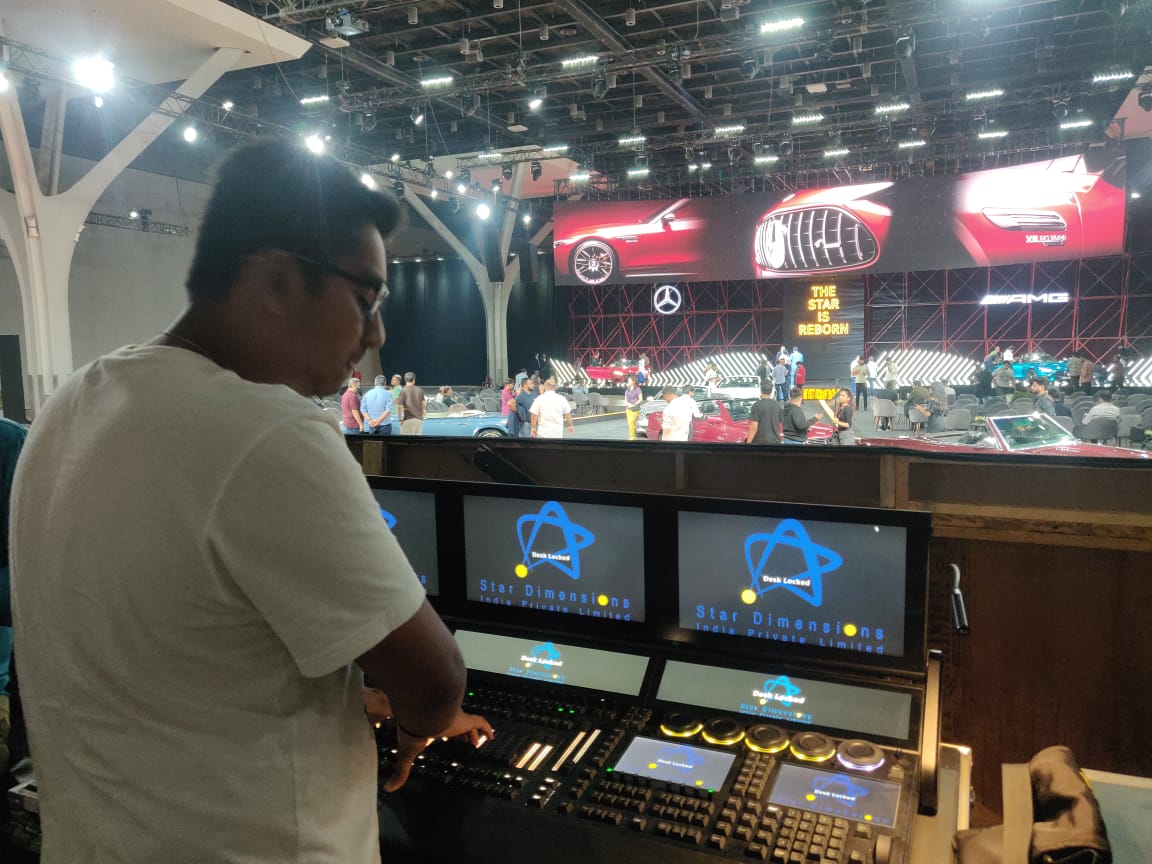
Real console time. Not a demo watched from the back of a room — actual hands-on hours on an industry console like GrandMA3 or Avolite Titan, building cues, programming presets, and running a live show file from start to finish.
If a workshop’s syllabus doesn’t name these four things specifically, ask what you’re actually paying for. It’s also worth knowing this isn’t a shrinking field to bet a course fee on — in the US, the Bureau of Labor Statistics projects continued demand for broadcast, sound, and lighting technicians, and in India, qualified GrandMA3 operators remain genuinely scarce.
Session-by-Session: The Curriculum Breakdown
This is what does a lighting workshop teach when it’s built properly — broken into the stages a student should move through, not a single afternoon of button-pressing.
Foundations: Understanding Light Before You Touch a Console
Every serious stage lighting course curriculum in India should open here: how light affects vision and health, the visual spectrum, types of light sources, and the laws of physics that govern angles, refraction, and colour temperature. Alongside this comes power and electrics — the basics of electricity, earthing, generators, and dimming circuits — because a lighting technician who doesn’t understand power is a liability on any real set.
DMX, Consoles and Control
Next comes DMX in depth: its history, daisy-chain networking, protocols like RDM, Art-Net and sACN, and how wireless and fibre-optic DMX extend a rig across a large venue. This is also where students are introduced to the consoles themselves — the different types available, and structured training time on the two consoles that dominate the industry: GrandMA3 and Avolite Titan.
Design, Plotting and Programming
Understanding a client’s needs and translating them into a lighting design comes next — light plots, inventory and budgeting, and CAD-based design for placing fixtures against a set. Programming follows: console setup, building presets, cue construction, timecode, and tracking, plus the practical skill of focus and centering — how to actually aim and gel a fixture correctly.
Practical, Hands-On Hours
None of the above means anything without practice. A proper program includes real practicals in power and cabling, light plotting, live programming, and — critically — actual live events, not simulated ones. Sound and video essentials are usually folded in here too, since modern lighting design has to sync with both.
What IIED’s Lighting Design Program Actually Includes
Held up against that checklist, here’s what IIED’s MA in Lighting Design actually covers — and who teaches it.
Taught by a Working Light Director, Not an Academic
The full curriculum is trained personally by Lloyd Albuquerque, a professional Light Director with live-show and concert experience — DMX, consoles, and live programming taught by someone who does the job, not someone who studied it once and moved into teaching full time.
Real Console Hours on GrandMA3 and Avolite Titan
[Insert real portfolio photo here — students at a GrandMA3/Avolite console. Alt text: “Students training on a GrandMA3 console during a hands-on stage lighting workshop session at IIED.”]
Students get structured, hands-on training on both GrandMA3 and Avolite Titan — the same consoles used on professional tours and broadcast events. GrandMA3 proficiency in particular is genuinely rare in India, which makes this component one of the program’s clearest differentiators against a generic lighting design workshop in India that only offers a generic console demo.
Practicals That Are Real, Not Simulated
The program’s practical deliverables include power and cabling, light plotting, console programming, applications training, and live event practicals — plus a portfolio built from that work. Batches are kept small, so every student gets real time behind the console instead of watching a shared demo from the back of the room.
The Fine Print
The MA in Lighting Design is full-time, open to any graduate, and priced at ₹3,00,000 per year across three instalments. IIED states a 100% internship or job opportunity outcome for students who complete it. Career outcomes span Light Director, Light Designer, Technician, Technical Supervisor, Light Programmer, and Light Operator roles.
It’s worth being clear about what this program is not: it isn’t a single-day or single-weekend “workshop” in the strictest sense of the word. It’s a full-time, two-year curriculum that covers everything a short session would only gesture at — which is exactly why it produces placements instead of just certificates. If what you’re picturing when you search “stage lighting workshop” is a two-hour taster session, know that’s a different (and much smaller) thing than what actually builds a hireable skill set.
For readers who want the foundational concepts explained on their own before diving into a full curriculum, IIED has a breakdown here: Stage Lighting 101: Core Concepts Explained.
Who a Stage Lighting Workshop Is Really For
Two kinds of students tend to search for this, and the right next step is slightly different for each.
The recent graduate with no clear path. You’ve finished college, you’re done with pure theory, and you want a fast, practical route into a real job — not another semester of vague promises. What you should be evaluating isn’t how inspiring a workshop’s Instagram page looks, but exactly what you’ll cover, hour by hour, and whether it ends in console time you can put on a résumé.
The event management graduate who hit a technical wall. You already understand coordination, vendors, and budgets — what you don’t have is the technical skill a design or technical role actually requires. For this profile, a stage lighting workshop isn’t a nice-to-have add-on to your degree; it’s the missing half of your résumé. A short session can confirm whether the technical side interests you, but it won’t replace the depth a hiring manager for a technician or programmer role will expect.
Both profiles are usually comparing several workshop pages side by side, and both are tired of vague copy. What actually helps at this stage is a syllabus with named modules, a named trainer with real production credits, and a straight answer about how many hours you’ll spend on a console versus in a chair. If a page can’t give you that, move on to one that can.
What Makes IIED Different From a Generic Stage Lighting Workshop
Mumbai has no shortage of short lighting sessions that promise exposure to the field. What’s harder to find is a program built around four things at once.
One trainer, one working professional. Lloyd Albuquerque personally trains the full lighting curriculum. Students aren’t handed off between multiple part-time instructors mid-course.
Small batches, not a crowd. Every student gets real time behind the console instead of sharing one demo unit with twenty other people.
Equipment that matches the industry, not a simplified version of it. GrandMA3 and Avolite Titan — the consoles used on professional tours — not a scaled-down teaching console that won’t transfer to a real job.
One institute, three connected verticals. IIED is the only institute in Mumbai teaching Event Design, Lighting Design, and Event Production under one roof, which matters if you’re not yet sure whether your future is behind a console, at a design table, or running production — the crossover knowledge compounds.
Real Outcomes: Where the Console Hours Lead
Proof beats promises, so here’s where IIED’s hands-on training has actually led — with real names, real companies, and real numbers from verified offer letters.
Atharv Devikumar Jog completed the One Year Program in Lighting Design and was placed as a Lighting Operator at SLS Production Equipment in Saudi Arabia, earning SAR 10,000 per month plus company accommodation, a return air ticket, and transportation. In his own words: “Joining IIED allowed me to dive deep into the intricate details and technicalities of light, which completely transformed my professional perspective.”
Silas Paul Uba came from an audio and media production background with no prior lighting theory. After the program, he was placed as a Lighting Technician at LumaSonic Structures Rental in Goa, earning ₹25,000 per month with full benefits including medical insurance. He put it simply: “My journey is proof that your previous production skills can be the perfect foundation for a new career in light.”
Neither of these students started as lighting designers. One came from audio, one was already working in the field but lacked technical grounding. What changed the outcome was structured console time and a real curriculum — not a weekend of inspiration.
The international scope isn’t limited to those two, either. Jude Pereira left medical studies to pursue lighting design through IIED and now works as an Event Designer and Lighting Technician at Disneyland Hong Kong, handling lighting for their live shows. Cajetan D’Silva learned the craft during the pandemic and now works internationally with Royal Caribbean, the world’s largest cruise line, handling lighting for their productions at sea. Both are proof that the same curriculum — physics, DMX, rigging safety, console hours — scales from a first placement in India to a career that travels.
Workshop vs. the Full MA in Lighting Design: Which Should You Choose
Here’s the honest answer, because overselling a short session helps nobody. A single stage lighting workshop or short module is useful for building foundational awareness — understanding what the field involves, getting a first feel for a console, and confirming whether the technical side genuinely interests you.
It is not, by itself, enough to make you hireable as a technician, programmer, or designer. That’s what the full MA in Lighting Design is built for — enough practical hours, enough console time, and a complete curriculum from the physics of light through live event practicals, to reach the placements described above.
If you already have one to two years of hands-on experience and want to move specifically from operator to designer, IIED’s GrandMA3 Mastery Program is a closer fit — a focused, 74-hour, one-month program covering advanced programming, macros, and show templates. But it assumes a working foundation already; it isn’t a starting point for someone with zero experience. If you’re weighing how steep that console learning curve really is, IIED has a realistic breakdown here: Is GrandMA3 Hard to Learn? A Real 74-Hour Timeline.
For a true beginner comparing options, the honest recommendation is the full program, not a shortcut version of it.