
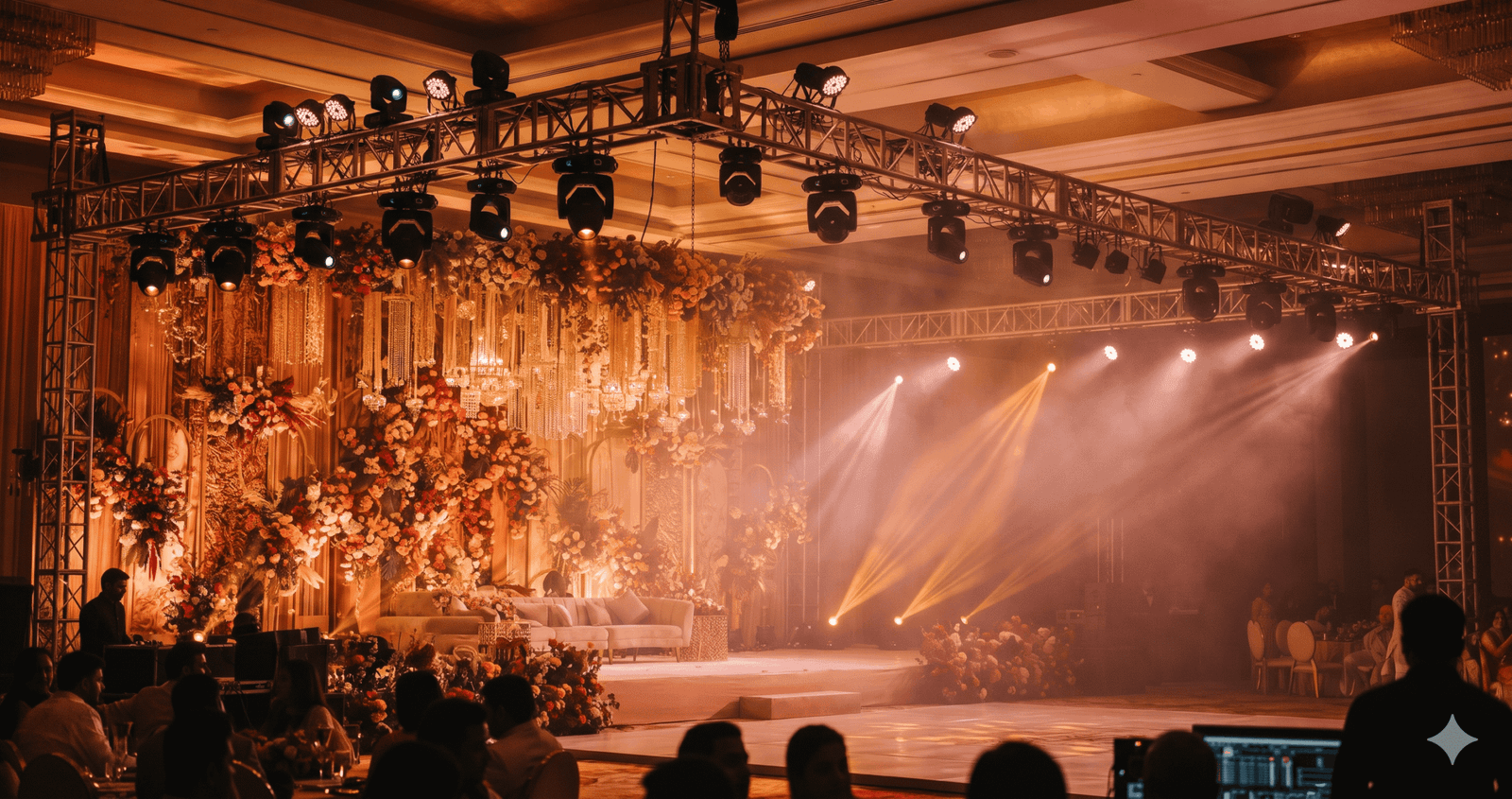
Walk into any big Indian wedding this season and count the lights. Moving heads over the sangeet stage. Warm washes on the mandap. Pixel strips along the baraat path. A haze machine waiting for the couple’s entry. Now ask who designed all of it, and who is running it live from the console at the back.
That person has a job most students have never heard of: wedding lighting design. This guide is for anyone thinking about it as a career, not for couples planning their own decor.
IIED COURSE
MA in Lighting Design
Learn to design, rig and programme full wedding rigs, from mandap washes to sangeet moving lights.
Duration: 2 years (4 semesters), full time · Mode: Classroom in Mumbai
Here is the gap. Indian weddings now use concert-grade lighting, but very few people train to design it. Most crews learn by carrying fixtures and watching. That works up to a point. The people who can plan a full rig, draw it, power it safely and run it live on a console are hard to find. That is where the career sits. Below we cover what the job involves, who hires, what IIED’s lighting alumni actually earn, and how to start.
Table of Contents
What a Wedding Lighting Designer Actually Does
A wedding lighting designer plans how every function will look, then makes sure the rig delivers that look on the night. It is not one event. An Indian wedding is four or five events, often across two or three days and two or three venues. Each one needs a different mood, and each one has different technical limits.
Sangeet: the closest thing to a concert
The sangeet is where wedding lighting design looks most like stage lighting. There are performances, a DJ, sometimes a live band. The designer plans moving heads, beams, washes and effects that change with each act. Family performers need to be lit well for the photographer and the video team. The DJ set needs energy. Someone has to cue all of that live, often with no rehearsal beyond a quick run-through.
Mandap: light for ritual and for the camera
The mandap is the opposite. The light here is warm, steady and soft. Faces must look natural for hours under a camera. The priest needs to see. Nothing can flicker or distract. A good designer works closely with the decor team so that flowers, fabric and drapes read the way they were designed to, instead of looking flat or washed out.
Reception: the big reveal
The reception usually has the biggest stage and the most guests. Lighting has to handle the couple’s entry, speeches, the first dance and hours of open floor. This is where timed cues matter. The entry might need the room to go dark, a single spot to pick up the couple and the stage to bloom in sequence. Get the timing wrong and the moment is gone.
Baraat path, venue facade and outdoor spaces
Then there is the outdoor work. The baraat route, the venue entrance, gardens, poolsides and building facades all need light. Outdoor work brings weather, long cable runs, generator power and safety around guests. Planning it is as much about logistics as it is about looks.
| Function | What the lighting has to do |
|---|---|
| Sangeet | Moving heads, beams, washes and effects that change with each act; performers lit well for the photographer and video team |
| Mandap | Warm, steady and soft light; faces look natural for hours under a camera; nothing flickers or distracts |
| Reception | Timed cues for the couple’s entry, speeches, the first dance and hours of open floor |
| Baraat path, facade and outdoor spaces | Weather, long cable runs, generator power and safety around guests |
So the job is part artist, part engineer and part show operator. The designer decides the look, plans the equipment, checks power and rigging with the production team, programmes the console and often runs the show live.
Wedding Lighting vs Wedding Decor vs Wedding Planning
On a wedding site, three teams often get mixed up in people’s minds. Knowing the difference helps you pick the right training.
- Wedding planners manage the client, budget, vendors, guest logistics and the overall timeline. They coordinate. They do not design the light or run the console.
- Wedding designers and decorators create the visual concept: the stage, mandap, florals, backdrops, furniture and styling. If you want to understand this side better, read our guide on wedding design vs wedding planning.
- Wedding lighting designers decide how all of that will be seen. They plan fixtures, positions, colours, power and cues, and they make the decor team’s work look the way it was imagined.
The best results happen when decor and lighting work as one team. A pastel floral stage can look stunning under the right colour temperature and lifeless under the wrong one. That is why IIED teaches Wedding, Event & Set Design, Lighting and Production under one roof in Mumbai. Wedding lighting is exactly where those worlds meet.
Most event management courses train planners and coordinators. They rarely teach lighting design or console programming. If you already have an event management background and keep ending up on wedding sites wishing you understood the technical side, this is the skill gap to fill.
The Technical Side of Wedding Lighting Design Most People Don’t See
Guests see colour and atmosphere. The wedding lighting designer sees a system that has to work every time. Here is what sits behind a modern wedding rig.
1. Fixtures
You need to know every major fixture family and what each one is for. PARs and LED washes for colour. Profiles for sharp, shaped light. Fresnels for soft fill. Moving heads (spot, wash, beam and hybrid) for movement and effects. Pixel fixtures and LED strips for lines and chases. Choosing the right fixture for each job, and the right number of them, is half of design.
2. Power
A large wedding rig draws serious power. Outdoor functions often run on generators. The designer must understand load calculation, power distribution and electrical safety, or at least speak the same language as the production electrician. A tripped circuit during the pheras is not a small mistake.
3. Rigging and trussing
Fixtures hang from truss and are lifted with hoists. Loads have to stay within safe working limits, especially over guests. Even if a rigging crew does the lifting, the designer plans where the weight goes and must understand what is safe.
4. DMX and the control network
Every intelligent fixture listens to a control signal, usually DMX or a network version of it such as Art-Net or sACN. DMX512 is an industry standard, published as the ANSI E1.11 (DMX512-A) standard. On a wedding rig with dozens or hundreds of fixtures, the designer has to plan addresses, universes and cabling so that everything responds correctly. When something stops responding mid-show, you need to troubleshoot fast.
5. The console and timed cues
All of this comes together on a lighting console. Consoles like grandMA3 let you store looks, build cue lists, time transitions and run effects. At a wedding, that means the couple’s entry, the varmala, the first dance and the cake cutting can each have a prepared moment that you fire at exactly the right second. It also means “busking“: running lights live to the DJ or band when nothing was planned. That skill is what separates an operator who can switch lights on from one who can run a show.
This technical depth is why wedding lighting design is a real profession and not “fairy lights and uplighters”. At the top end, the rigs are the same class of equipment used at concerts and award shows.
Who Hires Wedding Lighting Designers in India
Wedding lighting jobs in India come from four main places. Most professionals move between them over a career.
AVL rental companies
Audio, video and lighting (AVL) rental companies own the equipment and supply crews to weddings, concerts and corporate events. They hire technicians, operators, programmers and designers. Many weddings are lit by the rental company’s in-house team. IIED’s recruiters in this space include Stage Gear, Soundmindz, Global Service India, Fireflies Creative Technologies and Show Genesis.
Production houses and event agencies
Larger weddings, especially destination weddings, are often produced by event and production companies that handle staging, light, sound and video together. They need people who can design and run lighting as part of a bigger technical team.
Wedding design companies
High-end wedding design studios increasingly want lighting thinking inside the design team, so concepts are planned with light from day one. A designer who understands both decor and lighting is valuable here.
Freelance
Many experienced lighting designers work freelance, moving between rental companies, agencies and direct clients. Wedding season gives freelancers a steady run of work. Read our guide to the corporate event lighting design career in India if you want to compare weddings with the corporate side, where many freelancers also work.
The size of the market helps too. By the figure IIED uses in its course material, India’s wedding industry is worth ₹3.75 lakh crore and still growing. Lighting is now a standard line in big wedding budgets, not an extra.
What Wedding Lighting Jobs in India Pay
Let’s be honest about pay. There is no separate, published salary survey just for wedding lighting designers in India. What we can share is verified data from IIED’s own Lighting Design alumni, who now work at the AVL and production companies that light weddings and events.
For IIED Lighting Design alumni with 0–1 years of experience:
| Measure | IIED Lighting Design alumni (0–1 years of experience) |
|---|---|
| Highest CTC | ₹29.40 LPA |
| Average CTC | ₹8.20 LPA |
| Median CTC | ₹3.90 LPA |
Look at the median, not just the highest number. The median means half the group earned more than ₹3.90 LPA and half earned less. The average is pulled up by a few very strong offers, including international roles. Treat the median as the realistic starting point, and expect pay to grow as your skills and show list grow.
Some real entry-level examples from IIED’s Lighting Design alumni:
- Ritesh Khichariya had 2–3 years as a lighting operator in Raipur. He moved to Mumbai to study lighting design properly and now works as a Lighting Operator / Designer at Show Genesis, Mumbai, at ₹40,000 a month.
- Ashish Gonamanda joined as a complete fresher. He discovered lighting design was a career, trained at IIED and now works as a Lighting Operator / Designer at Show Genesis at ₹40,000 a month.
- Aditya Tawde was a freelance event manager. He now works as an Assistant Lighting Programmer at Fireflies Creative Technologies, Mumbai, on ₹25,000 a month during probation, then ₹40,000 a month.
None of these alumni are wedding-only lighting designers. They work for companies that light many kinds of shows, and weddings are a big part of that market in India. For the full pay ladder from technician to senior designer, read our detailed guide on lighting designer salary in India.
Skills and Tools for a Wedding Lighting Designer Career
A wedding lighting designer career rests on three groups of skills. You need all three to move from crew to designer.
1. Lighting fundamentals
How light, colour and the eye work. Colour temperature, so skin tones look natural on the mandap. Colour mixing, so the sangeet stage pops without clashing with the decor. Angles and intensity, so the photographer and video team get clean shots. This is the “why” behind every choice.
2. Planning and drawing
Before a single fixture is hung, a professional draws the rig. Light plots in CAD or Vectorworks Spotlight show where every fixture goes, how it is powered and addressed, and what truss it hangs on. 3D pre-visualisation in software like Capture lets you show the client and decor team what the stage will look like before load-in. On a tight wedding schedule, a clean plot saves hours on site.
3. Console programming and live operation
This is where wedding lighting gets exciting. With a console like grandMA3 you prepare cues for planned moments and build busking pages for unplanned ones. In IIED’s GrandMA3 Mastery Program, students build show files including busking pages for live events, the kind of setup you would use to run a sangeet or reception floor. The program runs for 74 hours across one month: 24 hours of live training plus 50 hours of self-paced practice.
The soft skills nobody mentions
- Calm under pressure. Timelines slip. The couple’s entry moves by forty minutes. You adjust.
- Clear communication. You talk to decor teams, planners, DJs, photographers and families, often in two or three languages.
- Stamina. Wedding season means long nights and back-to-back events.
- Safety sense. Guests, children and elderly relatives walk under and around your rig.
How to Become a Wedding Lighting Designer
There are two common routes. Both work. The difference is speed and depth. For the general route into the profession, also read how to become a lighting designer in India.
Route 1: Crew → operator → designer
Many people start as light boys or technicians with a rental company. You carry fixtures, run cable and learn by watching. Over time you may get to operate a simple show, then programme one. This route pays from day one, but progress depends on who you work under. Many technicians stay stuck because nobody teaches them the console, the drawings or the theory.
If you are already on this route, focused training can move you up faster. Ritesh had years of operating experience before he trained at IIED and stepped up to a Lighting Operator / Designer role. Rishabh Rao works in his family’s AVL rental company, one of Mumbai’s largest, and freelances with LGL Designs. He joined IIED for a professional foundation in the design principles behind the equipment his family business already supplies.
Route 2: Train first, then join the industry
If you are a recent graduate with no industry contacts, training first gives you the skills, a portfolio and an internship before you apply. Ashish is the proof that a fresher can get hired. He started with zero background and went straight to Show Genesis.
You have two training options at IIED:
- MA in Lighting Design – a two-year, full-time, hands-on master’s degree programme in Mumbai. It covers the science of light, power, rigging, fixtures, DMX, CAD plots, pre-visualisation and console programming on grandMA3 and Avolites Titan. In Semester 2 you choose an elective, and Lighting for Events is one of the options. Semester 2 also includes a supervised industry internship. Any graduate can apply.
- GrandMA3 Mastery Program – a one-month, 74-hour course for people who want console skills quickly, especially if you already work in lighting or events.
A simple plan to get started
- Learn the fundamentals of light and colour, and practise on grandMA3 onPC, which is free to download.
- Get on real wedding sites, even as crew, to understand how a load-in and a show day work.
- Learn to draw a light plot so you can plan, not just follow.
- Build a small portfolio: plots, pre-vis renders and photos of shows you worked on.
- Get structured training if you want to move faster and build a proper portfolio with mentors who light shows for a living.
Is a Wedding Lighting Designer Career Right for You?
This path suits three kinds of people.
The recent graduate who wants a practical job. You finished a degree, you are not sure what next, and the wedding industry feels familiar. Wedding lighting design gives you a technical, in-demand skill and a clear ladder to climb.
The crew member who wants to move up. You already work as a light boy, decorator’s technician, AV rental staff or DJ. You know the sites. What you are missing is the theory, the drawings and the console. Training turns your site experience into a design career.
The event management graduate who wants the technical side. You keep ending up on wedding sites, but you cannot do the technical work. Aditya made a similar move, from freelance event manager to Assistant Lighting Programmer.
It may not suit you if you dislike late nights, travel or working in a crowd under pressure. Wedding season is intense. But if you enjoy watching a dark room come alive at exactly the right moment, few jobs feel better.
The honest summary
Wedding lighting design is a real, skilled career in India. The work is technical and creative at the same time. Entry pay is modest but grows with skill, and trained people are hard to find. The fastest way up is to learn what most crews never get taught: the theory, the drawings and the console.
Frequently Asked Questions
What does a wedding lighting designer do?
A wedding lighting designer plans and runs the lighting for every wedding function. That means choosing fixtures, planning positions, power and rigging with the production team, programming the console and running cues live. Each event, from sangeet to mandap to reception, gets its own look, and the designer makes the decor read well on camera.
Is wedding lighting design a good career in India?
Yes, for people who enjoy technical and creative work together. Indian weddings now use concert-grade lighting, but few people train to design it. Trained designers and programmers are hard to find. Pay starts modest and grows with skill, and the same skills also open doors to concerts, corporate events and theatre.
How much does a wedding lighting designer earn in India?
There is no published wedding-only salary survey. IIED Lighting Design alumni with 0–1 years of experience show a highest CTC of ₹29.40 LPA, an average of ₹8.20 LPA and a median of ₹3.90 LPA. Recent alumni went into operator and designer roles at Mumbai companies at ₹40,000 a month.
What is the difference between a wedding decorator and a wedding lighting designer?
A wedding decorator creates the physical look: stage, mandap, florals, backdrops and styling. A wedding lighting designer decides how all of that is seen. They plan fixtures, colours, power and cues, and run the show live. The best weddings happen when both teams plan together from the start.
Do I need to learn a lighting console like grandMA3 to light weddings?
For the bigger, design-led weddings, yes. Moving lights, timed entries and live busking on the sangeet floor all run from a console, and grandMA3 is one of the most widely used. You can start practising on grandMA3 onPC, which is free, then train on a real console.
Which companies hire wedding lighting designers in India?
AVL rental companies, production houses, event agencies and wedding design studios all hire lighting people, and many designers freelance. IIED’s lighting recruiters include Stage Gear, Soundmindz, Global Service India, Fireflies Creative Technologies and Show Genesis, which light weddings, concerts and corporate events.
Can I become a wedding lighting designer without an engineering degree?
Yes. You do not need an engineering degree. IIED’s MA in Lighting Design accepts graduates from any discipline and starts from first principles, including power, rigging and control. Many working lighting designers came from other fields, including event management, sound and complete fresher backgrounds.
How long does it take to train as a wedding lighting designer?
It depends on your route. IIED’s MA in Lighting Design is a two-year, full-time programme with an industry internship. The GrandMA3 Mastery Program takes one month and 74 hours, which suits people already working in lighting or events. Learning only on site usually takes much longer.
Ready to Start Your Wedding Lighting Design Career?
Want to know which route fits you? Visit IIED in Malad East, Mumbai, see the grandMA3 consoles and lighting rig, and talk through your background with our team.
Book your free visit — call 9892966334 or email info@weareiied.com. IIED, Shop No. 506, 5th Floor, Magic Square, Dwarkadhish Road, off Poddar Road, Malad East, Mumbai 400097.
IIED COURSE
GrandMA3 Mastery Program
Already on wedding sites? Learn to cue entries and busk sangeet floors on grandMA3.
Duration: 1 month (74 hours: 24 hrs live training + 50 hrs self-paced practice) · Mode: Classroom at IIED’s training centre in Malad, Mumbai