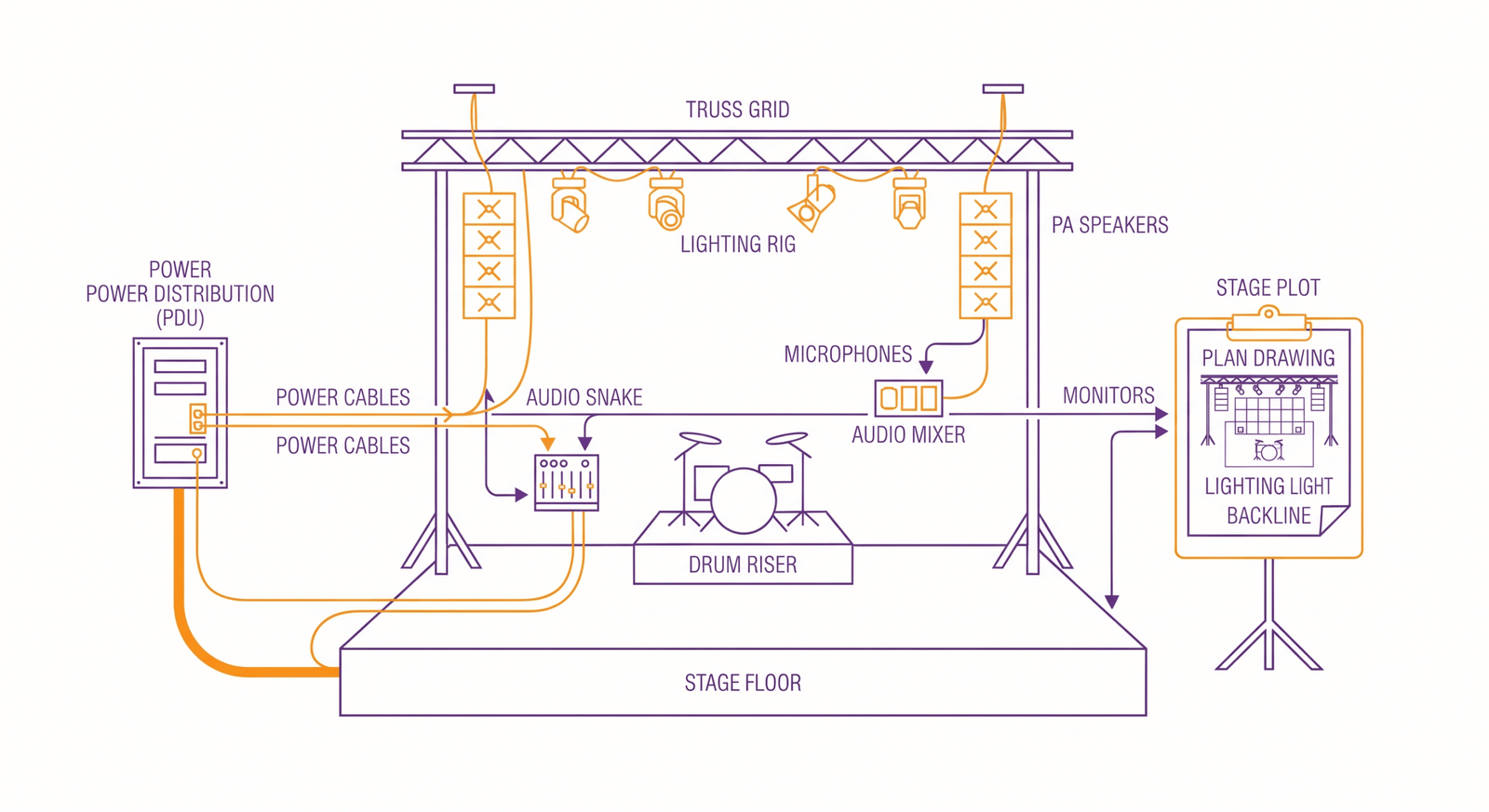
Every big show you’ve seen stood on a truss someone rigged, ran on power someone distributed, and opened on a cue someone called. A technical production course teaches you to be that person. It covers the backstage engineering of live events: staging, rigging, power, sound, lighting and video systems, safety and planning. It leads to roles like production manager, stage manager and technical director.
One quick clarification. If you’ve searched “technical production course India,” you’ve probably seen engineering and manufacturing “production technology” courses. This post is not about factories. It is about live events: weddings, concerts, award shows, corporate launches, exhibitions, film, TV and broadcast. Here is what a technical production course for events actually teaches, module by module, and which job each skill feeds.
IIED COURSE
MA in Technical Production
Every skill area in this post, taught hands-on over two years, from safety and rigging to running a public show.
Duration: 2 years · Mode: Full-time in Mumbai
We’ll use IIED’s MA in Technical Production as the worked example throughout, because it is the programme we know inside out. It is IIED’s own 2-year, full-time, hands-on master’s programme, built for live events in India. But the skill map applies to any serious technical production course you compare.
If you want the bigger picture of the career itself, read our guide to technical production careers in India. This post stays inside the classroom.
Table of Contents
Technical Production vs Event Management, in One Paragraph
Event managers coordinate. They handle clients, budgets, vendors, guest lists and timelines. Technical production makes the show physically work. It decides whether the stage can hold the set, whether the truss can take the load, whether the generator is big enough and whether the sound, lights and screens all talk to each other on the night. Both jobs matter. They are different skill sets, and a technical production course is built for the second one. For the full comparison, see our post on event production vs event management.
What You Learn in a Technical Production Course: 7 Skill Areas
A good live event technical production course isn’t a list of software and gadgets. It is a set of connected skills, taught in the order you’d use them on a real show. Here are the seven areas, with a real-world Indian example for each and the job title each one feeds.
| Skill area | Job it feeds |
|---|---|
| 1. Health, safety, risk and compliance | Event Safety Coordinator, and every senior production role. |
| 2. Staging, stage machinery, rigging and load management | Rigging Supervisor, Stage Manager, staging and rigging lead. |
| 3. Power, electrical distribution and on-site energy | Production Manager, Technical Director, Venue Technical Manager. |
| 4. Audio, lighting, video and systems integration | Technical Producer, Technical Director, Broadcast and Outside Broadcast Technical Coordinator. |
| 5. Production planning, logistics and site management | Production Manager, Production Coordinator, site and logistics manager, Touring Production Manager. |
| 6. Technical documentation: CAD drawings, plots and run sheets | Draftsman, Production Designer, Production Manager. |
| 7. Show calling and site leadership | Technical Director, Stage Manager, Show Manager. |
1. Health, safety, risk and compliance
What it is: Before anything gets built, someone has to ask what could go wrong. This module teaches risk assessment, method statements, fire and crowd planning, emergency procedures and the rules that apply to temporary structures and public events.
Real example: An outdoor sangeet in Udaipur with a tented stage, a crowd of guests, open flames for decor and a sudden wind forecast. The technical team needs a written plan for what happens if the wind picks up, who gives the stop order, and how guests get out.
Job it feeds: Event Safety Coordinator, and every senior production role. Safety isn’t a side topic. In IIED’s programme it runs through every year, and rigging carries a mandatory practical competence check. International bodies treat temporary event structures seriously too. The UK Health and Safety Executive keeps dedicated guidance on temporary demountable structures at events, covering safe construction, deconstruction and the equipment that holds speakers and lights.
2. Staging, stage machinery, rigging and load management
What it is: How stages, platforms, truss, towers and ground support go together. How chain hoists and motors lift loads. How to calculate what a truss can safely hold, and how load cells confirm it. This is where a stage rigging and staging course earns its name.
Real example: A Mumbai award show with a long LED wall, moving lights on three flown truss lines and a speaker cluster hanging left and right. Every kilo above the audience must be planned, checked and signed off before doors open.
Job it feeds: Rigging Supervisor, Stage Manager, staging and rigging lead. If this area interests you most, our rigging and trussing career guide goes deeper.
3. Power, electrical distribution and on-site energy
What it is: Where the power comes from, how much the show needs and how it gets safely to every fixture, speaker and screen. You learn load calculation, distribution boards, cabling and generator sizing.
Real example: A corporate launch in a convention hall where the house supply can’t run the LED wall, the lighting rig and the catering at the same time. The production team specs generators, plans the cable runs away from guest paths and keeps a backup ready for the keynote.
Job it feeds: Production Manager, Technical Director, Venue Technical Manager. Power planning is one of the clearest dividing lines between someone who coordinates a show and someone who can actually deliver it.
4. Audio, lighting, video and systems integration
What it is: A show is not three separate departments. Sound, lighting, video, LED and show networks have to work as one system. This module teaches how the pieces connect, what each team needs, and how to spot the problem when something stops talking to something else.
Real example: A concert where the LED content, lighting cues and backing track all run to timecode. If the video server and the lighting console lose sync, the whole show looks wrong. The technical producer needs to know where to look first.
Job it feeds: Technical Producer, Technical Director, Broadcast and Outside Broadcast Technical Coordinator. You don’t need to be the best sound engineer and the best lighting programmer. You need to understand all of them well enough to lead them.
5. Production planning, logistics and site management
What it is: Schedules, crewing, transport, load-in and load-out, and running a site. Who arrives when, which truck unloads first, where the forklift goes and how long the build really takes.
Real example: A destination wedding in Goa with three functions on three different lawns over two days. Each set has to go up, get used and come down before the next one starts, with the same crew and limited access roads.
Job it feeds: Production Manager, Production Coordinator, site and logistics manager, Touring Production Manager. Many people start here, because planning is where event management experience transfers most directly.
6. Technical documentation: CAD drawings, plots and run sheets
What it is: If it isn’t drawn, it doesn’t get built correctly. This area covers technical drawings in AutoCAD and Vectorworks, rigging plots, power plans, schedules and the full production book that every department works from.
Real example: A brand activation in a mall atrium. The venue wants a scaled floor plan, an elevation of the stage and a rigging plot before it gives permission. Without clean drawings, the event doesn’t happen.
Job it feeds: Draftsman, Production Designer, Production Manager. This is also the fastest skill to learn on its own, and the one with the clearest proof at IIED. More on that below.
7. Show calling and site leadership
What it is: On show day, someone runs the room. They call cues, keep departments in step, make decisions when plans change and keep everyone safe. In IIED’s programme this comes together in Year 2, through advanced production management and the technical director’s practice, large-scale event delivery and a major production staged before a live public audience.
Real example: A televised award night where a presenter runs long, a video playback fails and the next act is waiting in the wings. The person on headset decides, calmly and quickly, what happens next.
Job it feeds: Technical Director, Stage Manager, Show Manager. If you’re unsure how the top roles differ, read technical director vs production manager.
Labs, Studio Projects and the Internship
“Hands-on” gets used loosely. Here is what it means in a technical production course built properly, using IIED’s programme as the example.
Structures, rigging and documentation lab
In Semester 1 you work in a lab on real staging decks, truss, towers, ground support, chain hoists and rigging hardware. You learn by building, checking and taking down. You also learn to document what you build, so the drawing and the structure match.
Integrated production documentation studio
In Semester 2 you put together a complete production package for a show: drawings, power plan, systems plan, schedule and crewing. It is the kind of document a production house would hand to a venue and a client. It also becomes a portfolio piece.
Supervised industry internship
Also in Semester 2, you complete a supervised internship with a production house, technical vendor, venue or event company. You work on real load-ins, staging, rigging, power, systems, show operation and get-outs, with a logbook signed by your host supervisor.
Advanced studio and the public production
Year 2 adds advanced production and bid documentation, large-scale and complex event delivery, special effects and pyrotechnics within their licensing rules, automation and motion control, and production budgeting. It ends with you planning and delivering your own major production before a live public audience, plus a research dissertation. That production is your portfolio centrepiece as a technical director or production manager.
The equipment list matters too. IIED’s programme trains on staging decks and barriers, truss and ground support, chain hoists and motors, load cells, power distribution and generators, PA systems, lighting and LED screen systems, media servers and show networks. Software covers AutoCAD, Vectorworks and production scheduling tools.
Choose Your Specialisation
Indian live events are not one market. A course in technical production for events should let you lean towards the work you want. IIED’s programme offers an elective each semester. Here’s who each early track suits.
Live entertainment and concerts
For people who want touring rigs, festival stages and big flown systems. Expect more rigging, more power, more systems integration and tighter changeovers between acts.
Corporate, weddings and exhibitions
For people drawn to India’s biggest volume of work. Weddings, brand launches, conferences and exhibitions run all year. The challenge is speed, client changes and fitting production into venues that weren’t built for it.
Film and television
For people who like studio floors, sets and camera-ready lighting. Film and TV crew such as grip, electrical and studio technicians who want to move into production management often fit here.
Broadcast and streamed events
For people interested in live TV, outside broadcasts and hybrid events. The audience at home matters as much as the audience in the room, so signal flow and camera needs shape every decision.
Later electives cover touring and multi-venue production or technical production for theatre, then venue and facility technical management or production consultancy and technical design. Check the course page for the full list.
Careers a Technical Production Course Leads To
Here are the roles a technical director course India students usually aim for, and what each one does in a line.
| Role | What they do |
|---|---|
| Technical Director | owns the technical side of the whole show and signs off that it is safe and ready. |
| Production Manager | plans the build, the budget, the crew and the schedule, and runs the site. |
| Stage Manager / Show Manager | runs the stage on the day and calls the show. |
| Technical Producer | connects the creative brief to the systems that deliver it. |
| Rigging and staging lead / Rigging Supervisor | plans and supervises everything flown or built. |
| Site or logistics manager / Production Coordinator | keeps people, trucks and gear moving on time. |
| Venue Technical Manager | runs the technical side of a permanent venue. |
| Event Safety Coordinator | leads risk assessment and safety on site. |
For what these roles pay and how people progress, read technical production manager salary and career path in India. We don’t quote pay figures here because this post is about skills, and we only use numbers from verified offer letters.
IIED alumni already work inside some of India’s biggest production companies and venues. Pranay Mhatre, for example, is a Production Designer at Wizcraft in Mumbai. He came through IIED’s Event & Wedding Design Visualization course, not a technical production course, but it shows the kind of companies where this work happens.
Short Course or Full Programme?
This is the honest question most people should ask before committing to two years. The answer depends on what you want to do next.
The fast entry: one focused technical skill
If you want into production quickly, a 1-month CAD or Vectorworks course is the fastest door. Technical drawing is the skill production teams ask for first, and IIED’s short-course alumni prove it.
- Suhani Mudra finished an event management degree and felt she was missing skills. After IIED’s CAD for Events & Entertainment course, she became Draftsman and Production Manager at Potato Heads. Her degree taught her to plan. Technical skills taught her to produce.
- Arun Sagar took the same CAD course to upskill technically. He now works in the Operations & Production department at NMACC (Nita Mukesh Ambani Cultural Centre), BKC, Mumbai, one of the city’s most respected performance venues.
- Zargam Haider learned CAD at IIED and went straight into a Consulting Production Designer role at Hyperlink.
These are outcomes from the CAD course. The MA in Technical Production is a new programme, so it has no graduates yet. We share these stories because they show that technical production skills get IIED students hired. If you’re weighing the two drawing tools, read CAD vs Vectorworks for event production.
The full programme: leading whole productions
A short course gives you one skill. It won’t teach you power, rigging, systems integration, safety, logistics and show leadership together, and those are what a technical director or production manager needs. The 2-year programme is for people who want to lead whole productions, not just one department.
It also suits three groups especially well:
- Recent graduates from any stream who like the backstage, hands-on side of shows and want a structured start.
- Event management graduates who keep hearing “not enough technical experience” in interviews.
- Working crew, such as backstage hands, AV rental technicians and engineers drawn to live events, who want to move up from operating to managing.
Some people do both. They take a short course first, work for a season, then come back for the full technical production course once they know production is their career.
Frequently Asked Questions
What is a technical production course?
A technical production course teaches the backstage engineering of live events. You learn staging, rigging, power distribution, sound, lighting and video systems, safety, planning and documentation. It prepares you to make shows physically work, for roles like production manager, stage manager and technical director. It is not a manufacturing “production technology” course.
What do you learn in a technical production course for live events?
You learn seven connected skill areas: health, safety and risk; staging, rigging and load management; power and electrical distribution; audio, lighting and video systems integration; production planning and logistics; technical documentation in AutoCAD and Vectorworks; and show calling and site leadership. Good courses add labs, an internship and a live production.
Is technical production the same as event management?
No. Event management coordinates the event: clients, budgets, vendors and timelines. Technical production makes the show physically work: staging, rigging, power, sound, lighting, video and safety. Many event managers move into production by adding technical skills, but the two jobs need different training and lead to different roles.
What is the eligibility for IIED’s technical production programme?
Any graduate from any discipline can apply for IIED’s MA in Technical Production. You don’t need prior technical experience, because the course starts from first principles: the live-event industry, safety, staging and rigging. Event management, engineering, architecture and media graduates are all welcome, as are working crew with a degree.
How long is a technical production course?
It depends on depth. IIED’s MA in Technical Production runs for 2 years across 4 semesters, full-time, and covers every skill area plus an internship and a public production. Focused skill courses such as CAD for Events & Entertainment run for 1 month and teach one skill, like technical drawing.
What jobs can I get after a technical production course in India?
Common roles include Technical Director, Production Manager, Stage Manager, Technical Producer, Rigging Supervisor, Production Coordinator, Venue Technical Manager, Touring Production Manager and Event Safety Coordinator. These roles exist across concerts, weddings, corporate events, exhibitions, film, TV and broadcast. Entry roles usually start in coordination, drafting or crew leadership.
Do I need an engineering background to study technical production?
No. A technical production course for events starts from basics, so graduates from any stream can learn it. Engineers are very welcome, though. Their understanding of loads, electrics and systems gives them a head start in rigging, power and integration, and many find live events a more exciting use of those skills.
Can I start with a short course before a full technical production programme?
Yes. A 1-month CAD or Vectorworks course is a fast way into production work. IIED CAD alumni Suhani Mudra, Arun Sagar and Zargam Haider moved into production roles after it. Later, if you want to lead whole productions, a full technical production programme covers safety, rigging, power, systems and leadership together.
Ready to Start Your Technical Production Career?
Reading about truss loads and power plans only goes so far. The best way to judge any technical production course is to stand in the lab, see the equipment and ask the trainers hard questions. IIED is the only institute in Mumbai that trains event design, lighting and production under one roof, so you can also see how the departments work together.
Book your free visit to IIED and see the production lab and course details for yourself. For fees and intake details, use the enquiry form on the MA in Technical Production page.
Book your free visit — call 9892966334 or email info@weareiied.com. IIED, Shop No. 506, 5th Floor, Magic Square, Dwarkadhish Road, off Poddar Road, Malad East, Mumbai 400097.
IIED COURSE
CAD for Events & Entertainment
Want the fast entry first? Learn the drawing skill that took Suhani, Arun and Zargam into production.
Duration: 1 month · Mode: Live online or in person in Mumbai