
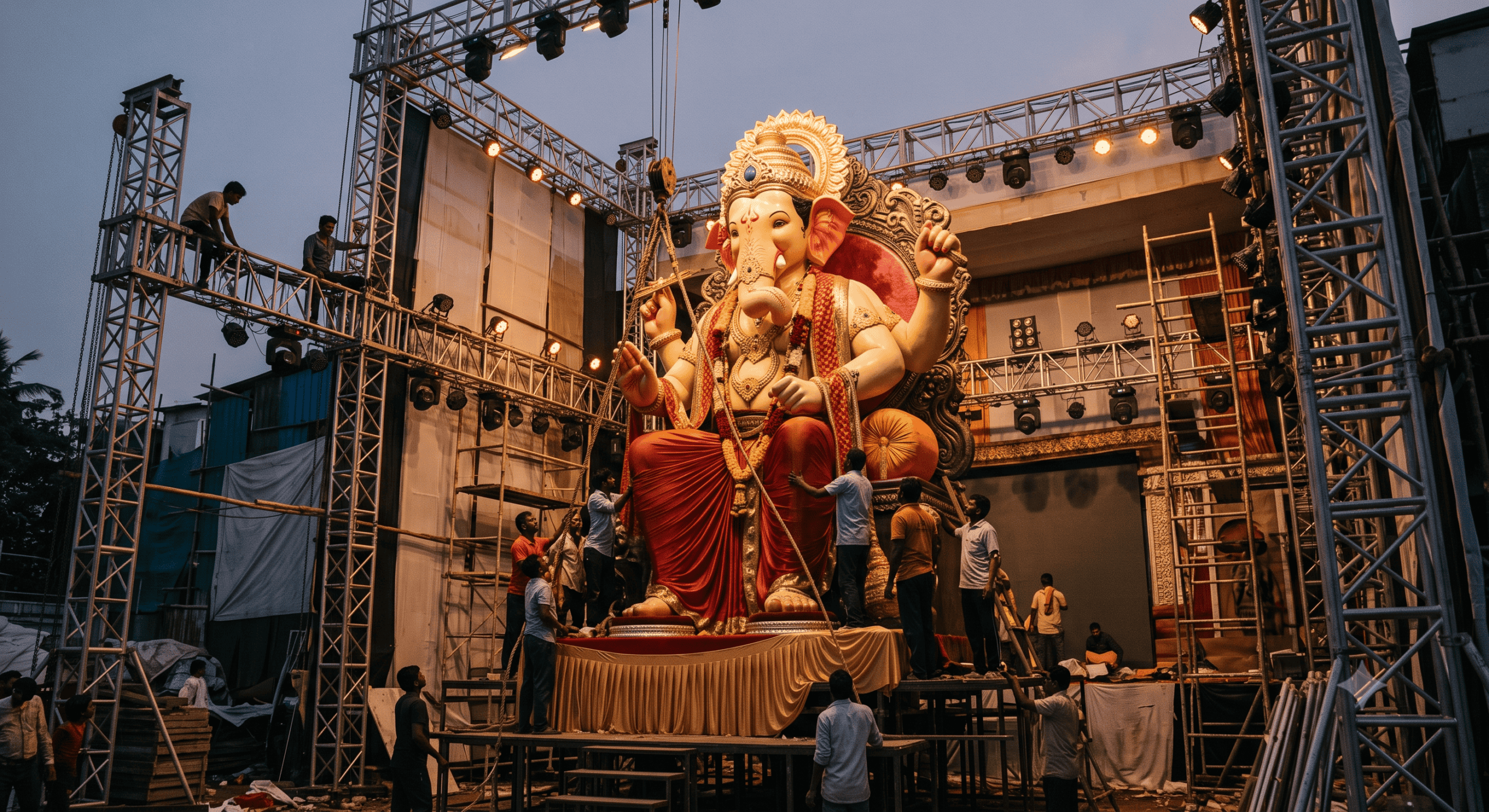
Every year, Mumbai’s Ganesh Chaturthi pandals get bigger, more ambitious, and more technically demanding. Massive structures. Elaborate lighting. Detailed theming that takes weeks to plan and days to execute. Yet almost nobody talks about pandal design as a real career. It gets filed under “decoration,” like it’s informal, seasonal, and doesn’t require real training.
That framing is wrong, and it’s worth correcting properly, because a real pandal design career runs on the same skills as any large-scale event production job: structural planning, trussing and lighting basics, material selection, vendor coordination, and budgeting under a deadline that cannot move by even a day. If you’ve ever helped build a pandal — for your building, your neighbourhood, your family’s mandal — and felt like you were doing something bigger than decoration, you were right. This piece breaks down what a pandal design career actually involves, the five skills behind every serious build, and the training path that turns informal pandal experience into professional production design work.
Table of Contents
Why Pandal Design Gets Filed Under “Decoration” (And Why That’s Wrong)
Start with the scale. Ganesh Chaturthi is one of the largest festival economies in the country, and Mumbai sits at the centre of it. According to official estimates reported by Editorji, the festival generates close to ₹50,000 crore in economic activity for the city every year. That figure covers idol makers, fabric suppliers, lighting and sound vendors, electricians, artists, and the designers who plan how a pandal actually looks and functions. A single well-known pandal in Mumbai can run a decoration budget stretching into crores. That is not the scale of a hobby. That is the scale of a serious production industry.
So why does pandal design still get called “decoration” instead of design? Partly because the work is seasonal and community-run rather than corporate, so it doesn’t look like a typical event industry job on paper. Partly because the people doing it — often local artists, contractors, or families who have run the same mandal’s pandal for generations — were never taught to describe what they do in industry terms. They know how to plan a structure, rig a lighting truss, manage a theme, and hit an impossible deadline. What they haven’t been told is that this is production design, the exact discipline trained inside a professional event and wedding design course.
That gap matters, because it means thousands of people every year are doing real design and production work without realising it could be the foundation of a full-time career, not just a once-a-year commitment.
It also matters because pandals themselves keep getting more ambitious. Replica structures modelled on famous temples and landmarks, multi-level walkthroughs, synchronised lighting sequences timed to aartis, and elaborate theming that changes every year all demand more planning, not less. A pandal that visitors can safely walk through for eleven straight days, in Mumbai’s monsoon-tail humidity, with thousands of people moving through a temporary structure daily, is an engineering and design problem before it is a decorative one. Treating that as an informal, un-trainable skill undersells exactly the people doing the hardest part of the job.
What a Pandal Design Career Actually Involves: 5 Real Skills
Strip away the festival context and a serious pandal build asks for the same core skills as a large concert stage, a big-budget wedding mandap, or a corporate exhibition booth. Here are the five that matter most.
1. Structural Planning
Before a single flower or fabric panel goes up, someone has to plan the structure: how tall it can safely go, how the load is distributed, how the crowd will move through and around it, and how it holds up over an 11-day festival with thousands of visitors passing through daily. This is spatial and structural thinking, the same skill used to plan a stage build or a large exhibition stand.
2. Trussing, Lighting and Sound Basics
Elaborate pandals aren’t lit with a few decorative bulbs anymore. Serious builds use proper trussing to hang lighting rigs, plan focal points so the idol and the theme are lit correctly at every hour of the day and night, and coordinate sound systems for aartis and performances. This is a direct overlap with event lighting and production training, not a decoration skill picked up casually.
3. Fabric, Material and Theming
Every pandal has a theme, and every theme has to be executed in real materials on a real budget: fabric draping, thermocol and fibre work, floral design, colour palettes that read well under lighting and in photographs. Choosing and working with the right materials at scale is a design skill in its own right, one that shows up in course curriculums under fabrics and furnishing.
4. Vendor Management and Budgeting
A pandal build involves coordinating electricians, fabricators, artists, florists, and labour teams, often across a tight and very public budget funded by community donations or sponsorships. Managing multiple vendors, tracking costs, and keeping a build on schedule when the deadline is a fixed religious date is a production management skill, not an artistic one.
5. Working Under a Deadline That Cannot Move
Weddings can be postponed. Corporate launches can slip a week. A Ganesh Chaturthi pandal cannot. The idol arrives on a fixed date and the structure has to be ready, tested, and safe by then, every single year. Learning to deliver complex creative and technical work against a deadline that will not bend is one of the most transferable professional skills in any production career.
Put these five together and what you have is a compressed, high-pressure version of full-scale event production design. The people who do this well every year already have the instincts. What most of them are missing is the formal training that turns instinct into a career people will actually hire and pay for outside the festival season.
Pandal Contractor vs. Pandal Designer: What’s the Real Difference?
Not everyone who builds a pandal is doing the same job, and the difference matters if you’re thinking about this as a career path.
A pandal contractor typically executes a brief: they source materials, manage labour, and put up a structure to a budget, often repeating a similar format year after year. A pandal designer does something different. They start with a concept, plan the structural and lighting design to support that concept, choose materials and colour schemes deliberately rather than by habit, and think about how the space will be experienced by a visitor walking through it. A contractor builds what they’re told. A designer decides what gets built and why.
This is exactly the same distinction that exists in the wider event industry between an event decorator who executes a standard set-up and an event designer who plans the full visual and spatial concept. If you’ve been doing pandal work as a contractor and want to move into design, the gap isn’t talent. It’s training in the design principles, production planning, and presentation skills that let you pitch and lead a concept instead of just building someone else’s.
Picture two people working on the same mandal’s pandal next season. One is handed a rough theme, a fixed budget, and a deadline, and spends the build sourcing thermocol, briefing labourers, and reacting to problems as they come up. The other sits down weeks earlier with sketches, a materials plan, a lighting layout, and a proposal that explains why the theme should look and feel a certain way, then manages the same vendors and budget against that plan. Both are doing real work. Only one of them is positioned to walk into a corporate event company, a wedding design studio, or their own client meeting and say, credibly, “I designed this.”
From Family Ganesh Chaturthi Pandal Design Work to a Real Event Career
Two groups of people are best placed to turn pandal experience into a professional career, and IIED sees both of them regularly.
The Directionless Creative: Helping With Family Pandal Work Since Childhood
The first group is students who’ve grown up helping with a family or neighbourhood pandal every year without ever thinking of it as “real” work. They already have the creative instinct and the hands-on production experience — they just haven’t had it named, structured, or turned into a portfolio. What they need is a formal way to learn industry-standard tools, build a professional digital portfolio, and present their work well enough to get hired outside the one festival they know.
The Stuck Event Management Graduate: Coordination Skills, No Design Training
The second group is event management graduates who’ve done pandal or festival coordination as part of broader event work, but were never taught the design and technical side: structure, lighting, materials, or budgeting as a design discipline rather than an operational checklist. This is a well-documented gap. Kshiti Jain, an event management graduate, has described struggling to break into design work until formal training gave her, in her words, “the foundation to build my own brand.” She now runs her own event design company. Lishika Jain, also an event management graduate, went through the same course and co-founded her own event design company with two partners. Neither built her business on pandal work specifically, but both illustrate the same path: event management experience plus real design and production training equals a business or career you couldn’t build on operations alone.
The proof that this pipeline works at the highest level of the industry is Pranay Mhatre, who completed IIED’s Event & Wedding Design Visualization course and was placed as a Production Designer at Wizcraft, India’s oldest and largest event company. Wizcraft builds productions at a scale that dwarfs even the biggest pandal, using the exact same core skills: structural planning, lighting and trussing, materials, vendor coordination, and deadline execution. If those skills can take someone into a production design role at Wizcraft, they can absolutely take a serious pandal builder into a professional event design career.
How to Become a Pandal Designer: The Training Path
The realistic path from informal pandal experience to a professional pandal design career runs through formal production design training, not through building bigger pandals and hoping someone notices.
IIED’s Event & Wedding Design Visualization course is built around exactly the skill set this article has walked through.
Unit 2, Production of Event Design, covers trussing, lighting and sound basics, fabrics and furnishing, and vendor management and budgeting — the same four disciplines behind every serious pandal build, taught as a formal, professional curriculum rather than picked up by trial and error once a year.
Unit 1 builds the design foundation (colour theory, elements and principles of design) that separates a designer from a contractor.
Unit 3 teaches presentation methods, including sketching and production design drawings, so you can pitch a concept instead of just executing one.
Unit 4 is a self-directed final project simulating a real professional commission, and the course closes with a professional digital portfolio you can actually show to employers or clients.
The course runs 3 to 4 months, part-time, open to anyone with a 10+2 qualification, with total fees of ₹60,000 across enrolment and two instalments. It is taught hands-on by working industry professionals at IIED’s Malad campus in Mumbai, in small batches, which matters when the skill you’re learning is inherently practical rather than theoretical.
Who This Course Is For: Aspiring Pandal Designers Across India
For a family running a pandal business, this training can turn a seasonal decoration operation into a design studio that takes on weddings, corporate events, and exhibitions the rest of the year. For a student who has only ever worked on one pandal a year, it’s the fastest real route into a career as an event designer, wedding designer, production planner, or art director — none of which have to wait for the next Ganesh Chaturthi to begin. And because the underlying skills (structure, lighting, materials, budgeting, presentation) are the same everywhere pandals are built, this training path holds whether you’re based in Mumbai, working with a mandal in another Maharashtra city, or coordinating festival builds anywhere else in India.
Ready to Build the Career Behind the Build?
If you’ve ever walked away from a pandal build knowing you did something more than decorate, that instinct is worth training properly. IIED’s Event & Wedding Design Visualization course teaches the exact structural, lighting, material and production skills behind every serious pandal, wedding, and event build, taught hands-on by working industry professionals at our Malad, Mumbai campus.
Book your free visit to IIED and see the Production of Event Design unit for yourself. Call 9892966334 or write to admission@iiedeventdesign.com.