
Table of Contents
The Engineering Degree That’s Sitting Unused
Every year, thousands of mechanical, electrical, instrumentation and civil engineering graduates in India finish a degree built on power systems, load calculations and structural math — and then take a job that uses almost none of it. A support role in a manufacturing plant. A generic IT services job. A government exam attempt that may or may not work out. The technical skill is real. The career that uses it creatively often isn’t.
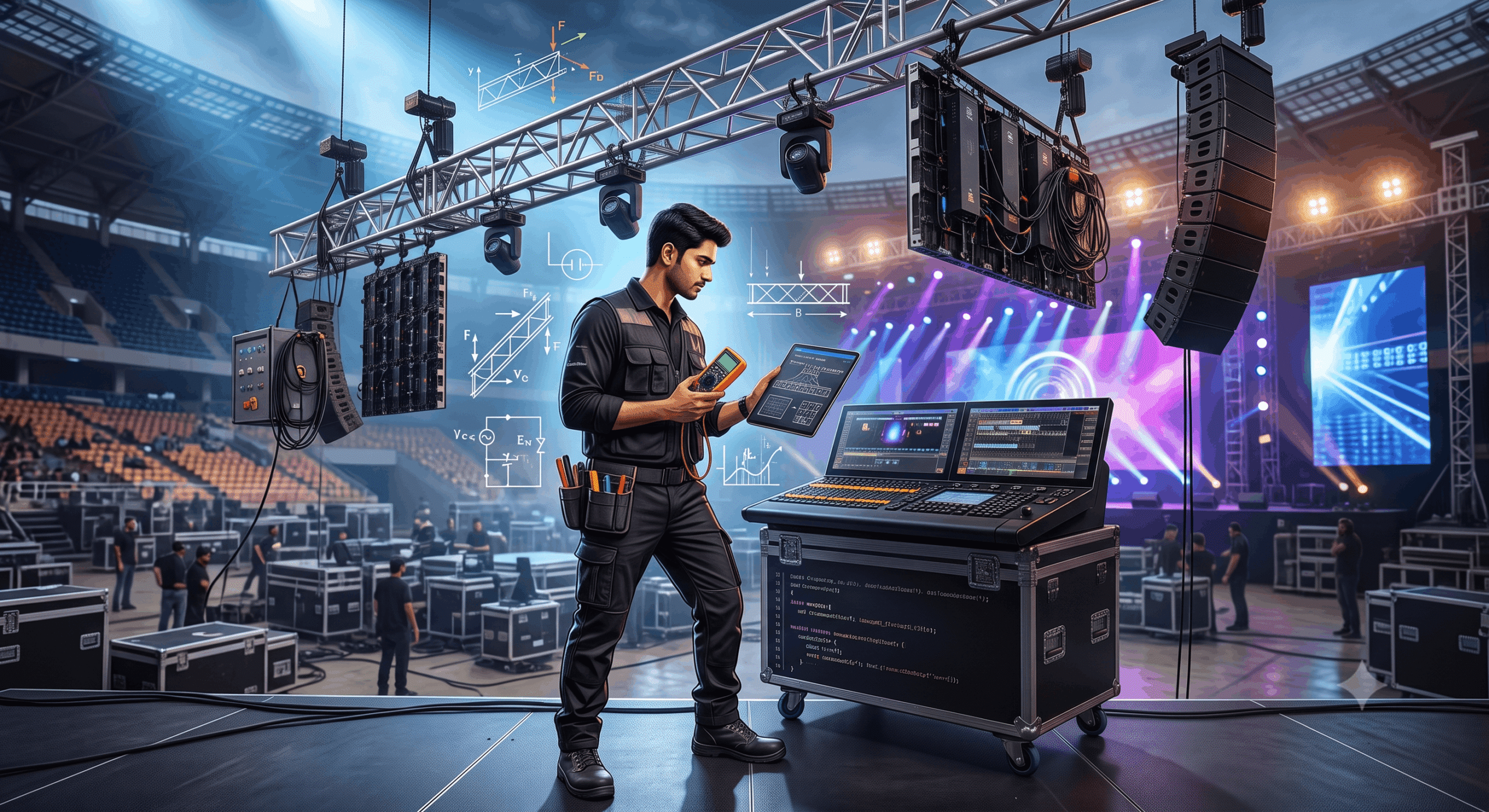
There is one industry that runs almost entirely on the fundamentals an engineering degree teaches, and it rarely comes up in campus placement conversations: live events. Technical production — the rigging, power distribution, lighting systems and AV that make a concert, wedding stage or corporate show actually work — is one of the few creative-industry careers where an engineering brain is a direct advantage, not something you have to unlearn.
This isn’t a “start from zero” story. It’s a skill-transfer story. If you understand electrical loads, earthing, structural weight limits or basic circuit theory, you already have the hardest part of technical production sorted. What’s missing is the industry-specific training — and that’s a gap a good course closes in months, not years.
What Technical Production Actually Covers in Live Events
“Technical production” gets confused with event coordination constantly, so it’s worth being precise. Coordination is logistics — vendors, timelines, guest lists. Technical production is engineering applied live, in front of an audience, with zero room for a second take.
It covers four core areas:
Rigging and trussing. Every lighting fixture, speaker cluster and video wall hanging above a stage or dance floor is suspended from a truss system that has to be calculated, rated and inspected for load. This is structural engineering with a strict deadline — the rig has to be safe before doors open, not eventually.
Power distribution. Concerts, weddings and corporate shows draw huge, uneven power loads across generators, distros and dimming circuits. Getting this wrong doesn’t just trip a breaker — it can blow out a console mid-show or, worse, become a safety hazard. This is where earthing, load balancing and basic circuit knowledge from an engineering degree map almost directly onto the job.
Lighting systems. Modern stage lighting runs on DMX and network protocols, controlled from consoles like GrandMA3 or Avolite Titan. A lighting technician isn’t just pointing a fixture — they’re programming cues, managing dimmer curves and troubleshooting signal chains in real time.
AV and show control. Audio, video and lighting increasingly run through the same networked systems, timecoded together. Someone has to understand how these systems talk to each other, and why a dropped signal at 8pm on show night is a technical problem, not a creative one.
None of this is coordination work. It’s applied engineering — for people who’d rather build and run a system than sit behind a spreadsheet.
Why an Engineering Background Is a Genuine Head Start
Here’s the honest version of this argument, without the overselling: an engineering degree does not hand you a job in technical production. But it gives you a real head start over someone coming in with zero technical foundation, in three specific ways.
You already understand load. Whether your degree was mechanical or electrical, you’ve done the math on how much weight a structure can bear or how much current a circuit can safely carry. Rigging and power distribution in live events use exactly this kind of thinking — just applied to a truss instead of a beam, or a dimmer rack instead of a substation.
You’re comfortable with systems thinking. Engineering trains you to trace a fault back through a system — mechanical, electrical or otherwise. That instinct is directly useful when a console loses connection to a dimmer rack mid-show and someone needs to find the break in the chain, fast.
You’re not intimidated by the technical vocabulary. Ohms, amps, load ratings, safety factors — this language is already familiar. Most people entering event technical production from a design or hospitality background have to learn this vocabulary from scratch. You don’t.
What this doesn’t mean is that you can walk onto a show floor and start rigging trusses or programming a lighting console. The fundamentals transfer. The industry-specific execution has to be learned properly — and that’s the part engineering colleges never teach, because it isn’t their job to.
What Engineering Degrees Don’t Teach You
This is the honest gap, and it’s worth naming clearly rather than glossing over it. An engineering degree gives you the physics. It does not give you:
Console operation. Programming a GrandMA3 or Avolite Titan desk is a specific, hands-on skill. It’s closer to learning a new instrument than to anything taught in a mechanical or electrical engineering syllabus.
Live-show safety protocols. Industrial safety standards and live-event rigging safety are related but not identical. Weight distribution on a moving truss, working at height above a live audience, and emergency de-rig procedures are event-specific knowledge.
DMX and show networking. Lighting and AV systems in events run on protocols — DMX512, Art-Net, sACN — that simply don’t appear in a standard engineering curriculum, however strong the electrical fundamentals are.
The show environment itself. Working to a hard cue, under time pressure, with a live audience watching, is a completely different working rhythm from a factory floor or a design office. It’s learned by doing it, ideally under people who already do it professionally.
This is exactly the gap a focused, industry-taught course is built to close — and it’s a matter of months of hands-on training, not another multi-year degree.
Real Career Paths This Opens
Once the technical production gap is closed, an engineering graduate has a genuine, specific set of career paths open — not a vague “creative industry” promise.
Lighting Technician / Operator
Runs and programs the lighting console during a live show, manages the rig, and troubleshoots signal and power issues in real time. This is the most direct entry point, and the one where engineering fundamentals — power, circuits, load — are used daily.
Rigging and Trussing Technician
Calculates, builds and inspects the structural systems that carry lighting, sound and video above a stage or venue. This role leans hardest on structural and load-bearing math — the exact skill set a mechanical or civil engineering background already builds.
Technical Director
Oversees the entire technical package of a show — lighting, sound, rigging, power, video — and makes the real-time calls when something breaks. This is a senior role built on years of hands-on technical experience, but it’s the natural long-term ceiling for someone who starts as a technician.
Production Manager
Manages the technical and logistical execution of an event from the ground up, coordinating between technical departments, the venue and the client. A strong technical foundation makes this role far more credible than a purely coordination-focused background would.
How IIED Bridges the Gap
This is precisely the gap IIED’s One Year Program in Lighting Design is built to close, and it’s worth being specific about what’s actually in it rather than making a vague claim.
The course includes a dedicated Power and Electrics module covering the basics of electricity, earthing, generators, dimming circuits and electrical safety — the exact engineering-adjacent content a technical-production career actually runs on. It also includes a Safety in the Workplace module covering loading, rigging and weight management, which is the industry-specific safety training an engineering degree doesn’t provide.
Beyond the fundamentals, students train hands-on on GrandMA3 and Avolite Titan consoles, work through CAD-based light plotting, and learn DMX and networking protocols under Lloyd Albuquerque, a working Light Director — not a lecturer teaching from a textbook.
IIED doesn’t yet have a named alumnus who came directly from a B.Tech or engineering degree on record — and it wouldn’t be honest to invent one. What IIED does have is a consistent pattern of technical and hands-on backgrounds transferring successfully into professional lighting production, which is the real evidence for this path.
Rishabh Rao was already working in his family’s AVL (audio-visual-lighting) rental business in Mumbai before joining IIED’s One Year Lighting Design Program for the technical and scientific foundation he was missing. “The education I received at IIED completely transformed my understanding of the science and artistry behind the equipment,” he says. “Today, those design principles are helping me drive our business forward with much more precision and confidence.”
Silas Paul Uba came from a background in audio mixing and media production, not lighting, before training at IIED. He was placed as a Lighting Technician at LumaSonic Structures Rental in Goa, earning ₹25,000 a month plus full benefits. “My journey is proof that your previous production skills can be the perfect foundation for a new career in light,” he says.
Atharv Devikumar Jog was already working in lighting but lacked the technical and scientific foundation the industry demands at a senior level. After completing the program, he was placed as a Lighting Operator with SLS Production Equipment in Saudi Arabia, earning SAR 10,000 a month plus accommodation and return flights.
Vinith, a former sound engineer, switched into lighting through IIED and now works as a Lighting Designer at LGL Designs — the company run by his own mentor, Lloyd Albuquerque.
The pattern across all four is the same one an engineering graduate would follow: a genuine technical or hands-on background, plus focused industry training, converting into a real production role.
What Technical Production Actually Pays
Real numbers, not projections. Salary in technical production in India varies by role, city and experience, but here’s verified data from IIED alumni placements:
- Lighting Technician at LumaSonic Structures Rental, Goa: ₹25,000/month plus medical insurance, personal accident cover, telephone allowance, tools and uniform
- Lighting Operator at SLS Production Equipment, Saudi Arabia: SAR 10,000/month (roughly ₹2,20,000/month at recent exchange rates) plus company accommodation, return flights and transportation
- Design Associate at The Finale Eventz, Mumbai: ₹45,000/month on probation, rising to ₹50,000/month confirmed
According to the U.S. Bureau of Labor Statistics, demand for skilled broadcast, sound and technical production talent has been on a sustained growth trajectory globally as live and streamed events multiply. In India specifically, GrandMA3 console operators are in genuinely short supply — demand for trained, console-certified technicians far outstrips the number of people who can actually run one professionally. That scarcity is good news for anyone entering the field with real console training rather than informal, on-the-job learning alone.
Is This the Right Path for You?
This path suits an engineering graduate who wants to build and run systems rather than sit behind a desk, who doesn’t mind irregular hours built around show schedules rather than a fixed 9-to-5, and who wants to see the direct result of their technical work in front of a live audience the same night they built it.
It doesn’t suit someone looking for the structured, predictable career ladder of a core engineering job at a large manufacturing company — technical production careers are built through reputation, hands-on hours and the shows you’ve worked, not through a fixed hierarchy.
There’s also a competitive-context reason this path is worth taking seriously right now. None of India’s major event-management institutes — NAEMD, NIEM, EMDI or Mseed — currently teach technical production as a dedicated, standalone skill track, let alone frame it as an entry point for engineering graduates specifically. Most event-education content in India is built around planning, coordination and vendor management, not the technical systems that make a show physically work. That gap means fewer structured pathways in, but it also means less competition for the engineering graduates who do make the move early, while the industry’s shortage of properly trained console operators and rigging technicians keeps growing.
It’s also worth being honest about what this path is not. It is not a formal recruiting pipeline from engineering colleges into event companies — no such pipeline exists yet in India, and it would be misleading to suggest otherwise. It’s a route built by individuals who recognise the overlap between what they were trained in and what the live events industry actually needs, then close the specific, learnable gap between the two.
Be honest with yourself about which of those two working styles you actually want — structured and hierarchical, or reputation-built and hands-on. The engineering fundamentals transfer either way. Where you take them is the real decision.’Book Your Free Visit
An engineering degree is not wasted if the job attached to it doesn’t use it. Technical production in live events is one of the few careers built almost entirely on the fundamentals you already have. The gap between what you know and what the industry needs is real — but it’s a matter of focused, hands-on training, not starting over.
Book your free visit to IIED’s Mumbai campus to see the console training, rigging and power modules in person, and talk through whether the One Year Program in Lighting Design is the right next step for your background.