
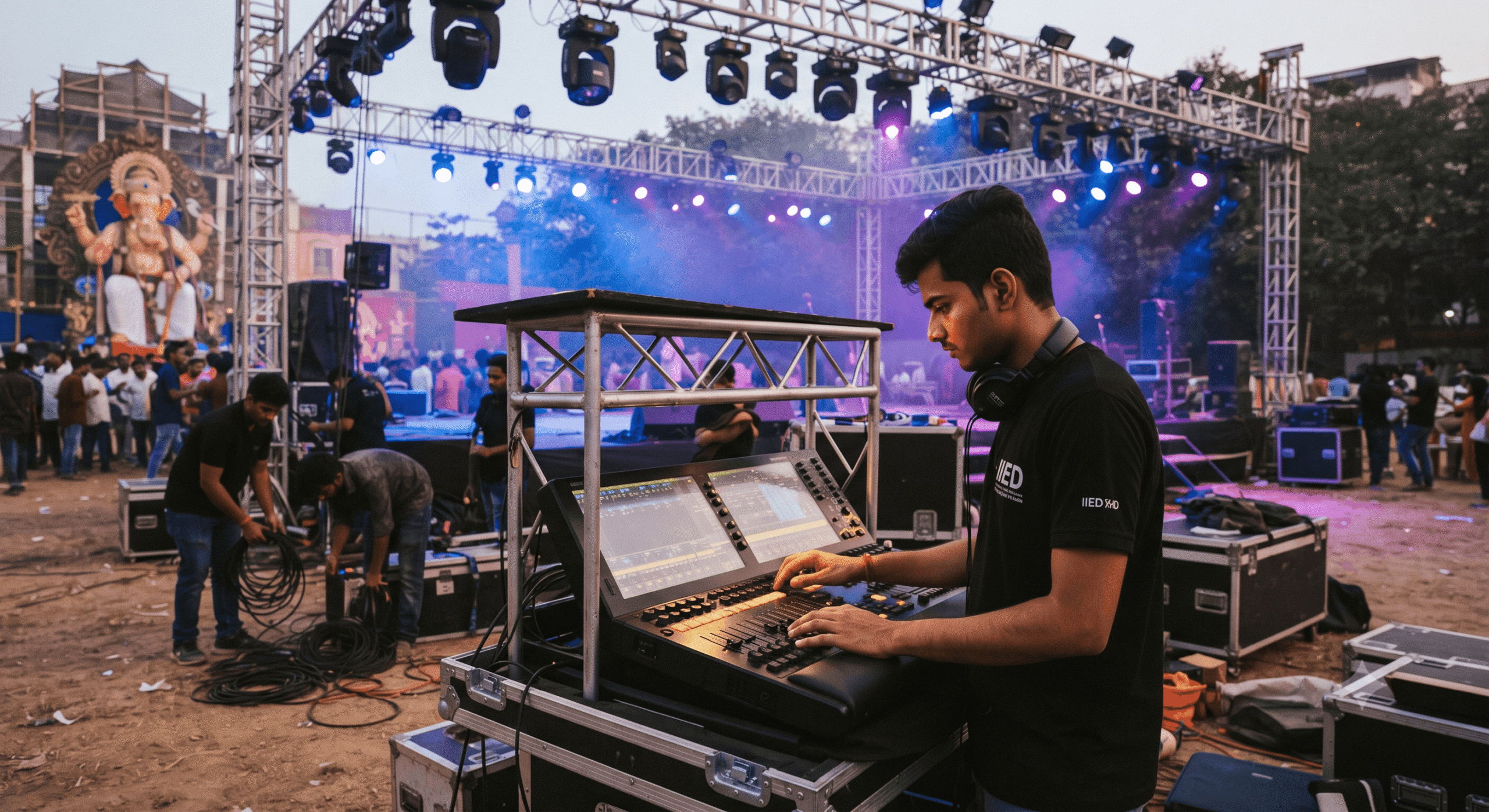
Every year, for about six to eight weeks, India’s event industry turns on every light it owns. A festival season lighting design career in India starts right here — in the run-up to Ganesh Chaturthi, through Navratri, and into the wedding season that follows Diwali. Pandal committees need mandal stages lit. Garba and dandiya organisers need a working rig before the first night of dancing. Corporate clients squeeze festival-themed events into the same crowded window. Rental and production companies that supply the lights, trusses and consoles for all of it suddenly need more hands than they have on payroll.
That hiring spike is real. But it does not reward casual interest. It rewards people who can walk onto a rig, read a light plot, and run a console without someone standing over their shoulder. This is not a piece about becoming a festival decorator for one season and disappearing. It is about what the festival hiring window actually looks like from inside a rental company, what skills get someone picked up first, and how real IIED alumni ended up working at exactly the kind of companies that staff up hardest during Ganpati and Navratri.
None of what follows is a promise that showing up during festival season is enough on its own. It isn’t. The honest point of this piece is narrower and more useful: festival season is a real, time-pressured hiring window, and trained technicians are the ones who get pulled into it first — this article shows exactly what “trained” means in practice, and how someone gets there.
Table of Contents
Why Ganpati and Navratri Create a Festival Season Lighting Design Career Spike in India
Ganesh Chaturthi is the first trigger. Sarvajanik mandals across Mumbai, Pune and across Maharashtra commission pandal lighting on a fixed, non-negotiable deadline — the pandal has to be lit before visarjan season begins, whatever else is happening. That means rental and production houses take on short-term technicians in bulk, fast, and usually with very little runway to train anyone from zero.
Navratri follows within weeks. Garba and dandiya nights run for nine straight evenings in banquet halls, open grounds and society compounds, and every one of those stages needs a working console, a trussing setup that will not fail mid-dance, and someone who can respond in real time when the DJ changes the set. Then comes the stretch from Diwali into wedding season, when corporate events and weddings both want festival-grade lighting on top of their usual production needs.
For rental and production companies, this six-to-eight-week window is the single biggest staffing pressure point of the year. They are not hiring for personality or general interest. They are hiring against the clock, for people who can be handed a rig and trusted with it immediately. That is exactly why a real, trained technician has an edge during this window that they simply do not have at other times of year — and why casual interest without technical grounding gets someone turned away at the door.
It also means the hiring decision itself looks different than it does the rest of the year. A production manager filling a festival-season roster in July or August does not have time to run a full interview process for every technician. They ask around, they check who can already run a console, and they go with the person a colleague can vouch for. That is a system that rewards visible, demonstrable skill — a portfolio, a course, a trainer who can confirm someone actually knows a rig — far more than it rewards a well-written resume.
What Seasonal Lighting Technician Jobs in India Actually Require
Rental and production companies staffing up for Ganpati and Navratri are not looking for someone who “knows lights” in a general sense. They are looking for four concrete, demonstrable things, and seasonal lighting technician jobs in India are usually filled by whoever can show these first.
Console Operation: GrandMA3 and Avolite Titan
Every festival rig eventually comes down to a console. GrandMA3 and Avolite Titan are the two consoles most Indian rental and production houses run on, and a technician who can set up a show file, build cues, and operate live under pressure is worth more than three people who can only patch cable. GrandMA3 operators are still genuinely rare in India — the demand for people who can run one properly is far ahead of the supply, festival season or not.
Rigging, Trussing, and DMX Literacy
Festival stages go up and come down fast, often outdoors, often on a tight structural deadline. A technician who understands rigging and trussing safety, and who can troubleshoot a DMX chain when a universe drops out mid-show, is the person a lead technician actually wants next to them. This is not optional knowledge picked up on the job in a week — it is exactly what a structured lighting design course covers before a student ever touches a festival rig.
Working Under a Lead Technician on a Festival Timeline
Festival-season work is compressed. There is no slow week to learn the ropes. The people who get asked back are the ones who can take direction from a lead technician, move fast without being told twice, and stay calm when a garba stage has ninety minutes to go from empty ground to fully rigged and cued. That is a trained habit, not a personality trait.
These four things rarely show up one at a time on the job. A single festival-season call might mean rigging a truss at 4pm, patching DMX by 6pm, and running a live console cue-to-cue by 8pm, all on the same stage, all under the same lead technician. That is why rental companies do not want to train someone through all four during the season itself — they want someone who already has the fundamentals and just needs to learn the specific rig.
Navratri Event Lighting Jobs and Freelance Lighting Technician Work During Festival Season
Navratri event lighting jobs are a category of their own inside the festival season window. Garba and dandiya stages need reliable, repeatable lighting for nine consecutive nights, which means rental companies want technicians who will not need re-training on night three. A dropped cue or a console freeze during a packed dandiya night is a real financial and reputational cost to the company running it — which is exactly why these jobs go first to people who have already put in console hours before Navratri starts, not during it.
In practice, that means a technician working a Navratri circuit is often running the same show file across several different venues on consecutive nights, adjusting it for a different stage size or truss layout each time. That kind of fast, repeatable adaptation is a console skill, not a decorating skill — which is exactly why rental companies filter for it before the season begins rather than hoping someone picks it up on night one.
Freelance Lighting Technician Work During Festival Season
Freelance lighting technician work genuinely picks up during festival season, and for a trained technician it can be a strong way to earn well and build relationships with multiple rental houses in a single window. But it works best as a launchpad after training, not instead of it.
Untrained freelance labour on a rig can get picked up for basic, low-paid work — carrying truss, pulling cable — but the jobs that pay properly and lead to repeat bookings go to people who can already operate a console and handle DMX and rigging basics safely. Several IIED alumni placed at rental and production companies moved from an initial technical role into a longer-term position once the season proved what they could do — the season is often the entry point, not the whole relationship.
Real IIED Alumni Now Working at the Companies That Hire for Festival Season
None of this is theoretical. IIED alumni from the One Year Program in Lighting Design are already working inside the exact category of company that staffs up hardest for Ganpati and Navratri — lighting rental and production houses.
Subha Bhattacharya traveled from a small town near Calcutta to train at IIED, without much confidence in English and without an industry background. She is now placed at Stagegear, a leading lighting rental company in Mumbai — precisely the kind of business that adds technicians hardest during festival season. Her story is proof that background does not decide who gets hired; trained skill does.
Rishabh Rao works in business development and technical operations at his family’s AVL rental company, one of Mumbai’s largest. Rental companies at this scale are exactly the ones hiring seasonal, festival-window technicians every year. IIED training sharpened his technical precision and gave him the confidence to run that business with real authority, not just family connections.
Shreeharsh already owned a lighting rental and production company in Pune before he enrolled — he travelled from Pune for every single lecture because he wanted to understand the “why” behind the light, not just the equipment. Today he does not just rent out gear. He designs and executes high-end experiences, which is exactly where festival-season rental work can lead for someone who treats it as a career, not a gig.
Silas Paul Uba switched into lighting from a background in audio and media production. In September 2025 he was placed as Technician – Lighting at LumaSonic Structures Rental Pvt. Ltd. in Goa, on ₹25,000 a month plus full benefits. His path is proof that a focused technical course — not a second full degree — is what gets someone hired at a rental and structures company.
Atharv Devikumar Jog shows where a strong technical foundation can eventually lead beyond the domestic festival circuit. He was placed as a Lighting Operator with SLS Production Equipment L.L.C. in Saudi Arabia in August 2025, on SAR 10,000 a month plus accommodation and flights — proof that the same console and rigging skills that get someone through an Indian festival season translate internationally.
Five different starting points — a small town outside Calcutta, a family rental business, an independent company owner in Pune, a career switch from audio, an international posting — and one common thread. Every one of them went into festival-adjacent, rental-and-production-house work with real console and rigging training already in hand, not picked up on the fly during their first festival season.
Who This Career Path Is For — and How Long Training Takes
This path fits two kinds of people particularly well. The first is a recent graduate with no clear direction yet — someone who has finished college in the last year or two, is not sure what comes next, and wants a fast, practical route to a real job rather than more theory. A visible seasonal hiring spike is exactly the kind of concrete, near-term opportunity that profile needs to actually move.
The second is someone who studied event management and can plan a timeline and manage a vendor, but has no hands-on technical skill — and has watched the actual production and technical roles go to people who already know GrandMA3 or have real lighting training. Festival season is when that gap becomes most visible, and most expensive to keep ignoring, because event management theory does not run a console.
Training does not have to mean a full year before someone is festival-ready. IIED’s GrandMA3 Mastery Program is a focused, one-month, 74-hour course built for people who already have a year or two of exposure and want to move from basic operator to someone who can be trusted with a show file — exactly the level a rental company wants walking in before Ganpati.
For someone starting with no technical background at all, the full MA in Lighting Design goes deeper: the physics of light, DMX and networking, rigging and workplace safety, light plotting, and live console training on both GrandMA3 and Avolite Titan, taught by working Light Director Lloyd Albuquerque. Course fees are structured in instalments rather than one lump payment, which matters for anyone weighing this against a season of unpaid learning-on-the-job — the investment is upfront and visible, not hidden inside a slower, unpaid apprenticeship.
It is also worth saying plainly: the global event industry is growing fast, with employment in event-related roles projected to grow around 8% between 2020 and 2030 — faster than average across occupations. Festival season is not a one-off spike inside a shrinking field. It is a yearly stress test of a field that keeps getting bigger, and the people who train ahead of it are the ones who benefit from that growth first.
Get Festival-Season Ready Before the Rush
Ganpati is already drawing rental and production companies into hiring mode, and Navratri is right behind it. The technicians who get picked up first this year are the ones who can already run a console, read a rig, and work fast under a lead technician — not the ones learning on the job in week one.
Book your free visit to IIED and find out whether the one-month GrandMA3 Mastery Program or the full MA in Lighting Design is the right way to get festival-season ready.