Learn sound and lighting together, or pick one? The answer depends on one thing: which one you want to be hired for.
A sound and lighting course can look like the safe choice. Two skills, one fee, more doors. But on a real show day, sound and lighting are two different jobs, run by two different people, on two different desks.
This guide helps you decide which route fits you, and how to test any sound and lighting course before you pay for it.
Table of Contents
We will be upfront from the start. IIED is a lighting-first institute. We train lighting designers and console programmers in Mumbai, and our lighting training covers the sound essentials a lighting designer needs to work beside an audio team. We do not run a standalone sound engineering course. If you want a pure audio career, a sound-focused school is the right call, and this post will tell you why.
If you are still weighing up the two careers themselves, how each is paid and where demand is growing, read our lighting design vs sound design career guide first. This post answers a narrower question: once you know roughly where you are heading, which kind of course gets you there?
IIED COURSE
MA in Lighting Design
Want depth over breadth? Two years on lighting, consoles, rigging and timecoded shows, built for one career.
Duration: 2 years · Mode: Full-time in Mumbai
What a Sound and Lighting Course Usually Means in India
Search for a sound and lighting course in India and you will find three very different things sold under similar names. Before you compare fees or brochures, work out which of the three you are looking at.
| Route | What it does | The catch |
|---|---|---|
| The combined diploma | Splits its hours between audio and lighting | Each craft gets roughly half the hours; rarely enough to run a show on your own |
| The specialist course | Picks one craft and goes deep | A narrower skill set, but you can actually do the job you trained for |
| Learning on the job | You join a rental company or an event crew as a helper | Real experience, but it is slow and it depends entirely on who you work under |
1. The combined diploma
This kind of sound and lighting course splits its hours between audio and lighting. You might spend mornings on a mixing desk and afternoons on a lighting console. Most combined courses also touch on rigging, cabling and power. The pitch is simple: learn the whole stage. The catch is time. If a course runs for a few months and covers two crafts, each craft gets roughly half the hours. That is enough to understand the basics. It is rarely enough to run a show on your own.
2. The specialist course
A specialist course is the opposite of a combined sound and lighting course. It picks one craft and goes deep. A lighting course spends its hours on the science of light, fixtures, DMX control, light plots, console programming and show design. A sound course spends them on acoustics, microphones, mixing, signal flow and system tuning. You come out with a narrower skill set, but you can actually do the job you trained for.
3. Learning on the job
Many people in India still learn by joining a rental company or an event crew as a helper. You carry cables, load trucks and watch the operators. Some people move up fast this way. Others stay on loading duty for years because nobody has time to teach them the console. On-the-job learning is real experience, but it is slow and it depends entirely on who you work under.
Why live shows treat sound and lighting as two separate jobs
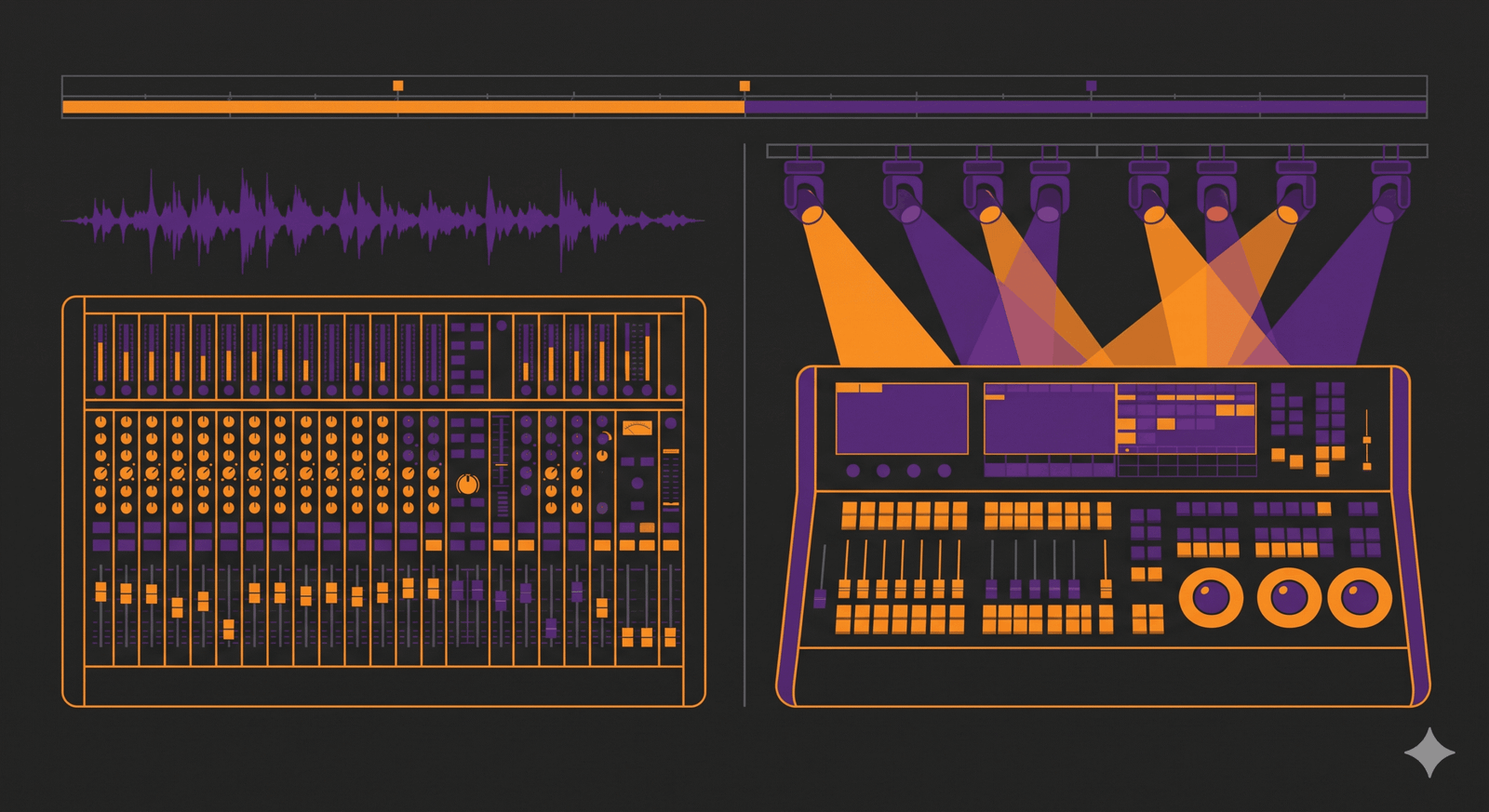
Walk onto any mid-size or large show and you will see two separate control positions. The sound engineer sits at the mixing desk, balancing microphones, instruments and playback for the audience. The lighting designer or operator sits at the lighting console, running cues, effects and looks. They talk to each other constantly, but they do not swap seats.
That split exists because both jobs need full attention during a show. A sound engineer listens for feedback, level changes and a singer drifting off-mic. A lighting operator watches the stage, follows the music and fires cues on the beat. Nobody can do both well at the same moment on a large show. So companies hire for one or the other. That fact should shape how you choose a sound and lighting course.
The US Bureau of Labor Statistics describes sound engineering technicians as a distinct occupation focused on recording, mixing and reproducing sound. Lighting is a separate craft with its own tools, language and career ladder. A good course respects that difference.
Learn Both or Specialise? The Honest Case for a Live Sound and Lighting Course
There is no single right answer here. Both routes have real strengths. What matters is matching the route to the work you want to do.
The case for learning both
A live sound and lighting course makes sense when the jobs you are aiming for expect one person to cover everything. That happens more than you might think.
- Small crews. A small wedding, a student fest or a corporate meeting in a hotel ballroom may run with two or three technicians in total. If you can set up a basic PA and a basic lighting rig, you are more useful to that crew.
- Rental houses. Many AVL rental companies in India send technicians out with both audio and lighting gear. Knowing how to patch both helps on load-in day.
- Venues. In-house technicians at banquet halls, auditoriums and small theatres often look after the whole system.
- Clubs and cruise ships. Some venue roles ask for a generalist who can troubleshoot audio, lighting and video on the same night.
If that is your target, a combined sound and lighting course can be a good starting point. Just go in knowing that you will probably need to deepen one side later if you want to move up.
The case for specialising
Specialising makes sense when you want to be the person a company calls for a particular skill. There are three strong reasons to go deep on one craft.
Depth on a console. Modern lighting consoles like grandMA3 take serious time to learn. Patching, presets, sequences, phasers, macros and timecode are not things you pick up in a few afternoon sessions. Companies want operators who are fast and calm on the desk. That speed comes from hours of practice on one system.
Higher pay at the top. In most technical crafts, the people who earn the most are the ones known for one thing. The senior lighting designer and the senior sound engineer are both specialists. Generalists are valuable, but they tend to plateau sooner.
A clearer portfolio. When you apply for a lighting job, the company wants to see lighting work. A portfolio with full light plots, programmed shows and pre-visualisation renders tells them exactly what you can do. A portfolio split across two crafts can look thin on both.
Where lighting meets sound anyway
Here is the good news. Even if you specialise in lighting, you will not lose touch with sound. Modern shows tie the two together through timecode, audio-synced cues and music-led programming. A lighting designer who understands song structure, beats and audio playback designs better shows. You can read more about how lighting is synchronised with audio on our blog.
This is exactly the overlap a lighting-first course should cover. At IIED, students programme timecoded light shows synchronised to music on grandMA3. That is the sound knowledge a lighting designer actually uses on the job. It is not the same as training to be a sound engineer, and we do not pretend it is.
5 Checks Before You Join Any Sound and Lighting Training in Mumbai or Elsewhere
Whether you pick a combined sound and lighting course or a specialist one, use these five checks. They work for any institute, in Mumbai or anywhere else in India. Ask each question directly before you sign up for any sound and lighting course. A good institute will answer without hesitation.
Check 1: Console hours on real gear
Ask how many hours you will personally spend on a real console, not watching a demo. Ask which consoles. For lighting, grandMA3 and Avolites are what many large shows in India run on. For sound, ask which digital mixers you will train on. If the answer is vague, or if most of the time is spent on theory slides, be careful. You get hired for what your hands can do.
For comparison, IIED’s GrandMA3 Mastery Program runs for 74 hours: 24 hours of live training and 50 hours of dedicated self-paced practice. That ratio matters. Practice is where the speed comes from.
Check 2: Mentors who work real shows
Ask who teaches the course and what they did last month. A mentor who is still designing or operating shows teaches current workflows, not the ones from ten years ago. They also know who is hiring. At IIED, lighting is taught by Lloyd Albuquerque, a professional lighting designer for 20 years who set up LGL Designs in 2003 and has designed for fashion shows, EDM concerts, rock shows, theatre, award nights and television.
Check 3: Small batches
Ask how many students share one console. If ten people crowd around one desk, most of them are watching, not learning. Small batches mean more time with your hands on the gear and more direct feedback from the mentor.
Check 4: A real portfolio by the end
Ask what you will have to show an employer when you finish. Light plots? Programmed show files? Pre-visualisation renders? Photos and video of a show you ran? A good course is built around producing work you can put in front of a hiring manager. If you want to compare lighting courses more closely on this point, read our guide on how to compare lighting courses in Mumbai.
Check 5: Placement proof with names
Ask for names, companies and roles. “Great placements” means nothing. “Ritesh, Lighting Operator / Designer at Show Genesis, ₹40,000 a month” means something. If an institute cannot name where its students work, treat that as a warning sign. Real outcomes have real names attached.
Sound Engineer vs Lighting Designer: Why Your Audio Background Is an Asset
If you already work in sound and are thinking about lighting, you are not starting from zero. You understand signal flow, cabling, power, show-day pressure and how a crew works together. Those skills carry straight across. Several IIED lighting alumni made exactly this move.
Vinith: from sound engineer to LGL Designs
Vinith was a sound engineer before he trained in lighting design at IIED. He then joined LGL Designs, working directly with his mentor, Lloyd Sir. Along the way he turned down a larger offer. In his words: “I actually received a significant offer from a global production company, but I chose passion and direct mentorship over a corporate title, ultimately joining Lloyd Sir’s own team at LGL Designs. Now I’m designing light for the biggest stages alongside the very person who taught me the craft.”
Silas Paul Uba: from audio mixing to LumaSonic, Goa
Silas came from sound engineering and audio mixing. After training in lighting design at IIED, he joined LumaSonic Structures Rental in Goa in September 2025 as a Lighting Designer (Technician – Lighting, Grade B). His offer: ₹25,000 a month plus ₹5,00,000 medical insurance, personal accident insurance, a telephone allowance, and tools and uniform. His advice for anyone making the same switch: “your previous production skills can be the perfect foundation for a new career in light.”
Tushar: one focused console course
Tushar worked as a lightman on film lighting crews. He wanted to run the console, not carry the fixtures. After GrandMA3 Training at IIED, he became a Lighting Operator at Pluto Disco Light, earning ₹30,000 a month in hand. His story shows what one focused skill can do when you already work on shows.
Specialised training leads to named employers
Ritesh Khichariya and Ashish Gonamanda both joined Show Genesis in Andheri East, Mumbai, as Lighting Operator / Designers at ₹40,000 a month each. Ritesh had two to three years as an operator in Raipur before training. Ashish was a complete fresher. Different starting points, same specialised lighting training, same employer.
Across IIED lighting design students with 0–1 years of experience, the highest CTC is ₹29.40 LPA, the average is ₹8.20 LPA and the median is ₹3.90 LPA. Those figures come from students who chose to go deep on lighting.
Want to know how? Book your free visit.
Lighting or Sound, Which Career Route Fits You?
Here is a simple way to match your situation to a route. Be honest with yourself about where you are today and where you want to be in three years.
| If you are… | Route to take |
|---|---|
| A fresher | Specialise in the one that excites you more; if you truly cannot choose, a short sound and lighting course can help you find out |
| A working sound technician | Stay in audio at a sound-focused school, or move across with a specialist lighting course |
| An event manager | Pick the craft you are drawn to and go deep |
| At a venue, rental house or on a crew | A combined course can tidy up your basics; one focused skill usually moves you further |
If you are a fresher
You have no industry background yet. That is fine. Ashish had none either. The key question is which one excites you more when you watch a show: the sound or the light? If it is clearly one, specialise in it. You will build a sharper portfolio and get to a paying role faster. If you truly cannot choose, a short sound and lighting course can help you find out, but plan to specialise afterwards.
If you are a working sound technician
If you love audio and want to stay in it, deepen your sound skills at a sound-focused school. That is the honest advice. If you have been watching the lighting desk and want to move across, your audio background is a real advantage, as Vinith and Silas showed. A specialist lighting course builds on what you already know rather than starting you from scratch.
If you are an event manager
Event managers often understand the whole show but not the technical detail. If you want to move into a technical role, pick the craft you are drawn to and go deep. Aditya Tawde was a freelance event manager before training in lighting at IIED. He joined Fireflies Creative Technologies in Mumbai as an Assistant Lighting Programmer.
If you work at a venue, rental house or on a crew
If your job already asks you to cover both audio and lighting, a combined sound and lighting course can tidy up your basics. But if you want to move up from technician to operator or designer, one focused skill usually moves you further. Tushar’s jump from lightman to console operator came from one course on one console.
Where IIED fits, honestly
IIED is the right choice if you want lighting to be your career. Our lighting students train on grandMA3, Avolites Titan, Capture and Vectorworks Spotlight, programme timecoded shows synced to music, and build a portfolio employers can judge. We cover the sound essentials a lighting designer needs. We do not train sound engineers. If audio is your end goal, choose a sound-focused school, and do it with the five checks above in hand.
Frequently Asked Questions
Should I learn sound and lighting together or pick one?
Pick one if you know which job you want to be hired for. Live shows treat sound and lighting as separate roles, and specialists build stronger portfolios. A combined course suits small crews, venues and rental work where one person covers both. Many people start broad and specialise later. Choose based on the job you want in three years.
What does a sound and lighting course teach?
A combined course usually covers basic audio mixing, microphones, lighting fixtures, a lighting console, cabling and power. Because the hours are split, each side stays fairly basic. A specialist lighting course goes deeper into light, DMX control, light plots, console programming and show design. Always ask how many hours you get on real gear.
Is a combined sound and lighting course worth it in India?
It can be, if your target jobs need one person to handle both, such as small events, banquet venues or rental crews. It is less useful if you want to become a lighting designer or senior sound engineer, where companies hire specialists. Check console hours, mentors, batch size, portfolio and named placements before paying.
Can a sound engineer become a lighting designer?
Yes. Your knowledge of signal flow, cabling, power and show-day pressure carries across. IIED alumni Vinith and Silas Paul Uba both moved from sound engineering to lighting. Vinith joined LGL Designs and Silas joined LumaSonic Structures Rental in Goa as a Lighting Designer. A focused lighting course builds on your existing production skills.
How long does it take to learn stage lighting well enough to get hired?
It depends on your starting point. Crew members already on shows can move up with one focused console course; IIED’s GrandMA3 Mastery Program runs 74 hours over one month. Freshers aiming to design need longer, deeper training, and IIED’s MA in Lighting Design runs for two years. Practice hours on a real console matter most.
Which pays more at entry level, sound or lighting?
Pay depends on the role, city and company more than the craft alone. We compare both careers, including how each is paid, in our lighting design vs sound design career guide on the IIED blog. For lighting, IIED alumni Ritesh and Ashish started at Show Genesis in Mumbai on ₹40,000 a month each.
Do lighting designers need to know sound?
They need to understand it, not run it. Lighting designers work with music, song structure and timecode, and often programme cues synced to audio playback. They talk to the sound team constantly. But they do not mix the show. A good lighting course teaches the sound essentials a lighting designer uses, such as timecoded shows synced to music.
What should I check before joining any sound or lighting course?
Use five checks. How many hours will you personally spend on real consoles? Do the mentors still work on live shows? How many students share one desk? Will you finish with a real portfolio? Can the institute name where its students now work? If any answer is vague, keep looking before you pay a deposit.
Ready to Start Your Lighting Career?
If lighting is your end goal, come and see how we teach it. Sit in on a class, try the console and meet the mentors.
Book your free visit — call 9892966334 or email info@weareiied.com. IIED, Shop No. 506, 5th Floor, Magic Square, Dwarkadhish Road, off Poddar Road, Malad East, Mumbai 400097.
IIED COURSE
GrandMA3 Mastery Program
Already working on shows? Add one focused console skill, the way Tushar went from lightman to operator.
Duration: 1 month · Mode: In-person in Mumbai