
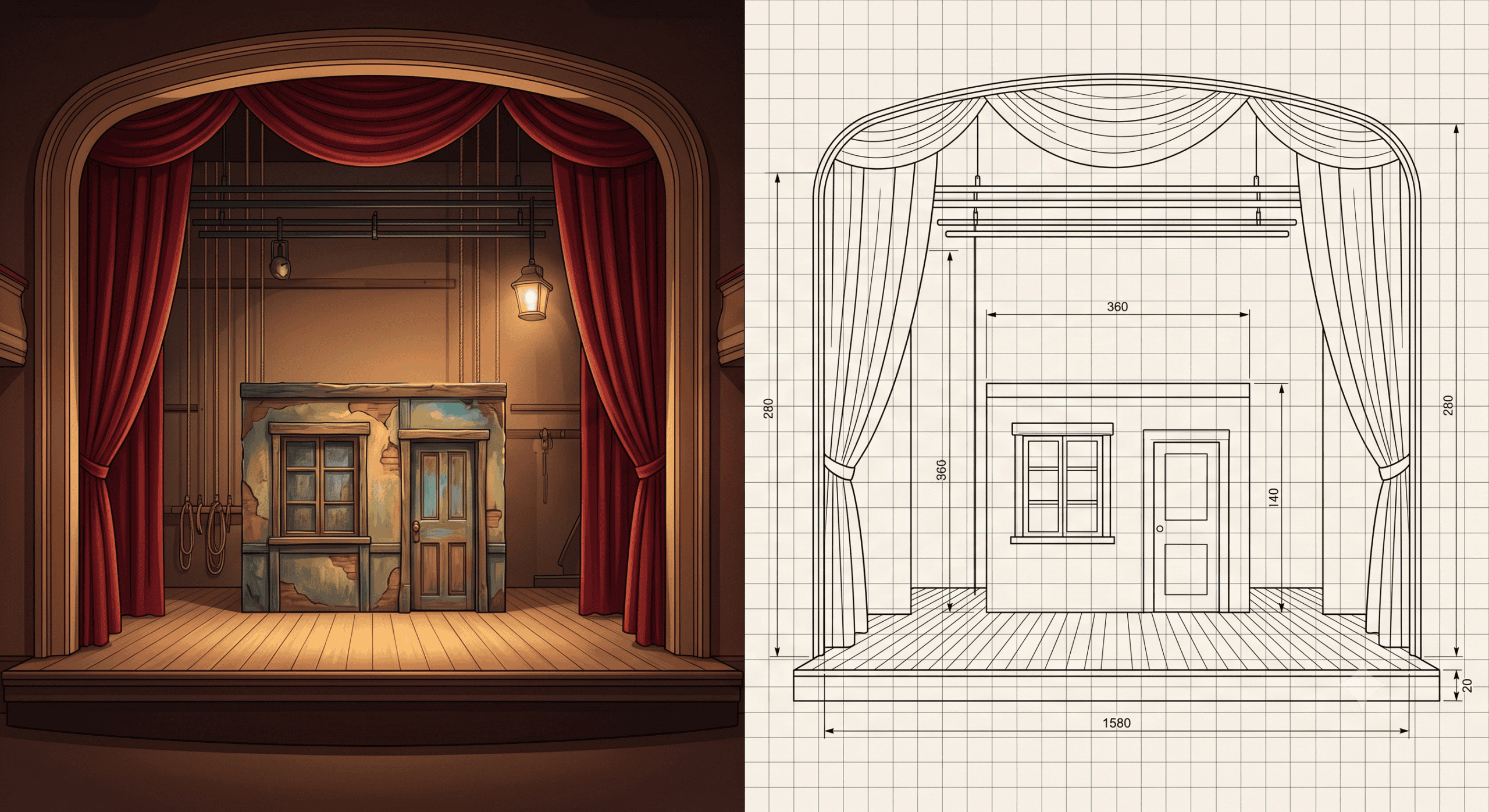
Most working set and production designers in India didn’t learn their craft in a design classroom. They learned it backstage — building sets for a college play, painting flats for a local theatre group, working till 2 a.m. before opening night. That’s the honest starting point behind a lot of theatre set design training in India, and it’s real training. It builds spatial sense, an eye for how a set reads from the back row, and the instinct to solve problems on a deadline that doesn’t move.
There’s a second half to this story that most people find out the hard way. Theatre background gets you in the room. It rarely gets you the job on its own. Event and film production companies hire designers who can hand over a CAD drawing, not just an idea — a rig plan, a floor plan with dimensions, a file a vendor can actually build from. That’s where most theatre set design training in India stops.
This post is about that gap: what theatre training actually gives you, what it leaves out, and how people with a theatre or dramatics background have closed it — including an IIED alumnus who went straight from a CAD course into the production team at one of Mumbai’s largest cultural venues.
Table of Contents
What Theatre Set Design Training in India Actually Gives You
College dramatics societies and local theatre groups have quietly trained a large share of India’s working set and production designers. If you’ve spent a few years building sets backstage, you already have real, transferable skills — even if no one has told you that in those words.
Spatial sense. You learn how a structure reads from the audience, not just from close up. You learn how depth, scale and sightlines change from the first row to the last. That instinct is hard to teach in a classroom and easy to build on a stage.
Hands-on build experience. You’ve probably measured, cut, painted, rigged and struck a set more times than you can count. You know what a flat weighs, how a platform holds under movement, and what breaks under stage lights.
Working under real pressure. The theatre doesn’t move opening night for anyone. You’ve built to a fixed deadline with a fixed budget and a director changing their mind two days out. That’s the same pressure event and production companies work under every single day.
Team coordination. Backstage crews run on communication — with directors, actors, lighting operators and each other. That’s a real production skill, not a soft one.
None of this is small. It’s exactly why theatre background shows up so often in the backgrounds of working event and production designers. The problem isn’t that theatre training is weak. It’s that it stops one step short of what the industry hires for.
What Theatre Training Doesn’t Teach You — The Technical Gap in a Set Design Career Path in India
Here’s where most people on a theatre-to-production set design career path in India hit a wall. Theatre teaches you to build a set with your hands and your eye. It rarely teaches you to document that set the way a professional production company, venue or vendor expects.
Technical documentation. College and community theatre almost never require a CAD or Vectorworks drawing. Sets get built from a sketch, a model, or verbal direction. Professional event and production companies work the opposite way — nothing gets built until there’s a scaled drawing.
Professional software fluency. AutoCAD and Vectorworks Spotlight are the working language of production design in India. If you can’t open, read or produce a drawing in one of these, you’re excluded from most production-design hiring conversations before they even start.
Vendor-ready paperwork. A working designer needs to hand a vendor a floor plan with dimensions, a rigging plot, a materials list and a budget sheet — not a moodboard. Theatre training almost never covers this, because a college production doesn’t route through outside vendors the way a wedding, concert or corporate event does.
Specs and budgets from day one. Companies that hire production designers expect someone who can price a build, not just imagine one. That’s a skill built through structured training, not through repetition alone.
This is the exact gap that shows up in interviews and portfolio reviews — a strong creative instinct with nothing technical to back it up on paper.
Why the Gap Matters: How Event and Production Companies Actually Hire
Event and film production companies in India don’t hire for vision alone. They hire people who can hand over a drawing a vendor can build from, on a timeline the production can’t afford to slip. That’s the single biggest difference between a theatre set designer and a working production designer.
Aron Sagar is the clearest proof of this. He came through IIED’s CAD for Events & Entertainment course and is now part of the Operations & Production department at NMACC — the Nita Mukesh Ambani Cultural Centre in BKC, Mumbai, one of the country’s most demanding production environments. His placement is direct evidence that the specific skill closing this gap is CAD fluency, not more theatre experience layered on top of what people already have.
It’s also worth putting this in context of where the industry is heading. India’s live events segment — concerts, weddings, cultural venues and large-scale public experiences — grew 44% in 2025 to become the fastest-growing part of the country’s media and entertainment sector, according to the FICCI-EY Media & Entertainment 2026 report. That growth means more shows, more venues and more production companies hiring — but they’re hiring for the technical deliverables, not just the creative instinct.
What that growth actually looks like on the ground is more shows running at once, more venues opening, and more production companies competing for a small pool of people who can be handed a brief and produce a build-ready drawing without hand-holding. A theatre background gets you comfortable in that environment faster than someone with no live-production exposure at all. But comfort in the environment and employability in the role are two different things, and the second one is decided almost entirely by what you can put on paper.
The Bridge: Turning a Theatre Background Into an Event Design Career at IIED
If you’ve got the theatre instinct already, you don’t need to start over. You need one focused, technical skill layered on top of what you already have. IIED runs three courses built for exactly this jump — from a theatre background to an event design career with real technical output.
CAD for Events & Entertainment
A 1-month, 36-hour course (₹20,000, inclusive of taxes) that takes you from basic AutoCAD navigation to producing detailed production working drawings — wedding and corporate floor plans, seating charts, stage elevations and concert site maps. This is the course Aron Sagar completed before joining NMACC’s production team, and it’s the fastest, most direct route from “I can sketch a set” to “I can hand over a drawing a vendor will build from.” Full curriculum and enrolment details are on IIED’s CAD for Events & Entertainment course page.
Vectorworks Spotlight for Event Production
A 1-month, 48-hour course covering the industry-standard BIM (Building Information Modeling) workflow — rigging, truss, lighting devices, soft goods and full technical stage drawings with title blocks and dimensions. It’s the natural next step for anyone who wants to go deeper into production documentation, and it includes a 100% three-month non-paid internship on completion.
Event & Wedding Design Visualization
A 3–4 month part-time course (₹60,000 offline) covering design foundation, production of event design, presentation methods and a final self-directed design project, ending in a professional portfolio. This is the course that trained Pranay Mhatre, now a Production Designer at WIZCRAFT International Entertainment — India’s oldest and largest event company — and Varun Jain, now a Design Associate at The Finale Eventz. Course details are on IIED’s Event & Wedding Design Visualization course page.
All three are hands-on, taught by working industry professionals, in small batches — not lecture-hall theory.
Real Outcomes: Four Alumni Who Made the Jump
These are verified IIED outcomes — real names, real companies, used exactly as documented.
Pranay Mhatre came through IIED’s Event & Wedding Design Visualization course and is now a Production Designer at WIZCRAFT International Entertainment, India’s oldest and #1 event company. His path is the strongest single proof point for the design-to-production career route this post is describing.
Arun Sagar completed IIED’s CAD for Events & Entertainment course and now works in the Operations & Production department at NMACC (Nita Mukesh Ambani Cultural Centre), BKC, Mumbai. His placement is direct proof that the CAD course specifically is what closes the technical gap between theatre instinct and hireable production skill.
Varun Jain completed the Event & Wedding Design Visualization course (offline) and joined The Finale Eventz as a Design Associate — ₹45,000/month during probation, confirmed at ₹50,000/month. CAD skill is named directly in his job description, making this the strongest combined salary-and-skill proof point in this list.
Kshiti Jain is a slightly different case worth including here. She came from an event management background — strong on coordination, theory and logistics, but without a design foundation. She struggled to break into wedding design on theory alone. IIED gave her the design skills to start her own event design company. If your background is theatre plus an event management diploma and you’re still not landing design roles, her path is the direct parallel: the missing piece usually isn’t more theory. It’s a structured technical foundation.
Four different starting points, four different courses, one consistent pattern: the people who made the jump from creative instinct to paid production work all added one specific, technical, documented skill on top of what they already had. None of them started over. None of them needed a second degree. They added a month or a few months of focused training to instinct that was already real.
Who This Is For
This is for anyone who has spent years being “the one who builds the set” — in a college dramatics society, a local theatre group, or backstage crew — without a clear sense of whether that adds up to a real, paying career.
It’s also for the specific overlap of people who have theatre or backstage experience and an event management diploma, but still can’t get hired for design roles. If that’s you, the fix usually isn’t another year of coordination theory. It’s one focused technical course that turns what you already know how to build into something a company can hire you to build for them.
If you’re still weighing whether this is a real, paying direction, the honest answer is: it depends on what you do next, not on whether your background so far “counts.” A theatre or dramatics background is not wasted time — every designer named in this post built on top of instinct they already had. The course fee is not the risk. Staying stuck between “I can build a set” and “I can get hired to build one” is the actual cost of waiting.
Your theatre background is a real head start — not a shortcut around the technical skill. If you’ve been the one building the set for years, come find out what that instinct is actually worth on paper. Book your free visit at IIED’s Malad East campus and bring a photo of something you’ve built.