
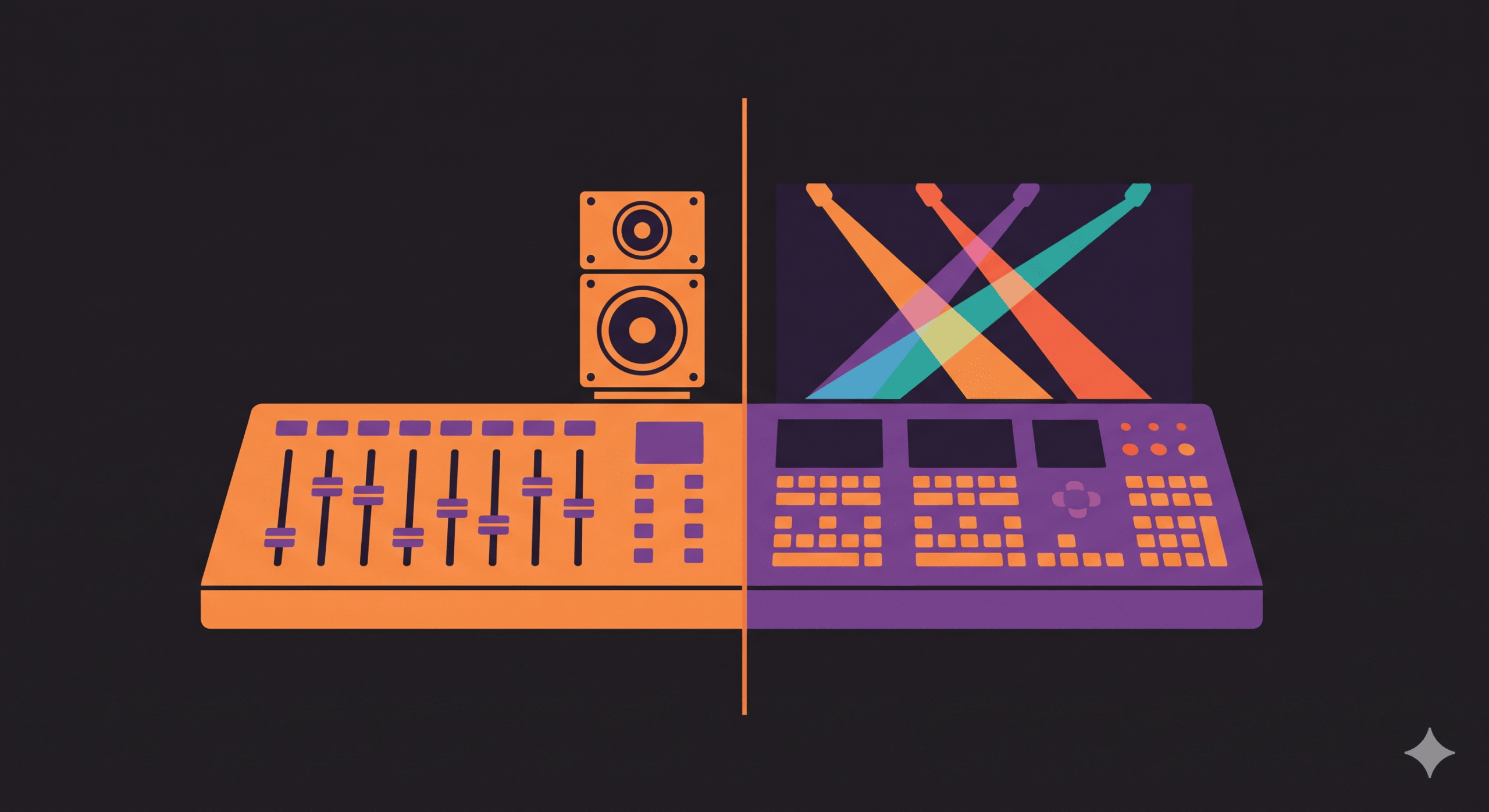
You love the side of a live show that the audience never sees. The desk at the back of the hall. The cables. The moment the room goes dark and something big is about to happen. Now you have to pick a lane: sound or light. This is the lighting design vs sound design career India question, and most answers online are either generic salary pages or a sales pitch.
We will not pick a winner for you. Pay depends on the role, the city, the employer and how good you get. What we can do is show you how both careers actually work inside India’s live events industry, how each one is entered and paid, and what pushes the pay ceiling up.
Where we quote salaries, they come from real IIED alumni offer letters. Where we don’t have verified numbers, we say so.
Table of Contents
What Each Job Actually Is: Live Sound vs Lighting
To weigh a lighting design vs sound design career India fairly, start with the work itself. Both teams work behind the same stage, often from the same front-of-house position. But the work, the tools and the way you think are different. Before you compare pay, be clear on what you would be doing every day.
The live sound side
A live sound crew makes sure every person in the room hears the show clearly. The main roles are the FOH (front-of-house) engineer, who mixes what the audience hears; the monitor engineer, who mixes what the performers hear on stage; and the system technician, who sets up, tunes and looks after the speaker system. The work is about ears, signal flow and fast problem-solving. When a mic fails mid-speech, the sound team has seconds to fix it.
IIED COURSE
MA in Lighting Design
Leaning towards light? Build design, rigging and grandMA3 programming skills over two hands-on years.
Duration: 2 years · Mode: Full-time in Mumbai
The lighting side
A lighting crew decides what the audience sees, where they look and how they feel. The main roles are the lighting operator, who runs the show on a console; the lighting programmer, who builds the cues, effects and timecoded sequences; and the lighting designer, who plans the whole look, from fixture choice to the light plot. The work mixes visual design with engineering: power, rigging, DMX data and console logic.
Side-by-side comparison
| Live sound | Lighting | |
|---|---|---|
| Core sense | Hearing, timing | Sight, colour, space |
| Entry roles | Stagehand, sound tech, monitor assistant | Lighting tech, operator, assistant programmer |
| Growth roles | FOH engineer, monitor engineer, system engineer | Lighting programmer, lighting designer, light director |
| Key tools | Digital mixing desks, speaker processors, mics, IEMs | Lighting consoles (grandMA3, Avolites), fixtures, CAD and Vectorworks, Capture |
| Rare, high-value skill | Strong live mixing and system tuning | Console programming, especially grandMA3 |
| Typical employers | AVL rental vendors, production houses, event agencies, venues, cruise lines and international production companies (often the same employers for both) | AVL rental vendors, production houses, event agencies, venues, cruise lines and international production companies (often the same employers for both) |
Notice that last row. The same AVL vendor that hires a sound tech also hires a lighting operator. These are not rival industries. They are two departments of one crew.
Lighting Designer vs Sound Engineer Salary India: How Each Career Is Paid
Here is the honest part of any lighting design vs sound design career India comparison. Nobody can give you one clean number for “sound engineer salary” or “lighting designer salary” in India. Both careers are paid in three main ways, and the way you are paid often matters more than the job title.
1. Salaried roles with AVL vendors and production houses
This is where most people start. You join a rental or production company as a technician or operator, work on their shows and get a monthly salary, sometimes with insurance and allowances. It is steady and you learn fast because you are on a show almost every week in season.
2. Freelance day rates
Once you have experience and contacts, many technicians go freelance and charge per show day. Income can be higher in peak season and much lower in the quiet months. Your rate depends on your reputation, your console or desk skills and who is hiring you.
3. Cruise and international contracts
Cruise lines and overseas production companies hire technical crew on contracts. These often include accommodation and travel, and the pay is usually in foreign currency.
What verified lighting pay looks like
For lighting, we can share real figures, because they come from offer letters of IIED alumni from earlier lighting programmes:
| Alumnus | Role and employer | Verified pay |
|---|---|---|
| Ritesh Khichariya | Lighting Operator / Designer at Show Genesis, Mumbai | ₹40,000/month. |
| Ashish Gonamanda | Lighting Operator / Designer at Show Genesis, Mumbai | ₹40,000/month. He joined as a fresher with no prior background. |
| Aditya Tawde | Assistant Lighting Programmer at Fireflies Creative Technologies, Mumbai | ₹25,000/month during probation, then ₹40,000/month (offer dated 12 Aug 2026). |
| Silas Paul Uba | Lighting Designer (Technician – Lighting, Grade B) at LumaSonic Structures Rental, Goa | ₹25,000/month plus medical and personal accident insurance, phone allowance, tools and uniform (offer dated September 2025). Silas came from sound engineering and audio mixing. |
| Atharva Jog | Lighting Operator at SLS Production, Saudi Arabia | SAR 10,000/month (Saudi riyal, not rupees) plus company accommodation, return air ticket and transport. |
Across alumni with 0–1 years of experience from IIED’s earlier Lighting Design programme, the placement figures are: highest CTC ₹29.40 LPA, average ₹8.20 LPA, median ₹3.90 LPA. Read these carefully. The highest figure is an outlier, not a typical first offer. The median, ₹3.90 LPA, is the middle point: half the offers were above it and half below, so it is a fairer guide for a first role than the average.
What about sound pay?
We won’t invent a number. IIED has no verified placement data for live sound roles, so we have no sound salary figures to share. In general, sound pay follows the same pattern as lighting: it varies by company, city, experience and how strong your mixing skills are. If someone quotes you a fixed “sound engineer salary,” ask where the number comes from.
So which pays better in the lighting design vs sound design career India debate? The honest answer is that the job title does not decide your pay. The skill you master does. That brings us to the ceiling.
What Sets the Ceiling in a Live Sound vs Lighting Career
In both tracks, a junior tech who only knows how to plug things in will stay on a junior salary. Pay rises when you hold a skill that is hard to find and easy to prove. Here is what that skill looks like on each side.
For sound
The ceiling rises with mixing skill (can you deliver a clean, balanced mix under pressure, for a band or a 2,000-person conference?), with comfort on the major digital consoles that rental companies own, and with system tuning: aligning and optimising a speaker system for a venue. A sound engineer known for great mixes on big shows can command strong rates. That takes years of ears-on experience.
For lighting
The ceiling rises with three things:
- Console programming. Running a grandMA3 or Avolites desk well, building cue stacks, phasers and timecoded shows. In India, grandMA3 programmers are still rare, and demand far exceeds supply. That gap is what pushes pay up.
- Design. Moving from “operate what someone else planned” to “plan the whole look.” Designers are paid for decisions, not button presses.
- Drawings and documentation. Light plots in CAD and Vectorworks Spotlight, and 3D pre-visualisation in Capture. A lighting person who can draw, programme and design is hard to replace.
Look at Aditya Tawde’s path. He moved from freelance event management into an Assistant Lighting Programmer role, and his salary was set to rise from ₹25,000 to ₹40,000 a month after probation. The title says “programmer” because that is the scarce skill his employer was hiring for.
The rule for both tracks
A rare skill, documented in a portfolio, raises your pay. Common skills, undocumented, keep it flat. Whether you choose sound or light, spend your first years building one skill that most people around you do not have, and keep proof of it: show files, photos, videos, references.
Where the Demand Is: A Technical Career in Live Events India
The good news for anyone choosing a technical career in live events India is that the market is growing. The FICCI-EY media and entertainment report (March 2026) found that India’s media and entertainment sector grew 9% to ₹2.78 trillion in 2025, with live events among the fastest-growing segments. More concerts, more festivals and more large public events mean more stages that need both sound and lighting crews.
Demand is not spread evenly across the year. These are the main drivers:
- Festival and wedding season. October to January is peak time. Navratri, Dussehra and Diwali lead straight into the wedding season, and big Indian weddings now use full concert-style rigs with moving heads, pixel fixtures and synchronised shows.
- Concerts and tours. Ticketed concerts in metros and tier-2 cities have grown fast. Every one needs a FOH engineer and a lighting operator.
- Corporate events. Product launches, award nights and conferences run all year and pay reliably.
- Cruise lines and international production. These hire Indian crew on contract, and lighting with console skills is in particular demand. IIED alumni have worked with Royal Caribbean, AIDA Cruises and SLS Production in Saudi Arabia.
For the lighting design vs sound design career India choice, the key question is where demand outruns supply. On the lighting side, it is clearly console programming. Many crews have people who can push faders. Far fewer have someone who can build a timecoded grandMA3 show from scratch. On the sound side, experienced FOH and system engineers are valued too, but the gap there is less about one specific console and more about years of mixing experience.
Switching and Stacking: You Don’t Have to Choose Forever
Here is something most lighting design vs sound design career India pages miss. Several IIED lighting alumni started in audio. Sound and lighting share a lot of ground: signal flow, cabling, power, networking, stage safety and the discipline of live shows. If you already work in sound, you are not starting from zero.
Two IIED alumni show this clearly:
- Silas Paul Uba worked in sound engineering and audio mixing. After training in lighting at IIED, he joined LumaSonic Structures Rental in Goa as a Lighting Designer (Technician – Lighting, Grade B), with a salary and full benefits. In his words: “My journey is proof that your previous production skills can be the perfect foundation for a new career in light.”
- Vinith was a sound engineer. After his lighting training, he received an offer from a global production company but chose to join LGL Designs instead, to work directly under his mentor Lloyd Albuquerque. He now designs lighting for large stages.
Read the full story of making that move in our guide to the sound engineer to lighting designer career switch in India.
You can also stack skills instead of switching. Many smaller crews want one person who understands both departments. A sound tech who can also run a lighting console is more useful on a tight crew. A lighting operator who understands audio signal flow communicates better at FOH. Either way, the second skill adds value to the first.
If lighting is the skill you want to add, start with the console. Our guide to a grandMA3 career in India explains what programmers do and where they work.
Sound Engineer or Lighting Designer, Which Is Better for You? A 3-Question Guide
“Sound engineer or lighting designer, which is better?” has no single right answer. The better track is the one you can get really good at. Ask yourself these three questions.
1. Do you prefer technical precision by ear, or visual design?
If you hear a bad mix and it bothers you for days, sound may be your track. If you notice the colour of a room, the angle of a shadow or how a stage looks on camera, lean towards lighting. Lighting also suits people who like a mix of art and logic: a designer’s idea has to become a programmed, cued show.
2. Do you want salaried work or freelance?
Both tracks offer both. But think about where you want to be in five years. Salaried roles with AVL vendors give stability and constant practice. Freelance gives higher peaks in season and full control of your calendar, but you have to find your own work. Many people start salaried, build a name and then go freelance.
3. Are you open to cruise or overseas work?
If yes, think about which skill travels best. Lighting programmers with grandMA3 skills are hired on cruise ships and by international production companies. IIED alumni have gone to Disneyland Hong Kong, Royal Caribbean and Saudi Arabia in lighting roles. Sound crews work internationally too, so this is about where your strongest skill fits.
If your answers point to lighting, the next step is serious training. Search “lighting design course Mumbai” and you will find many options. Pick one that puts you on real consoles, because that is the fastest route from “interested” to “employable.” At IIED, that means hands-on training on real grandMA3 consoles, small batches, and a mentor who works in the industry every week: Lloyd Albuquerque, a lighting designer for 20 years and founder of LGL Designs. IIED is also the only institute in Mumbai covering Event Design, Lighting and Production together, so you see how lighting fits into the whole show.
For the longer view, IIED’s MA in Lighting Design is a two-year, full-time, hands-on master’s programme. Details are on the MA in Lighting Design course page. For a step-by-step route, read how to become a lighting designer in India, and for detailed pay data, see our lighting designer salary in India guide.
Frequently Asked Questions
Which pays more in India, lighting design or sound engineering?
It depends on the role, city, employer and your skill level, not the department. IIED has verified lighting figures, such as ₹40,000/month for recent operators at Show Genesis, but no verified sound salary data, so we won’t claim one pays more. In both tracks, rare skills like console programming or strong live mixing raise pay.
What does a lighting operator earn in India at entry level?
Verified IIED alumni offers for entry roles range from ₹25,000/month (Silas Paul Uba at LumaSonic, Goa, with full benefits) to ₹40,000/month (Ritesh Khichariya and Ashish Gonamanda at Show Genesis, Mumbai). Pay varies by company, city and the skills you bring.
Can a sound engineer switch to lighting design?
Yes. Sound and lighting share signal flow, cabling, power and live-show discipline, so you start with an advantage. IIED alumni Silas Paul Uba and Vinith both moved from sound into lighting designer roles after training.
Do I need to choose between sound and lighting, or can I learn both?
You can learn both, and many crews value people who understand both departments. Most professionals go deep in one and build working knowledge of the other. Pick a main track first, then add the second skill.
Is lighting design a good career in India?
For people who enjoy both visual design and technical work, yes. Live events are among the fastest-growing parts of Indian media and entertainment, and skilled lighting programmers are in short supply. Like any live-events career, it involves long show days and seasonal peaks.
Which skill is rarer in Indian live events: console programming or live mixing?
GrandMA3 console programming is one of the rarest skills in Indian live events, and demand far exceeds supply. Good live mixers are valued too, but there are more trained audio people in the market. Rarity is part of why programmers can move up quickly.
Do I need a degree to start a technical career in live events?
No. Employers in live events mostly hire on skill, show experience and portfolio. A structured, hands-on programme helps you get those faster and with fewer gaps. IIED’s MA in Lighting Design is open to graduates from any discipline if you want the full two-year route.
How long does it take to become job-ready in lighting?
It depends on where you start and how deep you go. A focused console course like IIED’s GrandMA3 Mastery Program takes one month of training and practice, while the MA in Lighting Design builds design, rigging and programming over two years. Working crew with some background often become job-ready sooner.
Lighting Design vs Sound Design Career India: The Honest Bottom Line
Sound and lighting are two halves of the same show. Neither one always pays more. What decides your pay is how rare and how proven your skill is. If you love visual design and want to build one of the scarcest skills in Indian live events, lighting with strong console programming is a solid bet. If your ears are your gift, go deep in sound. And if you are a sound engineer wondering whether lighting is your next step, our alumni show it can be done.
Ready to Start Your Lighting Design Career?
The lighting design vs sound design career India decision is easier once you’ve stood at a real console. Come to IIED in Malad, Mumbai, sit in on a live lighting class, and talk to the people who do this every week.
Book your free visit — call 9892966334 or email info@weareiied.com. IIED, Shop No. 506, 5th Floor, Magic Square, Dwarkadhish Road, off Poddar Road, Malad East, Mumbai 400097.
IIED COURSE
GrandMA3 Mastery Program
Add the rarest lighting skill in Indian live events, whether you come from sound or lighting.
Duration: 1 month · Mode: In-person in Mumbai