
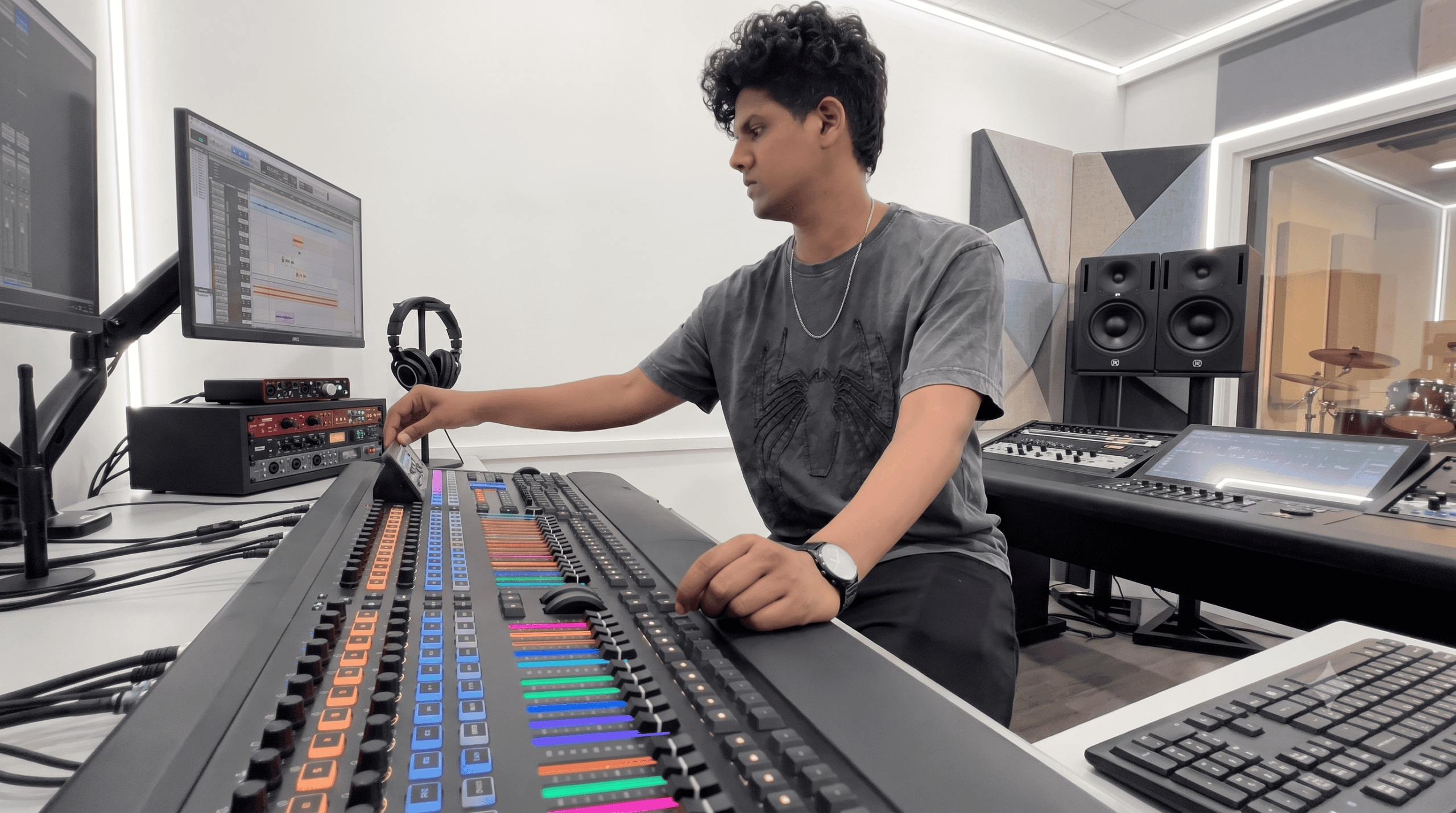
If you’re an audio engineer weighing a sound engineer to lighting designer career switch in India, here’s the honest answer: you are not starting from zero. You already think in cues, timing and technical precision — the same instincts lighting design runs on. This switch is real, it’s happening right now among working professionals, and two IIED alumni have already made it, with real jobs to show for it.
This article covers why the switch works, the one real skill gap most audio professionals need to close, two verified IIED alumni stories from sound to light, what the actual India live-events market looks like for trained lighting professionals, and how the One Year Program in Lighting Design is built for people bridging in from AV — not people starting with nothing.
Table of Contents
Why a Sound Engineer to Lighting Designer Career Switch Isn’t Starting Over
A sound engineer’s day is built on precision. Signal flow, timing, cueing, sync — you already read a show the way a lighting designer does: moment by moment, cue by cue, in step with the same run sheet and the same show caller. That overlap is not a coincidence. Both crafts sit inside the same live production world, working off the same cues, the same director’s calls, the same show clock.
The fear most audio professionals carry is that switching careers means throwing years of experience away. It doesn’t. A technical ear for timing translates directly into a technical eye for lighting cues. A mixing desk’s channel routing and a lighting console’s DMX universes solve the same underlying problem — getting the right signal to the right output at the right moment. What changes is the instrument, not the underlying skill.
There is exactly one real gap most sound engineers face when they consider this switch, and it’s a specific, learnable one: lighting-specific technical training. DMX protocols, console programming on GrandMA3 or Avolite Titan, rigging and trussing safety, light plotting, and lighting design theory aren’t things a sound engineer typically picks up on the job. Audio and lighting departments run in parallel on most shows, not together, so there’s rarely a natural way to absorb this training informally.
That gap is also the opportunity most people switching careers don’t get. GrandMA3 console operators are extremely rare in India — demand for trained operators far exceeds the current supply. An audio professional who closes this one gap isn’t catching up to lighting designers who started from scratch. They’re entering a specialised, understaffed field with a technical foundation — reading a live show under pressure — that most entry-level lighting students still need to build. The gap is narrow, not wide. It’s a defined list of console skills, protocols and design theory, not a second career’s worth of learning.
Two Real Sound-to-Lighting Career Switch Stories from IIED
These aren’t hypothetical outcomes. Two IIED alumni made this exact switch, from audio to lighting, and are working in the field today.
Vinit — From Sound Engineer to LGL Designs
Vinit trained in IIED’s One Year Program in Lighting Design. By the time he finished, he had an offer from a global production company on the table. He turned it down. Instead, he joined Lloyd Albuquerque’s own team at LGL Designs as a Lighting Designer, working directly alongside the mentor who trained him.
That’s not a fallback outcome. It’s a working audio professional choosing direct mentorship and a design role over a corporate title, because the technical foundation he built at IIED made that choice possible in the first place. It’s one of the clearest signals available that a sound engineer to lighting designer career switch can lead somewhere better, not just somewhere different.
Silas Paul Uba — From Audio Mixing to LumaSonic, Goa
Silas Paul Uba started in audio mixing and media production before switching to lighting through IIED. In September 2025, he was placed at LumaSonic Structures Rental Pvt. Ltd. in Goa as Technician – Lighting (Grade B), earning ₹25,000 a month, with medical insurance worth ₹5,00,000, personal accident insurance, a telephone allowance, and tools and uniform provided.
In his own words: “My journey is proof that your previous production skills can be the perfect foundation for a new career in light.” That’s the sound engineer to lighting designer career switch working exactly as it should — production instincts carried forward, not discarded.
How to Switch From Sound Engineering to Lighting Design: What Transfers and What You Still Need
This isn’t just a personal bet — it lines up with where the live events industry is actually going. Globally, the events market was valued at approximately $1.2 trillion in 2019, with employment in the sector projected to grow 8% between 2020 and 2030, faster than average for all occupations. India’s wedding industry alone is worth an estimated ₹3.75 lakh crore and growing, and weddings are one of the biggest consumers of live lighting design in the country. Against that scale, trained lighting professionals remain genuinely scarce — GrandMA3 operators in India are few, while concerts, weddings, corporate events and award shows run every month across every major city.
What You Already Know vs. What You Still Need to Learn
Before assuming you’re starting over, look at what actually transfers. What audio professionals already bring to lighting: an understanding of signal flow and system architecture, comfort reading a run sheet and working cue-to-cue, timing and sync instincts built from live mixing, experience working under a technical director or show caller, and a working relationship with pressure during a live show.
What still needs to be learned: DMX networking and protocols (RDM, Art-Net, sACN), console programming on GrandMA3 or Avolite Titan, the physics of light — angles, colour temperature, LUX and LUMEN — light plotting and CAD-based design, rigging, trussing and lighting-specific safety, and lighting design theory: reading a space and a client brief the way a designer does, not just an operator. Notice what’s on that second list. None of it is a second full career. It’s a defined technical curriculum, the kind that fits inside a structured, two-year, hands-on programme built around exactly this transition.
Who This Audio Engineer to Lighting Design Career Switch Is Actually For
This path fits a specific person: an audio or AV professional, typically 24 to 35, currently employed and technically capable, but quietly restless. Bored with a ceiling that audio-only roles have put on their income or their creative input. Not looking to blow up their life — looking for one skill that changes their trajectory without walking away from the income they already have.
It’s also worth a look for people coming from event coordination roles who already sense that planning and logistics alone won’t get them into design work. If you can already run a show but can’t yet design one, whether your background is audio or event coordination, the same lighting-specific training closes that gap. It’s not the right fit for someone looking for a side hobby — the program is full-time for two years, and the payoff, a 100% Internship or Job Opportunity outcome, reflects the level of commitment it asks for.
Addressing the Real Objections: Schedule, Risk and Family
Employed audio professionals considering this switch usually raise the same three concerns: will the course schedule clash with my job, am I taking on unnecessary risk by walking away from steady audio work, and will this actually pay better than what I have now.
On schedule: IIED’s admissions team can walk you through which course format fits around an existing job. On risk: this isn’t a restart, it’s an upskill — your audio background stays relevant throughout the program, most visibly in the Sound essentials module. On pay: real numbers exist rather than promises. Silas Paul Uba’s placement came with ₹25,000/month plus a full benefits package including medical insurance worth ₹5,00,000, and GrandMA3-trained professionals sit in a market where trained operators remain scarce relative to demand.
How IIED’s MA in Lighting Design Is Built for Audio Professionals
The MA in Lighting Design at IIED isn’t retrofitted for audio-to-lighting switchers. It’s built with two modules specifically for this bridge. Sound essentials covers designing lights while keeping audio in mind. Video essentials covers making lights and video work in sync. Both exist because IIED trains people who already understand one half of a live show and need the other half taught properly.
Beyond those two modules, the full curriculum runs from the physics and laws of light, through power and electrics, workplace safety (rigging, trussing, pyrotechnics, manpower management), DMX and networking protocols, live console training on GrandMA3 and Avolite Titan, light plotting and CAD-based design, and programming: cue building, tracking and timecode. Training happens directly under Lloyd Albuquerque, IIED’s Light Director — the same mentor Vinit now works alongside at LGL Designs.
The program runs full-time for two years and includes a 100% Internship or Job Opportunity outcome on completion. For fees, schedule and the full module-by-module breakdown, see IIED’s MA in Lighting Design course page.
If your goal is specifically the console rather than the full design curriculum, the GrandMA3 Mastery Program is a more focused route worth knowing about. And if you’re weighing how far a lighting design skillset can travel once you’re trained, IIED has covered that separately in International Lighting Design Jobs From India (2026). For outside context on where pure audio-technician roles are headed, the U.S. Bureau of Labor Statistics projects broadcast, sound and video technician employment to grow just 1% through 2034 — a useful data point when weighing a switch into a specialised, understaffed field like trained lighting design.
Still weighing whether your audio background counts for something in a room full of lighting designers? Book your free visit at IIED’s Malad East campus and bring your questions about the switch directly to the team. Call or WhatsApp 9892966334.