
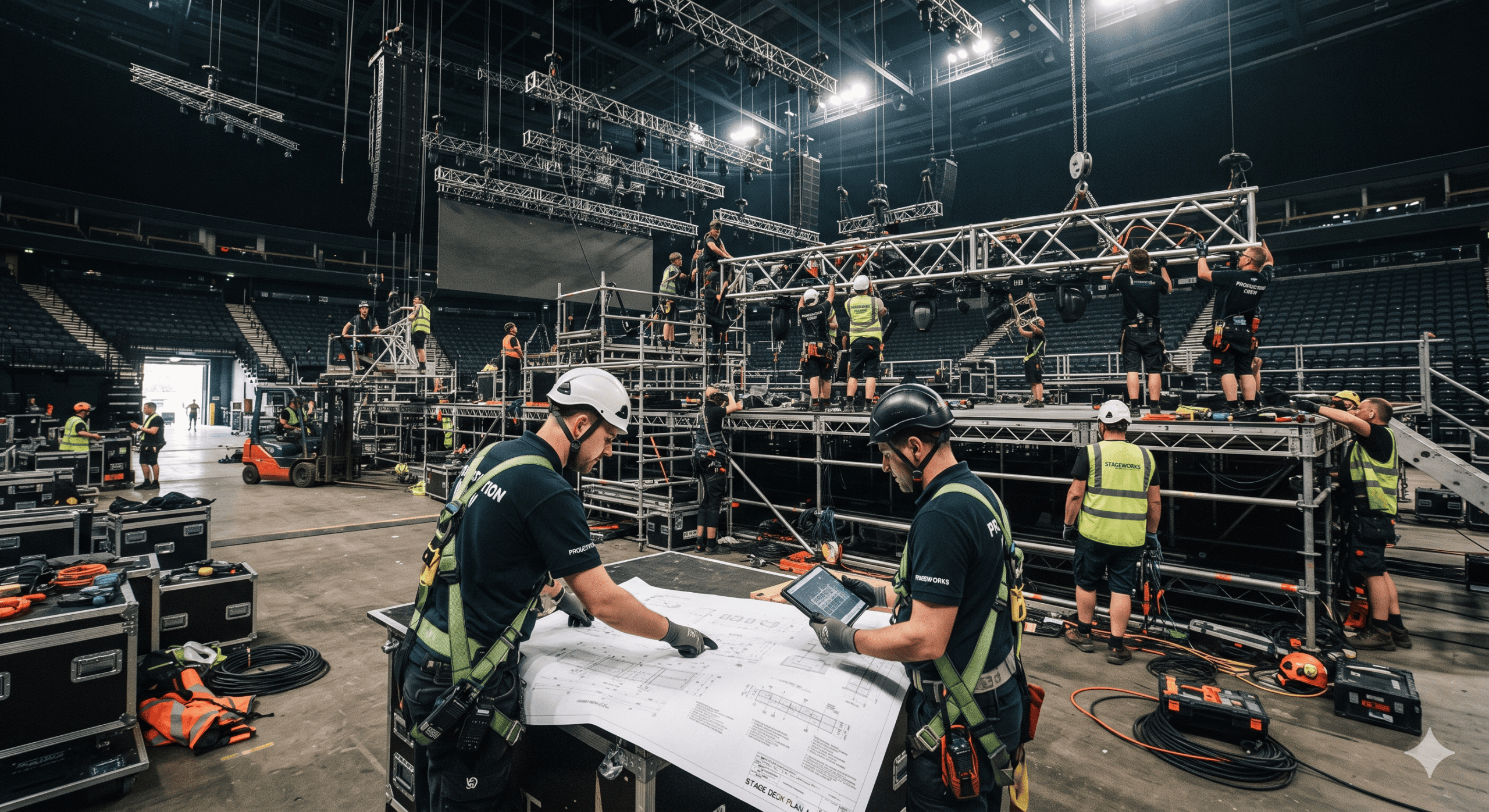
Every event has a creative lead everyone remembers. The designer gets the credit. The artist gets the applause. But someone has to turn that concept into steel, power, cable and a show that starts on time. That person is the production manager.
If you are thinking about a production manager career in India, this guide is for you. Maybe you finished an event management course and keep getting rejected for technical roles. Maybe you are a graduate who loves live events but doesn’t want to sit at a client desk. Or maybe you work in hospitality, interiors or engineering and want to move into shows. Either way, you will find the real picture here: what the job is, what you need to know, how the ladder works and how to start with zero experience.
No hype. No guarantees. Just how the work actually happens.
Table of Contents
1. What Does a Production Manager Actually Do?
A production manager is the person who makes the show buildable, safe and on budget. The designer says what the event should look like. The production manager works out how to build it, who builds it, what it costs and when each piece arrives.
The job runs in four stages. Here is what each one looks like on a real live event.
Stage 1: Pre-production (plan)
This is where most of the work happens, often weeks before the event. The production manager reads the design, breaks it into parts and builds a budget. They shortlist vendors for staging, lighting, sound, LED, trussing and fabrication. They collect quotes and compare them line by line.
They also go on a site recce. They check the venue’s load-in route, door sizes, ceiling height, rigging points and power supply. A stage that looks perfect in a render is useless if it can’t fit through the service gate. Then they turn everything into drawings and a production schedule that every vendor works from.
Stage 2: Load-in and build
On build day, the production manager runs the floor. Trucks arrive in a planned order. Crews follow the schedule. Truss goes up before lights. Lights get focused before the LED wall blocks access. The production manager keeps all of it moving.
Safety sits at the centre of this stage. Who is working at height? Is the rigging load inside safe limits? Are walkways clear of cable? A good production manager doesn’t need to rig the truss personally. They need to know enough to spot when something is wrong and stop it.
Stage 3: Show day
On show day, the production manager becomes the problem-solver. A generator trips. A vendor is short of crew. The client wants the stage moved half a metre. The show caller runs the cues, while the production manager keeps the whole system working behind them.
We cover this stage in detail in our post on what a production manager actually does on event day.
Stage 4: Load-out and close
The show ends, but the job doesn’t. Load-out has to be as safe and organised as load-in, usually with a tired crew and a venue deadline. After that, the production manager closes vendor bills, checks for damage, and writes a closing report: what went to plan, what didn’t and what to fix next time.
2. Where the Production Manager Career in India Actually Exists
Search for production manager jobs online and you will mostly find film, fashion and manufacturing roles. That hides a big part of the picture. Live events in India need production managers every single week.
Here is where the work sits:
- Concerts and live tours. Big stages, heavy rigging, tight load-in windows and touring schedules.
- Award shows and TV events. Complex sets, broadcast timing and many vendors working at once.
- Corporate events. Product launches, conferences and annual meets, often in hotels with strict venue rules.
- Weddings. Large Indian weddings now run like productions: mandap structures, stage builds, lighting rigs and multiple venues over several days.
- Exhibitions and trade shows. Booth builds, fabrication and fast turnarounds.
And here is who hires:
- Event agencies that run the full show for clients.
- AV and rental vendors (lighting, sound, LED and staging companies) that need people to manage their crews and gear on site.
- Venues and cultural centres with in-house operations and production teams.
- Wedding design companies that build large décor and stage setups.
Here is a real example. Arun Sagar took IIED’s CAD for Events & Entertainment short course to upskill technically. He now works in the Operations & Production department at NMACC (Nita Mukesh Ambani Cultural Centre) in BKC, one of Mumbai’s best-known performance venues. Venue production teams like this are a career path many students don’t even know about.
3. Event Production Manager Skills That Get You Hired
Event management courses teach planning and coordination. That is useful. But when you apply for a production role, companies ask different questions. Can you read a stage plan? Can you make one? Do you understand rigging loads? These are the event production manager skills that close the gap.
Reading and making technical drawings
This is the skill that separates coordinators from production people. Every vendor builds from drawings: stage plans, truss plots, elevations and power layouts. You need to read them fast, spot clashes and make your own when needed. The industry tools are AutoCAD and Vectorworks Spotlight. IIED trains students hands-on in both.
Rigging and load awareness
You won’t be climbing truss on day one. But you must understand what a rigging point can hold, why load is calculated before anything goes up and when to say stop. This knowledge protects people’s lives. Employers take it seriously.
Power basics
Lights, LED walls, sound and fabrication all pull power. A production manager needs to know how much is needed, where it comes from and how it is distributed safely. Most failures on show day trace back to power planning.
Vendor and budget management
You will handle quotes, negotiations and bills from many vendors at once. You need to read a quote, compare it with others and know when a cheap price will cost you on show day.
Calm communication
Production managers talk to clients, designers, vendors, venue staff and crew, often in the same hour. Clear, calm instructions under pressure matter more than any software.
For safety specifically, the UK Health and Safety Executive’s event safety guidance is a useful free reference. It shows how seriously the global live events industry treats planning, structures and crowd safety.
4. The Real Career Ladder (and What It Pays)
Nobody walks into a production manager title on day one. A production manager career in India usually moves up through four levels.
| Level | What you do | What you are learning |
|---|---|---|
| Production assistant / coordinator | Run errands on site, track vendor arrivals, update schedules, check deliveries | How a show is built, who does what, how long things really take |
| Junior production manager | Own one area (staging, a venue or a vendor group), make drawings, handle smaller budgets | Drawings, vendor handling, site decisions |
| Production manager | Own the full build, budget, schedule and safety of a show | Leadership, risk calls, client handling |
| Technical director | Lead the technical systems across large or complex shows | Deep systems knowledge across staging, power, lighting, sound and video |
What does production pay in events?
We will be straight with you. Production manager salary in events in India varies a lot by company, city and the size of shows you work on. We don’t publish salary bands we can’t verify.
What we can share are real offer-letter figures from IIED alumni. Varun Jain joined The Finale Eventz in Mumbai as a Design Associate at ₹45,000 a month during probation, rising to ₹50,000 once confirmed. CAD skills were part of his job description. Across IIED’s verified placements, entry-level design and lighting roles in India have paid ₹25,000–50,000 a month.
Production pay usually grows with responsibility. The bigger the shows you can run safely, the more you are worth.
A real example of the first step
Suhani Mudra is the clearest example of this ladder in action. She finished an event management degree but felt there were skills she was still missing. She loved production. So she took IIED’s CAD for Events & Entertainment course to learn technical drawing. Today she works at Potato Heads as a Draftsman and Production Manager.
Her lesson is simple. Your event management studies taught you to plan. Technical drawing taught her to produce.
5. How to Become an Event Production Manager in India With No Experience
You don’t need a contact in the industry to start. You need skills that save a production team time, and proof that you have them. Here is the practical route.
Step 1: Get on a real site
Volunteer, intern or join a crew for a few shows. Wedding season and festival season mean there is always work for willing hands. Watch the load-in. Note the order things go up. Ask the production manager what they are checking and why.
Step 2: Learn technical drawings
This is the single biggest jump you can make. Once you can read and draw a stage plan in AutoCAD or Vectorworks, you become useful in the production office, not just on the floor. IIED’s CAD for Events & Entertainment course is built for exactly this.
Step 3: Build a documentation portfolio
Designers show renders. Production people show paperwork. Build a portfolio with stage plans, truss plots, a sample production schedule, a vendor comparison sheet and a power layout. Even if they are for practice events, they prove you think like a production manager.
Step 4: Shadow a full show
Ask to follow one production manager from recce to load-out. You will learn more in one full cycle than in months of reading.
Step 5: Pick your environment
Concerts, weddings, corporate events, exhibitions and venues each work differently. Try a few and see which pace suits you. Many people start in weddings or corporate events and move to bigger stages later.
Not sure the field is right for you yet? Our guide to the technical production career in India explains the wider set of roles around production.
6. Production Manager vs Technical Director vs Event Manager
These three titles get mixed up all the time. Here is the short version.
| Event manager | Production manager | Technical director | |
|---|---|---|---|
| Main focus | Client, guests, agenda, overall experience | Building the show: budget, vendors, schedule, safety | Technical systems: staging, power, lighting, sound, video |
| Key question | “Is the client happy?” | “Can we build this safely, on time and on budget?” | “Will every system work together?” |
| Main tools | Run-sheets, guest lists, client calls | Drawings, production schedules, vendor quotes | Technical drawings, system plans, cue lists |
| Typical background | Event management, hospitality | Event management + technical skills, crew work | Years of technical production experience |
The production manager vs technical director question is the one students ask most. In short: the production manager owns the whole build and its money and schedule. The technical director owns how the technical systems work. On smaller shows, one person often does both. We go deeper in our post on technical director vs production manager.
7. What the MA in Technical Production Covers
If you want a structured route into production rather than learning piece by piece, IIED’s MA in Technical Production is a 2-year, full-time, hands-on programme in Mumbai. It is built around the exact skills this post describes. Graduates of any discipline can apply.
Semester 1
- Fundamentals and History of Technical Production
- Health, Safety, Risk and Compliance
- Staging, Rigging and Load Management
- Lab I
Semester 2
- Power and Distribution
- Audio, Lighting, Video Integration
- Production Planning, Logistics and Site Management
- Studio I
- Supervised internship
Careers the programme prepares you for include Technical Director, Production Manager, Stage/Show Manager and Technical Producer.
What makes this different from a management course? You learn the technical side of production next to design and lighting. IIED is the only institute in Mumbai that teaches Event Design, Lighting and Production together. You train hands-on with the same tools the industry uses, including AutoCAD and Vectorworks Spotlight, in small batches.
For full details, fees and the latest updates, see the MA in Technical Production course page.
Note: the alumni outcomes in this post come from IIED’s earlier short courses and programmes, not the MA. We share them because they show what technical skills do for real careers.
8. Who This Career Is For (and Who It Isn’t For)
This is a strong fit if you:
- Studied event management but can’t get technical roles. You already understand events. You are missing drawings, rigging awareness and production paperwork. That gap can be closed, as Suhani’s story shows.
- Are a graduate from any stream who loves live events. Commerce, arts, science and engineering graduates all move into production. What matters is how you think on site, not your degree title.
- Work in hospitality, interiors or engineering. Hospitality teaches you guest flow and pressure. Interiors teaches you drawings and materials. Engineering teaches you loads and power. All three transfer straight into production.
- Like solving problems more than being on stage. If you enjoy figuring out how something gets built, you will enjoy this work.
It may not suit you if you:
- Want fixed 9-to-5 hours every week. Load-ins start early and load-outs end late.
- Want to be the creative face of the event. That is the designer’s job. Production is the person who makes it real.
- Don’t like responsibility for other people’s safety. This job carries real responsibility.
Production also links closely to design. Pranay Mhatre completed IIED’s Event & Wedding Design Visualization course and joined Wizcraft, one of India’s oldest event companies, as a Production Designer. Zargam Haider learned CAD at IIED and went straight into a Consulting Production Designer role at Hyperlink. Design and production sit side by side. Knowing both makes you more useful to any team.
Frequently Asked Questions
What does a production manager do in the events industry in India?
A production manager turns an event design into a real, safe show. They plan the budget, choose vendors, make drawings and schedules, run the build and load-out, and solve problems on show day.
How do I become an event production manager with no experience?
Start by working on real sites as crew or an intern. Learn technical drawings in AutoCAD or Vectorworks and build a portfolio of production documents. Then shadow a full show and work your way up from assistant to production manager.
What is the difference between a production manager and a technical director?
The production manager owns the full build: budget, vendors, schedule and safety. The technical director owns how the technical systems, such as staging, power, lighting, sound and video, work together. On smaller events, one person may do both jobs.
Do I need an engineering or event management degree to become a production manager?
No. Both help, but neither is required. What employers want is site experience, the ability to read and make drawings, and sound safety awareness.
Which software should an event production manager know?
AutoCAD and Vectorworks Spotlight are the main tools for stage plans, truss plots and layouts. Spreadsheets for budgets and schedules matter just as much day to day.
What does an entry-level production role pay in India?
Pay varies by company, city and the scale of shows. Among verified IIED alumni, entry-level design and lighting roles have paid ₹25,000–50,000 a month. Varun Jain, for example, earns ₹45,000–50,000 a month as a Design Associate at The Finale Eventz.
Is production management a good career for event management graduates?
Yes, if you add technical skills. Event management gives you planning and coordination. Drawings, rigging awareness and production paperwork make you hireable for production roles. Suhani Mudra made exactly this move and now works as a Draftsman and Production Manager at Potato Heads.
Can a graduate of any stream study technical production?
Yes. Graduates of any discipline can apply for IIED’s MA in Technical Production. The programme teaches the technical foundations from the start.
Ready to Start Your Production Manager Career?
A production manager career in India is real, it is growing, and it rewards people who can actually build a show. You don’t need contacts. You need the right technical skills and proof that you can use them.
Want to see how IIED trains production, design and lighting together? Visit our Malad East campus, see the tools students work on, and talk to us about the right route for you.
Book your free visit — call 9892966334 or email info@weareiied.com. IIED, Shop No. 506, 5th Floor, Magic Square, Dwarkadhish Road, off Poddar Road, Malad East, Mumbai 400097.