
If you’ve spent any time researching a career in events, you’ve probably come across two job categories: event planner and event designer. Planners coordinate. Designers create the look and feel. But there’s a third career most beginners never hear about — and it might be the one that actually fits you.
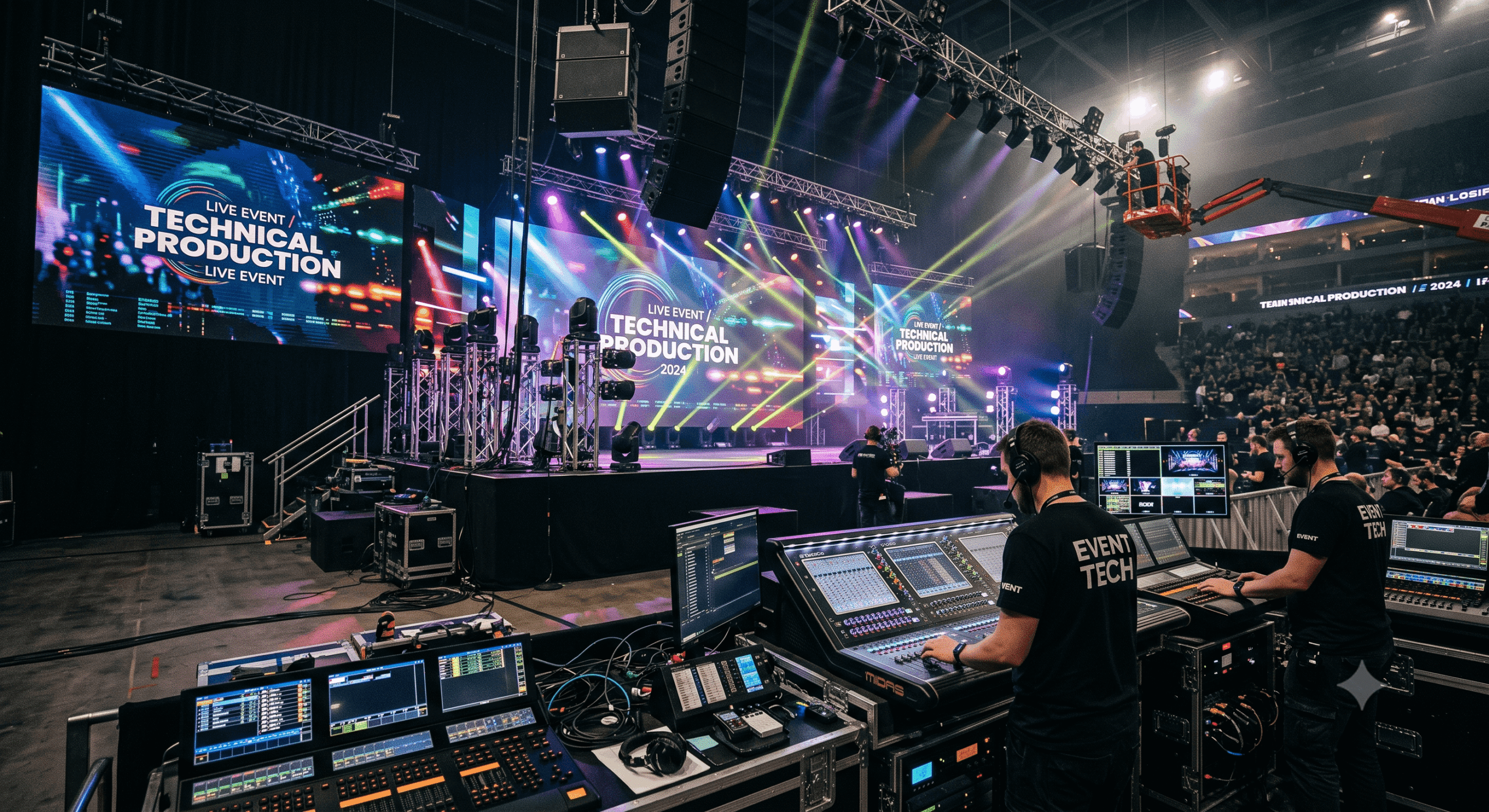
What is technical production in events? It’s the operational layer of a live event — the lighting, sound, staging, rigging, and power that make a concert, wedding, or corporate show actually happen. It isn’t vague “behind the scenes magic.” It’s real, hands-on, technical work with real job titles: Technical Director, Production Manager, Rigging Technician, Lighting Programmer, AV Technician.
If you’re drawn to solving problems under pressure, working with your hands, and building things that have to work the first time — not necessarily “artistic” design work — this article breaks down exactly what technical production is, what it pays, and how people build a career in it.
Table of Contents
What Is Technical Production in Events?
Technical production covers everything that has to be built, rigged, wired, and operated for an event to physically function. Think of a live concert or a big Indian wedding: someone has to hang the lighting truss safely, run and test the sound system, build the stage, manage the power load, and set up the AV screens. That work — the technical, operational layer — is technical production.
It sits apart from the other two career paths people already know about. Event management is coordination: timelines, vendors, budgets, logistics. Event design is aesthetics: how the space looks, feels, and photographs. Technical production is neither. It’s the engineering and operations layer underneath both — the part that has to be correct, safe, and working before the guests ever walk in.
This is why technical production is often invisible to beginners. Nobody markets it as a career path the way “event planning” gets marketed. But every concert, wedding, and corporate activation in India runs on people trained specifically to do this work — and trained people are in short supply.
The scale of demand is real. India’s wedding industry alone is worth ₹3.75 lakh crore and growing every year, and that’s before counting concerts, corporate activations, and award shows. Every one of those events needs a crew that can rig lighting safely, run sound without failures, and manage power without a blackout mid-show. Very few trained lighting and production professionals exist in India relative to that demand — which means the people who do get trained have far less competition for roles than they’d find in event planning or design.
Real Job Titles Inside Event Technical Production Jobs
Technical production isn’t one job — it’s a cluster of specialised, hireable roles. Here are the real titles you’ll find on a production crew:
Technical Director
Oversees the entire technical operation of an event — lighting, sound, staging, and power — and makes sure every department works together on schedule. On a large show, the Technical Director is the person production companies hold responsible when something has to work under pressure.
Production Manager
Manages the build: schedules, crew, equipment, and logistics for getting a stage, rig, and setup ready before doors open. This role sits closest to event management’s coordination skills, but applied to physical build-out rather than guest experience.
Rigging Technician
Handles the safe installation of trussing and suspended equipment — the person responsible for making sure nothing overhead fails. Rigging work is taught with real weight, load, and safety training, not guesswork.
Lighting Programmer / Operator
Programs and runs the lighting console live during a show — the role trained in IIED’s One Year Program in Lighting Design. Programmers build the cues before the show and operate them live, reacting in real time if anything changes.
AV Technician
Sets up and operates the audio-visual systems — screens, projectors, sound reinforcement — that most modern events depend on. As hybrid and livestreamed events grow, AV skills are becoming a standing requirement, not an extra.
These are the event technical production jobs that keep the live events industry running. They exist at concerts, weddings, corporate conferences, award shows, and theme parks — anywhere a physical production has to come together and work. On a typical large event, these roles report into a Technical Director or Production Manager, forming a small technical team that operates separately from the event management and design teams, even though all three work the same event.
Career progression in technical production tends to follow a clear, skill-based path rather than a fixed number of years. Most people start as an operator or technician on a specific system — lighting, sound, or rigging — and move up to managing a full department once they’ve handled enough live shows to be trusted with the bigger calls. Unlike careers that depend on tenure, progression here depends on what you can demonstrably run without supervision.
The Skills That Actually Get You Hired
Technical production hires on demonstrable skill, not a general degree. These are the specific, practical skills that show up on a production resume and get interviews:
CAD and Vectorworks. Technical drawings — light plots, stage layouts, floor plans — are how a production team communicates before anything gets built. Knowing CAD or Vectorworks means you can read and produce these drawings, which is a skill most event management graduates never learn.
GrandMA3 and lighting consoles. Live lighting runs on consoles like GrandMA3 and Avolite Titan. Operators who can program cues, build a show file, and run it live are genuinely rare in India — trained console operators can be counted on two hands relative to the demand.
Rigging and trussing basics. Understanding load, weight limits, and safe suspension isn’t optional — it’s the skill that keeps a crew and an audience safe. This is taught explicitly, not picked up casually on site.
Power and electrical safety. Every lighting and sound rig runs on managed power — earthing, generators, dimming circuits, and load calculations. Getting this wrong causes equipment failure or worse, so it’s treated as a core, non-negotiable skill rather than something crews figure out on the day.
DMX and lighting control protocols. Lighting fixtures talk to consoles through DMX and related protocols like Art-Net and sACN. Knowing how to network and troubleshoot these systems is what separates someone who can operate a console from someone who can actually run a full technical department.
None of these are “soft skills.” They’re specific, testable, and either you can do them or you can’t — which is exactly why trained candidates get hired fast in this field.
Technical Production vs Event Management vs Event Design
People confuse these three careers constantly, so here’s the direct comparison.
Event management is coordination. An event manager builds the timeline, manages vendors, tracks the budget, and makes sure the day runs on schedule. It’s a logistics skill.
Event design is aesthetics. An event designer decides what the space looks like — decor, colour, layout, atmosphere. It’s a creative and visual skill.
Technical production vs event management comes down to this: event management coordinates people and schedules. Technical production builds and operates the physical systems — lighting, sound, rigging, power — that the event actually runs on. A production manager doesn’t plan the guest list. They make sure the stage doesn’t fall over.
Most event management courses in India don’t teach any of this. That’s the specific skill gap this article opened with — coordination training doesn’t cover lighting consoles, rigging, or CAD, which is exactly why event management graduates who add a technical production skill become more hireable, not less.
Put side by side on the same event day, the difference is concrete. The event manager is on the phone confirming the caterer’s arrival time. The event designer is checking that the floral arrangement matches the approved mood board. The technical production crew is testing every lighting cue, checking rigging tension, and confirming the sound levels — all before either of the other two teams even notices anything is happening. Three different jobs, three different skill sets, one event.
Technical Production Career in India: Where IIED Students Have Landed
A technical production career in India isn’t theoretical — IIED students are already working in it, in India and abroad. These are verified placements, not projections, and they cover a full range of entry points: a short technical course, a full one-year program, and even a family business.
Aron Sagar completed IIED’s CAD for Events & Entertainment course and now works in the Operations & Production department at NMACC (Nita Mukesh Ambani Cultural Centre) in BKC, Mumbai — one of the country’s most prestigious performance venues. His path shows that a 1-month technical course can open the door to a serious production role.
Atharv Devikumar Jog completed the One Year Program in Lighting Design and was placed as Lighting Operator at SLS Production Equipment L.L.C. in Saudi Arabia — SAR 10,000 a month, plus company accommodation and return flights. His placement shows technical production as an international, well-paid career, not just a local gig.
Silas Paul Uba was placed as a Lighting Technician (Technician – Lighting, Grade B) at LumaSonic Structures Rental in Goa, earning ₹25,000 a month with full benefits. He came from an audio and media production background — proof that technical instincts from an adjacent field transfer directly into this career.
Rishabh Rao already worked in his family’s AVL (audio-visual-lighting) rental business in Mumbai before training at IIED. He now runs technical operations for the business with more precision and confidence — showing that technical production training pays off even inside a business you already have access to.
Is This Career Right for You?
Technical production suits people who like solving problems under pressure, working with their hands, and seeing something they built actually function — not necessarily people who think of themselves as “artistic.” If you’d rather be the one making sure the lighting rig holds and the show runs than the one choosing the colour palette, this is the career path that was missing from your list.
It also suits people who already have a technical or hands-on background outside events entirely — electricians, audio hobbyists, engineering students, or anyone who has ever set up a home theatre or sound system for fun. Silas Paul Uba’s move from an audio and media production background into a placed Lighting Technician role is a direct example of exactly this kind of transfer.
If you’re still exploring this quietly before telling your family, it helps to know that “is there really a job in this?” has a direct, verifiable answer here — named companies, named alumni, and real offer letters, not a promise. That’s usually the easiest way to bring a parent from skeptical to supportive: show them the placement, not just the pitch.
For context on how the wider events industry supports careers like this, safety and technical standards for rigging and production are maintained internationally by bodies like PLASA, the professional association for entertainment technology — a useful reference if you want to see how seriously the industry takes the technical side of live events.
Ready to See Technical Production in Action?
Technical production is a real, hireable career with real job titles and real training behind it — not a vague “backstage” idea. If you’re the kind of person who wants to build things that work rather than just plan or decorate them, this is worth a closer look. The alumni named in this article started exactly where you are now — researching a career they weren’t sure existed — and moved into paid, named roles within a year of training.
See IIED’s CAD, Vectorworks, and Lighting Design training in person before you decide anything. Book your free visit at IIED and walk through the same consoles and drawing tools our placed alumni trained on.