
Here is how to become a lighting designer in India. First, learn how light, colour, power, DMX and rigging safety work. Second, get hands-on time on a real lighting console like grandMA3 or Avolites Titan. Third, learn to draw a light plot and plan a show in CAD and visualisation software. Fourth, build a portfolio from real shows, even small ones. Fifth, crew your way up: technician, then operator, then programmer, then designer.
That is the whole route. It is not glamorous at the start. You will coil cables, load trucks and climb truss before anyone hands you the console. But every working lighting designer we know took some version of this path. This guide walks you through each step honestly, so you know what the first 12 to 24 months actually look like.
Table of Contents
Is Lighting Design a Real Career in India?
Yes. A lighting designer career in India is real, paid and growing. But it rarely looks like a neat job advert on a portal. Most of the work sits inside rental companies, production houses, event companies, concert crews, theatre groups and design studios.
Think about how many shows happen in India every single week. Weddings with stage and décor lighting. Corporate launches and award nights. Music festivals and concert tours. Garba nights, Ganpati pandals and Durga Puja installations. Theatre, fashion shows, product launches and brand activations. Every one of these needs someone who knows where to hang a light, how to power it safely and how to make it do something on cue.
The problem is not demand. The problem is trained people. A lot of crews in India learned on the job, by watching someone else. That works up to a point. Then a show needs a proper light plot, a programmed timecode cue list, or a safe rigging plan, and the gap shows. People who can do the technical work and the creative work together are hard to find. Skilled grandMA3 operators in particular are rare, and demand for them far exceeds supply.
The career also travels. IIED lighting alumni work in Mumbai, Goa, Saudi Arabia, Hong Kong and on international cruise productions. Light is a technical language. Once you speak it well, it works anywhere a show happens.
If you want to understand the day-to-day job first, read our guide on what a lighting designer actually does. This post is about something different: how you get in.
How to Become a Lighting Designer in India: The 5 Steps
These five steps are not a theory. They are the route our lighting alumni actually took, in roughly this order. Some moved faster. Some started from a completely different field. But nobody skipped the basics and still lasted.
Step 1 — Learn the Fundamentals: Light, Colour, Power, DMX and Rigging Safety
This is the step self-taught people skip. It is also the step that decides whether you are trusted on a site.
Start with light itself. How does a beam behave? What is the difference between a spot, a wash and a beam fixture? How does colour temperature change the mood of a stage? Why does a face look flat under one angle and alive under another? This is the “why” behind every cue you will ever program.
Next comes power. You must understand load, phases, distribution and how much a circuit can safely carry. Overloaded power is one of the most common problems at Indian events. A designer who understands electrics protects the crew, the client and the show.
Then learn control. Almost every professional fixture is controlled through DMX, a data protocol first created in 1986 and now maintained as the ANSI E1.11 DMX512-A standard. You need to know addressing, universes, fixture modes and how lighting networks carry data across a big site.
Finally, rigging and structural safety. Truss, clamps, safety cables, load limits and working at height. You will not be the rigger on day one. But you must understand what safe looks like, because a designer who asks for an unsafe position puts lives at risk.
None of this is exciting on Instagram. All of it is what gets you hired again.
Step 2 — Get Hands-On With Real Gear and a Console
You cannot learn lighting from YouTube alone. Videos are useful for revision. But a console under your fingers, real fixtures responding to your cues and a real deadline teach you things no video can.
Two consoles matter most in Indian live events today: grandMA3 and Avolites Titan. Learn one deeply first, then the other. Patch fixtures. Build groups and presets. Write cue stacks. Run effects. Then practise busking a live set when the band changes the setlist at the last minute, because that will happen.
Hands-on also means fixtures. Lamp a fixture. Change a gobo. Fix a dead channel. Trace a faulty data cable. Clients do not care how good your plot looks if the show goes dark ten minutes before doors open.
Our deep dive on building a grandMA3 career in India explains why console skills open so many doors so quickly.
Step 3 — Learn to Draw and Plan: Light Plots, CAD and Visualisation
A lighting designer does not just operate. A designer plans. That plan lives in drawings.
A light plot shows every fixture, its position, its address, its power and its purpose. Production managers, riggers and rental companies all work from it. Learn to draw plots in CAD. Vectorworks Spotlight is the industry tool built for exactly this work.
Then learn visualisation. Software like Capture lets you pre-programme and preview a show in 3D before you ever reach the venue. This saves hours of on-site time and lets you show a client what they are paying for. In India, where load-in windows are often painfully short, this skill matters more than people think.
When you can hand a crew a clean plot and arrive with a show already pre-programmed, people start treating you like a designer, not just a pair of hands.
Step 4 — Build a Portfolio and a Showreel From Real Work
Nobody hires a lighting designer from a CV alone. They want to see your light.
Start building your portfolio from the first show you touch. Small shows count. A friend’s band gig. A community festival. A school function. A wedding sangeet you helped light. Shoot good photos and short video clips. Note what you did on each one: designed, programmed, operated or crewed. Be honest about your role.
A strong lighting portfolio usually has:
- Photos and video of finished looks, shot from the audience view
- Your light plots and paperwork for at least two or three shows
- Screenshots from visualisation work (Capture renders, pre-viz clips)
- A 60 to 90 second showreel cut to music
- A short note on each project: venue, brief, your role, the gear you used
Your portfolio is what turns “I am learning” into “I have done this.” It is also how freshers compete with people who have more years on site but nothing to show.
Step 5 — Crew First: Technician, Operator, Programmer, Designer
This is the honest part. Almost nobody walks into a lighting designer title on day one. You climb a ladder. Each rung teaches something the next one depends on.
- Lighting technician: rigging, cabling, focusing, fixture maintenance. You learn how a show is physically built.
- Lighting operator: running the console during the show. You learn timing, cues and pressure.
- Lighting programmer: building the show file for a designer. You learn speed, structure and creative translation.
- Lighting designer: owning the look, the plot and the creative decisions. You lead the team.
Rental companies and production houses are where most people learn these rungs. Do not look down on a technician role. It pays you to learn, and the people you crew for become your network.
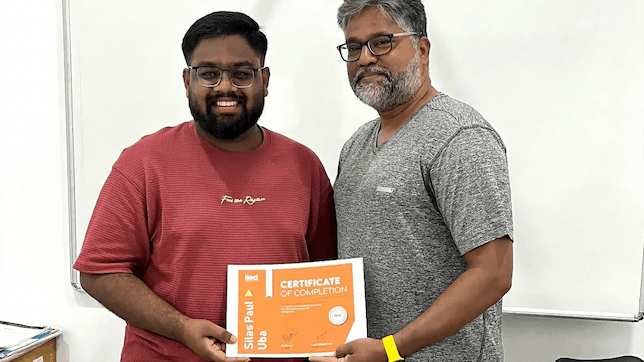
Silas Paul Uba, one of our lighting alumni, started as a Technician – Lighting at LumaSonic Structures Rental in Goa in September 2025. His offer included ₹25,000 per month plus ₹5,00,000 medical insurance. Atharv Jog went abroad as a Lighting Operator at SLS Production in Saudi Arabia in August 2025, at SAR 10,000 per month plus accommodation, a return air ticket and transport. Neither started with the designer title. Both started on the right ladder.
For the full picture of what happens after you get in, read our breakdown of the lighting design career path in India.
Lighting Designer Skills and Degrees: What Actually Gets You Hired
Do you need a degree to become a lighting designer?
No law in India says you need a specific qualification to work in lighting. People enter from every background. But “you don’t strictly need it” is not the same as “it doesn’t help.”
Here is what actually decides whether you get hired:
- Can you work safely? Power, rigging and working at height. This comes first, always.
- Can you run the console? A rental company or production house will test you on the desk.
- Can you show your work? A real portfolio beats a list of course names.
- Will someone vouch for you? Most lighting jobs move through references from people you have crewed with.
Structured training helps because it gets you to all four faster and with fewer gaps. Short certificate courses can teach a single tool well. A full-time programme gives you the fundamentals, the software, the hands-on lab time and an industry internship together. What matters is that you can prove the skill, not just the attendance.
The core lighting designer skills
If you are building a checklist, these are the lighting designer skills employers look for:
- Light and colour theory: beam types, colour temperature, angles, contrast, mood
- Electrical knowledge: power distribution, load calculation, safe cabling
- DMX and networking: addressing, universes, fixture modes, data distribution
- Console programming: grandMA3 and Avolites Titan, cue stacks, effects, timecode basics
- Drafting: light plots and paperwork in CAD, ideally Vectorworks Spotlight
- Visualisation: pre-programming and previewing shows in Capture
- Rigging awareness: truss, load limits, safety cables, working at height
- Soft skills: calm under pressure, clear communication with clients and crews, reliability
That last one is not a throwaway. In live events, the person who shows up on time, keeps calm when the generator trips and communicates clearly gets called back. Talent opens the door. Reliability keeps it open.
How to Start a Career in Lighting Design From Where You Stand
Everyone asks how to start a career in lighting design as if there is one starting line. There isn’t. Your route depends on where you are right now. Here is what we tell students in each situation.
Become a lighting designer after 12th
You have time on your side. Use it. Start crewing with a local rental company or sound-and-light vendor during holidays and weekends. Learn the gear, the vocabulary and the pace of a show. Practise on free offline console software at home; most major console makers offer a free PC version for exactly this. Keep your graduation going in parallel, because a full-time programme like our MA in Lighting Design is open to any graduate. By the time you graduate, you will already know whether you love this work.
Become a lighting designer after graduation
This is the most common starting point, and it is a good one. Your degree subject does not matter much. Commerce, arts, science, engineering, mass media: people succeed from all of them. Jude Pereira left medical studies to pursue lighting. Today he works as an Event Designer and Lighting Technician at Disneyland Hong Kong, handling lighting for their shows. A non-linear start is normal in this industry. What matters is that you now commit to structured training and real show hours.
Switching from sound, AV or media production
You are closer than you think. You already understand signal flow, cabling, show pressure and crew culture. Vinith was a sound engineer before he switched to lighting. Today he is a Lighting Designer at LGL Designs, working alongside his mentor Lloyd Albuquerque. Silas Paul Uba came from audio mixing and media production before his lighting role in Goa. Your existing production skills are a foundation, not a detour. What you need is the light-specific layer: optics, colour, DMX, console programming and plotting.
Already working in lighting, but self-taught
This is more common than people admit. You can run a desk and hang fixtures, but you feel the gaps when a big show comes along. Atharv Jog was in exactly this position. In his words: “Joining IIED allowed me to dive deep into the intricate details and technicalities of light, which completely transformed my professional perspective. This shift in expertise led to an incredible international placement with SLS Production in Saudi Arabia.” If this is you, a focused console course like our GrandMA3 Mastery can close a specific gap quickly, while a full-time programme rebuilds your foundation from the ground up.
From event management
Event managers already know how shows run, how clients think and how vendors work. Many of you have stood next to a lighting desk and thought, “I want to be the one doing that.” Moving into lighting turns you from the person who books the vendor into the person who creates the look. Your planning and client skills carry over directly.
After a career break
Cajetan D’Silva started learning lighting during the COVID lockdown, when the whole events industry had stopped. Today he handles lighting for international productions with Royal Caribbean. A break is not a dead end. Use it to get the fundamentals and the software in place, so you are ready the moment you step back onto a site.
Lighting Designer Course in India: Short Course or Full-Time Programme?
Once you decide to train properly, the next question is which kind of lighting designer course in India fits you. Here is the honest comparison.
Short courses
Short courses focus on one tool or one skill, usually a console. They are good if you are already working in lighting and need to fill a specific gap, like learning grandMA3 properly. They are not enough on their own if you are starting from zero, because they rarely cover power, rigging, optics, drafting and design process together.
A full-time programme: IIED’s MA in Lighting Design
If you are serious about becoming a lighting designer, not just an operator, a full-time programme gives you the complete foundation. IIED’s MA in Lighting Design is a 2-year, full-time, hands-on master’s degree programme built around exactly the five steps in this guide.
In the first year, you study:
- Light, vision and colour
- Electrical systems and power
- Trussing, rigging and structural safety
- Cabling and fixtures lab
- Fixtures, sources and optics
- Control systems, DMX and networking
- Lighting design process and realisation
- Design and documentation studio
You also choose electives that match where you want to work: interior architectural lighting, façade and landscape lighting, lighting for events, or lighting for film and television. In Semester 2, you complete an industry internship, so you are on real sites early, not just in a classroom.
You train on the tools the industry actually uses: grandMA3, Avolites Titan, Capture and Vectorworks Spotlight. The programme prepares you for roles like Lighting Designer, Light Director and Lighting Programmer/Operator. Any graduate can apply.
For fees and full programme details, visit the MA in Lighting Design course page.
Mistakes to avoid
- Skipping safety and electrics. It is the fastest way to lose trust on a site.
- Learning only from videos. You need real hours on a real desk with real fixtures.
- Waiting for the “designer” title. Crew first. The title follows the hours.
- Not documenting your work. No photos, no plots, no portfolio. Shoot everything.
- Chasing gear brands instead of fundamentals. Consoles change. Light and safety do not.
- Burning bridges. The crew chief you annoy today might be hiring next season.
Your 90-day starter plan
Days 1–30: Learn the language. Study beam types, colour temperature and basic electrics. Download free console software and learn to patch fixtures and build simple cues. Read about DMX addressing until you can explain it to a friend.
Days 31–60: Get your hands dirty. Contact two or three local rental companies or production vendors and offer to crew. Show up early. Coil cables properly. Ask questions during breaks, not during load-in. Start a notebook of every fixture and console you touch.
Days 61–90: Start building proof. Draw your first light plot, even for an imaginary show. Shoot photos and clips at every event you crew. Put together a simple portfolio page. Then decide on your training route: a focused console course if you are already working, or a full-time programme if you want the complete foundation.
At the end of 90 days, you will not be a lighting designer yet. But you will know, for certain, whether this is the career for you. And you will have taken the first real steps.
Ready to Take Your First Real Step?
You now know the route. The next step is seeing the gear, the lab and the training up close. Book your free visit to IIED in Malad, Mumbai — call 9892966334