
Table of Contents
An event design career for homemakers usually starts long before anyone calls it a career. It starts with picking the mandap flowers for a cousin’s wedding. Matching the drape colour to the centerpiece. Deciding, without being asked, exactly where the fairy lights should go so the hall doesn’t look flat in photos. Nobody paid for that work. Nobody called it design. But that is exactly what it was.
This article is for the homemaker who has quietly done this for years — for family, for friends, for her own home — and is now wondering if it could be something more. Something with a paycheck attached. The honest answer is yes. Not because “anyone can do anything,” but because the specific skill gap between what you already have and what a professional design career needs is smaller, and more learnable, than most people assume.
Design, Not Just Management: Why Most Career Advice for Homemakers Points the Wrong Way
Search for a career for homemakers in the events space and most of what comes up is event management advice — coordination, logistics, running the day smoothly. That’s a real skill, but it isn’t the one you’ve already been building. Coordinating a wedding day and designing what that wedding looks like are two different jobs, done by two different people, often on the same event.
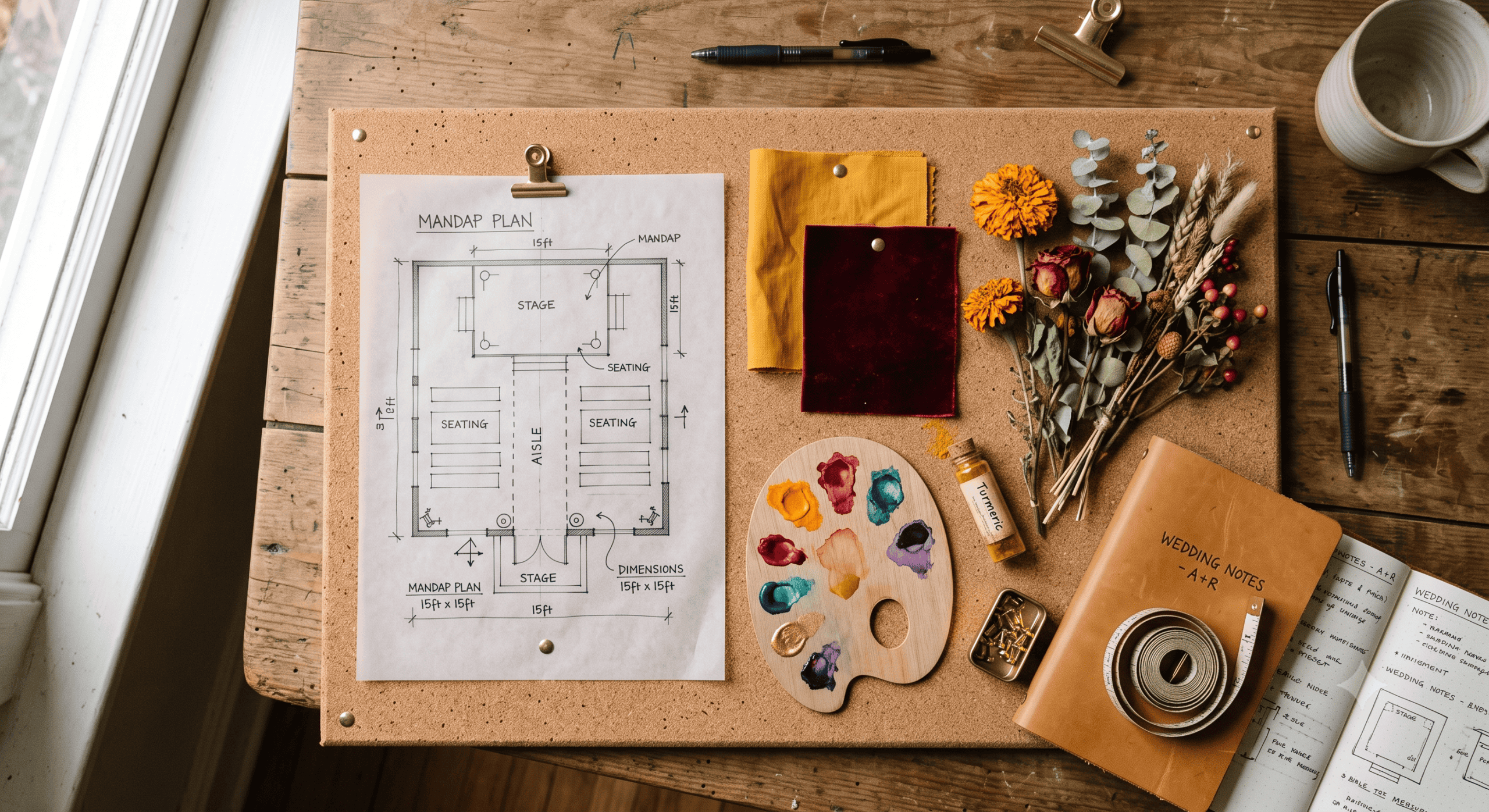
An event design career for homemakers is a more specific, more accurate target. It’s built around the part you’ve actually been doing without a title for it: choosing the colour story, deciding how the mandap should look, working out where flowers, drapes, and lighting should sit so the space feels right. Management courses teach you to run an event. A design course teaches you to shape what people remember about it — and that’s the skill that turns a good eye into billable work, whether that’s freelance styling, a boutique design business, or a design role at an established studio.
You’re Already Doing the Work of an Event Design Career for Homemakers
Ask any homemaker who has run three or four family weddings what she actually did, and the list is long: seating charts, floral budgets, colour stories, vendor negotiations, last-minute redesigns when the venue’s lighting looked wrong on arrival. None of that is planning in the logistics sense. It’s design. It’s the same decision-making a professional event designer gets paid to do — done for free, out of love, with no portfolio to show for it.
That distinction matters more than it sounds. Event management is coordination: vendor calls, run sheets, timelines. Event design is the actual look, feel, and visual story of an event — the mandap structure, the colour palette, the seating layout, the lighting mood. Homemakers who’ve planned weddings and family functions have usually been doing design work, not management work, without the vocabulary to call it that.
The gap isn’t talent. It’s technical training: sketching, layout and visualization software, budgeting a design (not just a guest list), and building a portfolio that proves the work instead of just describing it. That’s a specific, teachable skill set — not a personality trait you either have or don’t. For a broader look at how this translates into paid work, see our guide to launching a career as an event decorator.
Career After a Career Break: What Event Design in India Actually Looks Like
A career after a career break in event design in India doesn’t have to mean starting from zero. It usually means adding a professional layer — sketching, presentation, 3D visualization, vendor budgeting — on top of an eye for design you’ve already spent years sharpening. IIED’s Event & Wedding Design Visualization course is built for exactly that: 10+2 eligibility, no design degree required, and a curriculum that starts at design foundations rather than assuming prior technical knowledge.
The course runs 3–4 months, part-time, with an offline batch in Malad East, Mumbai, and a full online version with the same curriculum for students anywhere in India. Total fee for the offline programme is ₹60,000, split into an enrolment payment of ₹30,000 and two instalments of ₹20,000 and ₹10,000 — see our full breakdown of event design course fees in India for exactly what’s included. Students work toward a self-directed final design project and a professional digital portfolio — the actual proof employers or clients look for, not a certificate on a wall.
This isn’t a small or unusual situation. SHRM reports that an estimated 7 million women in India have taken a career break and are actively seeking to re-enter paid work, and roughly two-thirds of women who left the workforce for caregiving say they want to return to professional employment. Event design is one of the few career paths where the break itself — years spent running households, planning family functions, managing budgets and vendors — counts as direct, relevant experience instead of a gap you have to explain away.
Inside IIED’s Wedding Designer Course for Homemakers
The Event & Wedding Design Visualization course is built in four parts. Unit 1 covers design foundations — elements and principles of design, colour theory, basic typography — the formal vocabulary behind decisions you’ve already been making by instinct. Unit 2 moves into the production side of event design: trussing, lighting and sound basics, fabrics and furnishing, table styling, floral design, and vendor management and budgeting.
Unit 3 is presentation methods: sketching, graphic design for branding and layout, and production design using scales and construction drawings — the technical skills that let you hand a vendor or a client a real, professional layout instead of a verbal description. Unit 4 is a self-directed final design project that simulates a professional commission, which becomes the centrepiece of your portfolio.
No prior software experience is required to join. The course teaches design foundations, sketching, and presentation methods from the ground up, with practical sessions in floral design and sketching and masterclasses led by working industry professionals. For anyone worried this course assumes a design background you don’t have — it doesn’t. It assumes you know what a beautiful event looks like, because you’ve built a few. It teaches you the rest.
Assessment is by portfolio and presentation, not written exams — which matters if it’s been years since you sat a formal test. What gets evaluated is the same thing a client or employer will evaluate later: can you take a brief and turn it into a real, coherent design, presented clearly enough that someone else can execute it? That’s the actual job, and it’s the actual assessment.
Who this course is really for: homemakers who’ve planned three or more family functions and consistently got compliments on how it looked, not just how smoothly it ran. If people already ask you for decor advice before their own weddings and functions, that’s a stronger signal than any aptitude test. The course exists to turn that existing reputation into a portfolio, a price list, and a way to say yes when someone offers to pay for it.
How to Become a Wedding Designer After Marriage: Real Alumni, Real Work
The honest answer to how to become a wedding designer after marriage is: the same course, the same curriculum, applied to a life that already includes a family. IIED’s alumni prove this works in practice, not just in theory.
Priyanka Saini took the Event & Wedding Design Visualization course online from Jaipur. She now works as a Wedding Designer and Visualizer, consulting for multiple wedding companies on high-end 3D layouts — real, paid design work built from home. Sabari Kishor completed the same course online from a small town in Tamil Nadu and used the skills to modernise and grow their family’s decoration business with professional visualizations — proof that existing family or decor experience becomes a real professional edge, not a fresh start from zero.
Nirali Reshamiya studied the part-time evening course — just two hours a day — while continuing her existing job with a wedding decorator, and moved into a significantly higher role at Gurleen M Puri immediately after finishing. Her path shows the course is built to fit around existing commitments and family schedules, not compete with them.
And for anyone wondering how high the ceiling actually goes: Pranay Mhatre completed the same course and was placed as a Production Designer at WIZCRAFT, India’s oldest and #1 event company. That’s not a home-based side income story. It’s proof that this is a real, scalable career path, not a consolation prize for people who took time off.
Notice the range across these four stories. Priyanka and Sabari built home-based, client-facing design work without relocating. Nirali moved from assistant to a senior design role inside an established company. Pranay went from student to production designer at a company that runs some of India’s biggest live events. Same starting point — a course built for beginners — three very different destinations. That range is the point: the course doesn’t lock you into one outcome. It gives you the technical foundation, and you choose how far to take it — freelance on weekends, a full boutique studio, or a full-time design career at a company.
Is It Too Late? Answering the Real Fears Every Homemaker Has
Three fears come up in almost every counselling conversation with a homemaker considering this course, and each one has a specific, honest answer.
“Am I too old to start at 30 or 35?” No. IIED alumni have started this career in their late 20s and 30s after a break, a different profession, or years spent raising a family. The course is assessed on portfolio and skill, not age or prior design experience.
“Will my family support this?” IIED welcomes family members to sit in on a free counselling visit so they can see the curriculum, meet mentors, and understand the real career outcomes before anyone enrols. This is a common step for homemaker students specifically, and it’s a genuinely useful one — it turns “she wants to do a course” into “we saw exactly what this leads to.”
“Will anyone actually hire me after a career break, with no formal work experience?” Yes. What matters going in is an eye for design — something homemakers who’ve planned family functions and weddings already have. The course teaches the technical and presentation skills employers and clients actually pay for, and the portfolio you build during the final project is what does the talking in an interview or client pitch, not a resume gap.
Earnings vary by city, client base, and how a graduate chooses to work — freelance, a boutique studio, or a salaried design job. IIED shares real, verified alumni salary and placement data during counselling rather than publishing a single average, because the honest number depends on the path you choose.
One more thing worth saying plainly: a career break is not the same as a skills gap. The years spent managing a household budget, negotiating with contractors, keeping a family’s schedule and finances organised, and pulling off functions for forty or four hundred guests are years of real project management and design decision-making. They just weren’t labelled that way, and nobody put them on a resume. An event design career for homemakers doesn’t ask you to erase that experience or start over — it asks you to add the technical vocabulary and portfolio that lets someone else see what you can already do.
Book Your Free Visit
You don’t need to decide today whether this is a career. You just need to see the curriculum, meet the mentors, and ask the questions you actually have — with your family in the room if that helps. Book your free visit at IIED’s Malad East campus, or ask about the online course if you’re not in Mumbai. Call or WhatsApp 9892966334.
Bring the photos from the last wedding or function you helped design. Show a mentor the seating layout you sketched on a napkin, the colour board you put together on your phone, or the mandap you designed with a local florist. That’s not homework — it’s the start of a portfolio, and it’s a faster way to find out if this is real for you than reading one more article about it.