
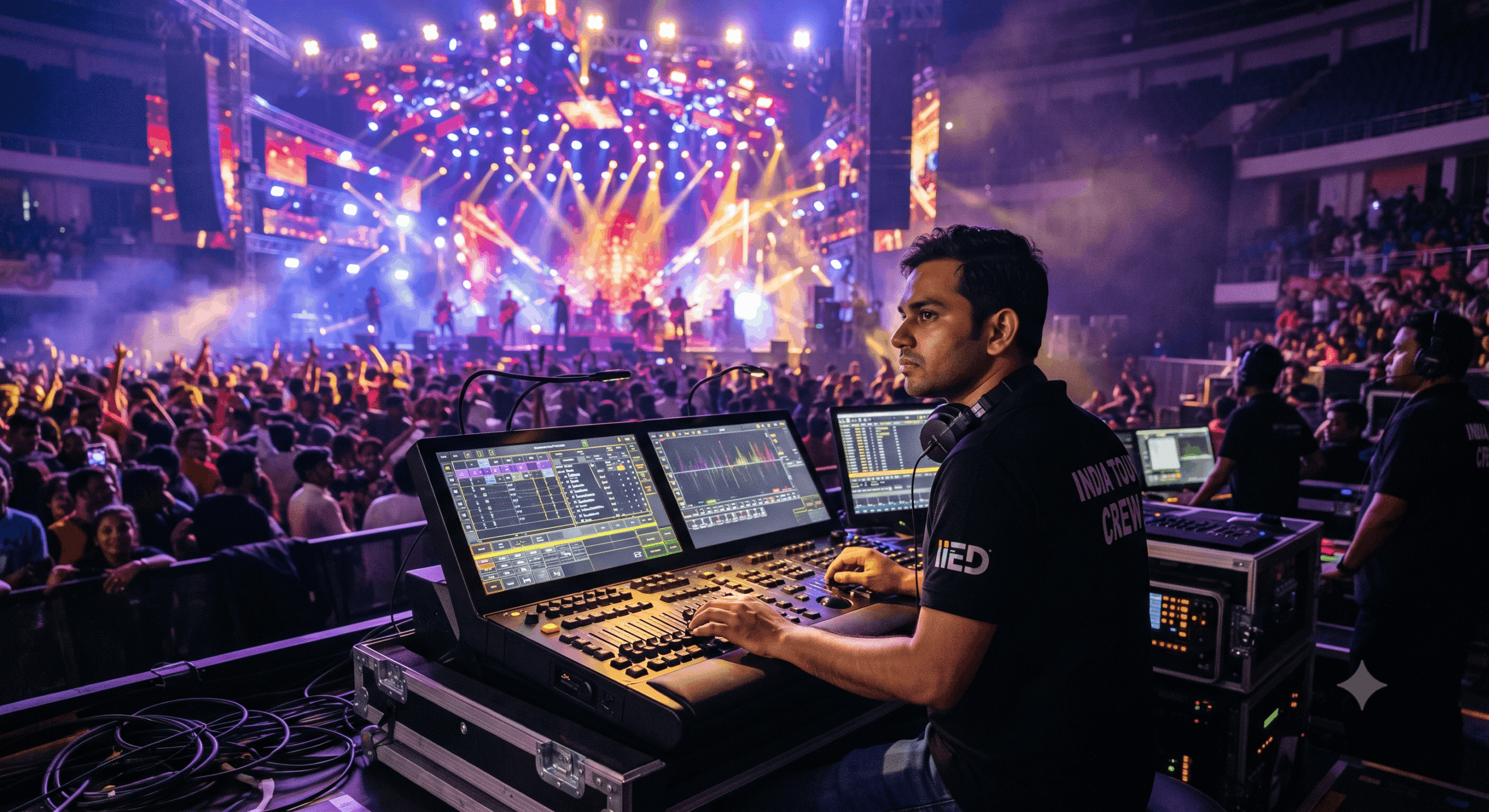
Most students picture a touring concert lighting designer as someone who walked straight onto a big stage. A lighting rig fills the arena, the crowd roars, and the name on the credits says “Lighting Designer.”
That picture hides the years before it. Nobody gets handed a tour. Every touring concert lighting designer in India started lower down: loading trucks, patching cables, running a console for a small show, then programming for someone else. Then, and only then, came the design credit.
This post gives you the real ladder. You will see what each step involves, which skills touring teams expect, where the first break comes from, and where a hands-on programme shortens the climb. If you are a graduate exploring a creative career, or already work in audio, video or rental crews and want to move into lighting, this is for you.
Table of Contents
What touring really means (and why India has so few trained people for it)
A tour is not one big event. It is the same show, repeated in different cities, night after night. The crew arrives, builds the rig, focuses it, runs the show, packs it down and moves on.
That changes what the job asks of you. A one-off event, like a wedding or a corporate launch, lets you build, adjust and fix things over several days. A tour does not. The show file must work in every venue. The crew must set up fast. Problems get solved in minutes, not hours.
It also changes who gets hired. Tour managers want people who are calm under pressure, know their console, and do not need hand-holding. They hire for reliability first and creativity second.
Here is the gap. Live entertainment in India is growing, but most training in the country teaches event management: budgets, vendors, logistics. Very few places teach you to program a console, read a lighting plot and run a show. GrandMA3 operators in India are extremely rare, and demand is far bigger than supply. That gap is your opening.
If you are still deciding whether lighting is the right path, read the five levels of a lighting career first. It lays out the whole field. This post zooms into one branch of it: live tours.
The real ladder: assistant, operator, programmer, designer
Think of touring lighting as a four-step ladder. You cannot skip steps, but you can move through them faster with the right training.
[DIAGRAM: a flat, minimal four-step ladder labelled Assistant, Operator, Programmer, Designer, in orange and purple on a white background, with a simple stage truss outline at the top. Alt text: “Four-step ladder from assistant to touring concert lighting designer in India”]
Step 1: Assistant or lighting technician
This is where almost everyone starts. You load in, rig trusses, run cable, patch fixtures, replace lamps and fix faults. You learn how a real rig goes together, how long things take, and what goes wrong at 2 a.m. before a show.
It is physical, fast and unglamorous. It is also the best classroom there is. You watch how the programmer and designer work, and you learn the language of the crew. Good technicians get noticed because they are early, careful and calm.
Step 2: Console operator
The operator runs the show live. You press the buttons when the cues come. On some shows, the operator plays the lighting like an instrument, following the performer in real time. On others, you run a programmed show cue by cue.
To get here, you need to know your console well enough to trust your hands. You must know how to recover when something goes wrong mid-song. Operators are valued for steadiness. A show that runs clean every night builds your reputation quickly.
Step 3: Programmer
The programmer turns the designer’s ideas into a working show file. You patch the fixtures, build the palettes and effects, record the cues and refine them in rehearsal. The designer says, “I want this to feel like sunrise.” You make it happen on the console, quickly.
This is the technical heart of touring. A strong programmer is hard to replace, so the best ones get called again and again. For concert tours, the console that matters most is GrandMA3, which is the industry standard. Learn it deeply and you become useful to almost every touring team. If you are unsure which desk to start with, read which console to learn first.
Step 4: Lighting designer
The designer decides how the show looks. You read the music, talk to the artist and production team, draw the plot, choose the fixtures and shape the mood across the whole set. You also manage the budget and the crew.
Design credits come last because they carry the most trust. A producer who hands you a tour is betting on you not to fail in front of thousands of people. You earn that trust by having done every job below you.
Some people never leave step 3, and that is a fine career. A senior programmer can earn respect and steady work. Know where you want to end up, but do the steps properly.
Skills touring teams expect before they hire you
Touring crews do not have time to teach basics. Here is what they expect you to arrive with.
Console programming, especially GrandMA3
This is the biggest one. You should be able to patch a rig, build groups and presets, write cues, run effects and manage a timeline without opening a manual. Practise on a real console, not only on the free software. Real hardware teaches you speed and muscle memory that a laptop does not.
The manufacturer’s own pages are a good starting point for learning how the system is organised: see the official GrandMA3 overview from MA Lighting. If you want structured, hands-on practice in Mumbai, look at the MA in Lighting Design at IIED.
DMX and networking basics
Modern rigs run on data. You need to understand how DMX works, how universes are numbered, and how a network carries that data to fixtures. When a fixture goes dark mid-show, someone has to work out whether the fault is the fixture, the cable, the node or the settings. That someone is you.
Fixture knowledge
Know the difference between a spot, a wash, a beam and a strobe, and when each one earns its place. Know what a fixture can and cannot do before you promise it to a designer. Read the fixture manuals. Most people do not, and crews notice the ones who do.
Reading plots and CAD drawings
A lighting plot is the map of the whole rig. It shows where every fixture hangs and what it is for. You should read one quickly and, ideally, draw one. Tools like Vectorworks Spotlight are widely used for this. If you can draw your own plots, you stand out from people who can only operate.
Working to a show timeline
Touring runs on schedules. Load-in at noon, focus at three, soundcheck at five, doors at seven. You need to finish your part on time, say early when you are behind, and stay calm when plans change. This is a professional habit more than a technical skill, and it is what gets you called back.
Teamwork and clear communication
Crews are small and the hours are long. People who communicate clearly, take feedback well and help others without being asked get hired again. People who sulk or take shortcuts do not. Skill opens the door. Attitude keeps you in the room.
Where the first break actually comes from
Almost no one gets their first break from a job ad. It comes from people. Here are the categories of places to look. These are types of employers, not specific company names.
Lighting rental companies
Rental houses supply the gear for concerts, weddings and corporate shows. They always need people to prep, load and run equipment. It is one of the most common entry points. You learn the gear, you meet designers and programmers when they collect equipment, and you get sent on shows.
Production houses
Production companies run the full show, with sound, lighting, video and staging under one roof. Working here exposes you to how all departments fit together. That helps later when you work with a tour’s production manager.
Mentor-led design studios
Some designers run small studios and take on trainees. You carry gear, program for them and watch how they design. This route is slower to start but gives you direct feedback, which is rare and valuable.
Freelance crew calls
Many shows hire freelancers through word of mouth and WhatsApp groups. Once a few designers and production managers know you are reliable, calls start coming. Be known as the person who turns up on time, works hard and stays calm.
Abroad and at sea
Indian lighting professionals also find work overseas, on cruise ships and in international venues. The alumni stories below show this is a real path, not a rumour.
Whichever door you use, the pattern is the same. Show up, do the small jobs well, and make it easy for people to recommend you.
Real IIED alumni who made the jump
Here is what these steps look like in real careers. These are IIED alumni, and the details come from their own accounts.
Jude Pereira: from medical studies to Disneyland Hong Kong
Jude left medical studies to pursue lighting. After training in lighting design at IIED, he now works as an Event Designer and Lighting Technician at Disneyland Hong Kong. In his own words: “My journey proves that with the right mentorship, you can turn an unconventional path into a world-class career.” His path shows that an unconventional start does not close the door.
Cajetan D’Silva: lighting for international productions
Cajetan learned lighting during the COVID lockdown through IIED’s hands-on lighting training. He now works on lighting for international productions with Royal Caribbean Cruise Line. Large productions at sea are a real route for Indian lighting professionals.
Atharv Devikumar Jog: already working, but missing the foundation
Atharv already worked in lighting but lacked a technical base. After training at IIED, he joined SLS Production Equipment L.L.C in Saudi Arabia as a Lighting Operator in August 2025. In his words: “Joining IIED allowed me to dive deep into the intricate details and technicalities of light, which completely transformed my professional perspective.”
Vinith: from sound engineer to lighting designer
Vinith started as a sound engineer and switched to lighting. He turned down an offer from a global production company to work directly with his mentor, Lloyd Albuquerque, at LGL Designs. He says: “Now I’m designing light for the biggest stages alongside the very person who taught me the craft.” If you work in audio, video or rental crews today, his story shows your existing skills can move across.
Shreeharsh: from gear provider to designer
Shreeharsh already owned a lighting rental company in Pune. He wanted to understand the “why” behind the light. He says: “I don’t just rent out lights — I design and execute high-end experiences that have elevated my company’s reputation.” This is the gear-provider-to-designer route.
A fair note: these stories show the ladder in action. They do not promise that every student will tour with a named artist. No honest programme can promise that. What a good programme can do is give you the skills, practice and mentor feedback that make the climb faster.
What your portfolio and show file should show a touring team
When you reach out to a designer, rental house or production manager, they want proof, not promises. Here is what to put in front of them.
A clean show file
Build a complete show on your console and keep a copy. It should be tidy: clear names, organised groups and presets, sensible cue lists. A messy file tells a programmer you do not think like a professional. A clean one tells them you can be trusted with their show.
Plots and drawings
Include two or three lighting plots you drew yourself, even for imaginary shows. They show you understand how a rig is laid out and how fixtures are chosen. Add a short note on why you made each choice.
Video of your work
Record your programmed shows. Short clips, labelled clearly, are enough. Show a range: a slow ballad look, a high-energy chase, a tricky transition. Include what you did on each, such as “programmed and operated” or “designed and programmed.”
Honest credits
List what you actually did. If you assisted, say assisted. If you operated, say operated. The lighting community is small, and false credits are found out fast. Honest credits build trust.
Keep your portfolio updated as you grow. A portfolio that stops at your course project tells people you have stopped learning.
Common mistakes that slow people down
Skipping console practice
Watching videos is not the same as running a console. Many beginners watch hours of tutorials and never touch a desk. Then they freeze at the first live job. Get hands-on time, and get a lot of it.
No plots in the portfolio
Some people show only photos of lit stages. A photo shows the result, not your thinking. Plots show that you can plan.
Expecting a design credit on day one
Nobody hires a first-timer to design a tour. If you refuse to load trucks or run cable, you will wait a long time. Accept the early steps and use them to learn.
Ignoring the basics of data and networking
Fancy looks mean nothing if the rig will not talk to the console. People who understand DMX and networking solve problems that stop others cold.
Being hard to work with
Talent matters, but crews choose the person they enjoy working with at 3 a.m. Be on time, listen well and help others.
Waiting for the perfect opportunity
Many people wait for a big tour to call. Take smaller shows. Every show builds your hands, your reputation and your contacts.
What a hands-on lighting programme covers that YouTube cannot
YouTube is a good place to start. It is free, and some creators explain things very well. But it cannot do three things.
First, it cannot put a real console under your hands. IIED trains students on actual consoles — GrandMA3, Avolites Titan, Capture and Vectorworks Spotlight — so you build speed and confidence before you reach a live show.
Second, it cannot give you feedback. When you program a look wrong, a video does not tell you why. At IIED, real industry mentor Lloyd Albuquerque, a Light Director, reviews your work and shows you how professionals think. That kind of correction saves months of trial and error.
Third, it cannot connect you to the industry. IIED shares verified career outcomes from real alumni and real companies, and supports students as they look for their first break.
The MA in Lighting Design at IIED is built around this hands-on approach: two years, four semesters, full-time, open to any graduate. The first semester covers the fundamentals of light, vision and colour, electrical systems and power, trussing, rigging and structural safety, and a hands-on power, cabling and fixtures lab. The second semester moves into fixtures, sources and optics, control systems, DMX and networking, and the full lighting design process, alongside a design and documentation studio project — plus a supervised industry internship. Batches are kept small, so you get personal attention. IIED is the only institute in Mumbai that teaches event design, lighting and production together, which helps you understand the whole show and not just your own corner of it.
If you already work in lighting and want a sharper technical base on the console itself, you can pair the programme with the GrandMA3 Mastery Program. For current fees, intake details and how to apply, see the MA in Lighting Design course page. For a look at a related topic, see the five levels of a lighting career.
No programme replaces experience on real shows. What a good programme does is shorten the distance between where you are and where crews will take you seriously.
Your next step
The ladder is real, and people are climbing it from India right now. You do not need to be born into the industry. You need console skills, a clean portfolio, a good attitude and someone to show you how professionals work.
Come and see the classroom, the consoles and the mentors for yourself. Book your free visit to IIED at Shop No. 506, 5th Floor, Magic Square, Dwarkadish Road, off Poddar Road, Malad East, Mumbai 400097, or call 9892966334.