
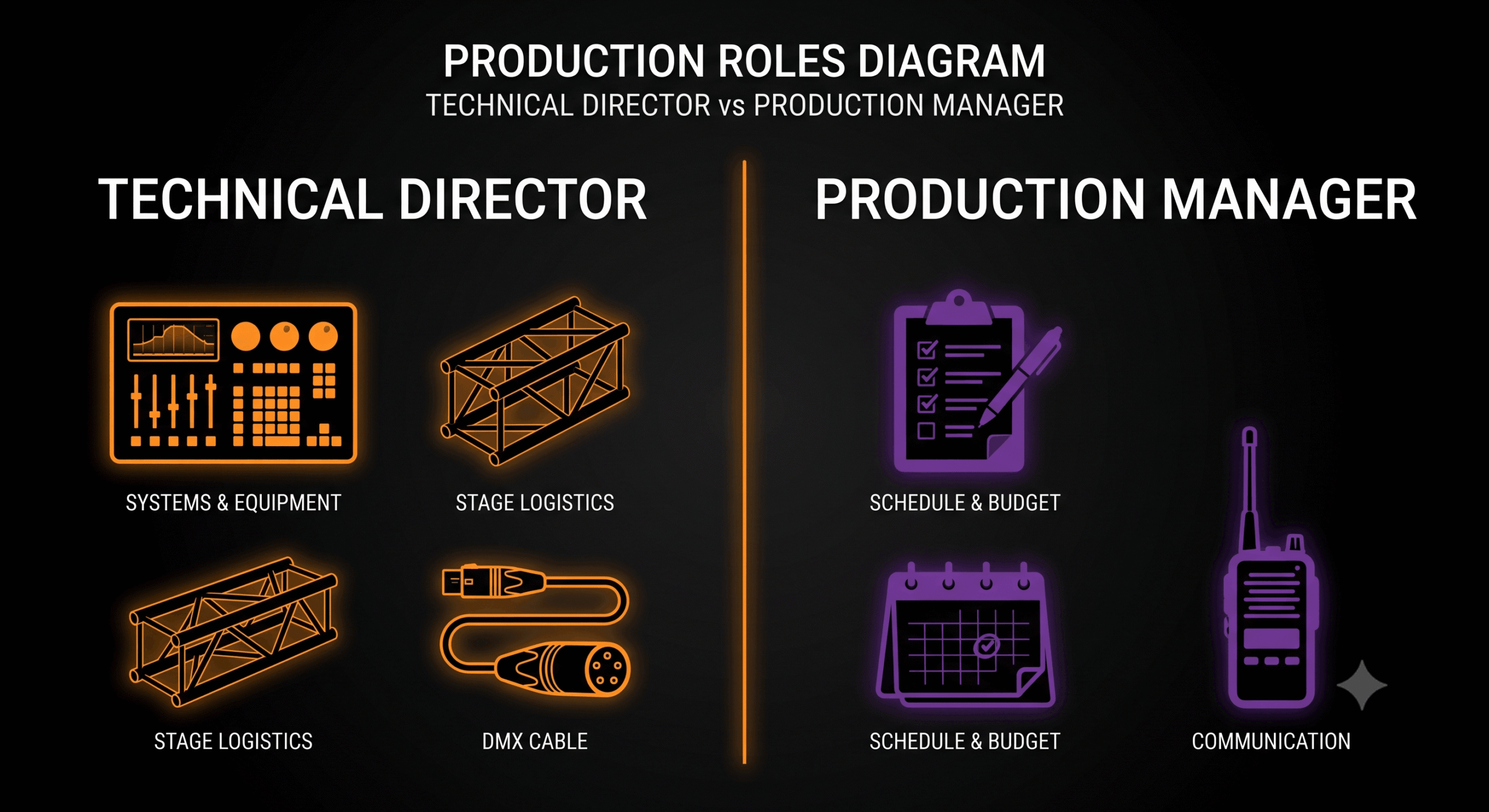
Every event management course throws around job titles like “Technical Director” and “Production Manager” as if they mean the same thing. They don’t. On an actual show day, the technical director vs production manager distinction decides who you report to, what you’re allowed to touch, and what you’re personally responsible for if something goes wrong at 7 PM with doors opening in ten minutes.
This gap is exactly why so many event management graduates can describe a show beautifully but can’t run the technical side of one. They know the vocabulary of coordination — timelines, vendor calls, guest lists — but not the vocabulary of production: who owns the rig, who owns the show flow, who signs off on the technical drawings before a truss goes into the air.
This post draws a clear, practical line between the two roles. What each one owns during load-in, show, and strike. How people actually get hired into each track in India. And which specific skills — console programming, CAD, rigging, technical drawings — build a real path toward becoming a Technical Director instead of stalling out as a coordinator who never quite makes the jump.
Table of Contents
What Does a Technical Director Actually Do on Event Day?
A Technical Director, or TD, owns the technical execution of the show. Not the paperwork around it — the actual physical and technical result. If lighting, sound, video, rigging, or staging don’t work, that’s the TD’s problem to solve, not someone else’s to escalate. This is consistent with how organisations like the United States Institute for Theatre Technology (USITT) define the role across live production and theatre: technical ownership, not administrative oversight.
During load-in, the TD is on site before almost anyone else. They walk the venue against the technical drawings, confirm power distribution, check rigging points against the venue’s load charts, and brief the technical crew — lighting techs, audio engineers, video operators, riggers — on the day’s plan. If a truss position doesn’t match the CAD drawing, the TD makes the call on the fix, right there, without waiting for a meeting.
Through the show, the TD is the person other technical department heads report to when something breaks. A moving light loses DMX signal mid-cue, a video feed drops, a wireless mic starts cutting out — the TD is troubleshooting in real time, often standing at the lighting or sound console themselves. On many mid-sized Indian productions, the TD is also the person programming the show on a console like GrandMA3, not just supervising someone else doing it.
At strike, the TD manages teardown in reverse order of load-in — video and audio come down before rigging, rigging comes down before the last truss leaves the venue — and confirms nothing goes back to the rental vendor damaged or missing. The TD signs off on the technical side of the show being genuinely finished, not just packed into a truck.
The throughline: a Technical Director’s authority comes from technical knowledge. They can read a lighting plot, understand a rigging load chart, operate or troubleshoot a console, and read a CAD drawing well enough to catch a problem before it becomes a safety issue. That’s not a skill you pick up from an event coordination syllabus. It’s trained separately, on the actual equipment.
What Does a Production Manager Do That a Technical Director Doesn’t?
A Production Manager, or PM, owns the schedule, the budget, and the people — not the equipment. Where the TD is asking “will this rig hold and will this cue fire,” the PM is asking “are we on schedule, is everyone paid, and does the client know what’s happening.”
During pre-production, the PM builds the production schedule: load-in call times, rehearsal windows, show time, strike time, and every vendor deadline in between. They negotiate contracts with vendors — lighting rental houses, sound companies, staging suppliers — and manage the budget across all of them. If the TD needs an extra truss of moving lights the day before the show, it’s the PM who has to find the money and get vendor approval, fast.
On event day, the PM runs the room, not the rig. They manage crew call times, coordinate between departments that don’t naturally talk to each other — catering, security, the client’s own team, the technical crew — and are the first point of contact when the client wants a change. If the client decides at 4 PM that they want the stage moved six feet, the PM is the one negotiating whether that’s realistic, and if it is, coordinating with the TD on how it actually gets done.
At strike, the PM is managing logistics: confirming trucks are booked, crew is released on schedule, and vendor equipment is returned and reconciled against the rental contract. The PM’s sign-off is commercial and logistical — everyone got paid, everything got returned, the budget closed within range.
The core difference in one line: a Technical Director is responsible for whether the show works technically. A Production Manager is responsible for whether the show happens on time, on budget, and without a logistics disaster. Both roles are essential on any real production. Neither one can do the other’s job without the other’s specific training.
Technical Director vs Production Manager: The Real Difference in India’s Live Event Industry
In India, this confusion runs deeper than most markets, mostly because event management education here has historically trained people for the Production Manager track — coordination, vendor management, timelines — while leaving the Technical Director track almost entirely to on-the-job learning in AV rental companies and production houses.
That’s a real gap and a real opportunity. IIED’s placement data shows GrandMA3 operators are extremely rare in India — demand for people who can genuinely program a console at a professional level far outstrips supply. That scarcity is exactly what pushes someone from “console operator” toward “Technical Director” faster in India than in more saturated markets, because production houses are actively hunting for people who can do both the technical work and start owning technical decisions.
The Production Manager route, by contrast, is more crowded. Most event management graduates in India are trained, at least loosely, for coordination-style roles. That’s not a bad career — it’s a real, necessary one — but it means the technical track is where the differentiation actually is right now for anyone willing to put in the console hours, the CAD hours, and the rigging fundamentals.
This is also why the two roles get confused on Indian job listings. A posting titled “Production Manager” at a mid-sized company might actually expect basic lighting console knowledge. A posting titled “Technical Director” at a smaller outfit might still expect some budget and vendor coordination. Titles aren’t standardized here the way they are in bigger international production houses. What matters is knowing, concretely, which skills belong to which track — so you can tell in an interview which job you’re actually being offered.
Company size changes this too. At a large production house working stadium shows or major weddings, the Technical Director and Production Manager are separate people, often with teams under each — a lighting head, an audio head, and system technicians reporting up to the TD, while coordinators and vendor liaisons report up to the PM. At a smaller outfit doing club shows or mid-sized corporate events, one person often does both jobs badly instead of one job well. Knowing the real difference is what lets you walk into a smaller company and specifically offer to own the technical side, rather than getting handed a vague “production” title that quietly expects you to juggle both. If you’ve been sorting through similarly confusing job titles, our breakdown of Set Designer vs Art Director covers the same problem on the design side of the industry.
Can You Become a Technical Director From an Event Management Background?
Yes — but not by staying inside event management theory. It happens through a specific, deliberate switch onto the technical skill track, and IIED has real, verified examples of exactly this happening.
Silas Paul Uba came into lighting from audio mixing and media production, not from a technical theatre background. After training in lighting design, he was placed as Technician – Lighting (Grade B) at LumaSonic Structures Rental Pvt. Ltd. in Goa in September 2025, at ₹25,000 a month plus medical insurance, personal accident insurance, telephone allowance, tools, and uniform. That’s the entry rung on the exact ladder that leads toward Technical Director — not a design-only job, a technical operations one, with real benefits attached to prove it’s a structured, professional role, not freelance gig work.
Aron Sagar, a graduate of IIED’s CAD for Events & Entertainment course, was placed in the Operations & Production department at NMACC — the Nita Mukesh Ambani Cultural Centre in BKC, one of the most significant performance venues in the country. That’s proof that a technical documentation skill — reading and producing CAD drawings — leads directly into production-side roles at major venues, not just design studios.
Both of these are event-and-lighting-adjacent stories, not proof that theory alone gets you there. What moved Silas and Aron onto the technical track was specific, hands-on training: console time, technical drawing practice, rigging fundamentals. If you’re an event management graduate who can talk fluently about mood boards and guest experience but has never touched a lighting console or produced a technical drawing, that’s the exact gap standing between you and a Technical Director track — and it’s a closeable one.
How to Start: The Real Skill Path to Each Role in India
The two tracks require genuinely different training. Trying to build both at once, without focus, is how people end up stuck as permanent coordinators who never get handed real technical authority.
The Technical Director Track: Console, Rigging, and System Skills
The core skill is console programming — specifically on GrandMA3, which dominates mid-to-large Indian productions and international touring shows. IIED’s GrandMA3 Mastery Program lists Technical Director as a direct career outcome, alongside Lighting Designer, Console Operator, System Technician, and Lighting Programmer — because console fluency is the foundation the TD track is built on, not a side skill. If you’re weighing whether that kind of console training is realistic to pick up, our honest breakdown of whether GrandMA3 is hard to learn walks through a real 74-hour timeline.
Alongside the console, a future TD needs to read and produce technical drawings — rigging plots, power distribution plans, venue floor plans. IIED’s Vectorworks Spotlight for Event Production course also lists technical director among its career outcomes, because venue documentation is core TD territory: you can’t sign off on a rigging point being safe if you can’t read the load chart and the drawing it’s based on.
Rigging fundamentals — understanding load limits, truss configurations, and how a venue’s grid actually works — round out the technical foundation. This is the part of the job event management theory never covers, because it’s genuinely a different discipline: closer to technical theatre and structural safety than to hospitality or coordination.
The Production Manager Track: Scheduling, Budgets, and Vendor Coordination
The PM track leans on project management skills applied specifically to live events: building realistic production schedules, negotiating vendor contracts, managing budgets across multiple departments, and communicating clearly under pressure when a client changes their mind three hours before doors open.
This is closer to what most Indian event management courses already teach — which is exactly why the PM track is more crowded, and why building genuine technical literacy on top of it (even without going full TD) makes a Production Manager significantly more valuable. A PM who understands what a rigging point actually is, or why a lighting console reprogram takes two hours and not twenty minutes, negotiates better with technical vendors and makes fewer unrealistic promises to clients.
Who This Path Is For
If you’re an event management student or graduate who’s realized you can describe a show but can’t run its technical side, the TD track is worth a serious look — especially given how few genuinely trained console operators exist in India right now. If you’re already working in AV, lighting, or production and deciding which ladder to climb — technical or managerial — the honest answer depends on what you enjoy doing at 2 AM during a load-in: solving a rigging problem, or solving a schedule problem. Both are real careers. Only one is taught almost nowhere in standard event management education, which is exactly why it’s the harder, more valuable skill to go build on purpose.