
If you’ve spent years behind the curtain — building sets, reading a stage, solving space problems under a tech-week deadline — you already have real design instinct. The question most people with a theatre or backstage background ask is simple: do these set design skills that transfer between theatre and events actually count outside a playhouse? The honest answer is yes, but only partly. Some of what you learned in theatre carries over directly into weddings and corporate events. Some of it doesn’t, and pretending otherwise is how people stay stuck freelancing instead of getting hired.
This isn’t a pitch that theatre experience is “basically the same job” as event design. It isn’t. Theatre teaches you to see space, tell a story through it, and work with a crew under pressure — that part transfers cleanly. What doesn’t transfer automatically is the technical and commercial layer that weddings and corporate events run on: CAD drawings, Vectorworks documentation, rigging and trussing safety standards, and vendor budgeting at a professional scale. That’s the specific, teachable gap. Here’s what carries over, what doesn’t, and what a realistic path from theatre to a paid design career actually looks like.
Table of Contents
What Set Design Skills Actually Transfer From Theatre to Events
Start with what you already have, because it’s more than most people give themselves credit for.
An eye for space. Theatre trains you to think in three dimensions before a single flat goes up — sightlines, scale, how a room reads from every seat. That instinct doesn’t disappear the moment you leave a proscenium arch. A wedding mandap or a corporate stage still needs someone who can look at an empty hall and know exactly how it should feel once it’s full.
Storytelling through design. A set designer in theatre isn’t decorating — they’re supporting a narrative. Colour, texture, and structure all serve the story being told on stage. Corporate events run on the same logic: a product launch has an arc, a brand message, a moment the whole room is built around. Wedding design works the same way, just with a different story — the couple’s, not a script’s.
Working with materials, under real constraints. Theatre teaches you to build with what’s available, on a budget, on a deadline, often overnight between shows. That resourcefulness is exactly what gets tested on a live event load-in, where a truck is late, a vendor short-ships, and the show still has to go up on time.
Coordinating a crew under pressure. Anyone who has run a tech week knows what it means to direct a team through a build with no slack in the schedule. Event production runs on the same skill — get the right people doing the right task, in the right order, with a hard deadline that doesn’t move.
These four things are the real, transferable core. They’re also exactly what separates someone who can design a space from someone who can only coordinate one — a distinction we go into in more detail in event design vs event management. Theatre gives you the design half. What it doesn’t automatically give you is the second half: the technical and commercial skills events specifically demand.
What Doesn’t Transfer Automatically: The Technical Layer You Need
This is the part most theatre-background candidates underestimate, and it’s the actual reason talented people with real design instinct get passed over for production roles.
CAD and Vectorworks documentation. Theatre set builds are often designed on paper, in a model box, or worked out directly with a technical director in the room. Commercial events don’t run that way. A wedding designer or corporate production house needs drawings a vendor, rigger, and venue can all read without you standing there to explain them — floor plans, elevations, load calculations, all produced in software like Vectorworks or AutoCAD. This is the single biggest skills gap between theatre-trained talent and hireable event production talent, and it’s covered in full in our CAD for Events & Entertainment course.
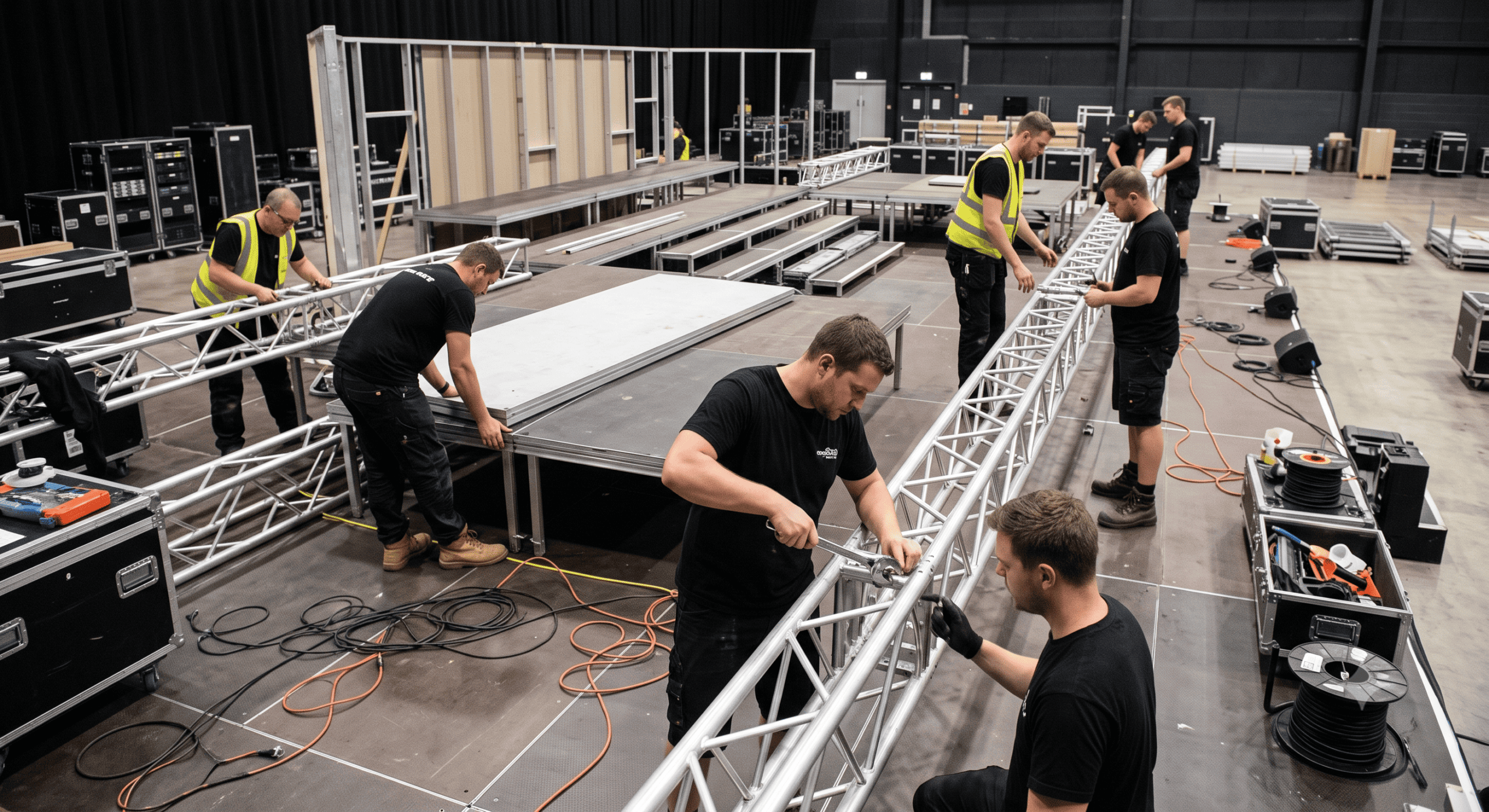
Rigging and trussing safety standards. A theatre fly system is a fixed, permanently engineered structure, inspected and maintained by the venue. A corporate stage or wedding structure is usually temporary — trussing and rigging assembled fresh for a single event, in a space that wasn’t built for it. That means understanding load limits, ground support versus flown structures, and the safety documentation that professional production houses require before they’ll let you near a rig. This isn’t optional knowledge. It’s the difference between a structure that’s safe to stand under and one that isn’t.
Vendor budgeting at commercial scale. Theatre budgets are usually fixed and internal — a production budget set by the company, worked within by the design team. Wedding and corporate event budgets involve external vendors: florists, structure fabricators, lighting and AV houses, furniture rental, each quoting separately, each needing to be negotiated, sequenced, and kept inside a client’s number. Managing that isn’t the same skill as managing a scene shop budget, and it’s rarely taught anywhere except on the job — or in a structured course built around real vendor workflows.
Client-facing design presentation. A theatre designer presents to a director and a production team who already speak the same visual language. A wedding or corporate client usually doesn’t. Being able to translate a design concept into renders, mood boards, and a walkthrough a non-designer can approve with confidence is its own skill — one that gets built through repetition, not instinct alone.
None of this means starting from zero. It means treating the technical layer as exactly that: a layer to add on top of design instinct you already have, not a replacement for it. That’s a matter of weeks of focused, hands-on training, not years of relearning a craft.
Theatre vs Wedding vs Corporate Events: What Changes Stage to Stage
The set designer’s job changes shape depending on which stage you’re building for. Understanding what shifts helps you see exactly where your existing skills fit — and where they need reinforcement.
Theatre Set Design
Built around a fixed script and a repeatable show. The set has to survive multiple performances, scene changes, and technical rehearsals. Design decisions serve the story first, the audience’s read of the room second. Budgets are internal, timelines are long by event standards, and the structure is usually a known, controlled venue.
Wedding Set Design
Built around one couple, one date, one emotional outcome, with zero margin for a second attempt. Every structure — mandap, stage, backdrop — is temporary, assembled and struck within hours. The client isn’t a director; it’s a family with a vision and a budget that needs managing, not just spending. Materials lean decorative — florals, drapery, lighting — but the underlying structure still has to be engineered and rigged safely.
Corporate Event Set Design
Built around a brand message and a business outcome — a launch, a conference, an anniversary. The design has to work for a camera and a livestream as much as for the room, because most corporate events are recorded or broadcast. Budgets are negotiated with a marketing or events team, timelines are tight, and the vendor coordination is heavier — AV, lighting, staging, and branding all need to move in sync.
What stays constant across all three is the underlying discipline covered earlier in this piece: reading space, telling a story through structure, and running a crew against a deadline. What changes is the client, the constraints, and the technical documentation each format demands — a distinction worth understanding fully, which is why we’ve written about the terminology split in set design vs production design.
Real Placements: Theatre-Adjacent Talent Now Working in Events
This isn’t theoretical. IIED students with backgrounds close to theatre and performance venues have moved into paid, professional event design roles — not by abandoning their instinct, but by adding the technical layer on top of it.
Pranay Mhatre completed IIED’s Event & Wedding Design Visualization course and was placed as a Production Designer at WIZCRAFT International — India’s oldest and largest event company. It’s the strongest single proof point that real production and set design skill gets you into the top tier of the Indian events industry, not just entry-level coordination work.
Aron Sagar, a graduate of IIED’s CAD for Events & Entertainment course, was placed in the Operations & Production department at NMACC — the Nita Mukesh Ambani Cultural Centre in BKC, Mumbai, one of the country’s most prestigious performance and cultural venues. His placement sits exactly at the intersection this article is about: a performance-venue environment that runs on professional, technical production skill.
Varun Jain moved from Jodhpur’s wedding industry to Mumbai specifically to master the technical side of design at IIED. He was placed as a Design Associate at The Finale Eventz, starting at ₹45,000 per month on probation and rising to ₹50,000 per month once confirmed. Varun already had an eye for design from years in weddings — what he was missing, and what IIED closed, was the technical layer. It’s the same gap this article has been describing, just from the wedding side rather than theatre.
Kshiti Jain, an event management graduate, found that coordination training alone wasn’t enough to break into wedding design work. IIED gave her the design foundation she was missing, and she went on to start her own event design company. Her story is a direct warning for anyone assuming general event experience — coordination, logistics, planning — automatically equals design skill. It doesn’t. Design is a separate, teachable craft, whether you’re coming from theatre or from event management.
Four different starting points — top-tier production, a prestigious cultural venue, the wedding industry, and event management — and the same underlying pattern: real instinct plus a structured technical foundation gets you hired. Neither one alone tends to be enough.
Is This Career Path Right for You?
This path fits two kinds of people especially well.
The first is someone with genuine backstage or theatre experience — stage crew, college theatre, amateur productions — who assumes that experience only “counts” inside a playhouse. It doesn’t. If you can already read a space and solve a build problem under pressure, you’re closer to a paid design career than you think. What you need isn’t a new instinct. It’s the CAD, rigging, and budgeting layer this article has laid out.
The second is someone stuck after an event management degree, possibly with theatre society or college fest experience in their background, wondering whether any of it is worth anything without formal technical training. It is — but as Kshiti Jain’s story shows, coordination experience alone won’t get you hired for design work. You need the same technical foundation, built specifically for design rather than logistics.
This path is less suited to someone looking for a quick add-on skill with no interest in the technical side — CAD, safety documentation, and vendor budgeting aren’t optional extras here, they’re the actual job. If reading a rigging plot or building a floor plan in Vectorworks sounds tedious rather than interesting, production and set design may not be the right lane, even with strong creative instincts.
Worth noting for context: India’s live events market is growing fast enough that this isn’t a bet on a shrinking industry. A BookMyShow–EY–Parthenon report published in 2026 put India’s live events market at roughly ₹13,000 crore, with the sector shifting toward more premium, experiential formats — exactly the kind of work that needs trained production and design talent, not just event coordinators. (Source: EY newsroom, 2026.)
If you’ve got theatre or backstage experience and want to know exactly which skills you already have and which ones you’re missing, book your free visit to IIED’s Malad East studio. Bring your questions — Raj will walk you through exactly what the technical layer involves and whether this path fits where you want to go.