
Most people say “I want to work in lighting” without knowing they are actually applying for one of three very different jobs. A lighting designer, a lighting programmer and a lighting operator sit on the same show, use some of the same tools, and get paid very differently for very different work. Recruiters know the difference between these titles precisely. Most applicants don’t. That gap is why a lot of genuinely talented people get passed over for a job they were actually qualified for, just with the wrong words on their resume.
This guide breaks down what a lighting operator actually does on console during a live show, what a lighting programmer does that an operator can’t, and what separates a lighting designer from both. Read it as a career ladder, not a ranking. An operator with the right training can become a programmer. A programmer with design instinct can become a designer. Real IIED students have made every one of these moves, and their placements are below.
Table of Contents
Why the Confusion Between These Three Jobs Costs You the Interview
A production house posting a job for a “Lighting Programmer” is not looking for the same skill set as a house posting for a “Lighting Operator,” even though both job ads will mention a console, both will mention GrandMA3, and both will sound similar to someone outside the industry. Recruiters in live events write job descriptions with these titles on purpose. If you apply to a programmer role with only operator-level skills, you don’t get an interview. If you apply to an operator role over-qualified as a designer, you get passed over for being the wrong fit at the wrong pay grade.
This is the single biggest confusion event management graduates and career switchers walk into. They know they love lighting. They don’t know which of the three jobs they’re actually trained for, or which one they should be training toward next. Getting this right before you apply is the difference between a fast “yes” and months of silence.
What a Lighting Operator Actually Does
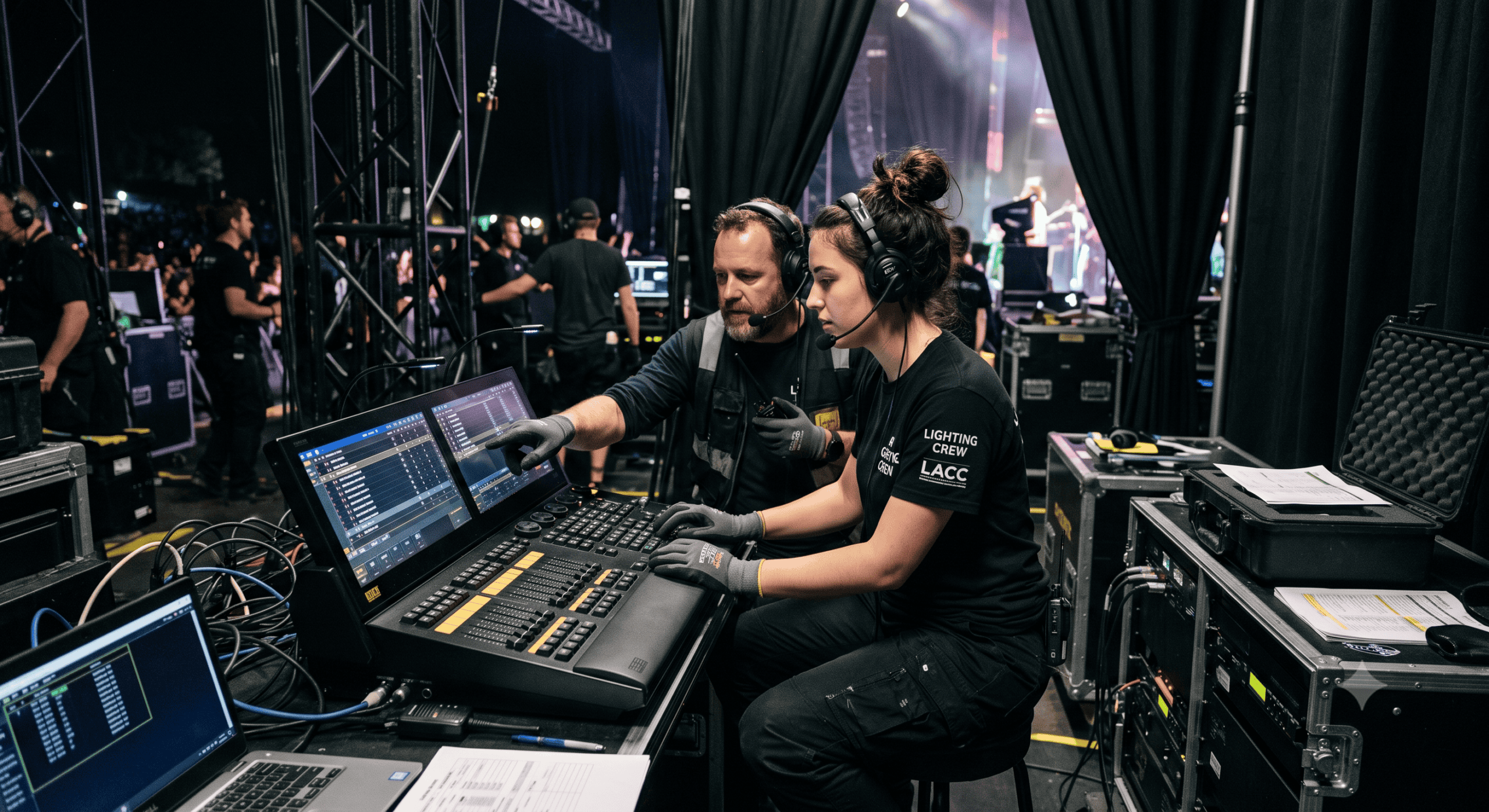
Think of the lighting operator as the person who makes a show happen in real time. The design is already built. The cues are already programmed. The operator’s job is to execute — pressing “go” at the right moment, tracking the show as it runs, catching a late entrance or a missed cue and recovering without the audience noticing. On a touring show or a wedding stage, the operator is often the only person on the console once the show starts.
This is not a lesser job. It is a live, high-pressure, technical role that demands total focus for the length of the show. What it doesn’t require, at entry level, is deep programming knowledge or design theory. It requires precision, calm under pressure, and a working knowledge of the console you’re running.
Atharv Devikumar Jog is a real example of this stage of the ladder. He was already working in lighting before he came to IIED, but lacked the technical foundation recruiters look for. After completing IIED’s One Year Program in Lighting Design, he was placed as a Lighting Operator with SLS Production Equipment L.L.C in Saudi Arabia in August 2025, on SAR 10,000 a month plus company accommodation, a return flight and transportation. That’s what a trained operator’s first placement can look like — real technical skill, verified by a real offer letter, not a promise.
What a Lighting Programmer Actually Does
The lighting programmer sits between the operator and the designer, and this is the role most people searching for a lighting programmer career in India don’t fully understand yet, mostly because very few Indian training programs teach it directly. A programmer’s job is to take a designer’s vision — the mood boards, the cue sheets, the verbal direction in a production meeting — and turn it into exact console data. Every fade time, every colour value, every position on a moving light gets built by the programmer before the operator ever presses go.
This is a technical-creative bridge role. You need to understand a console at a depth an operator doesn’t — patching, groups, presets, effects engines, timing — while also understanding enough about light, colour and composition to translate a designer’s intent accurately. On larger shows, the programmer works directly with the designer during tech rehearsals, building the show live as ideas change in the room.
Silas Paul Uba shows how this stage of the ladder actually plays out. He started his career in audio mixing and media production, then made the switch into lighting through IIED. In September 2025, he was placed as a Technician – Lighting (Grade B) with LumaSonic Structures Rental Pvt. Ltd. in Goa, on ₹25,000 a month with medical insurance, personal accident insurance, and tools and uniform provided. His previous production background became an asset, not a setback, once he had the technical lighting skill to go with it.
Lighting Designer vs Lighting Operator: The Real Difference
Here’s the difference between a lighting designer and a lighting operator in one line: the operator executes a show that already exists. The designer decides what the show looks like before a single fixture is programmed. A designer builds the concept — the light plot, the colour palette, the mood for every moment of the event — and works with directors, choreographers and clients to shape what the audience actually feels.
Designers carry creative ownership and the accountability that comes with it. If a wedding stage looks flat, or a concert’s lighting doesn’t land emotionally, that’s a design problem, not an execution problem. This is also why designers are paid for judgment and experience, not just console speed — the ladder from operator to designer is really a ladder from “can execute precisely” to “can decide what’s worth executing.”
Vinith is the clearest proof of what the top of this ladder looks like. After training at IIED, he was placed as a Lighting Designer with LGL Designs — his mentor Lloyd Albuquerque’s own company. He turned down an offer from a global production company to take the design role instead, choosing direct mentorship and creative ownership over a bigger name on a resume. That’s a designer’s decision, not an operator’s or a programmer’s — proof that the ladder isn’t just about technical skill, it’s about what kind of responsibility you actually want.
The Real Career Ladder — How IIED Students Have Moved Through These Stages
None of these three jobs are locked boxes. Operators become programmers. Programmers become designers. And people who are already technical — running their own AVL or rental business — use design training to change how they make decisions on jobs they’re already doing every week.
Rishabh Rao runs his family’s AVL rental business in Mumbai. He didn’t need IIED to get him a job — he needed it to change how he did the job he already had. After training in lighting design, he brought more precision and confidence to his technical operations, which is exactly what separates a rental technician from someone clients trust to make creative calls. His story matters here because it shows the ladder isn’t only for people starting from zero. It’s for anyone who wants to move from “I can run the gear” to “I understand why the gear is set up this way.”
The pattern across all four of these placements — Atharv in Saudi Arabia, Silas in Goa, Vinith at LGL Designs, and Rishabh in Mumbai — is the same. Real technical training changes what job title you’re eligible for, what you get paid, and how much creative ownership you’re trusted with.
Why This Matters More in India’s Events Market Right Now
This confusion isn’t just a wording problem — it’s costing real money on both sides. Trained GrandMA3 operators in India are still extremely rare, and demand from production houses, rental companies and touring shows far outpaces the number of people who can actually run a board under pressure. That gap runs all the way up the ladder — programmers who can translate a designer’s brief into working cues are harder to find than operators, and designers with both creative judgment and technical fluency are rarer still.
For someone job-hunting, that scarcity is an advantage, but only if you can prove which rung of the ladder you actually belong on. A recruiter scanning resumes for a programmer role isn’t going to interview someone who lists “lighting” as a general interest. They’re looking for specific, provable skill at a specific stage — which is exactly what a structured program and a real placement record give you.
Where GrandMA3 Fits at Every Stage of the Ladder
GrandMA3 shows up in job postings for all three roles, which is exactly why it confuses people. It’s the shared tool, not the differentiator. An operator uses GrandMA3 to run a pre-built show live. A programmer uses GrandMA3 to build that show from a designer’s brief, deep in the console’s programming layers. A designer uses GrandMA3 as one part of a much bigger toolkit — alongside light plots, mood boards and client conversations — to decide what the show should be in the first place.
Knowing GrandMA3 gets you in the door. What you do with that knowledge is what determines which of the three jobs you’re actually being hired for. If you’re still working out where you stand on the GrandMA3 learning curve, our breakdown on whether GrandMA3 is hard to learn covers the realistic timeline, and our piece on GrandMA3 career paths and pay in India maps out what each stage of console skill is actually worth in the current market. Trade bodies like the Association for Lighting Production and Design draw this same line internationally — operators execute, programmers build, designers decide.
Which Lighting Role Fits You?
If you’re a recent graduate with no clear direction, start where Atharv and Silas started — operator and technician roles that get you paid while you build technical depth. You don’t need to know yet whether you’ll end up a programmer or a designer. You need a first real credit on your resume, and console time to find out what part of the job you’re actually good at.
If you already have hands-on production experience — in audio, AVL rental, or event coordination — you’re better positioned to move faster toward programmer-level work, the way Silas’s media production background became an asset once paired with lighting-specific training. Your existing production instincts transfer. What’s missing is the console-specific technical depth, which is a trainable gap, not a career restart.
If you already have design instinct and want creative ownership, the goal is the designer track Vinith is on now — but very few people get hired straight into design without first proving they understand execution. Most working designers operated or programmed at some point before anyone trusted them with the whole concept.
Event management graduates in particular tend to underestimate how much technical skill separates a coordinator from any of these three roles. Coordinating a run-of-show and programming a console are not related skills, even though both sit inside the same event. If lighting is the direction you want, the fastest path is technical training built specifically for it — not a general events background stretched to cover a specialist job.
If you’re already running your own AVL or rental operation, like Rishabh, you may not need a new job title at all. What changes is how confidently you can make design and technical calls on the jobs you’re already booking — and what that confidence is worth to a client comparing your quote against a competitor’s.
Get on the Ladder
Every stage of this ladder — operator, programmer, designer — starts with the same thing: real, hands-on training on the console recruiters actually ask for. Atharv, Silas, Vinith and Rishabh didn’t get placed because they said they loved lighting. They got placed because they could prove it on a real GrandMA3 board.
If you want to see where you’d start on this ladder, come see the console yourself. Explore IIED’s MA in Lighting Design, which covers the operator-to-programmer-to-designer skill progression from the ground up. Book your free visit to see a GrandMA3 console in action.