
Open five lighting technician job listings in India and the same two names show up again and again: GrandMA3 and Avolite Titan. Course pages mention both. Rental companies list both on their equipment sheets. If you’re a recent graduate or an event management student trying to break into lighting design, this is the real question nobody answers directly — grandMA3 vs Avolite Titan, which one do you actually learn first?
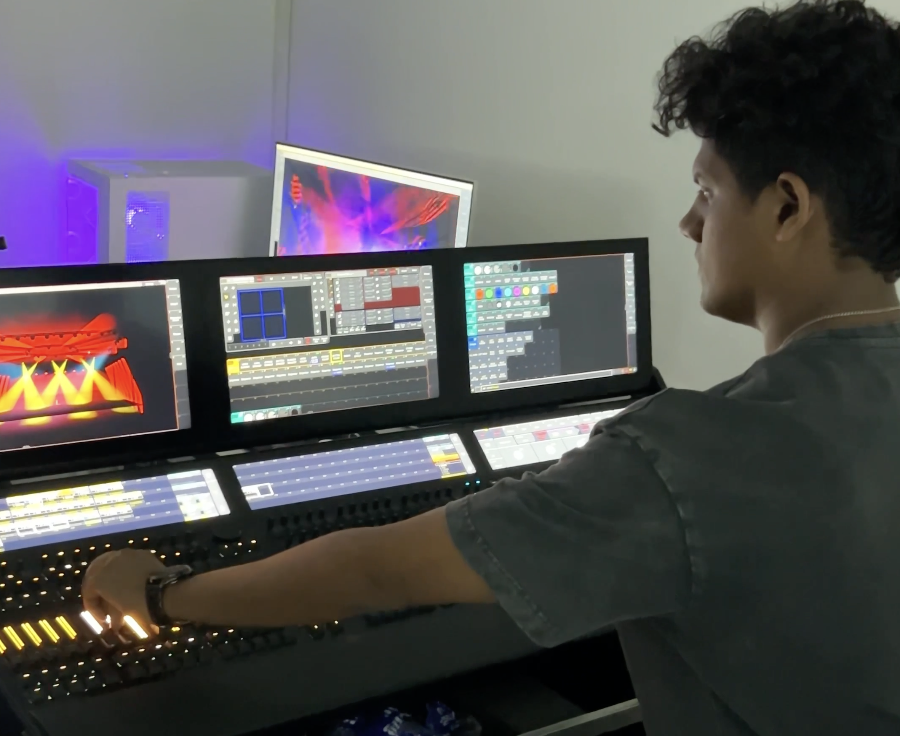
Here’s the direct answer: learn GrandMA3 first. It’s the console the Indian live events industry is short on trained operators for. It’s what runs the country’s biggest concert tours and large-format productions. And it’s the skill behind IIED’s own graduates getting hired into real technical roles, in India and abroad. Avolite Titan is genuinely worth knowing — but as your second console, once you’re already working, not as your entry point.
This isn’t an argument to ignore Avolite Titan. It’s a practical answer to a specific, tactical question: if you can only train on one console right now, which one moves your career forward faster? Here’s the honest breakdown, backed by real placement data.
Table of Contents
What GrandMA3 and Avolite Titan Actually Do
GrandMA3, the touring standard
GrandMA3 is MA Lighting’s flagship console system — full-size, light, compact, and a free onPC software version for practising on a laptop. It’s built for large, complex rigs: multiple universes of DMX, integrated 3D visualisation, and the processing power to run a stadium show or a broadcast production without dropping a cue. In India, GrandMA3 is what shows up on tour riders for major concerts and large-format live events, because it’s the system that can handle a rig at that scale without compromise.
Avolite Titan, the working alternative
Avolite Titan is Avolites’ console software, running across their range of hardware from smaller Sapphire and Arena desks up to larger touring consoles. It’s a capable, widely used system — common in theatre, corporate events, and rental fleets across India and internationally. Many production and rental companies run mixed inventories of GrandMA and Avolite hardware, choosing whichever console fits the job and the client’s rider. Knowing Avolite Titan makes you more flexible on a crew. It doesn’t replace the need to know GrandMA3 — it adds to it.
Both systems do the same fundamental job: they let a lighting designer or operator control fixtures, build cues, and run a show. The core lighting concepts — DMX, presets, groups, sequences, programmer logic — transfer between them once you understand one console properly. IIED trains students on actual GrandMA3 hardware, not just the free onPC simulator, because reading a manual and running a real rig under time pressure are different skills entirely, and the difference shows up in what a graduate can actually do on day one of a job.
Why GrandMA3 Should Be Your First Console in India
Here’s the practical reason to prioritise GrandMA3: trained GrandMA3 operators are genuinely rare in India relative to the demand for them. Production companies, rental houses, and touring crews are actively looking for people who can run a GrandMA3 rig — and the supply of trained operators hasn’t caught up with how fast large-scale live events have grown in India. That gap is the single biggest reason GrandMA3 is the higher-priority console for anyone starting a technical lighting career here.
This isn’t a claim IIED makes in isolation. MA Lighting’s own case study on Yo Yo Honey Singh’s “A MILLIONAIRE” India tour is a clear, real-world example of what GrandMA3 at scale actually looks like in this country: the show ran across 10 major cities, with Mumbai-based rental vendor SSL Lights supplying four grandMA3 full-size consoles and two grandMA3 processing units to control more than 350 lighting fixtures. Two lighting designers ran the consoles in tandem — one handling general stage and effects lighting, the other running lasers and key lighting for the cameras. That’s the level of production GrandMA3 is built for, and it’s happening on Indian tours right now, not just on international stages.
That kind of production doesn’t run on Avolite Titan operators who happen to also know GrandMA3 a little. It runs on people who know GrandMA3 properly — system architecture, programming, tracking, live show management under pressure. Learning it first means you’re building toward the console that the biggest, highest-paying jobs in Indian live events actually require.
Avolite Titan still matters. It’s common enough that not knowing it at all will occasionally limit which crew you can join. But it’s a console most working lighting professionals pick up on the job, once they already understand console logic from GrandMA3. Learning GrandMA3 first and adding Avolite Titan once you’re working the industry is a more realistic sequence than trying to become equally fluent in both before you’ve worked a single professional rig.
Is GrandMA3 Harder to Learn as a Beginner?
Let’s be honest about this instead of oversimplifying it, because a “no, it’s easy” answer would be exactly the kind of overpromise IIED doesn’t make. GrandMA3 has a real learning curve. It’s a genuinely complex system, and the first few weeks of learning it as a beginner mean getting comfortable with concepts that don’t exist on simpler consoles: system architecture, the “programmer” concept, and how groups, presets, sequences, and tracking all interact with each other.
What makes it manageable is structure. IIED’s foundational GrandMA3 training breaks this down in a defined order — starting with system architecture, networking, and DMX protocols, moving into environment setup and 3D visualisation, then building up through groups, presets, sequences, tracking, recipes, and phasers. Nobody is expected to understand a full console architecture on day one. The curve is real, but it’s climbable with the right sequence and enough hands-on console time.
If you’re comparing it to Avolite Titan specifically: Avolite Titan’s interface is generally considered more approachable for a first-time user, which is part of why some beginners default to it. But “easier to start” and “more valuable to know first” are two different questions. A console that’s simpler to open on day one isn’t necessarily the one that gets you hired on day 200. Most working lighting designers will tell you the same thing: the console worth the steeper learning curve is the one the industry is actually short on operators for.
Real IIED Careers Built on GrandMA3
The strongest argument for learning GrandMA3 first isn’t theoretical — it’s what’s already happened to IIED’s own graduates.
Atharv Devikumar Jog was already working in lighting before he came to IIED, but he lacked a real technical foundation on the console side. After training in IIED’s One Year Program in Lighting Design, he was placed as a Lighting Operator at SLS Production Equipment L.L.C. in Saudi Arabia in August 2025, on SAR 10,000 a month plus company accommodation, a return air ticket, and transportation. In his own words: “Joining IIED allowed me to dive deep into the intricate details and technicalities of light, which completely transformed my professional perspective. This shift in expertise led to an incredible international placement with SLS Production in Saudi Arabia.” His story is proof that console skill — not just industry experience — is what turns a lighting job into an international placement.
Silas Paul Uba came from an audio and media production background with no prior lighting experience at all. After training at IIED, he was placed as a Lighting Technician (Technician – Lighting, Grade B) at LumaSonic Structures Rental Pvt. Ltd. in Goa in September 2025, on ₹25,000 a month plus medical insurance of ₹5,00,000, personal accident insurance, a telephone allowance, and tools and uniform. He put it simply: “I joined IIED to professionalize my passion. This specialized skillset opened the door to an incredible opportunity at LumaSonic, Goa. My journey is proof that your previous production skills can be the perfect foundation for a new career in light.”
Vinith trained under Lloyd Albuquerque — IIED’s Lighting Design Mentor and a working Light Director — and was in a strong enough position after his console training that he turned down an offer from a global production company to join Lloyd’s own studio, LGL Designs, instead. As Vinith describes it: “I actually received a significant offer from a global production company, but I chose passion and direct mentorship over a corporate title, ultimately joining Lloyd Sir’s own team at LGL Designs. Now I’m designing light for the biggest stages alongside the very person who taught me the craft.” That’s a graduate whose console training was strong enough to make him a genuinely competitive hire — with real options to choose from.
None of these three placements happened because someone learned “a bit of everything.” They happened because the technical foundation — GrandMA3 first — was solid enough to be hired on.
GrandMA3 Mastery vs the One Year Program — Which Path Fits You
Once you’ve decided GrandMA3 is your priority, the next question is which course actually gets you there, and IIED runs two different paths depending on where you’re starting from.
If you’re already working in events or lighting with a year or two of general experience, and you specifically want to move from technician to designer on GrandMA3, the GrandMA3 Mastery Program is built for exactly that. It’s a focused, one-month, 74-hour program (₹75,000 + GST) split into two phases: foundational user training — system architecture, environment setup, 3D visualisation, and core programming — followed by advanced system management, including workflow automation through macros, advanced tracking, and professional show templates. You leave with real deliverables: a standardised show template, a timecoded performance sequence, and a working phaser library, not just a certificate.
If you’re starting from zero — no prior lighting or console experience at all — the full One Year Program in Lighting Design is the more realistic starting point. It covers the full foundation: the physics of light, DMX and networking, power and electrics, safety on set, and live console training on both GrandMA3 and Avolite Titan, taught by Lloyd Albuquerque, a working Light Director. This is also where the “either/or” framing of this article stops being strictly true — students in the One Year Program train on both consoles, because they have the time to build both skill sets properly across a full year rather than a single focused month.
The honest way to choose between them: if your budget and timeline only stretch to one short, focused course, GrandMA3 Mastery is the higher-return move, because it’s built specifically around the console the industry is short on operators for. If you’re starting with no background at all and want the complete picture — design theory, electrics, safety, and both major consoles — the One Year Program is the more thorough route, and it happens to solve the GrandMA3 vs Avolite Titan question for you by training both.
Who This Guide Is For
This is written for two kinds of readers.
The first is the recent graduate who has already decided they want a technical lighting career and is stuck on one concrete, tactical question before they’ll commit to a course: which console do I actually need to learn? If that’s you, you don’t need more general inspiration about lighting as a career — you need a direct answer about where to put your first month or year of training, and GrandMA3 is that answer.
The second is the event management student or graduate who already understands event coordination but has zero console experience, and is weighing whether GrandMA3 Mastery is worth ₹75,000 and a month of focused study, or whether Avolite Titan should be a competing priority. For this reader, the answer is the same: Avolite Titan is a bonus skill, not a competing priority. GrandMA3 is the technical foundation worth building first, because it’s the console that opens the door to the widest range of technical lighting roles — operator, programmer, technician, and eventually designer.
If neither of those describes you exactly but you’re generally curious about lighting as a career path, this comparison still holds: when in doubt, GrandMA3 is the console worth learning first in India, today.
The Bottom Line
Strip away the debate and the answer is straightforward: GrandMA3 first, Avolite Titan second. GrandMA3 is the console India’s live events industry doesn’t have enough trained operators for, it’s what the country’s biggest tours and productions actually run on, and it’s the technical foundation behind real IIED placements — in Saudi Arabia, in Goa, and inside Lloyd Albuquerque’s own studio. Avolite Titan is a genuine, useful skill, and knowing it makes you a more flexible hire. But it’s not where a beginner’s limited time and budget should go first.
If you can only commit to one short, focused course right now, that’s GrandMA3 Mastery. If you’re starting from zero and want the complete technical and design foundation — including live training on both consoles — that’s the One Year Program in Lighting Design. Either way, the console-first question this article opened with has one honest answer, not two.
If you’re still weighing GrandMA3 against Avolite Titan on your own, the fastest way to make the decision properly is to see the console in person before you commit to a course. Book your free visit to IIED’s Malad East studio to sit at an actual GrandMA3 console setup, meet Lloyd Albuquerque’s team, and ask the tactical questions this article can’t fully answer for your specific situation — your background, your timeline, and your budget. Call 9892966334 or write to admission@iiedeventdesign.com to book your visit.