
If you have searched for a lighting design course cost in India, you have probably run into the same wall we did while researching this piece: almost nobody publishes real numbers. Most institutes hide fees behind a “contact us for details” form, and the only pages that do show pricing are usually about interior or architectural lighting design, not the console-and-rigging skill set that gets you hired on live shows, weddings, and concerts. This article exists to fix that.
We are going to give you the actual fees for both of IIED’s lighting design pathways: the GrandMA3 Mastery course and the full MA in Lighting Design. Then we will help you work out which one actually fits where you are right now, because the two courses are not competing options — they solve two different problems, at two very different price points.
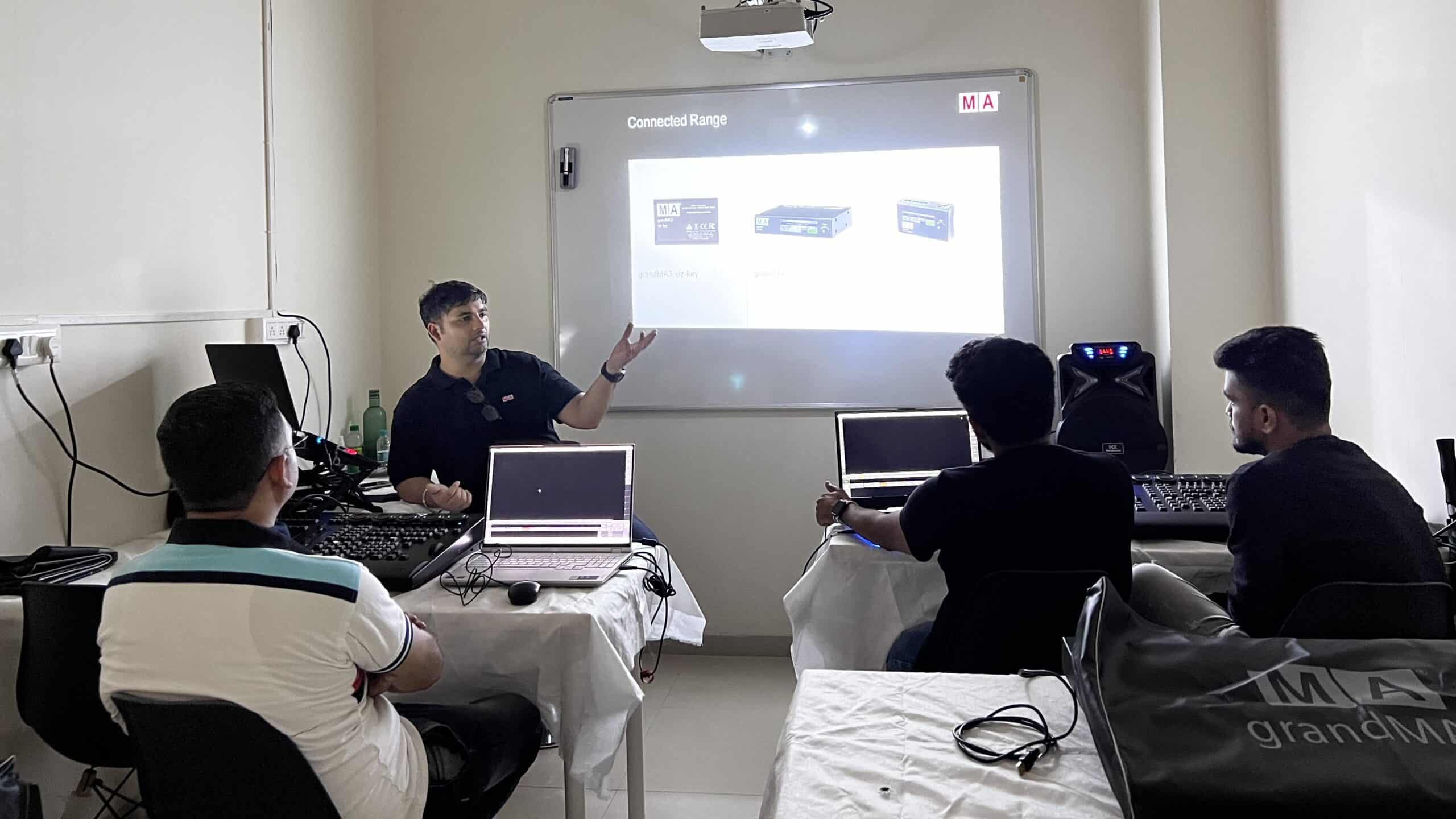
Table of Contents
How Much Does the GrandMA3 Mastery Course Cost at IIED?
The GrandMA3 Mastery course at IIED costs ₹75,000 plus 18% GST. That is the full fee — there is no separate enrolment charge or hidden instalment on top of it. In return you get 74 hours of training spread across one month, built entirely around the GrandMA3 console: the same desk used to run lighting on major concerts, weddings, and corporate shows across India.
This is not a beginner’s course in the physics of light. It assumes you already have some hands-on experience — as a technician, an operator, or someone who has worked backstage on productions — and it is built to take that experience and turn it into one specific, high-value skill: operating GrandMA3 at a professional level. The course is split into two phases, moving from console fundamentals to full programming and live cueing, with practical deliverables at every stage rather than theory alone.
Because the fee covers a single, focused month rather than a full year, it is the lowest-friction way to add a serious technical skill without stepping away from a job or a family commitment for long. Working professionals often ask whether GST is included in that ₹75,000 figure — it is not. GST is added on top, so budget for roughly ₹88,500 all-in.
How Much Does the MA in Lighting Design Cost?
The MA in Lighting Design costs ₹3,00,000 per year, split across three instalments so you are not paying the full amount upfront: an enrolment payment of ₹1,00,000, a first instalment of ₹1,00,000, and a second instalment of ₹1,00,000. Each instalment is due at a different stage of the program, which spreads the financial commitment out over the year rather than requiring it in one lump sum.
This program is the full foundation. It starts from the physics and anatomy of light and moves through laws of light and colour temperature, power and electrics, workplace safety (rigging, loading, weight, pyrotechnics), DMX and its protocols, light consoles including both GrandMA3 and Avolite Titan, design theory, light plotting and CAD-based design, programming and cue building, and live console training. Sound and video essentials are woven in too, because on a real show, lighting does not work in isolation from either.
The program’s stated outcome is a 100% Internship or Job Opportunity for every student who completes it, and it is taught by Lloyd Albuquerque, a working Light Director. Students leave with a built portfolio, not just a certificate, which matters more than it sounds — in this industry, what you can show is what gets you hired.
GrandMA3 vs the MA in Lighting Design: Which One Fits You?
The honest answer depends entirely on what you already know. This is the exact question IIED gets from two very different kinds of students, and the right course is different for each of them.
If you already have 1–2 years of hands-on experience
If you have already been working — as a lighting technician, a stagehand, in AV rental, or in any production-adjacent role — and you know the physical world of trussing, rigging, and cabling but have never had formal console training, GrandMA3 Mastery is very likely the smarter first move. You do not need to relearn what you already know on the job. You need the one skill that gets you promoted from technician to operator or designer, and that skill is the console. At ₹75,000 + GST, it is a targeted investment against a very specific gap.
If you are starting from zero
If you have no production background at all — no rigging experience, no console time, no understanding of DMX or electrical safety — jumping straight into GrandMA3 alone will leave real gaps. You would be operating a professional console without understanding the physics, safety rules, and design thinking that a working Light Director actually uses on set. The MA in Lighting Design builds that foundation first, then takes you into console work with the context to use it properly. This is the right starting point for Profile 5 students in particular — event management graduates who already hold a diploma but were never taught the technical, hireable skills that lighting design demands.
Can you do both, in either order?
Yes. Some students complete GrandMA3 Mastery first to test whether lighting design suits them before committing to the full programme, then move into the MA in Lighting Design once they know it is the right career. Others complete the MA in Lighting Design first, since it already includes GrandMA3 console training as part of the curriculum, and use GrandMA3 Mastery later purely as a refresher before a specific job or gig. Both paths work — there is no penalty for entering at either point.
What You Actually Get for the Money
It helps to be specific about what each fee actually buys, because “course fee” can mean very different things between institutes.
The GrandMA3 Mastery fee buys you 74 hours of direct console time and instruction, structured across two phases with practical, gradeable deliverables. You are not sitting through generic lighting theory you already know — every hour is spent building the specific skill the fee is named for.
The MA in Lighting Design fee buys the physics and safety foundation, full DMX and console theory, live console training on both GrandMA3 and Avolite Titan, light plotting and CAD-based design work, sound and video essentials, and a built professional portfolio — plus IIED’s 100% Internship or Job Opportunity outcome at the end of it. It is also the only pathway that includes design theory: understanding a client’s brief and building a lighting concept around it, not just operating a desk someone else has already programmed.
Neither course sells fees behind a “contact us” wall, and neither one changes what it teaches based on who is asking. That matters, because in an unregulated training market, the biggest risk is not overpaying — it is paying for something vague and finding out too late it did not teach what you actually needed.
Real Outcomes: What IIED Lighting Design Graduates Are Earning
Numbers on a course page mean little without proof of what they lead to. Here is what real IIED lighting design graduates are doing right now.
Atharv Devikumar Jog completed the One Year Program in Lighting Design and was placed as a Lighting Operator at SLS Production Equipment L.L.C in Saudi Arabia in August 2025, earning SAR 10,000 a month, plus company accommodation, a return air ticket, and transportation. Atharv was already working in lighting before he joined IIED — what he lacked was the technical foundation, and the full year program gave him exactly that. His placement shows the ceiling of the ₹3,00,000 program: an international role with a complete benefits package, not just a salary line.
Silas Paul Uba came from an audio mixing and media production background, not lighting. After completing his lighting design training at IIED, he was placed as a Technician–Lighting (Grade B) at LumaSonic Structures Rental in Goa in September 2025, on ₹25,000 a month plus ₹5,00,000 in medical insurance, personal accident insurance, a telephone allowance, and tools and uniform provided. His story matters for anyone worried that a background in a different field is a disadvantage — it is not. Existing production experience, even in a different discipline, is an asset once it is paired with formal lighting training.
Vinith, a One Year Program graduate, turned down a significant offer from a global production company to join Lloyd Albuquerque’s own team at LGL Designs instead. That is not a story about settling — it is proof that the training builds real, industry-recognised skill, skill good enough that Vinith’s own mentor wanted him on the team. When a working Light Director hires his own graduate, that is the clearest signal available that the program teaches more than a certificate’s worth of knowledge.
These three stories cover the two most common starting points searchers land on this page from: already working in production and needing the console skill (Atharv, and the case for GrandMA3 Mastery), coming from a completely different field (Silas), and building skill good enough to be hired by your own trainer (Vinith).
Is a ₹3,00,000 Lighting Design Program Worth It?
This is the question every serious enquiry eventually comes down to, so we will answer it directly rather than dodge it.
Free YouTube tutorials and cheap short courses can teach you the buttons on a console. They cannot put you in a room with a working Light Director, they cannot give you supervised rigging and safety practice, and they cannot connect you to the internship and job network that comes from training inside a real studio built around this industry. GrandMA3 operators in India are extremely rare — demand for trained console operators far outpaces the number of people who can actually run one at a professional level. That scarcity is exactly why a targeted, credentialed skill in this space commands real salaries, whether that is the ₹25,000–45,000 a month range for entry-level India-based roles or the SAR 10,000-plus international packages graduates like Atharv have landed.
India’s live events industry backs this up at a macro level, too. According to the FICCI-EY report on India’s media and entertainment sector, live events was the fastest-growing segment of the entire M&E industry in 2025, expanding 44% year-on-year on the back of ticketed concerts and large-scale public events. That is not a shrinking market being asked to absorb more trained operators — it is a genuinely booming one that still cannot find enough of them.
Set against that backdrop, ₹3,00,000 per year for two years of physics, safety, console, design, and portfolio training — with a 100% Internship or Job Opportunity outcome attached — is not a discretionary expense. It is closer to a targeted bet on one of the few corners of India’s events industry where demand for skilled people is outrunning supply. The same logic applies at a smaller scale to the ₹75,000 GrandMA3 fee: it is a precise investment in the single skill that is hardest to find qualified people for.
Whichever course you are weighing, the honest advice is the same: do not choose based on price alone, and do not choose based on marketing claims either. Choose based on what you already know how to do, and what specific gap is standing between you and the job you actually want.
Which Course Is Right for You?
If you are currently employed and weighing a fast, low-disruption upskill against a bigger commitment, start by being honest about your production background. Already worked hands-on for a year or two? GrandMA3 Mastery is built for exactly that gap. Starting from nothing but genuine interest? The MA in Lighting Design gives you the full foundation employers are actually looking for.
Both pathways lead to the same place: real, paid work in an industry that cannot currently find enough trained people to fill it. The fastest way to know which one fits you is to talk it through in person, with real course details in front of you, not a form submission.
Book your free visit to find out which course fits where you are. Come to IIED’s Malad East campus, see the GrandMA3 consoles in person, and walk out with a clear answer instead of another vague quote.