
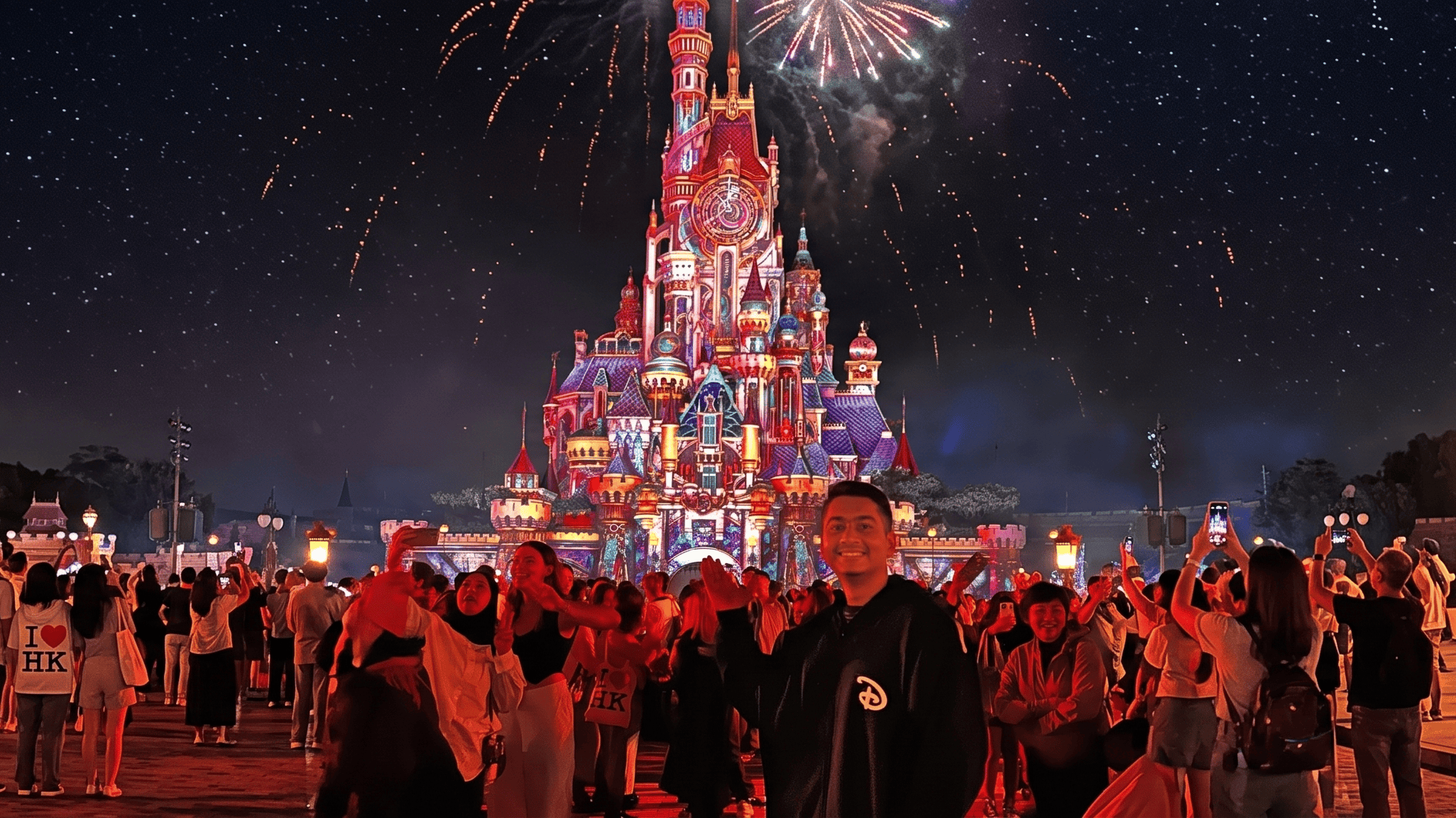
A student in a training room in Malad East, Mumbai, is learning to program a GrandMA3 console. Eighteen months later, he is running lighting for a live show at Disneyland Hong Kong. That is not a hypothetical. That is Jude Pereira’s real path, and it is the clearest example we have of what international placements for event design and lighting students in India actually look like when they are earned, not promised.
If you have searched for how to get a job abroad in event design from India, you have probably read a lot of vague advice: “network more,” “build your portfolio,” “consider studying overseas.” Almost none of it tells you what actually got someone hired. This post does. We are going to walk through three real, named IIED alumni who now work internationally in lighting design, what technical skills actually opened those doors, what the realistic path looks like, and what you should expect in terms of salary, timeline and effort. No invented numbers. No “guaranteed abroad” promises. Just the real path, and an honest picture of who it fits.
Table of Contents
Can You Really Get an International Job in Event Design or Lighting From India?
The honest answer is yes — but not the way most students assume. The common assumption is that you need to move abroad first, study at a foreign university, or already have an international network before any international lighting design career India-based student can access is even possible. That is not what happened for the three alumni in this post, and it is not what IIED sees as the realistic route.
The real path runs in the opposite direction. You train hands-on, in India, on the exact equipment international productions run on — GrandMA3 consoles, AutoCAD, Vectorworks. You build a real portfolio of real work. Then you get placed, sometimes in India, sometimes internationally, based on what you can actually do with a lighting rig or a design brief, not based on where you studied.
Most IIED placements are still in India. That needs to be said plainly, because over-promising is exactly what a “10 Reasons You’ll Work Abroad” article does, and it is not honest. What is true is that international placement is a real, earned outcome for students who go deep on a specific technical skill — not the default expectation for everyone who enrolls. The difference between a student who stays local and one who gets an international offer usually comes down to one thing: how deep their technical skill goes, and whether they have proof of it.
Three Real Students Who Landed International Lighting Placements
These are not composite case studies. These are three named IIED alumni, all graduates of the One Year Program in Lighting Design, all placed internationally, all verifiable against actual offer documentation.
Jude Pereira — Event Designer and Lighting Technician, Disneyland Hong Kong
Jude left medical studies to pursue lighting design — a background switch that surprises people every time it comes up in a counselling conversation. After completing the One Year Program in Lighting Design, he was placed as an Event Designer and Lighting Technician at Disneyland Hong Kong, where he now handles the lighting for some of their biggest live shows.
In his own words: “Today, I am living my dream as an Event Designer and Lighting Technician at Disneyland Hong Kong, where I handle the lighting for their most captivating shows.” Jude’s story is the one we point to when a student — or a student’s parent — needs proof that lighting design is a real, global profession, not a hobby with no career ceiling.
Atharv Devikumar Jog — Lighting Operator, SLS Production Equipment L.L.C., Saudi Arabia
Atharv was already working in lighting before he joined IIED, but he lacked the technical foundation to move up. After completing the One Year Program in Lighting Design, he was placed as a Lighting Operator with SLS Production Equipment L.L.C. in Saudi Arabia in August 2025. His package: SAR 10,000 per month, plus company accommodation, a return air ticket, and transportation.
Atharv’s own words: “Joining IIED allowed me to dive deep into the intricate details and technicalities of light, which completely transformed my professional perspective. This shift in expertise led to an incredible international placement with SLS Production in Saudi Arabia.” His path matters most for one specific group: people already working in events or lighting who suspect they have hit a ceiling because they never got proper technical training.
Cajetan D’Silva — Lighting for International Productions, Royal Caribbean
Cajetan trained during the COVID-19 lockdown, when most people assumed the events industry had no future at all. After completing the One Year Program in Lighting Design, he was placed with Royal Caribbean, the world’s largest cruise line, handling lighting for their productions and traveling internationally as part of the role.
In his own words: “I took the uncertainty of COVID-19 and turned it into an opportunity. Now I’m traveling the world and working with Royal Caribbean, the biggest cruise line in the industry, handling lighting for their massive productions.” Cajetan’s story is proof that timing your training around a “bad moment” in the industry does not close the door — the technical skill is what opens it, regardless of when you start.
What International Lighting and Event Companies Actually Look For
None of these three placements happened because of a polished resume or a persuasive cover letter. They happened because of specific, demonstrable technical skill. If you are serious about lighting design jobs abroad for Indian students, this is the part to pay attention to.
The single biggest factor is console skill — specifically, GrandMA3. Trained GrandMA3 operators are extremely rare in India. Demand for people who can actually program and run a GrandMA3 console far exceeds the supply of people trained to do it. That gap is precisely why a specific, narrow technical skill opens doors that a general event management degree does not. International productions — theme parks, cruise lines, touring shows, production companies — run on this console. A student who can walk into an interview and demonstrate real programming, cueing and live-operating skill on a GrandMA3 is solving a hiring problem that companies actually have.
The second factor is design literacy through CAD tools — AutoCAD and Vectorworks specifically. International production companies plan lighting and set design digitally before a single fixture goes up. A student who can read and build a light plot, place fixtures against a CAD-based set design, and speak the language of angles, DMX universes and rigging safety is someone a production manager can trust with real budget and real equipment, not just enthusiasm.
This is not a small or shrinking field either. The broader entertainment and stage lighting industry is a growing global market — independent market research shows sustained global growth in lighting technology and entertainment lighting demand through the 2030s, driven by rising investment in live events, concerts and immersive entertainment venues worldwide. That growth is exactly why the gap between trained console operators and industry demand keeps widening — and why a technically trained Indian student is not competing against an oversupplied market abroad.
How to Get a Job Abroad in Event Design From India: The Real Path
Strip away the aspiration and here is the actual sequence that produced Jude’s, Atharv’s and Cajetan’s placements. It is not glamorous. It is hands-on, technical, and it takes real time.
Step 1: Train on the real equipment, not just the theory
The MA in Lighting Design at IIED is a full-time course covering the physics and laws of light, power and electrics, workplace safety, DMX and networking protocols, light consoles (GrandMA3 and Avolite Titan), CAD-based light plotting, live programming, and live console training on actual rigs. It is taught by Lloyd Albuquerque, a working Light Director, not a lecturer reading from a textbook. The course carries a 100% Internship or Job Opportunity outcome for students who complete it, which is a course-level guarantee about domestic placement pathways — not a promise of an international posting, which depends on the individual student’s skill level and portfolio.
The fee structure is straightforward: enrolment of ₹1,00,000, followed by two further instalments of ₹1,00,000 each, for a total of ₹3,00,000 across the one-year program.
Step 2: Build a real, specific portfolio — not a general one
Every one of the three alumni above built a portfolio during training: light plots, programming assignments, live-event documentation. A generic “I can do lighting” portfolio does not get an international interview. A portfolio that shows a specific console programmed for a specific rig, with specific problem-solving decisions explained, is what a hiring manager at a production company or a theme park actually reads.
If GrandMA3 is the console you are building toward, our GrandMA3 Career in India guide breaks down exactly what a strong GrandMA3-focused portfolio should include and why that console specifically keeps showing up in international placement stories like Atharv’s.
Step 3: Get placed — and stay open to where the opportunity actually is
This is the step students get wrong most often. They assume the placement itself has to be international from day one. In reality, some of the strongest international-track students take a domestic placement first, prove their skill on real productions, and move internationally later — while others, like Atharv, come in already working and use the technical training to unlock an international jump directly. There is no single fixed order. What stays constant is that the placement — wherever it lands first — has to be earned through demonstrated skill, not applied for on hope alone.
Domestic vs International: What You Should Actually Expect
Here is the grounded version of this conversation, the one a mentor should have with you rather than a marketing page.
Most IIED graduates in lighting design are placed in India, at real companies — production houses, event companies, rental and technical houses in cities like Mumbai and Pune. Domestic lighting design salaries and offer structures are covered in detail in our Event Designer & Lighting Salary in India: Real 2026 Data post, which is worth reading alongside this one if you want the full domestic-versus-international picture side by side.
International placements, when they happen, tend to come with a different package structure entirely. Atharv’s Saudi Arabia placement, for example, included a monthly salary of SAR 10,000 alongside company-provided accommodation, a return air ticket, and transportation — benefits that are common in international production and hospitality-adjacent lighting roles but rare in a typical Indian entry-level lighting job. Cajetan’s Royal Caribbean role adds ongoing international travel as part of the job itself, which is a different lifestyle proposition entirely from a fixed-location domestic role.
Who does this path actually fit? Two groups, based on what we see in real enrolments. The first is the recent graduate who is anxious about direction and wants a fast, practical path with a real, visible outcome — an international placement is about as concrete an outcome as this field offers.
The second is the student who is still in college and needs to make the case to parents that this is a real, global career, not a creative hobby with no ceiling — Jude’s story, in particular, tends to do that work in a single conversation.
It does not fit everyone, and that is fine. If your goal is to stay based in one Indian city and build a stable domestic career, that is also a completely legitimate outcome of the same training — most of our alumni do exactly that. International placement is one real outcome among several, not the only one that counts as success.
Ready to Build a Portfolio That Can Actually Get You Placed?
Jude, Atharv and Cajetan all started in the same training room in Malad East, Mumbai, learning the same consoles and the same CAD tools. Where they ended up came down to how deep they went on real, specific technical skill — not luck, and not a foreign degree.
If you want to know honestly whether this path fits you, book your free visit to IIED’s Mumbai campus and sit in on a real lighting design class before you decide anything. Call 9892966334 or write to info@weareiied.com to schedule it.