

Nobody hires an event designer for their degree. They hire the person who can show a mood board, a layout and a render. “No experience” is the most common reason freshers give for not applying to design studios. A strong event design portfolio answers that objection before anyone raises it, and you can build one before you have a single paying client.
This guide gives you five practical projects, one page structure for each, the tools you need, the mistakes studios notice in seconds, and how to send your work so it actually gets opened. Every step is something you can start this week, at home, with free or low-cost tools.
|
IIED COURSE Short Term Event Design CourseBuild all five portfolio projects with mentor feedback, from first sketch to final render, in classroom sessions. ● Duration: 4 months |
In this guide
- What hiring studios look at first
- The 5 projects for an event design portfolio for beginners
- How to present each project
- Tools you need
- Common mistakes to avoid
- Where to host it and how to send it
- Event design portfolio examples from IIED alumni
- FAQs
What Hiring Studios Look at First in an Event Design Portfolio
Short answer: the work first, then the thinking behind it. A studio owner or design head often gives a fresh portfolio only a few minutes on the first pass. In that window, they are checking three things.
1. Concept clarity
Can you take a brief and turn it into one clear idea? A good concept has a name, a colour story and a reason. “Royal blue and gold because the couple met in Jaipur’s old city” tells a studio you think like a designer. “Pretty florals” does not.
2. Layout and technical understanding
Every event is built in a real space. Studios want proof that you understand scale, guest flow, stage size, entry points and where the vendors set up. A simple floor plan or stage elevation, even a hand-drawn one to scale, shows you can design something that can actually be built.
3. Finish and presentation
Clients see your visuals before they see the venue. A clean render or a well-composed visual, clear captions and consistent page design tell the studio you can present to their clients without hand-holding.
Why an event management CV is not enough
If you studied event management, you may already have internships and coordination work on your CV. That is useful, but it proves you can run an event, not design one. Managing vendors and guest lists does not show a design head that you can create a stage concept. Your portfolio has to show the design skill directly.
That is exactly the gap Manisha Mahto closed. She studied event management in Ahmedabad, moved from Ranchi to Mumbai, trained at IIED and joined Inextis Events as a Junior Graphic Designer at ₹30,000 a month gross. Her coordination background helped. Her design work got her the job.
The 5 Projects That Make an Event Design Portfolio for Beginners
You do not need clients to build an event design portfolio. You need briefs. When nobody gives you one, write your own. These five projects together cover what most wedding and event studios in India want to see from a fresher.
| Project | What it proves | Key pages |
|---|---|---|
| 1. Full wedding concept | Concept, colour and styling | Mood board, palette, mandap or stage sketch, rendered view |
| 2. Corporate or launch event | Technical and layout skill | Stage elevation, floor plan, branding placement |
| 3. Floral and table styling study | Hands-on detailing | Photographs, material list, close-ups |
| 4. Re-design of a real event | Critical thinking | Before notes, your concept, revised visual |
| 5. Brief-to-delivery project | Professional workflow | Brief, budget line, vendor list, final visual |
Project 1: A full wedding concept
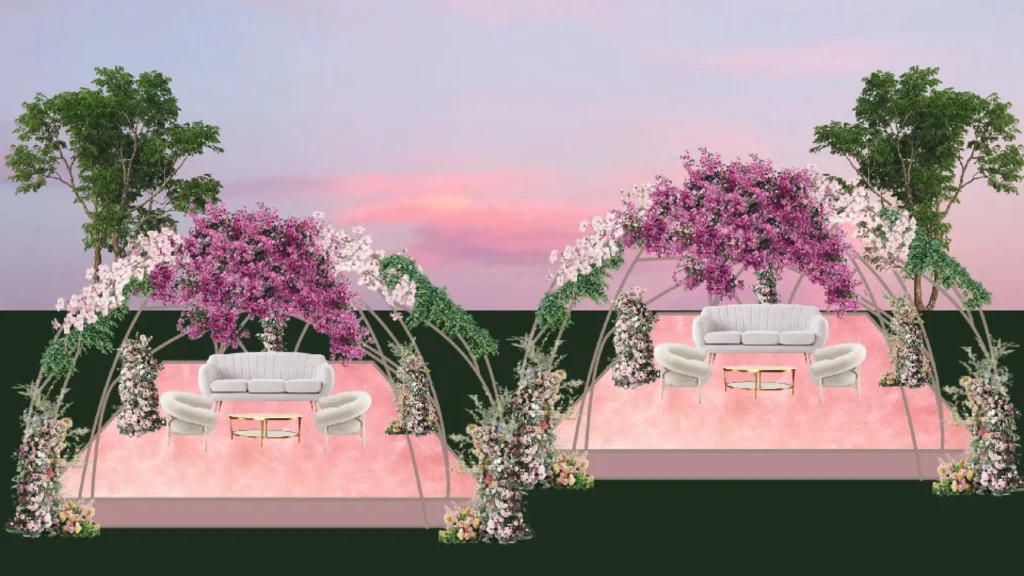
Pick one function, such as a sangeet, haldi or wedding ceremony, and design it end to end. Start with a mood board of 8 to 12 references. Lock a colour palette of four or five shades. Sketch the mandap or stage. Then produce one rendered or visualised view that shows what the guest will see when they walk in.
This is the anchor of any wedding design portfolio with no experience behind it. Weddings are a huge share of design work in India, and a studio will almost always ask, “Show me a wedding.”
Project 2: A corporate or product launch event
Weddings show style. Corporate events show structure. Invent a brand launch or an annual awards night. Design the stage with an elevation drawing (front view with heights and widths) and a floor plan showing seating, the stage, LED screen placement, entry and exit. Add where the client’s branding sits.
This project matters because many large event companies, the kind that hire production designers, run corporate work all year, not just in wedding season.
Project 3: A floral and table-styling study
This one is physical. Style a dinner table, a welcome table or a small floral installation. It can be at home, at a friend’s birthday dinner or at a family function. Photograph it well, in daylight, from three angles plus close-ups. Add a short list of materials and what each piece cost.
Studios love this because it proves you can make things with your hands, not just on a screen. It also gives you real photographs in a portfolio that might otherwise be all digital.
Project 4: A re-design of a real event you attended
Think of a wedding, campus fest or corporate event you attended. Write a short note on what worked and what did not: the entry felt cramped, the stage was hidden behind the buffet, the colours fought each other. Then present your own concept for the same event with a revised layout and visual.
Keep it respectful. You are showing how you think, not criticising someone else’s work. A design head reads this page and sees a person who notices problems and solves them.
Project 5: A brief-to-delivery project
This is the most professional page in your event design portfolio. Write a one-paragraph client brief: event type, guest count, venue, budget range. Then show your response: concept, a simple budget line by category (structure, florals, lighting, furniture, fabric), a vendor list by trade, and the final visual.
It tells the studio you understand that design lives inside a budget and a team. Very few fresher portfolios include this, so it helps you stand out.
How to Build an Event Design Portfolio Page That Shows Your Process
Five good projects in an event design portfolio can still fall flat if they are presented as a pile of pretty images. The fix is a consistent structure. Give each project one spread (one or two pages) and follow the same order every time.
- The brief. Two or three lines: event, client type, guest count, venue, budget range.
- The concept. A name for the idea and one paragraph on why it fits the brief.
- The sketch. Your rough hand sketch. Do not hide it. Studios want to see that you can think on paper.
- The layout or plan. Floor plan, stage elevation or table plan, to scale where possible.
- The final visual. Render, visualised image or photograph of the finished piece.
- What you would change. One honest line. This shows maturity and makes interviews easier.
This structure does something important for your event design portfolio. It shows process, not just output. Anyone can download a beautiful image. Only a designer can show the path from brief to sketch to plan to final visual.
If any project was a group effort, say so and name your role. “Concept and floor plan by me, render by teammate” is far better than letting a studio find out in the interview.
Tools You Need to Build an Event Design Portfolio
You do not need expensive software on day one to start an event design portfolio. Here is what each part of the portfolio needs, from simplest to most advanced.
- Sketching: A sketchbook, pencils and markers. Hand sketches are still how most designers pitch the first idea.
- Visualisation: Photoshop is widely used in wedding studios to build visuals from photographs and references. Read why designers choose Photoshop for wedding visualisation.
- Plans and drawings: AutoCAD or Vectorworks for floor plans and stage elevations. Our guide on which software to use for wedding design compares the options.
- Layout of the portfolio itself: Free design tools or simple presentation software work fine for putting pages together.
If you are a student, check free options first. Autodesk, the maker of AutoCAD, offers free education access to eligible students and educators for learning use. That is enough to practise floor plans for your portfolio projects.
The honest truth: free tools get you started, but self-teaching software through videos is slow. Many freshers spend months learning commands without ever producing a client-ready drawing. Hands-on training with a mentor who checks your work regularly shortens that path a lot.

Common Event Design Portfolio Mistakes Studios Notice in Seconds
Design heads see a lot of fresher event design portfolio submissions. These are the mistakes that send yours to the “maybe later” pile.
Ten mood boards that look the same
Five pastel floral boards prove one thing five times. Range matters in an event design portfolio. Mix a wedding, a corporate event, a physical styling study and a technical drawing.
No technical drawings
A portfolio with no floor plan or elevation tells a studio you cannot hand a design to the production team. Even one clean plan changes how your whole event design portfolio reads.
Copying Pinterest images
Using references on a mood board is normal, as long as you label them as references. Presenting someone else’s photo as your final design is not. Experienced designers recognise popular images instantly, and it ends the conversation.
No captions or role clarity
An image with no caption forces the reader to guess. Two lines per project page, covering what the brief was and what you did, solve this.
A 40-page PDF nobody opens
Bigger is not better for an event design portfolio. A heavy file that takes a minute to download, packed with every class assignment, will not get read. Edit hard. Your best five projects beat your twenty average ones.
Where to Host Your Event Designer Portfolio in India and How to Send It
Once your event design portfolio is ready, how you share it matters almost as much as what is in it.
A short PDF: 8 to 12 pages
Open with a cover page (name, role you want, phone, email). Follow with a one-page “about me” with a photo and your skills. Then your five projects, one spread each. Close with a contact page. Keep the file small enough to attach to an email or send on WhatsApp without trouble.
A simple online link
Upload the same work to a free portfolio site or a shared drive folder with view access. A link is easier to forward inside a studio than an attachment. Test it in a private browser window before you send it.
What to write in the email
Keep it to five lines. Who you are, the role you are applying for, one line on why this studio (mention a specific event they did), the link and PDF, and your phone number. Do not paste your whole CV into the email body.
Instagram as a second showcase
Many studios check Instagram before they reply. A clean profile with your project visuals, sketches and styling photos backs up your PDF. Keep personal posts on a separate account.
Event Design Portfolio Examples: How IIED Alumni Got Hired
Everything above is easier to believe when you see it work. These are real IIED alumni, and in each case the portfolio did the talking.
Shreya Pais: zero experience to a job in Dubai
Shreya joined IIED’s Event & Wedding Design Visualization training as a fresh graduate with no experience. She is now working in Dubai. In her words: “By the time I finished the course, my work spoke for itself — I had a portfolio so impressive that it landed me a job instantly. IIED bridged the gap between being a fresh graduate and a ready-to-hire designer.”
Pranay Mhatre: Production Designer at Wizcraft
Pranay completed IIED’s Event & Wedding Design Visualization training and was hired as a Production Designer at Wizcraft International Entertainment in Mumbai, one of India’s oldest and best-known event companies. It remains our flagship placement for this programme.
Bhavya: from Jodhpur to Taxi Design, Mumbai
Bhavya took the online course from Jodhpur. “By the end, I had built a professional portfolio that caught the eye of Taxi Design, leading to a dream job offer in Mumbai,” she says. If you live outside Mumbai, her story is proof that location does not decide whether your portfolio gets seen.
Saanchi Rajwani: paid internship before graduating
Saanchi was a second-year graduation student when she won a paid event design internship at Robust Events, with a ₹30,000 monthly stipend, while still doing the course and before finishing her degree. You do not have to wait for graduation to start building.
Who this guide is for
- Recent graduates in any stream who want a creative career but have nothing to show yet.
- Students still in graduation who want to start early, the way Saanchi did.
- Event management graduates who have coordination experience but need design proof, like Manisha.
- Anyone restarting a career, including homemakers who have styled family functions for years. That styling counts. Photograph it and build Project 3 around it.
How IIED Builds Your Event Design Portfolio Into the Course
You can build an event design portfolio from this guide on your own. Many people do. But if you want a structured path with someone checking your work at every step, this is how it works at IIED.
- Portfolio development is part of every IIED course. Regular assignments are designed to become portfolio pieces.
- The final design project is a set of self-directed projects based on real-world scenarios, refined with faculty guidance and peer feedback into a professional portfolio.
- Assessment includes your portfolio, a group practical and presentations, so you practise presenting your work before you face a studio.
- Practical sessions cover sketching, graphic design and layouts with software, the exact skills the five projects above need.
- Small batches and real mentors, including Sushant Waidande, Event Design Mentor, so your work gets individual feedback, not a generic grade.
Our Wedding, Event & Set Design training is built for people starting from zero. If you want to know how long it realistically takes, read how to become a job-ready event designer in 4 months. For the wider career route, see our guide on how to become a wedding designer in Mumbai.
Event Design Portfolio FAQs
What should be in an event design portfolio?
An event design portfolio should include four to six projects that show concept, layout and finish: a wedding concept with mood board and rendered view, a corporate stage with floor plan and elevation, a physical styling study, and a brief-to-delivery project with budget and vendor list. Add captions explaining your role in each.
Can I build an event design portfolio with no experience?
Yes. You do not need clients, you need briefs. Write your own briefs for a wedding, a corporate launch and a table-styling study, then design them end to end. IIED alumna Shreya Pais joined with zero experience and her portfolio landed her a job, and she now works in Dubai.
How many projects should a beginner event design portfolio have?
Five strong projects is a good target for a beginner. That is enough to show range across weddings, corporate events, hands-on styling and technical drawings without overwhelming the reader. Five well-presented projects will always beat twenty average class assignments in a hiring studio’s first look.
Do I need software like Photoshop or AutoCAD to build an event design portfolio?
You can start with hand sketches and free tools, but studios expect at least one visualised image and one technical drawing. Photoshop is widely used for wedding visuals, and AutoCAD or Vectorworks for floor plans and stage elevations. Hands-on training makes learning these tools much faster than self-study.
Should I make a PDF portfolio or an online one?
Make both. Keep a short PDF of 8 to 12 pages that you can attach to an email or send on WhatsApp, and put the same work on a simple online link that is easy to forward inside a studio. Use Instagram as a second showcase for visuals and styling photos.
Can I use Pinterest images in my event design portfolio?
Only as clearly labelled references on a mood board. Never present someone else’s photo as your own final design. Experienced designers recognise popular Pinterest images instantly. Your final visuals, sketches, plans and styling photos must be your own work, with any group work credited.
How long does it take to build a job-ready event design portfolio?
It depends on how much time you give it and whether you have guidance. Working alone with free tools can take many months, mostly spent learning software. In IIED’s 4-month short term courses, assignments and the final design project are refined with faculty guidance and peer feedback into a professional portfolio.
Does IIED help students build a portfolio during the course?
Yes. Portfolio development is included in every IIED course. Assignments are designed to become portfolio pieces, the final design project is refined with faculty guidance and peer feedback into a professional portfolio, and assessment includes your portfolio, a group practical and presentations.
Start Your Event Design Portfolio This Week
A portfolio is the experience when you have none. Start with one wedding concept this week. Add a corporate stage plan next week. Style a table, photograph it, and write it up. By the time you have five projects presented with brief, concept, sketch, plan and final visual, “no experience” stops being a reason not to apply.
Want to see what finished student work looks like? Browse real student portfolios at weareiied.com/portfolios, then come and see how it is made. Book your free visit to IIED in Malad East, Mumbai, meet the mentors and look through student portfolios in person.
|
IIED COURSE Online Short Term Event Design CourseLive outside Mumbai? Build a professional event design portfolio online, the way Bhavya did from Jodhpur. ● Duration: 4 months |