
Table of Contents
Two rooms, same skill set, completely different jobs. In one, a show caller counts a cue into someone’s ear while a lighting programmer tracks a rigid broadcast clock. In the other, a designer walks a mandap floor plan with a bride’s mother, adjusting a colour palette an hour before the first guest arrives. Both are technical production. If you’re trying to work out the real difference between award show technical production and wedding event production in India, this is where most career advice gets it wrong — it treats “technical production” as one job. It isn’t. And picking the wrong lane wastes a year you don’t get back.
This isn’t a generic overview. It’s a way to self-diagnose which side of technical production actually fits you, using the real demands of each job and real outcomes from people who trained for both.
Award Show Technical Production Careers in India: What the Job Actually Demands
Award shows, concerts, and film production runs on precision. Every cue is numbered. Every light, every audio hit, every camera move happens on a timecode that doesn’t wait for anyone. The room isn’t designed around a client’s feelings — it’s designed around a broadcast clock and a live audience that will notice if something is a half-second late.
Cue-Based Show-Calling and Timecode
If you work award show technical production, you learn to read a cue sheet the way a musician reads a score. A show caller counts down, a programmer fires a preset, a rigger locks a truss position before the doors open — and none of it changes once the show starts. Rehearsal is where the real work happens. By the time the audience is in their seats, your job is to execute exactly what was rehearsed, under a clock that doesn’t move for you.
The Rehearsal Clock and Large Rig Reality
This side of technical production also means working with bigger rigs — more truss, heavier loads, more people on a crew, more safety protocol. You’re rarely the one talking to the client. You’re talking to a production manager, a show caller, or a director, and your job is precision, not persuasion. It’s closer to the kind of large-scale, high-production-value environment you’d find at a major performance venue than at a single wedding stage — the kind of work covered in our guide to building a concert and stage design career in India.
None of this is more prestigious than wedding production. It’s just a different job with a different rhythm — and if you like systems, repeatability, and getting one precise thing right every single time, this is the lane that will hold your attention.
Wedding Event Production Technical Skills: What the Job Actually Demands
Wedding and event production technical skills sit on the same foundation — rigging, lighting, power — but the job around that foundation looks nothing like an award show control booth.
Client-Facing Design, Not Just Client-Facing Execution
A wedding stage isn’t built to a timecode. It’s built to a mood. You’re in the room with the client — often more than once — talking through a colour palette, a mandap structure, a lighting temperature that needs to look right in photographs and in person. The technical decisions (which fixture, which rigging point, which power distribution) still matter, but they’re in service of a feeling the client is trying to create, not a cue that has to land on frame.
Flexible, On-the-Spot Problem Solving
Weddings and live events rarely run exactly to plan. A florist arrives late, a client changes the stage backdrop the morning of, the venue’s power supply isn’t what was promised. Wedding event production technical skills include the ability to solve a problem on-site, in front of the client, without a rehearsal to fall back on. You get more creative latitude than an award show crew — and less of a fixed script to hide behind.
This is also where vendor and decor coordination lives. You’re not just running lights and sound — you’re coordinating with florists, caterers, decor teams, and the client’s family, often in the same conversation. It’s a comparison worth understanding properly if you’re weighing design-led production roles against each other — our piece on set designer vs art director roles in India covers the same kind of role-distinction problem from a different angle.
Where the Skills Overlap — The Shared Technical Foundation
Here’s the part most “pick a lane” content skips: award show and wedding technical production are not separate skill sets. They’re the same foundation, applied differently.
- Rigging and trussing safety — load calculations, weight limits, safe hang points. This doesn’t change whether you’re hanging truss for a concert or a mandap canopy.
- DMX and lighting fixtures — conventional and intelligent fixtures, consoles like GrandMA3 and Avolite Titan, daisy-chaining and networking protocols.
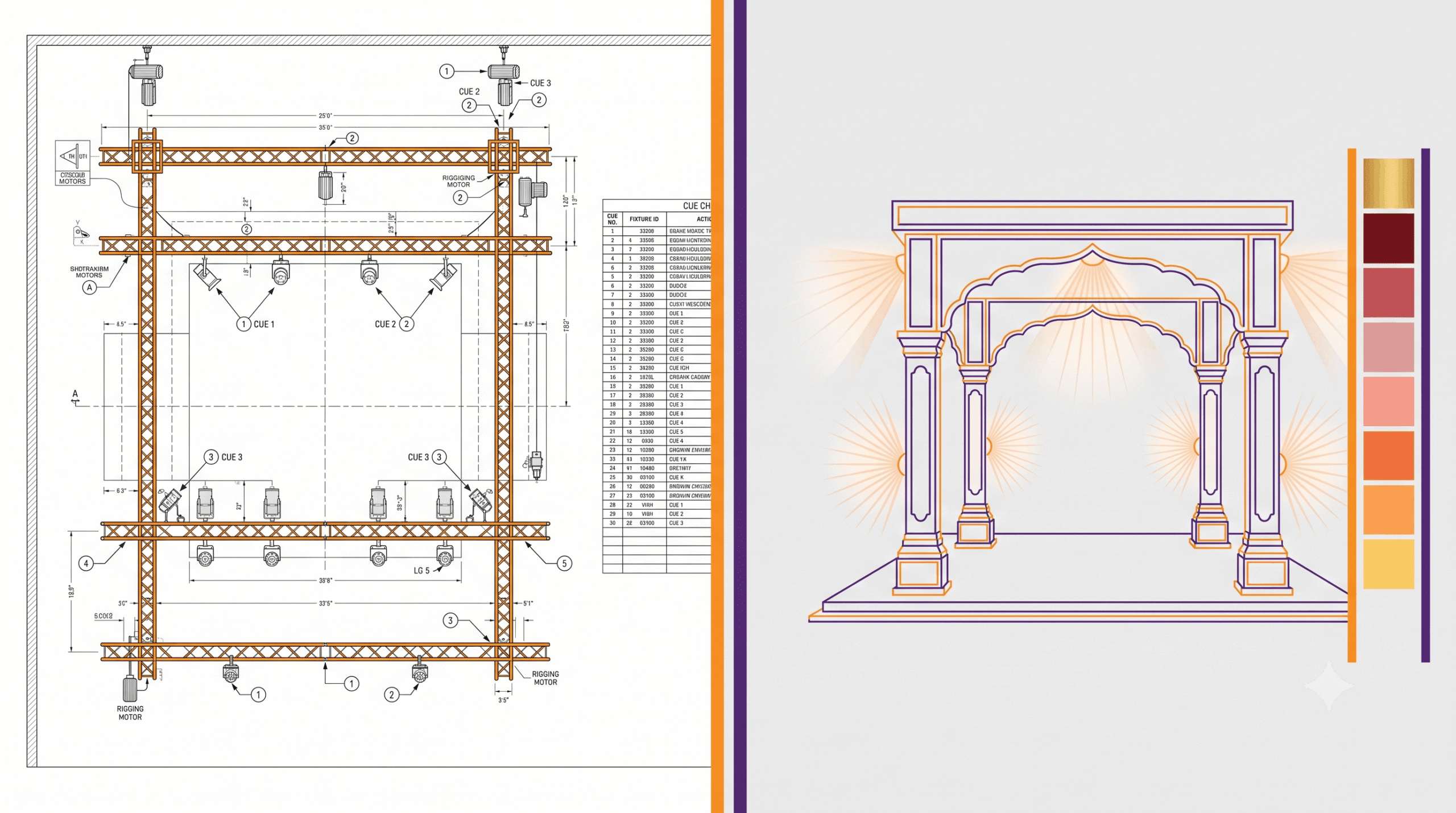
- AutoCAD and Vectorworks documentation — every professional rig, on either side, starts as a drawing before it’s built. Light plots, floor plans, and production drawings are how a crew avoids guessing on-site.
- Power and electrics basics — earthing, dimming circuits, generator loads, electrical safety. Get this wrong on a wedding stage or a concert rig and the consequences are the same.
This is the actual foundation IIED trains, regardless of which lane a student ends up choosing. A course like Vectorworks Spotlight for Event Production or CAD for Events & Entertainment isn’t “for weddings” or “for award shows” — it’s the documentation and rigging literacy that both jobs are built on. You can see the full breakdown on the Vectorworks Spotlight for Event Production course page.
How to Self-Diagnose Which Lane Actually Fits You
Ask yourself these honestly — not which answer sounds better, which one is actually true for you.
Do you like precision and repeatable systems, or do you like reading a room? If you’d rather nail the same cue perfectly every night of a run than have a new conversation with a new client every week, award show and concert production will hold your attention longer than wedding work will.
Do you want client contact, or do you want to avoid it? Wedding and event production puts you in front of clients constantly — briefings, walkthroughs, last-minute changes. Award show production puts you in front of a production manager and a cue sheet. Neither is better. One will drain you if it’s not your nature.
Do you want a fixed script or genuine creative latitude on the day? A show caller’s cues are locked before doors open. A wedding designer is still making calls the morning of the event. If you want the ability to change your mind on-site, wedding and event production gives you more room to do that.
Do you want to travel to big venues and productions, or build closer, longer relationships with clients and vendors in one city? Both paths can travel — Silas Paul Uba works with a rental and production company in Goa, Atharv Devikumar Jog works internationally in Saudi Arabia — but the day-to-day texture of who you’re working with is different in each lane.
This isn’t a false choice where both options sound equally appealing so you can avoid deciding. Be honest about which list of demands you actually want to live inside, five days a week.
Who This Decision Is Actually For
If you’re an event management student or graduate who already knows you want to work in technical production but haven’t picked a niche, this comparison is for you. You don’t need to guess — you need to know what each job actually asks of you before you commit a year of training to one direction.
It’s also for AV and production staff already working in the industry who are trying to decide which direction to move in next. Maybe you’ve been doing general AV support and want to specialise. Maybe you’ve been doing wedding decor setup and want to move into the more technical, rigging-and-lighting side of production. Either way, the honest answer is the same: figure out which demands suit you before you specialise, not after.
What both groups need first is the same technical foundation — rigging, DMX, lighting, CAD and Vectorworks documentation, power and electrics. That’s what a structured, hands-on course gives you that on-the-job exposure alone often doesn’t: the fundamentals done properly, so you can choose your lane instead of falling into whichever one you happened to land in first.
Real IIED Alumni Working Both Sides of This Divide
The clearest way to see that both lanes are real, working careers is to look at where IIED-trained students actually ended up.
Aron Sagar, a CAD for Events & Entertainment graduate, now works in the Operations & Production department at NMACC (Nita Mukesh Ambani Cultural Centre) in BKC, Mumbai — one of the country’s most prestigious cultural and performance venues. His placement sits on the high-production-value, large-venue side of technical production, the same technical foundation that concert and award-show-scale production runs on.
Varun Jain works as a Design Associate at The Finale Eventz in Mumbai, a high-end wedding design company. He started on probation at ₹45,000/month and was confirmed at ₹50,000/month — real, verified proof that the wedding and event production side of this industry pays properly when you bring real technical and design skill to it.
Silas Paul Uba works as a Lighting Technician (Technician – Lighting, Grade B) at LumaSonic Structures Rental Pvt. Ltd. in Goa, earning ₹25,000/month plus medical insurance, personal accident insurance, a telephone allowance, and tools and uniform. His role sits on the technical, rental-and-production-company side of the industry — the infrastructure that both weddings and large-scale shows depend on.
Atharv Devikumar Jog works as a Lighting Operator at SLS Production Equipment L.L.C. in Saudi Arabia, earning SAR 10,000/month plus company accommodation, a return air ticket, and transportation. His placement shows what the international, large-scale production company side of this career path can look like once you have the technical foundation to compete for it.
To be direct about what we don’t have: IIED doesn’t currently have a named alumnus placed specifically on an award-show production crew, and we’re not going to invent one to make this article look tidier. What we do have is verified proof that the same technical training — rigging, lighting, DMX, CAD and Vectorworks documentation — leads to real jobs across prestigious venues, rental and production companies, wedding design firms, and international placements. That’s the actual range this foundation opens up.
Why This Choice Matters More Now Than It Did Five Years Ago
India’s live events industry isn’t a niche anymore. According to a BookMyShow-EY-Parthenon report, India’s live events market is valued at roughly ₹13,000 crore, and the organised segment of that market grew 44% in 2025, driven by higher spending on ticketed events, weddings, government functions, and religious gatherings — with the organised segment projected to grow from ₹14,500 crore in 2025 to ₹19,600 crore by 2028 (EY, March 2026). That growth is happening on both sides of the divide this article covers — concerts, award shows, and large-format live productions on one side; weddings, corporate events, and religious gatherings on the other.
What that means practically: there’s real, growing demand for trained technical production professionals in India right now, on both lanes. The people getting hired into it aren’t the ones who learned “a bit of everything” informally — they’re the ones who built the actual foundation (rigging, DMX, lighting, CAD, Vectorworks) and then chose deliberately which side of the industry to specialise in.
Still not sure which side of technical production actually fits you? Book your free visit to IIED and walk through both paths with a real industry mentor before you commit a year of training to either one.