
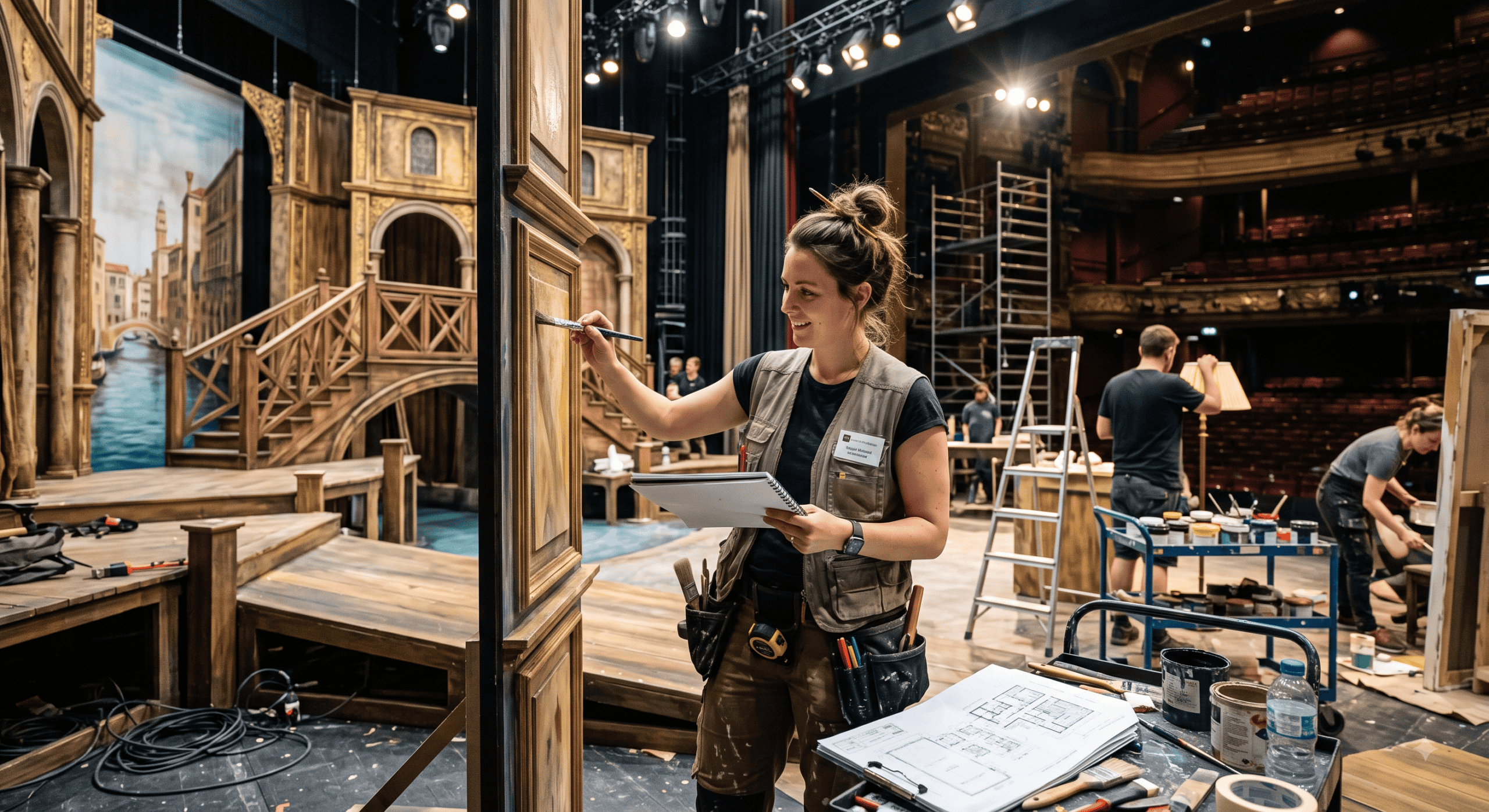
Someone designs every stage you’ve watched an award show on. Someone draws up the mandap in every wedding reel you’ve saved. Someone specs the backdrop behind every product launch you scrolled past on Instagram. That person has a job title — set designer — and it is not the same job as an event planner.
If you’ve searched for what does a set designer do in India, you’ve probably found vague answers: “creative,” “artistic,” “detail-oriented.” None of that tells you what the job actually involves on a Tuesday. This guide does. It covers the real daily tasks, where set designers get hired in India, the technical skill that separates a hireable set designer from someone with a good Pinterest board, and how four real IIED-trained designers moved into set and production design roles — with the companies and numbers to prove it.
Table of Contents
Most people who eventually work as set designers in India never set out to become one, because almost nobody teaches the job under that name. Colleges offer event management degrees built around coordination. Decor and styling workshops teach taste and trend, not technical drawing. The gap between “I have a good eye” and “I can hand a fabricator a drawing they can build from” is exactly where most aspiring designers get stuck — and exactly where this guide, and the courses below, are aimed.
What a Set Designer Actually Does, Day to Day
A set designer’s job starts long before anyone sees a finished stage or mandap. It starts with a brief — from a client, a producer, or an event company — and ends with a physical structure that gets built, lit, used for one night or one show, and then struck. Everything in between is the actual job.
Concept sketches come first. A set designer takes a brief — “royal theme,” “product launch on a rotating stage,” “beachside mandap” — and turns it into a visual concept, usually several sketch options before one gets approved.
Once a concept is approved, it has to become buildable. That means technical and production drawings — scaled plans, elevations, and construction details, usually done in CAD software like AutoCAD or Vectorworks. This is the step most people who “love design” skip in their head, and it’s the step that actually gets you hired. A sketch tells a client what something will look like. A technical drawing tells a fabricator exactly what to build, at what size, with what material.
Material and budget specs come next — what fabric, what wood, what metal, what LED strip, and at what cost. A set designer who can’t price their own design accurately gets overruled by budget, every time.
Then there’s vendor and fabrication coordination — briefing carpenters, fabricators, florists, and lighting vendors, checking their work against the drawings, and solving problems when a material doesn’t arrive or a structure doesn’t fit the venue.
Finally, on-site build supervision. Someone has to be at the venue while the set goes up, making real-time calls when the plan meets the actual physical space — a low ceiling, an uneven floor, a load-in door narrower than expected.
None of this is optional creative flourish. It’s the actual job. The “design” part — colour, mood, concept — is maybe a third of the work. The rest is technical documentation, budgeting, coordination, and being the person on-site who can solve a build problem in real time.
Set Designer vs. Event Designer vs. Event Planner — Where the Roles Split
The three job titles get used interchangeably online, which is exactly why so many students never hear “set designer” as an option.
An event planner — sometimes called an event manager or coordinator — handles logistics: timelines, vendor bookings, budgets, guest lists, day-of coordination. Their job is making sure everything happens on schedule. They are not usually designing the visual world of the event — they’re running it.
An event designer builds the visual and experiential concept — the colour palette, the layout, the mood, the overall look. Event design is the broader discipline: it covers decor, styling, spatial planning, and often set design within it.
A set designer is where that concept becomes a physical, technical structure. Set design is often the execution layer inside event design — the specialised branch that turns a mood board into a stage, a mandap, or a backdrop that can actually be built, wired, and struck safely. Not every event designer does set design. But most set designers need event design’s visual instincts, plus a technical skill layer most event design generalists don’t have.
This matters most if you’ve done a BEM (Bachelor of Event Management) or similar coordination-focused course. Those programs are strong on logistics and vendor management. They rarely teach technical or production drawing — which is exactly the skill that separates someone who can coordinate a stage build from someone who can design and document one. If this distinction sounds familiar, IIED has written more on it: Event Design vs Event Management — What’s the Real Difference.
Where Set Designers Work in India
Set Designer for Weddings and Events — Mandap and Stage Builds
India’s wedding industry is worth ₹3.75 lakh crore and still growing, and almost every big-budget wedding now has a designed mandap, stage, or entrance structure — not just flowers pinned to an existing frame. Set designers on the wedding side work with decor companies and independent designers, drawing up mandap structures, stage elevations, and entry installations, then coordinating the carpenters and florists who build them.
Corporate Events and Product Launches
Product launches, brand activations, and conferences need a set too — a stage, a backdrop, a branded environment. Corporate set design tends to be more structured and deadline-driven than weddings, with tighter technical specs — screen sizes, rigging points, sightlines — set by the client’s AV and production team.
Award Show Set Designer — Concerts and Live Production
This is where set design gets closest to its film and theatre roots — big, technically complex builds with rigging, trussing, and multi-level stages, usually run by a production house rather than a solo designer. Set designers here work inside a larger technical production team, alongside lighting and sound designers. This is award show set designer territory — high pressure, high technical demand, and where the biggest production houses hire from.
Exhibitions and Trade Shows
Exhibition and trade show design is a career path most event students don’t even know exists — designing and building booths and pavilions within strict size and budget constraints, often for repeat corporate clients season after season.
Across all four, the pattern is the same: someone has to turn a concept into a technically documented, buildable structure, then get it built on time, on budget, and safely. That’s the job, whether the venue is a five-star banquet hall or a concert arena.
The Technical Skill Gap: Why “Good Taste” Doesn’t Get You Hired
A strong eye for colour, texture, and composition matters. But it isn’t what gets someone hired as a set designer in India right now — because most applicants already have it. What’s rare is someone who can also produce a technical drawing a fabricator can build from without a dozen follow-up questions.
This is the actual hiring gap. Production houses, wedding decor companies, and event production teams are not short on people with a decor Pinterest board. They’re short on people who know how to draft a floor plan, an elevation, or a stage layout in CAD or Vectorworks — software that turns “I imagine something grand here” into exact measurements, load points, and material lists.
That’s also why IIED’s Event & Wedding Design Visualization course pairs design foundation with production drawing from Unit 2 onward, and why CAD for Events & Entertainment exists as a dedicated add-on — because production and technical drawing skill is what a fabricator, a producer, or a hiring manager actually checks for before trusting someone with a real build.
If you’re weighing whether to invest time in a decor or styling course versus one that teaches CAD-based production drawing, this is the reason the second option is what gets people hired for set and production roles specifically — not just styling or coordination roles. The U.S. Bureau of Labor Statistics projects five percent job growth for meeting, convention, and event planners through 2034, faster than the average for all occupations — and the roles with a technical skill layer, like set and production design, are the ones best placed to capture that growth rather than compete for entry-level coordination work.
Real Proof: How IIED-Trained Designers Moved Into Set and Production Design
These are real, verified placements — not composite stories.
Pranay Mhatre completed IIED’s Event & Wedding Design Visualization course and was hired as Production Designer at WIZCRAFT International Entertainment — India’s oldest and largest event company. A production designer title at the top event company in the country is about as strong a proof point as this field has: it means the technical and creative skill built in the course translated directly into a real design and production role, not just an assistant or coordination job.
Aron Sagar completed IIED’s CAD for Events & Entertainment course and now works in the Operations & Production department at NMACC — the Nita Mukesh Ambani Cultural Centre in BKC, Mumbai, one of India’s most prestigious performance venues. Aron’s placement is direct proof that the CAD and technical drawing skill behind set design is what opens the door to high-credibility production roles, not just the creative side of the job.
Varun Jain completed IIED’s offline Event & Wedding Design Visualization course and was hired as Design Associate at The Finale Eventz in Mumbai, starting at ₹45,000/month on probation and confirmed at ₹50,000/month. That’s real salary proof for a design-execution role — not a rough estimate, an actual offer letter number.
Kshiti Jain is the story that matters most if you’ve already done an event management degree. She graduated in event management and struggled to break into wedding design with that degree alone — it had taught her coordination, not design or build skills. After IIED, she built the technical design foundation to start her own event design company. If your BEM or event management course taught you logistics but never touched CAD, sketching, or production drawing, Kshiti’s path is the direct answer to “can I still do this.”
Four different starting points — a fresh graduate, a technical specialist, a coordination-trained designer, a career-builder — and four real outcomes in set and production design work. None of these are guaranteed outcomes for every student. They’re what’s possible when the technical skill gap above gets closed.
What It Takes to Become a Set Designer in India — Course Path, Skills, Portfolio
There’s no single official “set designer” degree in India. The path that actually works is building the two skill layers set design requires: design and technical documentation.
The foundation is a course that covers both the visual and the technical side — concept sketching, production of event design (trussing, lighting and sound basics, fabrics, vendor management and budgeting), presentation methods (sketching and production or construction drawings), and a final design project that simulates a real professional commission. IIED’s Event & Wedding Design Visualization course runs 3–4 months part-time and covers exactly this ground, closing with a professional portfolio — the thing every set design hiring conversation actually starts with.
For anyone aiming specifically at production-heavy set design — award shows, corporate production, exhibition builds — CAD for Events & Entertainment is the technical add-on. It teaches the AutoCAD-based production drawing skill that Aron Sagar’s NMACC placement above is proof of.
If you’re a directionless graduate wondering whether “set designer” is a real, hireable job title: it is, and the four stories above are the answer, not a sales pitch. If you’re an event management graduate who’s realised your course taught coordination but not design, the technical gap is closeable — Kshiti Jain closed it and built a company from it. Neither situation needs a second three-year degree — both of IIED’s courses above are built for people starting exactly where you are, whether that’s mid-graduation with no clear direction, or already holding a coordination-focused degree that never taught you to design or build.
Fees for the Event & Wedding Design Visualization course run ₹60,000 total, split into an enrolment payment and two instalments — not a single lump sum. Most students recover that investment within their first two to three months of paid design work, once they’re placed.
The portfolio is what actually gets checked in a hiring conversation or a fabricator’s first meeting with you: real sketches, real technical drawings, a final project that shows you can take a brief from concept to buildable plan. That’s what both of IIED’s courses above are built to produce.
What course should I take to become a set designer?
Start with IIED’s Event & Wedding Design Visualization course as the design and production foundation. Add CAD for Events & Entertainment or Vectorworks Spotlight for Event Production as the technical layer if you’re aiming at production-heavy set design work specifically.
If you’ve read this far because you’re wondering whether “set designer” could actually be your career — it’s a real, hireable job, and the technical skill is learnable in months, not years. Pranay, Aron, Varun, and Kshiti all started exactly where you are now.
See the Event & Wedding Design Visualization course, or book your free visit to IIED’s Malad East campus and ask Raj directly what it takes to go from sketch to hired.