
You already know how to read a stage. You just don’t know it pays more outside the college auditorium.
If you’ve spent years behind a followspot in a college theatre, an auditorium, or a drama school production, you already have real technical skill. Cue-building. Focus. Colour theory. Timing that has to land exactly right, every single night. That is not a hobby. That is training most people never get.
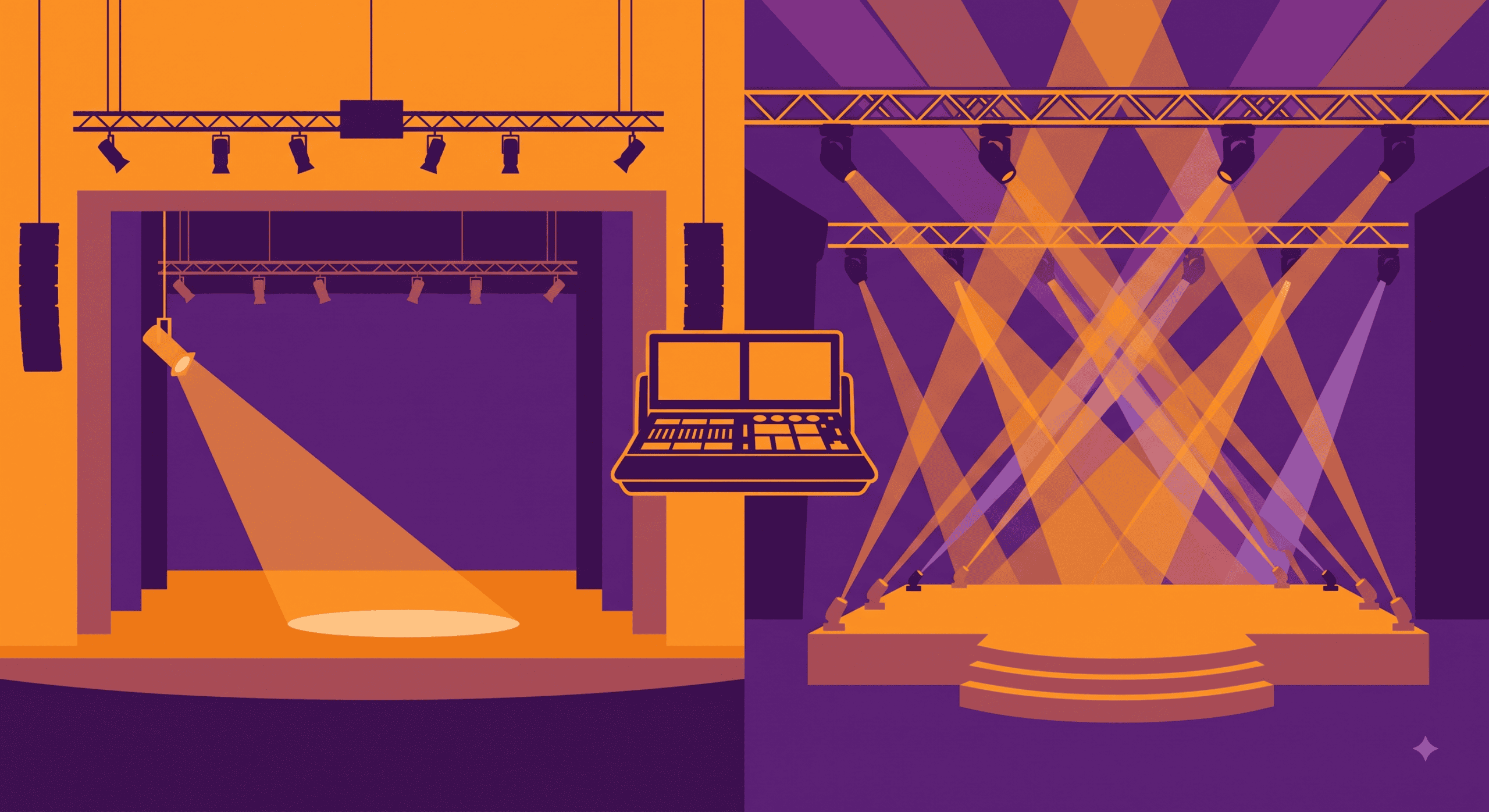
Here’s the honest question worth asking: theatre lighting vs event lighting — what’s the actual difference, and where does the paid work live in India right now? This article breaks down what the two fields share, where they genuinely diverge, and how a theatre-trained eye turns into a paying career in weddings, concerts, corporate shows, and award nights.
Table of Contents
What Theatre Lighting and Event Lighting Actually Have in Common
Before the differences, give yourself credit for the overlap. It’s bigger than most people think.
Both fields start with the same basic language: cue-building. In theatre, you build a cue stack scene by scene, timed to a script that never changes once the run opens. In event lighting, you build cues too — for a wedding entrance, a corporate keynote, an award announcement — except the “script” is a run-of-show sheet that can shift an hour before doors open. The skill of thinking in cues, not just switches, is identical.
Focus is identical too. Knowing how to angle a fixture so it hits a face and not a backdrop, how to avoid spill onto a screen, how to layer front light with backlight for depth — that’s the same craft whether the subject is an actor hitting a mark or a bride walking down an aisle.
Colour and gel theory carry over directly. Warm versus cool washes to shift mood, complementary colours to make a subject pop against a set, saturation choices that read differently under different fabrics and skin tones — a theatre-trained eye already understands this instinctively. Most event lighting operators without a theatre background have to learn it the hard way, on the job, under pressure.
And timing — the discipline of hitting a cue on the beat, on the line, on the moment — is arguably the single hardest skill to teach from scratch. If you’ve called or run cues for a live show, you already have it.
What you’re missing isn’t taste or instinct. It’s the console, the rigging discipline, and the live-event pace that Indian weddings, concerts, and corporate shows actually run on.
Theatre Lighting vs Event Lighting: 4 Honest Differences
Here’s where the paths genuinely split. None of these differences make theatre lighting “lesser” — they just explain why the paid work and the console skills sit on the event side right now.
1. Fixed Narrative vs Live, Fast-Turnaround Design
Theatre lighting designs for a story that has already been finalised. You light the same cue the same way for weeks, sometimes months, refining it show after show. There’s a preview night, a tech week, a director giving notes on take four of the same scene. Event lighting rarely gets that luxury. A wedding lighting designer might get one site visit, one afternoon to rig, and one live run with zero repeat performance. There’s no preview night. What you build has to work the first time, in front of four hundred guests who are not coming back tomorrow for a better version. That single-shot pressure is the biggest mental shift theatre-trained technicians describe when they move into events.
2. Rep Plots vs GrandMA3-Scale Rigs
Most college and repertory theatres run smaller consoles and fixed rep plots — a lighting rig that stays largely the same across multiple productions, adjusted show to show. You learn one console deeply, and the fixture count rarely goes past a few dozen.
Live events in India — weddings, concerts, award shows — are increasingly run on GrandMA3-scale consoles, with hundreds of moving-head fixtures, complex DMX universes, and pixel-mapped LED screens working together in real time. It’s a different scale of console literacy, and it’s the single biggest technical gap between a theatre background and a hireable event lighting resume. This is also the fastest gap to close with the right hands-on training — it’s a console skill, not a talent gap.
3. Theatre’s Pay Ceiling vs Event Volume and Pay in India
This is the honest part nobody says out loud in college theatre departments. Outside a handful of metro repertory companies, paid theatre lighting work in India is limited — few full-time roles, inconsistent gig frequency, modest day rates. Event lighting in India runs on volume: weddings, concerts, corporate activations, and award shows happen every week of the year, in every city, and someone has to run the desk for each one. More paid work, more consistently, is the honest advantage of the event side today. A theatre technician who adds console and rigging skills isn’t leaving their craft behind — they’re pointing the same craft at a market that actually hires at scale.
4. Crew Structure and Time Pressure on Site
A theatre lighting crew works inside a production schedule measured in weeks. An event lighting crew often works inside a schedule measured in hours — load in at dawn, rig by noon, focus by four, doors at seven. The skill of staying calm and precise while a vendor, a client, and a run-of-show sheet all change at the last minute is something theatre rarely teaches, because theatre rarely has to move that fast. Event crews are also often smaller and more cross-functional on site — a lighting technician might be expected to talk directly to the client’s planner or the sound engineer, not just a stage manager relaying notes. That direct-communication skill matters as much as the console work.
Which Pays More? Theatre Lighting Career in India vs Event Lighting
If you’re weighing a theatre lighting career in India against a move into events, the honest answer is: it depends what you want, but the paid opportunity is heavily weighted toward events right now.
India’s live events industry is growing fast. Market research firm 6Wresearch projects the Indian live events industry to grow at roughly 9.3% CAGR through 2026–2032, driven by rising demand for immersive live experiences and expanding event-tourism — and that growth pulls lighting demand with it, from weddings to concerts to corporate activations. Theatre, by comparison, is a smaller, slower-growing market in India outside a few metro repertory houses.
That doesn’t mean theatre lighting skill is worth less. It means the console skills, DMX knowledge, and live-event pace that get you hired on the event side are not optional extras — they’re the missing 30% between what you already know and what actually gets booked, week after week, in India’s wedding and events industry.
It’s also worth being honest about what “career” means in each field. A theatre lighting career in India, for most people outside two or three metro cities, means a mix of freelance production work, occasional festival gigs, and possibly a teaching or technical-director role at a college or auditorium. It’s real work, and it can be a full career for the right person in the right city. But it rarely scales into a full-time, high-volume income the way event lighting does, simply because the number of paid theatre productions running at any given time in India is small compared to the number of weddings, concerts, and corporate shows happening every single week.
The Real Difference Between Theatre Lighting and Event Lighting Design, In Practice
This section is for two kinds of readers. The first is already working lighting in a theatre setting — college crew, auditorium technician, drama school stagehand — and either underpaid or bumping into a ceiling on how much that work can grow. The second is a theatre or performing-arts student wondering whether lighting can be a real, well-paid career outside college drama fests, not just a passion project.
If either sounds like you, the honest starting point is this: your existing eye for cues, focus, and colour is not something you have to relearn. It’s an asset. What changes is the console you run, the pace you work at, and the volume of paid work available to you once you can operate on the rigs Indian event companies actually use. That’s a training gap, not a talent gap — and it closes faster than most people expect once you’re on a real console instead of reading about one.
On paper, the difference between theatre lighting and event lighting design comes down to pre-production time. A theatre production gets weeks of tech rehearsal to refine every cue. An event lighting designer typically gets a single site visit, a floor plan, and a run-of-show document — then has to translate that into a full rig, programmed and ready, inside a single load-in day.
This changes who event lighting design actually suits. If you love the slow, layered process of refining a cue over weeks, pure theatre will always have a place for you. If you thrive under a tighter clock, enjoy variety — a wedding one week, a concert the next, a corporate product launch after that — and want the console skills that make you employable across all of them, event lighting is the better fit.
It also changes what “hireable” looks like. Most institutes in India still teach event coordination — logistics, vendor management, timelines — not the console operation, rigging, and DMX skills that actually get someone hired to run lighting on a live show. A theatre background already gives you the eye. What’s missing is formal, hands-on training on the exact consoles and rigs that Indian event companies use. See our companion explainer on what a lighting designer actually does for a fuller picture of the role.
How to Move From Theatre Lighting Into a Paid Event Lighting Career
This is not about abandoning theatre. It’s about adding the console mastery, DMX and rigging knowledge, and live-production discipline that turn an existing theatre-trained eye into work that actually gets booked.
IIED’s MA in Lighting Design is built for exactly this bridge — from basic light physics (start with the fundamentals in Stage Lighting 101) through to live console training on the same GrandMA3-scale consoles Indian event companies run, with a real industry mentor guiding the technical side.
Real students have made a version of this jump already. Jude Pereira left medical studies to train in lighting design at IIED. Today he works as an Event Designer and Lighting Technician at Disneyland Hong Kong, handling lighting for their live shows — theatrical productions run at event scale, which is exactly the kind of large-scale live work this bridge leads to. In his own words: “My journey proves that with the right mentorship, you can turn an unconventional path into a world-class career.”
Cajetan D’Silva trained during COVID lockdown and now works lighting for international productions on Royal Caribbean cruise ships — another live, theatrical production environment outside a traditional theatre building. He describes it simply: “I took the uncertainty of COVID-19 and turned it into an opportunity.”
David grew up watching his father’s band, fascinated by stage lighting from the wings. He now works as a freelance Lighting Designer, in his words, “creating the same atmosphere and energy for performers that once inspired me from the wings of my dad’s shows” — proof that a stage-passion background converts directly into paid freelance work.
Vinith switched from sound engineering into lighting through IIED, and turned down a global production company offer to work directly under mentor Lloyd Albuquerque at LGL Designs. His story shows that a craft-first background — not only theatre, but any live-production root — can convert into a serious paid lighting career with the right technical training.
None of these are theatre-to-event conversions on paper. All of them prove the same thing: a live-production eye, paired with real console and rigging training, gets hired. If you already have the eye, IIED gives you the console skills, the DMX knowledge, and the live-event fluency that close the gap.
That training happens on the same scale of console Indian event companies run on site, under a working mentor who is still active in the industry, not just teaching from a textbook. It’s a two-year commitment that trades classroom theory for time on a real desk, real fixtures, and real rigging — the exact gap this article has been describing.
Want to see if this bridge is right for you? Book your free visit at IIED’s Malad East campus and walk through the Lighting Design program with a real mentor before you decide anything.